
Free workplace safety assessment
A workplace safety assessment, often called a workplace risk assessment, looks at the jobs people do, the hazards in each one, the controls already in place and the actions still needed. Use this free self-assessment guide to choose your workplace type, describe one real task and flag the hazard areas that apply, then build a basic assessment from your answers. It is a starting draft: the employer completes it with the people who do the work, and a qualified person checks it.
Free to read. Your email opens the full guide, your work email and phone number show your basic assessment, and downloads need a free account.
Workplace safety assessments by industry
Each industry page lists its own jobs, what each hazard area means there, control ideas and a worked example. The basic assessment works the same way on every page.
Manufacturing safety assessment
Production, setup, cleaning and maintenance tasks.
Warehouse safety assessment
Receiving, picking, storage and loading tasks.
Restaurant safety assessment
Kitchen, service, delivery and closing tasks.
Retail store safety assessment
Receiving, stocking, checkout and backroom tasks.
Office safety assessment
Desk work, storage, deliveries and shared areas.
Healthcare safety assessment
Handling, cleaning, equipment and support tasks.
Auto repair shop safety assessment
Service bays, lifting, tires and chemical tasks.
Cleaning company safety assessment
Products, floor care, waste and client-site tasks.
Hotel safety assessment
Housekeeping, laundry, reception and maintenance.
Start with the work, then widen the review
A workplace risk assessment looks at how people could be harmed while doing their jobs and which controls need attention. Begin with the workers and the actual task, including setup, cleaning, servicing and emergencies. A single checklist cannot show that every hazard has been found, so use the basic assessment to organize questions, collect evidence and decide what needs a qualified person's assessment.
How to do a workplace safety assessment
- 1
Describe the job
Choose your workplace type and state, then write one task you want reviewed.
- 2
Flag your concerns
Choose the hazard areas that need review, or say you are not sure yet. Add who could be exposed and the controls already in use.
- 3
See your basic assessment
Enter your work email and phone number to see your starting draft on screen, with review questions, open areas and an action register. A free account lets you download it as a PDF.
- 4
Complete the workplace review
Walk the job with the people who do it, check the missing facts and record controls, owners, dates and evidence. A qualified person checks the finished assessment.
Workplace safety assessment checklist: 15 hazard areas
Use these areas as a starting screen, not as proof that a hazard exists or is controlled. Flag the ones that apply to the task, then add anything the list misses.
- 1
Machinery and stored energy
Moving parts, pinch points, unexpected startup and stored pressure or energy.
- 2
Vehicles and material movement
Forklifts, reversing vehicles, loads, docks and people on foot near them.
- 3
Slips, trips and falls
Walking surfaces, ladders, openings, platforms and how people reach their work.
- 4
Electrical hazards
Damaged equipment, energized parts and electrical work that is part of the task.
The first four areas are open to everyone. Enter your email to read the rest of the guide.
Free basic assessment
Build your basic assessment
Three short steps. The draft is built from your answers and this page's guide, with no AI involved.
- 1Workplace, state and task
- 2Hazard areas
- 3Review
Step 1 of 3Workplace, state and task
Describe one real task: what is done, where and with what.
The full guide
Free written guide
Enter your email to read the full guide
Read the rest of this guide here: the jobs to include, hazard areas 5 to 15, choosing controls, what a photo can and cannot show, and how to prepare. Downloads need a free account.
One email with our general OSHA site checklist, and one follow-up. Unsubscribe anytime.
Blank risk assessment worksheet
Workplace risk assessment worksheet
One task per copy: the jobs to include, all fifteen hazard areas with their questions, the hierarchy of controls, the action register and the sign-off. Ready to print in English or Spanish.
Needs your work email and phone number on this page, and a free OSHA Scan account with the same email.
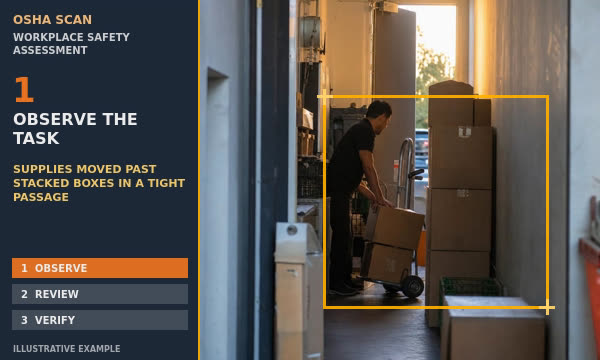
Illustrative example
What a task review can look like
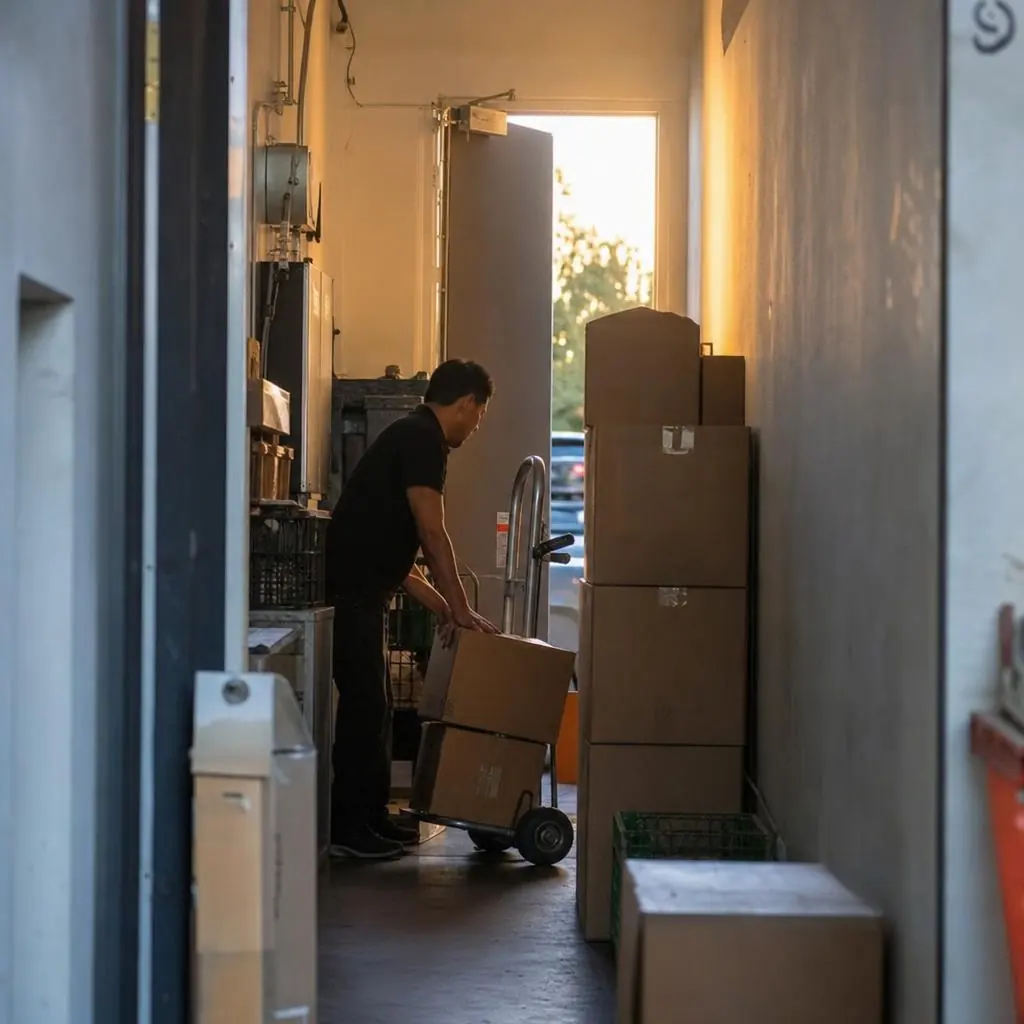
A business looks tidy on a daytime walk-through but receives supplies after hours. Employees report awkward unloading and a blocked route during deliveries. The team records the delivery task, the people involved and the conditions at that time. It reviews how supplies are stored and received, assigns changes and checks the route during the next delivery.
Observe: moving supplies between work areas. Review: discuss hazards and existing controls with the people doing the job. Verify: assign an owner and check the correction during real work.
An illustrative example written for this page, not a customer case. The example scan shows how OSHA Scan's AI points out visible details for a person to check; it is a second set of eyes, not a finding.
Compliance score
83
Lower means more potential hazards found
Score uses visible confirmed findings only. Not a safety certification.
2 confirmed · 0 need review · 0 positive
1Boxes stacked above head height along the corridor wall
MediumPossibly related to secure storage (29 CFR 1910.176(b))
Observed condition: The top boxes sit above the reach of the person loading the hand truck, so pulling one down or bumping the stack could bring boxes down in a narrow space.
Corrective action: Lower the stack to a height people can reach without stretching, keep heavier boxes low, and check that the stack is stable before people work beside it.
Medium confidenceNot fully clear from the photo — verify on site.
2Boxes and a crate on the floor narrowing the walkway
MediumPossibly related to housekeeping (29 CFR 1910.22(a)(1))
Observed condition: The corridor is the route to the back door, and boxes left on the floor narrow it for anyone pushing the loaded hand truck or walking through.
Corrective action: Give incoming boxes a set place out of the walking route and clear the floor before the next delivery is moved through.
High confidence
Observe, review, verify
Find your state's guide
How OSHA coverage is arranged differs by state. Each OSHA Scan state guide explains the arrangement there and links to official information.
- Alabama
- Alaska
- Arizona
- Arkansas
- California
- Colorado
- Connecticut
- Delaware
- Florida
- Georgia
- Hawaii
- Idaho
- Illinois
- Indiana
- Iowa
- Kansas
- Kentucky
- Louisiana
- Maine
- Maryland
- Massachusetts
- Michigan
- Minnesota
- Mississippi
- Missouri
- Montana
- Nebraska
- Nevada
- New Hampshire
- New Jersey
- New Mexico
- New York
- North Carolina
- North Dakota
- Ohio
- Oklahoma
- Oregon
- Pennsylvania
- Rhode Island
- South Carolina
- South Dakota
- Tennessee
- Texas
- Utah
- Vermont
- Virginia
- Washington
- Washington, DC
- West Virginia
- Wisconsin
- Wyoming
Related pages
Official sources
Use these official pages to complete the review. OSHA Scan is not affiliated with or endorsed by OSHA or any government agency.
Frequently asked questions
What is a workplace safety assessment?
A workplace safety assessment is a structured review of the work people do: the tasks, the hazards in each one, who could be hurt, the controls already in place and the actions still needed. On this page it is a free self-assessment guide that your team completes, starting with one real task. It is not an on-site assessment by a consultant or by OSHA.
How is a workplace safety assessment different from a risk assessment, a JHA or a safety audit?
The terms overlap. A workplace safety assessment and a workplace risk assessment both look across tasks and areas for hazards and controls; a risk assessment also weighs how likely and how serious harm could be. A job hazard analysis (JHA) breaks one job into steps and lists the hazards and controls for each step. A safety audit checks a workplace or program against set requirements. This page gives you a starting draft for the first two.
How often should you do a workplace safety assessment?
Treat it as ongoing work, not a one-time form. Review it on a schedule your team sets, and again when tasks, equipment, materials, the layout or the people doing the work change, after an injury or near miss, and when workers raise a concern. Some OSHA standards set their own timing for specific inspections or reviews.
Does OSHA require a workplace safety assessment?
There is no single universal OSHA form for a general workplace safety assessment. Specific standards do require one for particular hazards: for example, the PPE standard requires employers to assess the workplace for hazards that call for protective equipment and to certify that assessment in writing (29 CFR 1910.132(d)). Some State Plans, such as California's, require a written injury and illness prevention program that includes identifying and evaluating hazards. Check the standards that apply to your work.
Is this risk assessment suitable for a small business?
Yes. Start with one real job, then repeat the review for other tasks and shifts. Add any hazard the page does not list.
Can this cover every hazard?
No general starting draft can. Include the workers, nonroutine work, records, measurements and specialist review where they are needed.
What is free on this page, and what needs my details?
Everyone can read how it works, the first four hazard areas, the example, these answers and the sources. Your email unlocks the rest of the written guide. To see your basic assessment, answer the three builder steps and enter your work email and phone number. Downloading the assessment as a PDF, or the blank worksheet in English or Spanish, needs a free OSHA Scan account. No credit card is needed.
Is this an official OSHA inspection or certification?
No. It is an educational starting draft. OSHA Scan is independent and is not affiliated with, endorsed by or certified by OSHA or the U.S. Department of Labor. A qualified person should complete and check the workplace assessment.
Reviewed by OSHA Scan Editorial
This content is produced by the OSHA Scan Editorial team and reviewed with AI assistance. It is general safety information, not legal or compliance advice. OSHA Scan is an independent tool and is not affiliated with, endorsed by, or certified by OSHA or the U.S. Department of Labor.
Start with one real task
Answer three short steps to see your basic assessment on this page. A free OSHA Scan account lets you download it and the blank worksheet as PDFs.
Start my free assessment