
Chemical inventory list — OSHA's requirement and how to build one that stays current
OSHA's Hazard Communication Standard requires a list of every hazardous chemical known to be present in the workplace, kept as part of the written program and tied to your safety data sheets. In practice the list is the backbone of HazCom: it's how you know whether every chemical on the shelf has a sheet on file. Most inventories die in a spreadsheet because nobody reconciles them when products arrive or get discontinued. OSHA Scan builds the list a different way — scan each chemical's label room by room and it becomes a live library with the product name, manufacturer, and location assigned, so the count and the SDS status update as you go. It doesn't guarantee completeness; walking every room is still on you.
Free · No account needed to scan · You may be asked for the free phone Access Pass
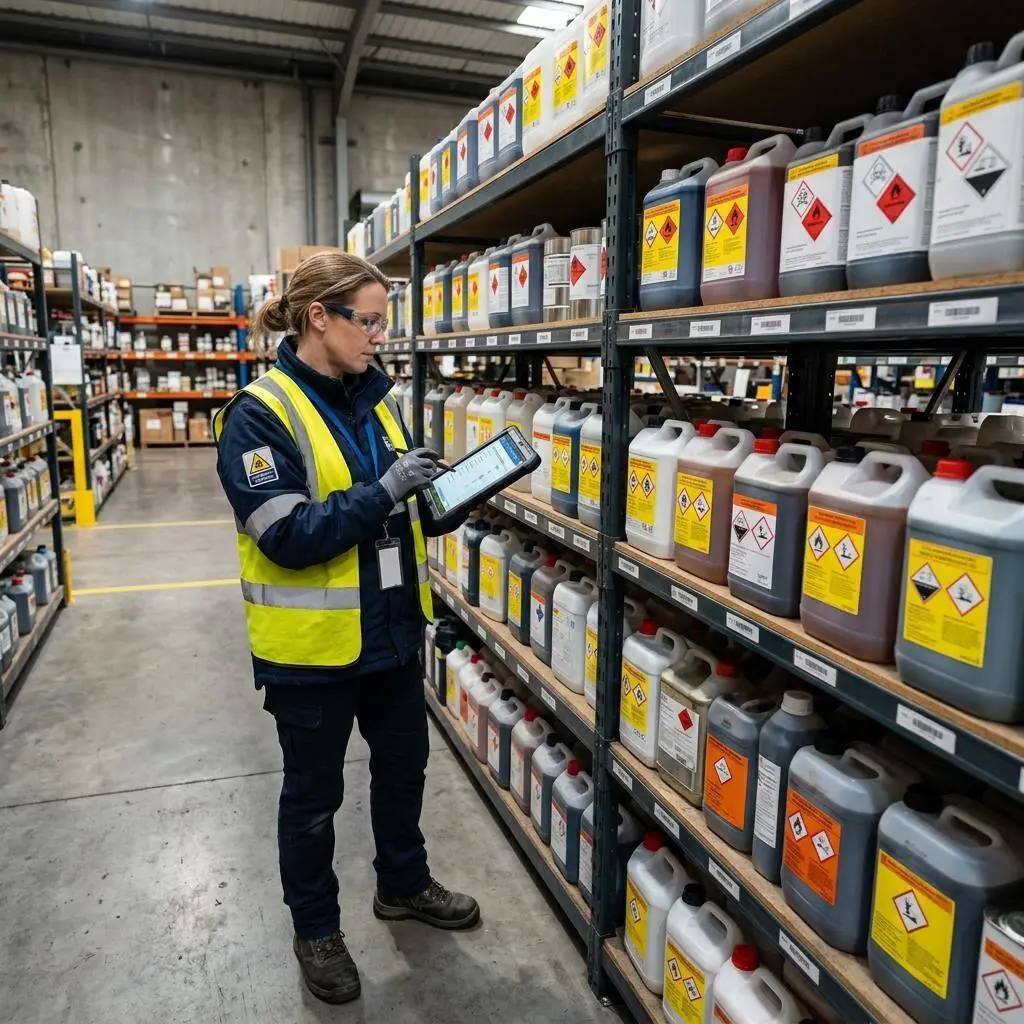
The chemicals-without-sheets problem starts with a list nobody keeps current
Almost every HazCom failure traces back to an incomplete inventory. Picture a facility running dozens of hazardous products across the shop, the janitor's closet, the boiler room, and the paint locker — while the SDS binder holds far fewer sheets, because products added over the years were never logged. Without a current list, you can't even know that gap exists. That's why the standard treats the inventory as foundational: it's the master index that everything else — labels, SDS access, training coverage — is checked against. The list can be organized by work area or department, and it's the thing an inspector asks for first because it reveals the shape of your whole program in one page.
The reason inventories decay is boring and universal: they're built once, in a spreadsheet, and then never reconciled. A supplier ships a new degreaser, someone discontinues an old sealant, a department buys its own sanitizer — and the spreadsheet in the shared drive falls behind reality within a quarter. Building the list from label scans room by room changes the dynamic. Instead of typing entries from memory, you walk each area with a phone, scan what's actually on the shelf, and OSHA Scan reads the product name and manufacturer and assigns the chemical to that location — turning the inventory into a live library the whole team can search, not a document that dies in a drawer. The checklist below covers the reconciliation discipline that keeps it alive.
HazCom's chemical inventory requirement: what the standard actually says
OSHA's Hazard Communication Standard (29 CFR 1910.1200) requires employers to compile and maintain a list of hazardous chemicals known to be present in the workplace. The list must use product identifiers that match the corresponding safety data sheets, must be part of the written HazCom program, and must be accessible to employees and their representatives. OSHA does not prescribe a specific format — a spreadsheet, a printed binder, or a digital library all satisfy the requirement as long as they are current and cross-reference to the right SDS for each entry. The inventory is foundational because it anchors every other HazCom element: training must cover the hazards the inventory reveals, SDS access depends on knowing what products are present, and label checks can only be verified against a known list.
In practice the inventory is one of the first documents an OSHA compliance officer asks to see during a HazCom inspection — and one of the most common sources of citations. The most frequent gaps are chemicals present on the floor that have no corresponding SDS in the library, outdated SDSs filed for products whose formulations have since changed, and satellite areas (service trucks, cleaning closets, maintenance rooms) omitted from an inventory that only captures the main storage area. A label-scanning approach that captures the inventory room by room at the point of use closes all three gaps faster than any clipboard-based walkthrough.
State-plan differences in HazCom enforcement
Federal HazCom (1910.1200) aligns with GHS (Globally Harmonized System of Classification and Labelling of Chemicals), but state-plan states can and do layer on additional requirements. California's Cal/OSHA enforces HazCom under Title 8, Section 5194, which adopts the GHS-aligned federal framework and in some areas applies additional California-specific requirements. California also maintains separate consumer-notification requirements under state law that are distinct from the Cal/OSHA workplace HazCom program — employers should consult Cal/OSHA Title 8 for current workplace requirements. Washington's L&I similarly enforces HazCom under its own state-plan framework with provisions that may differ from the federal baseline.
Industry-specific chemical inventory requirements add another layer. Laboratories operating under OSHA's Laboratory Standard (1910.1450) have different SDS and inventory obligations than general-industry employers under 1910.1200. Construction sites using hazardous chemicals are covered by 1926.59, which adopts 1910.1200 by reference. Employers in manufacturing with process quantities of highly hazardous chemicals above regulatory thresholds may also fall under Process Safety Management (1910.119), which imposes a separately maintained chemical inventory as part of the PSM program. Building the baseline chemical inventory as described on this page satisfies the core 1910.1200 requirement and provides the foundation for any of these overlay requirements.
Chemical inventory: step by step
Run through these steps before crews start — each one covers a visible gap the AI can help you catch.
- 1
Walk the site room by room
Go area by area — production floor, janitor's closet, boiler room, paint locker, storage yard, and service trucks — so nothing is counted from memory. Every space that holds a chemical is a stop on the walk.
- 2
Scan each product's label
Photograph the label on each container. OSHA Scan reads the product name, manufacturer, signal word, and GHS pictograms to create the inventory entry, so you're not transcribing faded print by hand.
- 3
Assign a location to every entry
Tag each scanned chemical to the room or area it lives in, so the list is organized by work area the way OSHA expects and workers can find what's stored near them.
- 4
Attach or flag the SDS
Upload the manufacturer's SDS PDF for each chemical; where none is on file, the entry is flagged so the missing sheets surface as a list instead of a surprise.
- 5
Reconcile the count against the library
Compare the number of chemicals to the number of SDSs on file and resolve every gap — this is where the chemicals-without-sheets problem gets caught and closed.
- 6
Update on every delivery and discontinuation
Add new products before they go into service and remove used-up or phased-out ones, with a named owner and a review cadence so the list stays current between formal audits.
How OSHA Scan helps you build and check the inventory
What a label scan captures for the list, and the visible inventory gaps a storage-area photo can flag.
Label reading for each entry
Scan a product label and the AI reads the product name, manufacturer, signal word, and GHS pictograms to create the inventory entry — no manual typing from a faded bottle.
Location assignment room by room
Each scanned chemical is tagged to the room or area where it lives, so the list is organized by work area the way OSHA expects and workers can find what's near them.
Chemicals vs. SDSs on file
As you attach SDS PDFs, the library shows which entries still have no sheet — surfacing the chemicals-without-sheets gap instead of hiding it in a spreadsheet.
A living list, not a snapshot
Add a chemical when it arrives and the whole team sees it from any phone; the inventory stays close to reality between formal reviews. Reconciling on every delivery is still a human habit.
Demo: the library entry a scanned label comes back with
An illustrative example for this trade — product identity, signal word, GHS pictograms, and hazard statements, filed and searchable.
Aerosol penetrating lubricant spray
Example manufacturer
The half-used aerosol can nobody logged is exactly the line item a scan-in-as-received habit keeps on your master inventory list.
- H222 — Extremely flammable aerosol
- H229 — Pressurized container: may burst if heated
Now scan your own label — free
Photograph any chemical product on your shelf. The AI transcribes the label — no account needed to try it, though you may be asked for the free phone Access Pass.
- A running list built from label scans — product, manufacturer, and room
- A count of chemicals vs. SDSs on file so gaps surface immediately
- A checklist for the reconciliation steps a scan can't do for you
One lifetime free label scan
The 11-point chemical inventory checklist
How to build a hazardous chemical list that survives deliveries, discontinuations, and turnover. The first four are free — create a free account or leave your email to unlock the rest and start scanning your rooms into a live list.
Free checklist — 11 points
Enter your email to unlock the full checklist
Read the checklist here after entering your email. A free account is required to download the PDF.
One email with the checklist, one follow-up. Unsubscribe anytime.
What the AI can and can't detect
OSHA Scan reads a single photo. That makes it fast and easy for anyone on site — but it also means it has real limits. Here's an honest look at both.
What it can catch from a photo
- Unlabeled or generically labeled containers that wouldn't appear on a typed list
- New deliveries staged and not yet logged, visible in the photo
- Whether chemicals are stored in areas an inventory walk might skip
- Product name, manufacturer, and hazard elements readable from a label scan
What a photo can't tell it
- Whether the list captures every chemical across the whole facility
- Whether discontinued products have been removed from an old inventory
- Whether each entry actually has a current, correct SDS on file
- Chemicals stored in other rooms, vehicles, or sites not in the frame
SDS digital library
Build a searchable chemical library from label photos. Review manufacturer SDS matches when available and follow the status of missing documents.
Missing-document requests enter a review queue; they do not automatically contact suppliers.
Job-site locations
Organize inspections by location and compare safety performance across every site you manage.
Team roles & permissions
Invite admins, managers, and supervisors with role-based access that keeps the right people in control.
A qualified person must review AI-flagged items before making safety decisions. Do not replace required comprehensive safety walkthroughs with AI reports. Features, limits, and downloads depend on your account’s plan and permissions.
See the workflow click into place
Illustrative AI-assisted workflows. Review the findings; they are not a compliance certification.
Always confirmed by a person on site
A scan is a fast first look, not the final word. Before treating this kind of area as safe, a competent person should still confirm:
- Walk every room, closet, cabinet, and vehicle against the list, not just the main storage area
- Reconcile the list one-for-one with the SDS library and resolve every mismatch
- Confirm recent deliveries and discontinuations are reflected
- Check that satellite sites and service trucks contribute their chemicals
People also ask
Does OSHA actually require a chemical inventory list?
Yes. The Hazard Communication Standard requires employers to compile a list of the hazardous chemicals known to be present in the workplace, maintained as part of the written program, using a product identifier that matches the corresponding safety data sheet. The list can be kept for the workplace as a whole or by individual work area. It's foundational because everything else in HazCom — labels, SDS access, training — is checked against it, and it's usually the first document an inspector asks to see.
What's the difference between a chemical inventory and the SDS library?
The inventory is the list of what chemicals you have; the SDS library is the collection of the sheets themselves. They're supposed to match one-for-one, and the whole point of keeping both is to compare them: if the list shows more chemicals than the library holds sheets, you've found a real gap. Building the list from label scans makes this comparison automatic — the library shows which scanned entries still have no SDS attached, instead of you discovering it during an inspection.
How do I keep a chemical inventory from going out of date?
By reconciling it at the two moments it changes: every delivery and every discontinuation. A new product gets added — with its location and SDS — before it goes into service, and a used-up or phased-out product gets removed. Assigning a named owner and a review cadence keeps the habit alive. A live library the team updates from their phones drifts far less than a spreadsheet in a shared drive that only one person ever opens.
Can I build the inventory just by scanning labels?
Scanning gets you most of the way and much faster than typing: photograph each container's label and OSHA Scan reads the product name, manufacturer, and hazard elements and assigns the chemical to the room you're in. What scanning can't do is guarantee you visited every room, cabinet, and truck — completeness depends on a person walking the whole site. Treat the scan as the tool that builds and maintains the list, and the room-by-room walk as the discipline that makes it complete.
Reviewed by OSHA Scan Editorial
This content is produced by the OSHA Scan Editorial team and reviewed with AI assistance. It is general safety information, not legal or compliance advice. OSHA Scan is an independent tool and is not affiliated with, endorsed by, or certified by OSHA or the U.S. Department of Labor.
Keep exploring
More ways to see what an AI OSHA scan can do for your site.
The AI OSHA inspection tool
The overview hub — how the scanner works and every job, site, and hazard it covers.
SDS scanner & chemical library
The scanning workflow that turns each label into a located inventory entry.
Written HazCom program
The program the inventory anchors — who owns the list and how it's maintained.
Missing SDS: what to do
How to close the gaps the inventory reveals when a sheet isn't on file.
Hazard communication checklist
The full HazCom chain the inventory sits at the center of.
EPCRA Tier II reporting
When your chemical inventory also has to be reported to state and local emergency planners.
OSHA: Hazard Communication
OSHA's HazCom hub, including the written program and chemical list requirements.
Official resource — osha.govA full sample report
See a complete labelled example of everything a scan returns.
Ready to secure your job sites?
Start with one lifetime use per eligible scan type — no credit card. Build JHA-ready reports and catch changing conditions sooner.
Start your free trial