
1
Set the scene
Start with context
Fill the frame
2–3 ft for close-ups; keep ladders, cords and workers fully in view.
An electrical job hazard analysis (JHA, called a JSA by OSHA) breaks an electrical task into steps and identifies the shock, arc-flash, and stored-energy hazards at each one. OSHA Scan lets an electrician or electrical contractor photograph the panel, the cords, or the work area and get an instant read on the visible hazards — an open panel exposing energized conductors, a missing knockout cover, a damaged cord bypassing GFCI protection, a blocked disconnect, or no lockout/tagout device visible on an isolation point — each tied to the OSHA standard it may relate to, with a suggested fix. It is free to try with no account (you may be asked for the free phone Access Pass). It is an AI second set of eyes, not a substitute for a qualified person: no photo can confirm a circuit is de-energized, so the drafted analysis is verified and signed on site.
Free · No account needed to scan · You may be asked for the free phone Access Pass
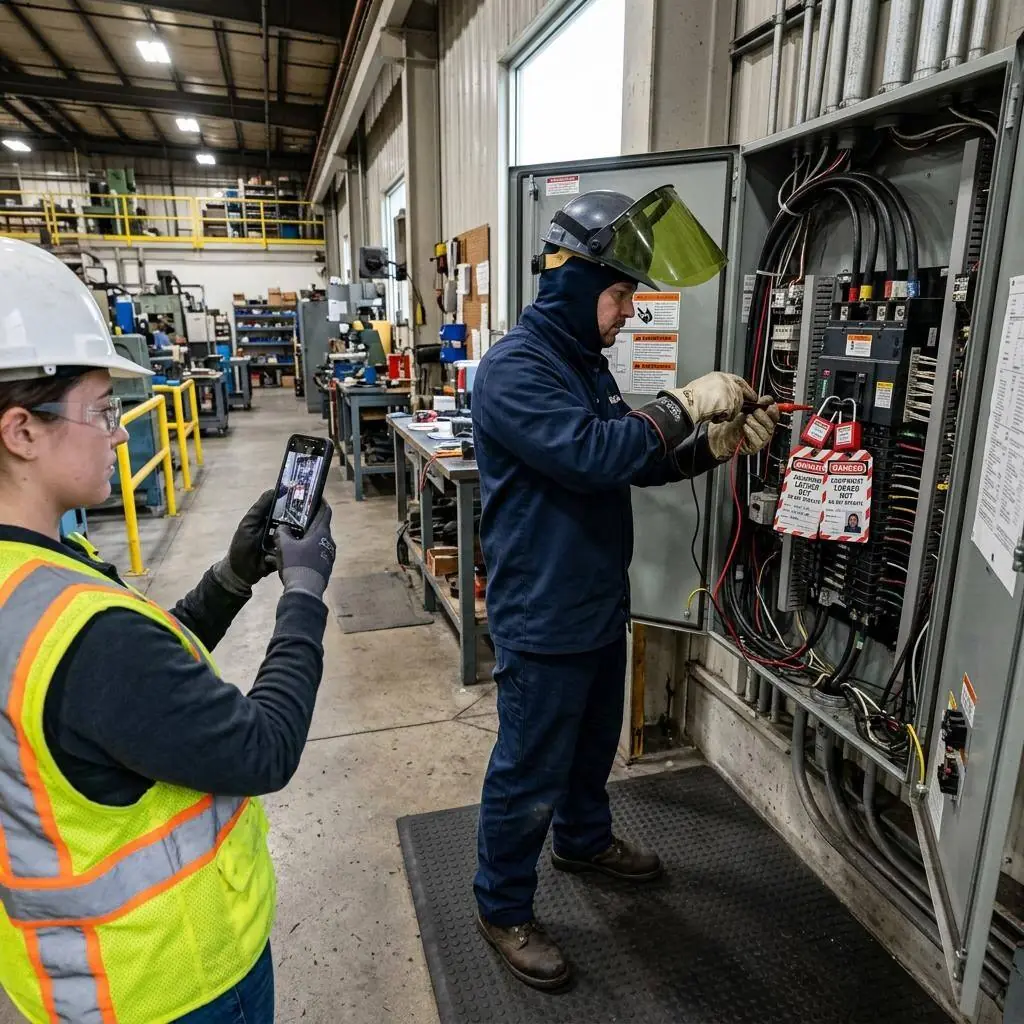
Electrical work concentrates the hazards that kill fast: contact with energized conductors, arc-flash burns, and the release of stored energy on a circuit everyone assumed was dead. A job hazard analysis is where a crew breaks the task into steps and decides how each hazard is controlled before anyone opens a cover. On most electrical jobs the formal JHA covers the planned scope, but the panel changeout that came up mid-shift, or the cord run across a wet slab, often runs on experience alone. A photo-based first pass drops the cost of documenting those in-between tasks to nearly zero.
The scanner reads visible conditions at panels, disconnects, junction boxes, temporary power, and cord runs: an open panel with the deadfront removed and bus bars exposed, a missing knockout or blank exposing energized wiring, a damaged or spliced cord feeding tools without visible GFCI, a disconnect blocked by stored material so it can't be reached in an emergency, or an isolation point with no lockout device or tag visible in the frame. Each visible hazard comes back with the OSHA standard it may relate to, why it matters, and a specific suggested control — the hazard and control columns of your electrical JHA, drafted from the actual site.
Every scan saves as a dated, scored report. Accepted findings become corrective actions with owners; a re-scan after the fix documents the corrected state; and the whole thing exports to PDF or Excel for the JHA or JSA form your program already files. The workflow is built so the qualified person's verification and sign-off land exactly where they belong — after the draft, never instead of it.
OSHA's electrical requirements sit in a few places an electrical JHA leans on. The selection of safe work practices for energized and de-energized work is covered by 29 CFR 1910.333; the control of hazardous energy — lockout/tagout — by 1910.147. On construction sites, wiring design and protection and equipment use fall under 29 CFR 1926.404 and 1926.405, with general electrical safety practices in 1926.416. None of these mandate a JHA by name; the analysis is the practical method crews use to satisfy them, and OSHA publishes a free Job Hazard Analysis booklet (Publication 3071) with templates if you want a starting form.
NFPA 70E — the Standard for Electrical Safety in the Workplace — is where arc-flash boundaries, PPE categories, and energized-work permits are spelled out in detail. It is worth naming honestly: NFPA 70E is an industry consensus standard, not an OSHA regulation. OSHA does not enforce 70E line by line, but inspectors and courts routinely treat it as the recognized method for meeting the general electrical safety duty, so most contractor arc-flash programs are built on it. This page references it as the consensus reference it is, never as an OSHA rule.
The single most important fact about electrical work is invisible in a photo: whether the circuit is live. A panel can look identical energized or dead. Stored energy in capacitors, backfeed from a generator or a parallel source, and induced voltage on long parallel runs are all real and all outside what any image can show. That is precisely why the electrical JHA and the lockout/tagout procedure exist — to force a test-before-touch step that a photo can never replace.
So the scanner is scoped honestly to what a camera captures: the visible state of covers, conductors, cords, guarding, and whether a lockout device and tag are physically present on an isolation point in the frame. It can flag that no LOTO device is visible; it cannot confirm the energy is actually isolated. Every electrical report makes that boundary explicit and lists verifying de-energization by a qualified person as a manual step, every time.
The highest-return use is consistency across crews and jobs. Ask several foremen to write a JHA for the same panel task and you get several vocabularies; scanned photos come back with hazards named the same way, mapped to the same 1910/1926 references, scored on the same scale. For an electrical contractor rolling records up across sites — or answering a general contractor's prequalification questionnaire — that uniformity is worth as much as the speed.
The second win is the temporary-power and cord-management sprawl that formal JHAs rarely keep up with. Cords get damaged, GFCIs get bypassed, and panels get buried behind stored material between the morning huddle and the afternoon. A one-photo re-scan turns any of those into a documented, dated finding with a suggested fix — a running record of the visible electrical hazards a paper JHA written once at bid time will never show.
Run through these steps before crews start — each one covers a visible gap the AI can help you catch.
List each action from start to finish — for a panel task: identify the circuit, isolate and lock out, test for absence of voltage, remove the cover, perform the work, restore covers, remove locks. Finer steps make the hazard at each step easier to identify and control.
Isolate the energy source, apply each authorized worker's lock and tag at the isolating device, account for stored energy and backfeed, and test for absence of voltage with a meter proven on a known live source. This may relate to 29 CFR 1910.147 and 1910.333, and no photo can replace the live/dead test.
With a smartphone, photograph the open panel, the cord runs, the disconnects, and the temporary power. Capture the covers, the conductors, the GFCI, and the clearance around the equipment — conditions you can see but might miss writing from memory.
Upload each photo to OSHA Scan. The AI returns each visible hazard — exposed conductors, missing covers, damaged cords, blocked panels, no visible LOTO — with the OSHA standard it may relate to, the risk level, and a suggested corrective action. That is the drafted hazard and control content for your electrical JHA.
The AI draft is a starting point, not a final document. A qualified person confirms de-energization, adds hazards the photo could not show (stored energy, arc-flash incident energy), verifies controls and PPE, and signs off. Assign each finding for correction and export the JHA to PDF or Excel before work begins.
The visible shock, arc-flash, and lockout core of an electrical JHA, read from an image.
Open panels with the deadfront removed, missing knockouts or blanks, and junction boxes without covers that leave conductors and bus bars exposed to contact.
Cut, spliced, or crushed cord insulation, cords run through water or doorways, and tools fed from receptacles with no visible GFCI protection.
Work at open, energized-looking equipment with no arc-rated PPE visible, and no boundary or barrier around exposed live parts in the frame.
Disconnects and panels blocked by stored material, and isolation points with no lockout device or tag visible in the photo.
Scan a photo like the one above and this is the report you get — score, findings, OSHA references, and fixes. It is an illustrative example, clearly marked — not live scan data.
Compliance score
43
Lower means more potential hazards found
Score uses visible confirmed findings only. Not a safety certification.
4 confirmed · 0 need review · 0 positive
1Open electrical panel with deadfront removed, exposing energized-looking bus bars and conductors
Possibly related to selection of electrical work practices (29 CFR 1910.333) and wiring protection (29 CFR 1926.405)
Observed condition: An exposed panel interior puts bare conductors within reach — a slipped tool or an incidental touch can cause a fatal shock or an arc flash. A photo cannot confirm the panel is de-energized, which is exactly why a test-before-touch step belongs in the JHA.
Corrective action: Treat the panel as energized until a qualified person verifies isolation; apply lockout/tagout and test for absence of voltage before any work; reinstall the deadfront when work is not in progress. Write the verify-de-energized step into the JHA.
High confidence
2Damaged extension cord with taped splice feeding a tool, no GFCI visible
Possibly related to ground-fault protection and cord use (29 CFR 1926.404(b))
Observed condition: A spliced or crushed cord defeats the insulation and grounding path, and without GFCI a fault has no fast disconnect — on a damp slab that is a shock or electrocution risk on the next tool startup.
Corrective action: Remove the damaged cord from service; feed portable tools through a GFCI or a GFCI-protected assured-grounding program; inspect cords before each use and tag out any with damaged insulation.
High confidence
3Electrical disconnect blocked by stored material stacked in front of it
Possibly related to working space about electric equipment (29 CFR 1926.403) and access to disconnects
Observed condition: A disconnect that cannot be reached in seconds is useless in an emergency, and the required clear working space in front of live equipment is there so a worker can step back from a fault, not into stacked material.
Corrective action: Clear and maintain the working space in front of the disconnect and panel; mark the clearance on the floor; add a keep-clear check to the JHA and the daily walk.
Medium confidenceNot fully clear from the photo — verify on site.
4No lockout device or tag visible on the isolation point during work
Possibly related to control of hazardous energy — lockout/tagout (29 CFR 1910.147)
Observed condition: If the energy isolating device carries no lock or tag, nothing physically prevents someone from re-energizing the circuit while a worker is in contact with it — the exact scenario LOTO exists to stop.
Corrective action: Apply a lock and tag to each energy-isolating device before work; verify isolation by testing for absence of voltage; confirm each authorized worker's lock is in place. Photos show whether a device is present, not whether energy is actually isolated — verify that on site.
Medium confidenceNot fully clear from the photo — verify on site.
Upload a photo like the one above and get a compliance score and hazard count. No account needed to scan, though you may be asked for the free phone Access Pass — create a free account to unlock the full report.
Use the real site or facility name. If you save the scan after signup, it becomes the report name.
Three angles, one deeper scan
Only the wide shot is required — every extra angle gives the AI more places to look.
Required: Set the scene — one wide shot lets the AI sweep the whole area at once
Stand at the entry point and capture corner to corner: floors, ladders, scaffolds, and everyone at work
Drop a job-site photo or walkthrough video
Click to upload, drag & drop, or snap a photo on site. Photos scan free with no signup and no card — you may be asked for the free phone Access Pass. Video walkthroughs (up to 3 min) run on a free account.
Small habits, sharper scans
Set the scene
Start with context
Fill the frame
2–3 ft for close-ups; keep ladders, cords and workers fully in view.
Capture clearly
Make the frame usable
Light it right
Keep the sun or lights behind you — glare and shadows hide hazards.
Tap to focus
Tap the hazard on screen and hold still one second — blur can't be flagged.
Choose the useful view
Give the AI room to understand
Go landscape
Turn your phone sideways — a wider frame catches more of the scene.
Only upload photos you have permission to use, and avoid images showing personal, customer, or confidential information. Demo photos and results are held privately for up to 48 hours so you can save them to a free account; unclaimed photos are deleted automatically. Results are an AI-assisted preliminary review, not an official OSHA determination.
New: Video walkthrough scans
Record up to 3 minutes of your site — the AI extracts frames and categorizes findings with exact timestamps. Free account required.
Get the best results
Wide shot first
Stand at the entrance and photograph the entire work area so AI sees the full context
Hazard areas
Photograph elevated surfaces, equipment, electrical panels, and anywhere workers are active
Close-ups last
Move in close on anything damaged, missing, or that looks risky — the AI catches more detail
Break the electrical task into steps and walk the panel, cords, and isolation points with these points. The first few are free — create a free account to unlock the full checklist and scan your own electrical photos.
Break the electrical task into steps first
List each action in order — de-energize, verify absence of voltage, remove cover, perform work, restore. Finer steps make the hazard at each one easier to name and control.
Verify de-energization before touching anything
Isolate, apply lockout/tagout, and test for absence of voltage with a meter proven on a known source. No photo and no assumption replaces the live/dead test — write it in as its own step.
Apply lockout/tagout at every energy-isolating device
Each authorized worker's lock and tag on each isolation point; account for stored energy in capacitors and any backfeed or parallel source before work begins.
Match arc-rated PPE to the task
For energized work or work near exposed live parts, arc-rated clothing, gloves, and face protection selected using your arc-flash study or the NFPA 70E consensus method your program follows.
OSHA Scan reads a single photo. That makes it fast and easy for anyone on site — but it also means it has real limits. Here's an honest look at both.
Snap a photo of the job site, and the AI categorizes findings against OSHA standards.
Each finding includes consistent corrective actions and structured JHA outputs. Check items off as your crew resolves them.
Every inspection gets a deterministic 0-100 compliance score derived from hazard severity, so you can track sites at a glance.
A prioritization aid based on recorded findings—not a certification or a complete measure of site safety.
Generate detailed inspection reports and export data to Excel for record-keeping and stakeholders.
A qualified person must review AI-flagged items before making safety decisions. Do not replace required comprehensive safety walkthroughs with AI reports. Features, limits, and downloads depend on your account’s plan and permissions.
Illustrative AI-assisted workflows. Review the findings; they are not a compliance certification.
A scan is a fast first look, not the final word. Before treating this kind of area as safe, a competent person should still confirm:
Not by name. OSHA does not have a general rule that says 'you must write a JHA.' Its electrical standards — 29 CFR 1910.333 for safe work practices, 1910.147 for lockout/tagout, and 1926.404/405/416 for construction wiring and practices — require the hazards to be controlled, and a JHA (JSA) is the practical method most crews use to do that. The one certification-style requirement people confuse it with is the PPE hazard assessment under 29 CFR 1910.132(d), which is a separate, documented assessment. OSHA also publishes a free JHA booklet, Publication 3071, with templates.
Yes. OSHA uses the terms job hazard analysis and job safety analysis interchangeably — JHA and JSA are the same method: break the task into steps, identify the hazard at each step, and set a control. This page uses JHA, but everything applies equally if your program calls it a JSA.
No, and OSHA Scan never claims it can. A panel looks the same live or dead, and stored energy, backfeed, and induced voltage are all invisible in an image. The scanner reads the visible state — open covers, exposed conductors, damaged cords, whether a lockout device is physically present — and flags what it sees. Confirming the circuit is dead is a test-before-touch step done by a qualified person, and every electrical report lists it as a manual verification.
No. NFPA 70E, the Standard for Electrical Safety in the Workplace, is an industry consensus standard, not an OSHA rule — OSHA does not enforce it line by line. In practice, inspectors and courts treat 70E as the recognized method for meeting OSHA's general electrical safety duty, so most contractor arc-flash and energized-work programs are built on it. We reference it as the consensus standard it is, not as an OSHA regulation.
Visible ones: open panels and missing covers or knockouts that expose conductors, damaged or spliced cords, tools without visible GFCI, blocked disconnects and panels, missing lockout devices or tags on an isolation point in the frame, and equipment near overhead lines. It cannot measure voltage, confirm de-energization, calculate arc-flash incident energy, or see stored energy — those stay on the manual-verification list.
Trying it is free with no account (you may be asked for the free phone Access Pass): upload an electrical photo and see the score and hazard count. A free account unlocks the full findings with OSHA references, saved reports, corrective-action tracking, and PDF/Excel export. Any electrician, electrical contractor, foreman, or safety manager can run it — the report gives a specific fix in plain language, and the qualified-person steps are always flagged for on-site verification.
Reviewed by OSHA Scan Editorial
This content is produced by the OSHA Scan Editorial team and reviewed with AI assistance. It is general safety information, not legal or compliance advice. OSHA Scan is an independent tool and is not affiliated with, endorsed by, or certified by OSHA or the U.S. Department of Labor.
Free PDF checklist
33 critical checks across 7 categories — the same visible gaps the AI scanner looks for. Sent to your inbox as a free PDF.
More ways to see what an AI OSHA scan can do for your site.
The overview hub — how the scanner works and every job, site, and hazard it covers.
The panel, cord, and wiring scan this JHA page draws its findings from.
The energy-isolation procedure the electrical JHA depends on.
Arc-flash boundaries and PPE, with the NFPA 70E context spelled out.
The general photo-to-JHA workflow behind this electrical page.
The step-by-step method every electrical JHA follows.
Flag missing arc-rated and electrical PPE from a photo.
OSHA's lockout/tagout standard — the energy-isolation requirement at the core of every electrical JHA.
Official resource — osha.govSee a complete labelled example of everything a scan returns.
Start with one lifetime use per eligible scan type — no credit card. Build JHA-ready reports and catch changing conditions sooner.
Start your free trial