
Written hazard communication program — what it must contain and why templates fail
OSHA's hazard communication standard requires every employer with hazardous chemicals to develop and maintain a written program that describes how the site handles labels, safety data sheets, a chemical inventory, employee training, non-routine tasks, and contractor communication — and names the person responsible for each. A generic template is not a compliant program; it fails the moment an inspector compares it to the chemicals and practices actually on site. OSHA Scan does not generate the written program for you. What it does supply is the living evidence a program depends on: a chemical inventory built from label scans and an SDS library your team can reach from any phone or a printed room QR poster. Grab the free 12-point checklist below to build a program that matches your real operation.
Free · No account needed to scan · You may be asked for the free phone Access Pass
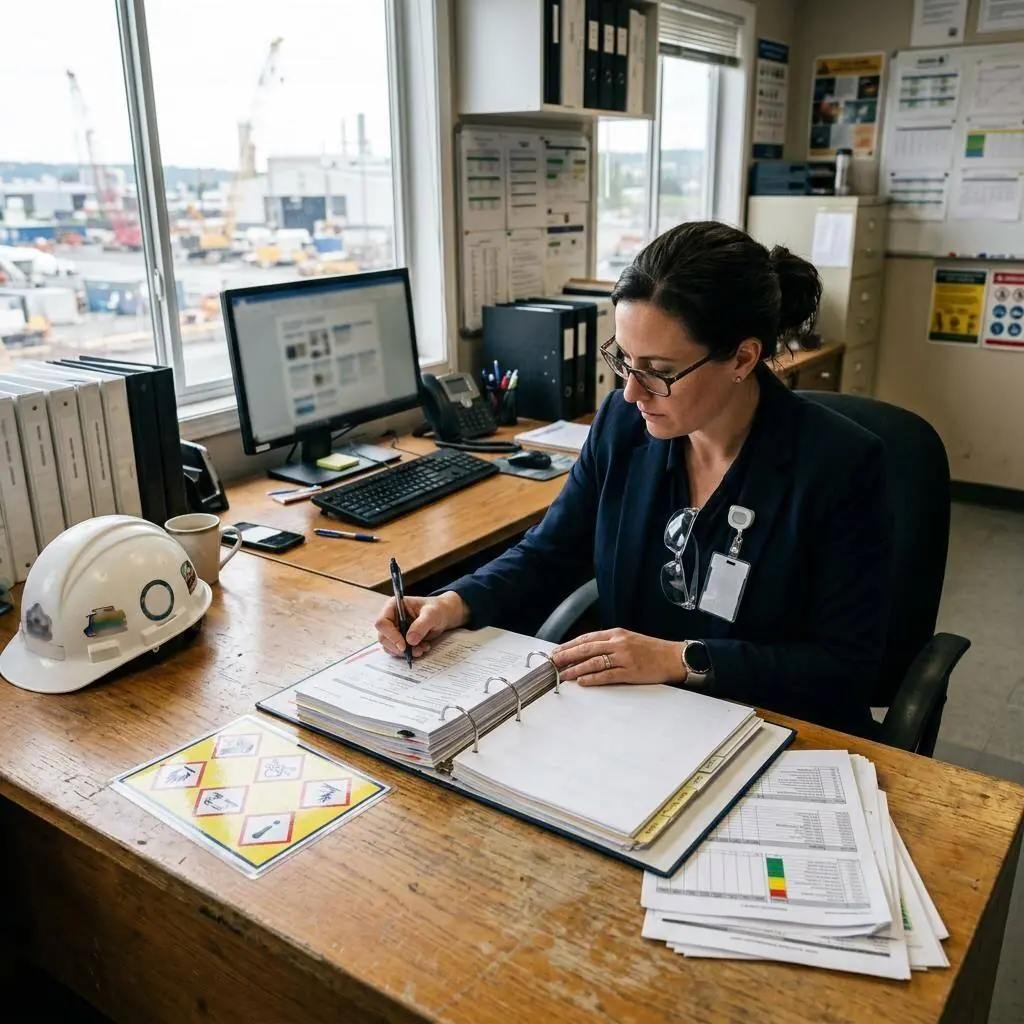
Templates fail because they describe a workplace that isn't yours
Download a written HazCom program template and you'll get a tidy document that references 'the chemical inventory,' 'the SDS location,' and 'the responsible person' in the abstract. That's the problem. OSHA's standard requires a program that describes how your site actually handles these things — where your SDSs live, who maintains your inventory, how your workers get trained, which of your tasks are non-routine. When a compliance officer opens the binder and the program says SDSs are in 'the designated location' while the crew can't find one, the document becomes evidence against you rather than proof of a working system.
The trouble usually isn't the absence of a program — it's a program that lists procedures the site doesn't follow and chemicals the site no longer uses, while omitting the ones it does. That gap between paper and practice is exactly where OSHA Scan earns its place. It doesn't write your program, but it gives you two things the program has to point at and keep current: a chemical inventory generated from scanning your actual container labels, and an SDS library workers reach on their phones or through a room QR poster. When your written procedure says 'the SDS is accessible during the shift,' the room poster is the honest proof. The checklist below covers every required element so your program describes the site you really run.
The paper-versus-practice gap: how inspectors read a written program
When an OSHA compliance officer evaluates hazard communication, the written program is often the first document requested — and the way it's read is telling. The officer doesn't just confirm the binder exists; they test whether it matches what they see on the floor. If the program names an SDS location, they ask a worker to produce an SDS from it. If it lists a chemical inventory, they compare it against the containers actually in storage. If it names a responsible person, they may ask to speak with them. A program that survives this reads like a description of a real system; one that fails reads like a document written once and never reconciled with the workplace it's supposed to govern.
This is why HazCom's written-program requirement, 29 CFR 1910.1200(e), draws citations even from employers who clearly have safety intentions — the program simply falls out of sync with a changing chemical lineup. Construction's parallel standard applies the same GHS framework and adds emphasis on multi-employer sites, where a general contractor's program must account for the information exchange with subcontractors bringing their own chemicals. In state-plan states, the written-program expectation is at least as demanding as federal HazCom. The practical takeaway is consistent: build the program around an inventory and SDS-access method you actually keep current, so the paper and the practice tell the same story on the day someone checks.
Written HazCom program: step by step
Run through these steps before crews start — each one covers a visible gap the AI can help you catch.
- 1
Build your chemical inventory first
Walk every storage area and work zone and list each hazardous chemical as it appears on the label. Scanning container labels into OSHA Scan turns this into a searchable library you can keep current — the inventory your written program will reference.
- 2
Attach an SDS to each chemical and confirm access
Collect a current SDS for every inventoried chemical and store it where workers can reach it during the shift. In OSHA Scan, attach the manufacturer's SDS PDF to each entry so it opens from any phone, then decide your access method for the program.
- 3
Write your site-specific procedures
Author the labeling, SDS, and training procedures describing how your site actually operates — where SDSs live, how secondary containers get labeled, and how workers are trained. Name the responsible person for each. OSHA Scan does not generate this text; you write it to match your operation.
- 4
Add non-routine task and contractor sections
Document how you communicate hazards for non-routine jobs and how you exchange chemical and SDS information with on-site contractors. Reference the shared access method — a printed room QR poster gives everyone the same no-login view.
- 5
Distribute, train, and date it
Make the finished program available to employees, train the crew on how it works, and record the write and review dates. Set a schedule to revisit it whenever your inventory or procedures change.
What a storage-area scan contributes to your written program
OSHA Scan can't author your program, but a photo review surfaces the concrete facts a program has to reflect — and flags the drift that makes a template inaccurate.
Inventory reality check
Scanning container labels builds a chemical library that becomes your living inventory — the exact list a written program is supposed to reference, not a stale attachment.
SDS procedure evidence
An SDS library reachable from any phone gives your 'SDSs are accessible during the shift' procedure something real to stand on, instead of a location nobody can confirm.
Access point for the record
A printed room QR poster is documentable proof of readily-accessible SDSs — the kind of concrete detail that turns a generic procedure into a site-specific one.
Label and storage conditions
Flags unlabeled or unreadable containers and risky storage in frame — the on-the-ground conditions your labeling and storage procedures are supposed to govern.
Demo: the library entry a scanned label comes back with
An illustrative example for this trade — product identity, signal word, GHS pictograms, and hazard statements, filed and searchable.
Isopropyl alcohol surface cleaner
Example manufacturer
An everyday cleaner like this is the kind of chemical your written program must name in the inventory, tie to an SDS, and fold into training.
- H225 — Highly flammable liquid and vapour
- H319 — Causes serious eye irritation
Now scan your own label — free
Photograph any chemical product on your shelf. The AI transcribes the label — no account needed to try it, though you may be asked for the free phone Access Pass.
- The full list of required elements a written HazCom program must contain
- Why site-specific detail — not a template — is what survives an inspection
- Honest notes on what OSHA Scan supplies (inventory, SDS library) and what you still author
One lifetime free label scan
The 12-point written HazCom program checklist
Every element OSHA expects your written program to contain, written so a template becomes a site-specific document. The first four are free — leave your email to unlock the rest and build a program that matches your real operation.
Free checklist — 12 points
Enter your email to unlock the full checklist
Read the checklist here after entering your email. A free account is required to download the PDF.
One email with the checklist, one follow-up. Unsubscribe anytime.
What the AI can and can't detect
OSHA Scan reads a single photo. That makes it fast and easy for anyone on site — but it also means it has real limits. Here's an honest look at both.
What it can catch from a photo
- Unlabeled or unreadable containers your labeling procedure must govern
- Whether an SDS access point exists at the storage area
- Containers present that may be missing from the inventory list
- Risky storage conditions your program's storage procedure should address
What a photo can't tell it
- Whether a written program document exists or names owners
- The quality and site-specificity of written procedures
- Non-routine task and contractor communication procedures
- Whether the program is dated, reviewed, and accessible to employees
SDS digital library
Build a searchable chemical library from label photos. Review manufacturer SDS matches when available and follow the status of missing documents.
Missing-document requests enter a review queue; they do not automatically contact suppliers.
Job-site locations
Organize inspections by location and compare safety performance across every site you manage.
Team roles & permissions
Invite admins, managers, and supervisors with role-based access that keeps the right people in control.
A qualified person must review AI-flagged items before making safety decisions. Do not replace required comprehensive safety walkthroughs with AI reports. Features, limits, and downloads depend on your account’s plan and permissions.
See the workflow click into place
Illustrative AI-assisted workflows. Review the findings; they are not a compliance certification.
Always confirmed by a person on site
A scan is a fast first look, not the final word. Before treating this kind of area as safe, a competent person should still confirm:
- A written program exists and names a real, current responsible person
- Every procedure describes how this site actually operates, not a template
- Non-routine task and contractor communication sections are present and accurate
- The program is dated, reviewed, and available to employees on request
People also ask
What must a written hazard communication program contain?
Under 29 CFR 1910.1200(e), a written HazCom program must describe how the employer handles container labels, safety data sheets, and employee training, and must include a list (inventory) of the hazardous chemicals present. It also has to address non-routine tasks, hazards of chemicals in unlabeled pipes, and how information is shared with on-site contractors under multi-employer duties. Crucially, it must describe how your specific site does these things and name who is responsible.
Can I just download a written HazCom program template?
A template is a fine starting skeleton, but it is not a compliant program on its own. OSHA requires the program to reflect your actual workplace — your chemical inventory, your SDS location and access method, your training approach, your named responsible person. The classic failure is a template left generic: it describes procedures the site doesn't follow and chemicals it doesn't use, which reads as evidence the program isn't real. Customize every section to your operation.
Does OSHA Scan generate a written HazCom program for me?
No. OSHA Scan does not author or generate the written program — that document is yours to write so it matches your site. Where it helps is supplying the living pieces the program depends on: a chemical inventory built from scanning your container labels, an SDS library your team opens from any phone, and printable room QR posters that make your 'SDSs are readily accessible' procedure concrete and documentable. You write the program; OSHA Scan keeps the inventory and SDS evidence current.
Who is the 'responsible person' in a written HazCom program?
It's the individual — named by role or name — who owns each part of the program: maintaining the chemical inventory, ensuring labels stay compliant, keeping the SDS library current and accessible, and coordinating training. Small businesses often assign all of this to one person, such as an owner or site supervisor; larger operations split it across roles. What OSHA looks for is that a real, reachable person holds the duty, not a vacant title, and that the program says who it is.
How often should the written program be updated?
There's no fixed calendar interval, but the program has to stay accurate, so update it whenever something it describes changes: a new chemical enters the inventory, an SDS access method changes, a responsible person leaves, or a new non-routine task begins. Many employers also do a scheduled annual review. Keeping the inventory current in a tool like OSHA Scan gives you an early signal of when the written program's chemical list needs to catch up.
Reviewed by OSHA Scan Editorial
This content is produced by the OSHA Scan Editorial team and reviewed with AI assistance. It is general safety information, not legal or compliance advice. OSHA Scan is an independent tool and is not affiliated with, endorsed by, or certified by OSHA or the U.S. Department of Labor.
Keep exploring
More ways to see what an AI OSHA scan can do for your site.
The AI OSHA inspection tool
The overview hub — how the scanner works and every job, site, and hazard it covers.
SDS scanner
Scan chemical labels to build the living inventory and SDS library your program references.
Hazard communication checklist
The full HazCom chain the written program ties together — labels, SDS, training, and more.
Chemical inventory list
How to build and keep current the inventory your written program must include.
HazCom training requirements
The training procedure your written program has to describe and document.
OSHA — 1910.1200 Hazard Communication
The full text of the standard, including the written-program requirements in paragraph (e).
Official resource — osha.govA full sample report
See a complete labelled example of everything a scan returns.
Related OSHA program guides
Ready to secure your job sites?
Start with one lifetime use per eligible scan type — no credit card. Build JHA-ready reports and catch changing conditions sooner.
Start your free trial