
1
Set the scene
Start with context
Fill the frame
2–3 ft for close-ups; keep ladders, cords and workers fully in view.
Spot visible dust-control gaps on the job site.
Use visual review to prompt a task-specific silica assessment, then verify controls, sampling or Table 1 applicability, respiratory protection, training, and records.
Free preliminary visual review · No account required
OSHA Scan may flag visible concerns. A photo cannot measure airborne respirable crystalline silica or verify an exposure limit, control efficiency, respirator fit, medical surveillance, or a written exposure-control plan.
Use the real site or facility name. If you save the scan after signup, it becomes the report name.
Three angles, one deeper scan
Only the wide shot is required — every extra angle gives the AI more places to look.
Required: Set the scene — one wide shot lets the AI sweep the whole area at once
Stand at the entry point and capture corner to corner: floors, ladders, scaffolds, and everyone at work
Drop a job-site photo or walkthrough video
Click to upload, drag & drop, or snap a photo on site. Photos scan free in about 15 seconds — no signup, no card. Video walkthroughs (up to 3 min) run on a free account.
Small habits, sharper scans
Set the scene
Start with context
Fill the frame
2–3 ft for close-ups; keep ladders, cords and workers fully in view.
Capture clearly
Make the frame usable
Light it right
Keep the sun or lights behind you — glare and shadows hide hazards.
Tap to focus
Tap the hazard on screen and hold still one second — blur can't be flagged.
Choose the useful view
Give the AI room to understand
Go landscape
Turn your phone sideways — a wider frame catches more of the scene.
Only upload photos you have permission to use, and avoid images showing personal, customer, or confidential information. Demo photos and results are held privately for up to 48 hours so you can save them to a free account; unclaimed photos are deleted automatically. Results are an AI-assisted preliminary review, not an official OSHA determination.
OSHA Scan reads a single photo. That makes it fast and easy for anyone on site — but it also means it has real limits. Here's an honest look at both.
Important Limitation: A photo cannot measure airborne respirable crystalline silica or verify an exposure limit, control efficiency, respirator fit, medical surveillance, or a written exposure-control plan. It can only flag visible task and control cues.
Respirable crystalline silica is generated by tasks such as cutting, grinding, drilling, or crushing silica-containing materials. OSHA has separate construction and general-industry/maritime standards requiring exposure controls and worker protection.
Cutting, grinding, drilling, crushing, or otherwise disturbing stone, concrete, mortar, brick, engineered stone, and other materials can generate respirable crystalline silica. The particles are not reliably visible even when a larger dust cloud is visible.
Construction and general industry/maritime have separate OSHA standards. Determine the applicable standard, task, material, control method, exposure assessment, housekeeping, respiratory protection, medical-surveillance, and written-plan duties before describing a task as controlled.
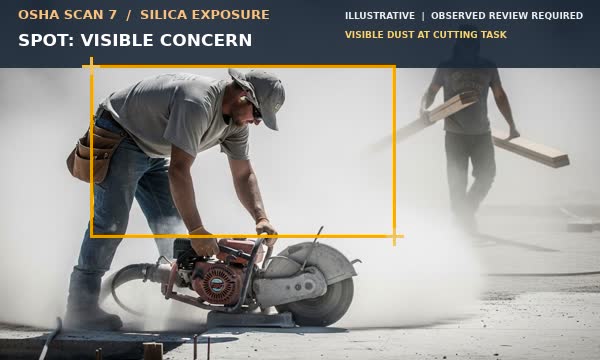
The reviewed scene shows visible dust around a masonry-cutting task. Visual review can flag a control check; it cannot infer airborne concentration or a safe exposure.
Flag cutting, grinding, drilling, or crushing for a task and material review.
Record a visible dust cloud as a prompt for controls and exposure assessment; respirable silica may be present without visible dust.
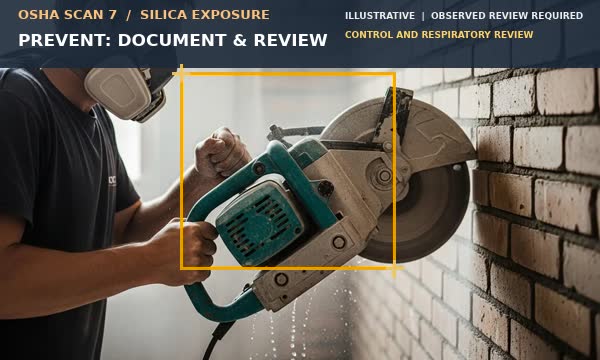
Note whether water delivery, local exhaust, enclosure, or dust collection is visibly present; do not claim it is effective.
Flag dry sweeping or compressed air for review where safer effective alternatives are available.
The reviewed scene shows a masonry worker using respiratory protection and supports a controls-documentation workflow. Visible PPE is not proof of fit, certification, or correct selection.
Apply water at the source, local exhaust, enclosures, or other controls suited to the task and applicable standard.
For construction, follow the specified method when applicable or use the alternative exposure-control method and required assessment.
Use effective, safe alternatives to dry sweeping or uncontrolled compressed air where available.
When required, implement selection, fit, use, training, medical evaluation, and surveillance through the employer's qualified program.
Training must be task-specific and explain health effects, exposure-generating work, controls, housekeeping, respiratory protection, and the site plan.
Keep the task/material inventory, applicable standard, written exposure-control plan, Table 1 or alternative method, exposure assessment and laboratory results, engineering-control checks, housekeeping, respirator and fit records, training, medical-surveillance eligibility, and corrective close-out. Attach dated photos only as visible evidence.
A photo cannot establish an airborne concentration, 8-hour TWA, PEL/action-level result, control capture efficiency, respirator fit, or medical record. Route those questions to industrial-hygiene and respiratory-program personnel.
Photo-based reviews support documentation. Your responsible program owner must arrange on-site verification by people with the qualifications and designated roles required for the task.
Review the cited requirements, proposals, and educational guidance separately. State plans may have additional or different requirements.
Binding construction requirements for exposure controls, Table 1, exposure assessment, written plans, training, and related protection.
Binding general-industry and maritime requirements; do not substitute construction-specific assumptions.
Joint educational hazard alert for countertop manufacturing, finishing, and installation; guidance does not change the binding standards.
Current educational resource on exposure-monitoring methods and laboratory review; sampling is not replaceable by a photo.
Educational item highlighting wet methods, local exhaust, and enclosures for engineered and natural stone work.
A.No. It cannot measure airborne silica, an 8-hour TWA, the PEL, an action-level result, or control efficiency. Use the applicable OSHA method and qualified exposure assessment.
A.Table 1 in the construction standard pairs listed tasks with specified engineering controls, work practices, and respiratory-protection conditions. Confirm that the actual task and conditions fit the table.
A.No. A photo cannot verify selection, NIOSH approval, fit, medical evaluation, training, use, or exposure conditions.
Reviewed by OSHA Scan Editorial
Last updated September 11, 2026
This content is produced by the OSHA Scan Editorial team and reviewed with AI assistance. It is general safety information, not legal or compliance advice. OSHA Scan is an independent tool and is not affiliated with, endorsed by, or certified by OSHA or the U.S. Department of Labor.
Upload a job site photo and let our AI act as a second set of eyes. It's free to try and requires no account.
Analyze Respirable Crystalline Silica + Free Scan