
Laboratory SDS management — a moving inventory of hundreds of reagents
Laboratory SDS management means keeping a current safety data sheet and an accurate inventory for a reagent collection that can run from hundreds to thousands of bottles and changes almost weekly as experiments consume and reorder chemicals. Labs governed by OSHA's Laboratory Standard (29 CFR 1910.1450) are not exempt from SDS access — the Lab Standard requires employees to have ready access to safety data sheets, and the Chemical Hygiene Plan relies on a maintained inventory of the hazardous chemicals in use. OSHA Scan builds that inventory the practical way: photograph each reagent's manufacturer label and the AI reads the product, manufacturer, signal word, and GHS pictograms into a searchable library you attach the SDS PDF to, then share via a QR poster at the storage cabinet. It reads labeled commercial reagents — not unlabeled synthesized intermediates.
Free · No account needed to scan · You may be asked for the free phone Access Pass
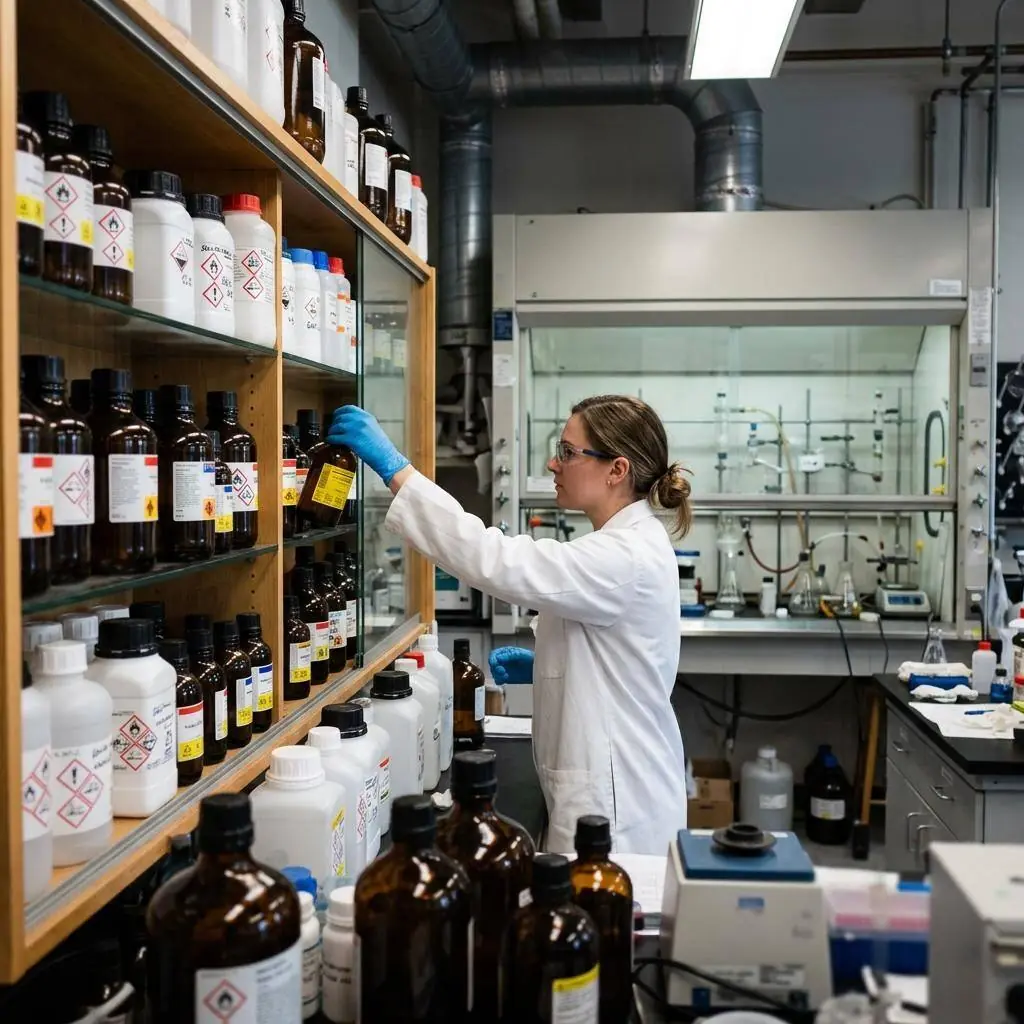
The inventory that changes faster than anyone can keep a binder current
A working laboratory is the hardest SDS environment there is, and not because of any single hazardous chemical — it is the volume and the churn. A modest academic or QC lab holds hundreds of reagent bottles; a busy research group or industrial analytical lab holds thousands. Bottles arrive weekly, get consumed, get reordered from a different vendor when the usual one is backordered, and get shared across benches and rooms by researchers who did not order them. A binder or a spreadsheet built in January is fiction by March. The person who needs the sheet — someone reaching for a solvent at the bench, or first-aid information after a splash — cannot afford to page through an office binder that no longer matches the shelf.
OSHA Scan attacks the churn at the point of entry. Photograph a reagent's manufacturer label and the AI reads the product name, manufacturer, signal word, and GHS pictograms into a searchable library entry, and you attach the manufacturer's SDS PDF to it. Because the entry starts from the label the moment a bottle lands on the shelf, the inventory tracks reality instead of lagging it. Print a QR poster for each storage cabinet or reagent room and any lab member scans it to a no-login page listing that location's chemicals with their pictograms and attached sheets. One honest boundary: the scanner reads printed commercial labels, so it builds your inventory of purchased reagents — it is not for unlabeled synthesized intermediates or in-house preparations that carry no manufacturer label.
The Laboratory Standard vs. HazCom: what 1910.1450 actually requires for SDS and inventory
OSHA regulates laboratory chemical use primarily through 29 CFR 1910.1450, the occupational exposure to hazardous chemicals in laboratories standard, rather than through the full Hazard Communication Standard that governs industrial chemical use. This distinction confuses many lab managers into thinking labs are lightly regulated on paperwork — they are not. The Lab Standard requires a written Chemical Hygiene Plan, a designated Chemical Hygiene Officer, defined procedures for particularly hazardous substances, and — importantly for SDS management — it preserves the employee's right of ready access to safety data sheets and requires that labels on incoming containers not be removed or defaced. A Chemical Hygiene Plan cannot function without knowing what chemicals are on the shelves, so a maintained hazardous-chemical inventory is effectively a prerequisite even where the standard does not use the word 'inventory' the way HazCom does.
The practical enforcement reality in labs centers on the everyday drift: bottles received without being logged, incompatible reagents sharing a shelf because bench space is scarce, peroxide-forming ethers aging past safe windows without a tracked date, and SDS access that exists on paper but not at the bench where a splash happens. State-plan states such as California layer additional expectations onto university and industrial labs. Because a lab's chemical population changes constantly, the compliance question is less 'do we have a binder' and more 'does our inventory and our SDS access reflect the shelves today.' Capturing each reagent at receiving from its manufacturer label — and putting the attached sheets one QR scan away from the cabinet — is a defensible way to keep the answer yes without a standing full-time inventory clerk.
What one reagent scan captures for the lab inventory
Photograph a manufacturer reagent label and the AI reads these elements into a searchable inventory entry.
Reagent identity
Product name and manufacturer read from the bottle label, so each purchased reagent becomes its own searchable entry the moment it reaches the shelf.
Signal word & pictograms
The signal word and GHS pictograms captured from the label — the fast hazard read a researcher needs before opening a bottle at the bench.
Attached manufacturer SDS
Attach the manufacturer's SDS PDF to each reagent entry; the file is checked to look like a real SDS on upload and stays one tap from every bench.
Per-cabinet QR access
Print a QR poster for a flammables cabinet or reagent room; lab members scan it for a no-login page of that location's chemicals and sheets.
Demo: the library entry a scanned label comes back with
An illustrative example for this trade — product identity, signal word, GHS pictograms, and hazard statements, filed and searchable.
Isopropyl alcohol 99% (isopropanol)
Example manufacturer
Isopropanol sits on the reagent bench and gets used all day for cleaning and prep, so anyone reaching for the wash bottle near a flame needs the high-flammability hazard on their phone.
- H225 — Highly flammable liquid and vapour
- H319 — Causes serious eye irritation
Now scan your own label — free
Photograph any chemical product on your shelf. The AI transcribes the label — no account needed to try it, though you may be asked for the free phone Access Pass.
- A searchable reagent library built from label photos across benches and storage cabinets
- The manufacturer, signal word, and GHS pictograms read off each reagent label
- A QR poster for the storage cabinet so any lab member reaches the attached SDS from a phone
One lifetime free label scan
The 12-point laboratory SDS management checklist
Walk your benches, reagent rooms, and storage cabinets with these points. The first four are free — leave an email to unlock the rest and start scanning your own reagent labels.
Free checklist — 12 points
Enter your email to unlock the full checklist
Read the checklist here after entering your email. A free account is required to download the PDF.
One email with the checklist, one follow-up. Unsubscribe anytime.
What the AI can and can't detect
OSHA Scan reads a single photo. That makes it fast and easy for anyone on site — but it also means it has real limits. Here's an honest look at both.
What it can catch from a photo
- Product name and manufacturer from a photographed reagent label
- Signal word and GHS pictograms on the label
- Whether a bottle carries a legible manufacturer label at all
- Visible storage red flags like flammables on open racks
What a photo can't tell it
- The contents of an unlabeled synthesized or in-house intermediate
- Whether the inventory covers every reagent in every room
- Peroxide concentration or age of a stored ether
- Chemical Hygiene Plan quality or exposure monitoring data
SDS digital library
Build a searchable chemical library from label photos. Review manufacturer SDS matches when available and follow the status of missing documents.
Missing-document requests enter a review queue; they do not automatically contact suppliers.
Job-site locations
Organize inspections by location and compare safety performance across every site you manage.
Team roles & permissions
Invite admins, managers, and supervisors with role-based access that keeps the right people in control.
A qualified person must review AI-flagged items before making safety decisions. Do not replace required comprehensive safety walkthroughs with AI reports. Features, limits, and downloads depend on your account’s plan and permissions.
See the workflow click into place
Illustrative AI-assisted workflows. Review the findings; they are not a compliance certification.
Always confirmed by a person on site
A scan is a fast first look, not the final word. Before treating this kind of area as safe, a competent person should still confirm:
- The inventory matches the reagents physically on the shelves right now
- Each attached SDS is the current version for the bottle in hand
- Storage compatibility against each reagent's actual SDS guidance
- Unlabeled or in-house intermediates are identified and handled outside the scanner
People also ask
Do labs under the OSHA Laboratory Standard still need safety data sheets?
Yes. Being covered by 29 CFR 1910.1450 (the Laboratory Standard) instead of the general Hazard Communication Standard does not remove the SDS obligation. The Lab Standard specifically requires that employees have ready access to safety data sheets, and the written Chemical Hygiene Plan is built around knowing the hazardous chemicals in use — which means a maintained inventory. Building that inventory from reagent-label scans and attaching each manufacturer's SDS is a direct way to meet both the access and inventory expectations.
How is a lab's SDS obligation different from a factory's HazCom obligation?
A manufacturing plant using chemicals in a production process falls under the full Hazard Communication Standard (1910.1200) with its written program, labeling, and training requirements. A laboratory using chemicals on a laboratory scale falls under the Laboratory Standard (1910.1450), which substitutes a Chemical Hygiene Plan and a Chemical Hygiene Officer for parts of the HazCom program — but it still incorporates SDS access and container labeling. In practice, both need a current inventory and reachable sheets; OSHA Scan builds that from labels either way.
Can I scan chemicals I synthesized in the lab that have no manufacturer label?
No — and this is an honest limit worth stating plainly. OSHA Scan reads printed commercial labels to identify a product and pull its hazard elements, so it builds your inventory of purchased reagents. An unlabeled synthesized intermediate or an in-house preparation carries no manufacturer label and no manufacturer SDS to attach, so the scanner cannot classify it. Those materials still need to be labeled and handled under your Chemical Hygiene Plan by a qualified person.
How does OSHA Scan handle a reagent inventory that changes every week?
By moving the work to the point of entry. Instead of reconciling a spreadsheet against the shelves periodically, a lab member scans each new bottle's label into the searchable library when it arrives and retires bottles as they are consumed. The QR poster at each storage cabinet then always reflects the current entries. The app does not auto-fetch sheets or monitor versions — you attach the manufacturer's SDS — but the label-scan intake keeps the inventory close to real time without a full re-audit.
Does the app write an SDS if none is available for a reagent?
No. OSHA Scan can hold an AI-drafted chemical profile when no sheet is on file, but it is always labeled as an internal draft and is never presented as the manufacturer's authoritative SDS. Manufacturers and importers are responsible for classifying their products and producing the SDS; the app helps you organize and reach those sheets, not author them.
Reviewed by OSHA Scan Editorial
This content is produced by the OSHA Scan Editorial team and reviewed with AI assistance. It is general safety information, not legal or compliance advice. OSHA Scan is an independent tool and is not affiliated with, endorsed by, or certified by OSHA or the U.S. Department of Labor.
Keep exploring
More ways to see what an AI OSHA scan can do for your site.
The AI OSHA inspection tool
The overview hub — how the scanner works and every job, site, and hazard it covers.
SDS scanner
Photograph any reagent label to build a searchable SDS library.
Laboratory safety inspection checklist
The full bench, fume hood, and storage safety walk-through for labs.
Chemical inventory list
How to build and maintain the hazardous-chemical inventory itself.
How to read an SDS
A section-by-section guide to the 16-section safety data sheet.
OSHA 29 CFR 1910.1200 — Hazard Communication
The SDS and labeling requirements that the Laboratory Standard incorporates.
Official resource — osha.govA full sample report
See a complete labelled example of everything a scan returns.
Ready to secure your job sites?
Start with one lifetime use per eligible scan type — no credit card. Build JHA-ready reports and catch changing conditions sooner.
Start your free trial