
1
Set the scene
Start with context
Fill the frame
2–3 ft for close-ups; keep ladders, cords and workers fully in view.
Spot visible guarding gaps before an injury occurs.
Use image review to prompt a machine-specific inspection, then verify guarding, controls, energy isolation, and training with qualified personnel.
Free preliminary visual review · No account required
OSHA Scan may flag visible concerns. A photo may flag an apparently exposed moving part or missing guard, but it cannot verify guard dimensions, interlocks, stopping time, hidden energy, lockout/tagout, or a zero-energy state.
Use the real site or facility name. If you save the scan after signup, it becomes the report name.
Three angles, one deeper scan
Only the wide shot is required — every extra angle gives the AI more places to look.
Required: Set the scene — one wide shot lets the AI sweep the whole area at once
Stand at the entry point and capture corner to corner: floors, ladders, scaffolds, and everyone at work
Drop a job-site photo or walkthrough video
Click to upload, drag & drop, or snap a photo on site. Photos scan free in about 15 seconds — no signup, no card. Video walkthroughs (up to 3 min) run on a free account.
Small habits, sharper scans
Set the scene
Start with context
Fill the frame
2–3 ft for close-ups; keep ladders, cords and workers fully in view.
Capture clearly
Make the frame usable
Light it right
Keep the sun or lights behind you — glare and shadows hide hazards.
Tap to focus
Tap the hazard on screen and hold still one second — blur can't be flagged.
Choose the useful view
Give the AI room to understand
Go landscape
Turn your phone sideways — a wider frame catches more of the scene.
Only upload photos you have permission to use, and avoid images showing personal, customer, or confidential information. Demo photos and results are held privately for up to 48 hours so you can save them to a free account; unclaimed photos are deleted automatically. Results are an AI-assisted preliminary review, not an official OSHA determination.
OSHA Scan reads a single photo. That makes it fast and easy for anyone on site — but it also means it has real limits. Here's an honest look at both.
Important Limitation: A photo may flag an apparently exposed moving part or missing guard, but it cannot verify guard dimensions, interlocks, stopping time, hidden energy, lockout/tagout, or a zero-energy state.
Machine guarding uses barriers, devices, and safe work practices to protect people from point-of-operation, nip-point, rotating-part, flying-chip, and spark hazards. Servicing that exposes hazardous energy also requires an energy-control program.
A machine's point of operation, power-transmission parts, rotating parts, chips, sparks, and unexpected movement can injure operators and nearby workers. Guarding must prevent contact without creating a new hazard or interfering with safe operation.
Guarding and lockout/tagout are related but distinct. A visible guard does not prove safe servicing, and a lock or tag in a photograph does not prove all hazardous energy was isolated and verified.
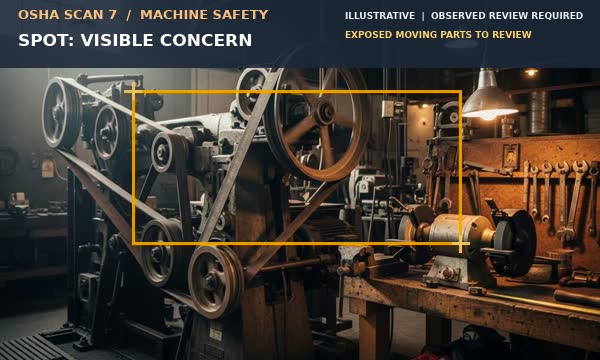
The reviewed scene shows an exposed belt and pulley assembly. Visual review can flag similar visible conditions for an in-person machine-specific assessment.
Flag visibly exposed belts, pulleys, gears, shafts, or nip points where contact appears possible.
Note an apparently unguarded work area and route the finding to the machine owner or safety professional.
Record missing, damaged, displaced, or apparently defeated guards; do not infer interlock function from appearance.
Flag clutter, reach-through access, or nearby people for a task and safeguarding review.
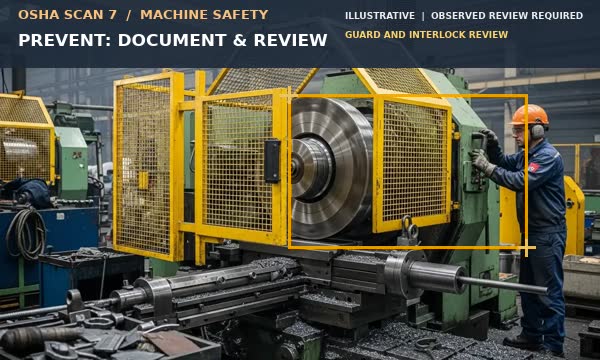
The reviewed scene shows a guarded machine and operator control area supporting a preventive review workflow.
Use secure barriers and safe distances appropriate to the machine and task.
Use engineered devices where appropriate and have qualified personnel test their function; a photo cannot verify performance.
For servicing or maintenance, identify, isolate, lock/tag, release or restrain stored energy, and verify according to the written procedure.
Remove damaged or missing guards from service until corrected, then document the inspection and authorization to resume.
Training must match the machine, role, guard design, and energy-control procedure.
Keep the machine/task hazard assessment, guard and interlock inspection, energy-control procedure, authorized/affected employee training, maintenance work order, corrective action, and restart authorization. Attach a dated photo only to document the visible observation and its follow-up.
A photo cannot prove a lockout, de-energization, interlock test, emergency-stop function, or zero-energy state. Those require the written procedure and physical verification by trained personnel.
Photo-based reviews support documentation. Your responsible program owner must arrange on-site verification by people with the qualifications and designated roles required for the task.
Review the cited requirements, proposals, and educational guidance separately. State plans may have additional or different requirements.
Binding general-industry guarding requirements for point-of-operation and other machine hazards.
Binding lockout/tagout requirements for servicing and maintenance where hazardous energy can cause injury.
Binding requirements for covered belts, pulleys, gears, shafts, and related power-transmission apparatus.
Educational hazard-recognition and solution resource; OSHA states eTools do not create new requirements.
Educational topic page linking hazards, standards, and possible solutions.
A.No. A photograph cannot verify isolation, stored-energy control, or zero energy. Follow the site's written 1910.147 procedure and have a trained person verify it.
A.It is the area where work is performed on the material being processed. The applicable machine guard must protect people exposed to that operation.
A.No. It may show the visible guard or device, but function, stopping performance, and safe integration require a physical test by qualified personnel.
Reviewed by OSHA Scan Editorial
Last updated September 11, 2026
This content is produced by the OSHA Scan Editorial team and reviewed with AI assistance. It is general safety information, not legal or compliance advice. OSHA Scan is an independent tool and is not affiliated with, endorsed by, or certified by OSHA or the U.S. Department of Labor.
Upload a job site photo and let our AI act as a second set of eyes. It's free to try and requires no account.
Analyze Machine Safety & Guarding + Free Scan