
1
Set the scene
Start with context
Fill the frame
2–3 ft for close-ups; keep ladders, cords and workers fully in view.
OSHA's fire protection rules come down to a few visible disciplines: portable extinguishers mounted, identified, charged, and — above all — reachable (29 CFR 1910.157); exit routes unobstructed and unlocked (1910.36–37); combustible materials stored away from ignition sources like heaters and electrical equipment; and the working space in front of electrical panels kept clear (1910.303(g)). Most fire citations aren't exotic — they're a pallet leaned in front of an extinguisher, cartons piled against a panel, a space heater parked between stacks of cardboard. OSHA Scan reads a photo of your facility and flags those visible gaps with the standard each may relate to. It is an AI-assisted first pass, not a fire marshal inspection.
Free · No account needed to scan · Results in seconds
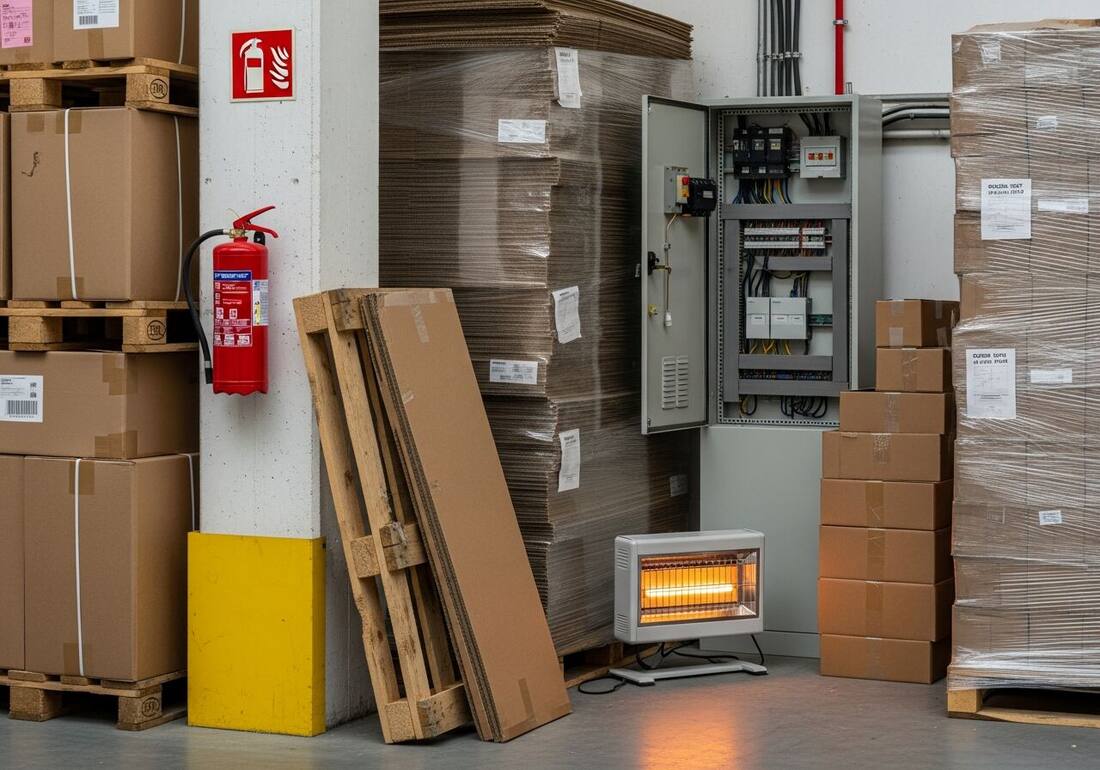
Almost no workplace fire starts somewhere surprising. It starts where combustible storage crept over months into the wrong spot: cardboard stacked against an electrical panel, packaging piled around a portable heater someone brought in one cold week, pallets leaned wherever there was wall — including in front of the extinguisher. Each individual decision looked harmless; together they build the classic fire triangle with the response equipment buried behind it. OSHA's most frequent fire-related citations reflect exactly this: blocked extinguisher access, obstructed exit routes, and storage in electrical working space.
The response side decays the same way. An extinguisher works if someone can reach it in the first seconds — 1910.157 requires them mounted, identified, and 'readily accessible,' which ends the moment a pallet leans in front of one. Exit routes obey the same logic: 1910.36 requires them kept free and unobstructed at all times, not just at inspection time. A photo catches all of this instantly, because every one of these failures is a physical object sitting where it shouldn't. The checklist below adds what the camera can't see: extinguisher service dates, the fire prevention plan, and training.
OSHA's fire protection standards (29 CFR 1910.155–165 for general industry) focus primarily on fire extinguisher availability, maintenance, and employee training; exit route design and maintenance (1910.36–37); and emergency action plans (1910.38). These requirements address the occupational safety dimension of fire — ensuring employees can escape safely and that first-response suppression equipment is accessible. Citations under these standards are common because they involve physical conditions inspectors can observe directly: a blocked exit, an extinguisher with an outdated inspection tag, or a fire door propped open.
Fire suppression systems, building exit capacity, and high-piled storage requirements are primarily regulated by local fire codes (typically based on NFPA 1 or IFC) and enforced by local fire marshals, not OSHA — a distinction that matters when determining who is most likely to inspect and cite a specific condition. However, OSHA and local fire authorities often inspect the same facility, and a condition that OSHA cites under the general duty clause may simultaneously trigger local fire code violations. Employers in multi-tenant buildings also need to coordinate with property management on exit route integrity — a fire door propped open in a shared corridor is simultaneously an OSHA violation, a fire code violation, and a lease violation in most commercial leases.
What the AI checks in a photo of a warehouse, shop, or work area.
Pallets, boxes, and equipment parked in front of mounted extinguishers — 'readily accessible' means reachable in seconds, not after moving freight.
Cardboard, packaging, and pallets stored against electrical panels, space heaters, and hot equipment — fuel staged next to the spark.
Storage, carts, and materials narrowing or blocking the paths people need in an evacuation.
The clearance in front of panels and disconnects used as storage — blocking both fire prevention and emergency shutdown access.
Scan a photo like the one above and this is the report you get — score, findings, OSHA references, and fixes. It is an illustrative example, clearly marked — not live scan data.
Compliance score
44
Lower means more potential hazards found
5 potential hazards found
1Portable space heater running on the floor directly between stacked cardboard and combustible packaging
Possibly related to fire prevention and housekeeping (29 CFR 1910.22, 1910.39) and heating equipment clearances
Observed condition: A radiant heater against cardboard is an ignition sequence waiting for a shift change — heater fires in storage areas typically start after hours, when nobody is left to catch them small.
Corrective action: Remove the heater from the storage area or enforce a marked clearance zone around it — most heater manufacturers specify three feet from combustibles — and fix the comfort problem it was compensating for.
High confidence
2Mounted fire extinguisher with pallets and sheet materials leaned directly in front of it
Possibly related to portable extinguisher accessibility (29 CFR 1910.157(c))
Observed condition: A fire doubles in size roughly every 30 seconds early on — the time spent dragging pallets away from the extinguisher is the difference between a discharge and an evacuation.
Corrective action: Clear everything in front of the extinguisher and mark a keep-clear zone on the floor beneath it so storage creep can't reclaim the space.
High confidence
Upload a photo like the one above and get a compliance score and hazard count in seconds. No account needed to scan — create a free account to unlock the full report.
Use the real site or facility name. If you save the scan after signup, it becomes the report name.
Three angles, one deeper scan
Only the wide shot is required — every extra angle gives the AI more places to look.
Required: Set the scene — one wide shot lets the AI sweep the whole area at once
Stand at the entry point and capture corner to corner: floors, ladders, scaffolds, and everyone at work
Drop a job-site photo or walkthrough video
Click to upload, drag & drop, or snap a photo on site. Photos scan free in about 15 seconds — no signup, no card. Video walkthroughs (up to 3 min) run on a free account.
Small habits, sharper scans
Set the scene
Start with context
Fill the frame
2–3 ft for close-ups; keep ladders, cords and workers fully in view.
Capture clearly
Make the frame usable
Light it right
Keep the sun or lights behind you — glare and shadows hide hazards.
Tap to focus
Tap the hazard on screen and hold still one second — blur can't be flagged.
Choose the useful view
Give the AI room to understand
Go landscape
Turn your phone sideways — a wider frame catches more of the scene.
Only upload photos you have permission to use, and avoid images showing personal, customer, or confidential information. Demo photos and results are held privately for up to 48 hours so you can save them to a free account; unclaimed photos are deleted automatically. Results are an AI-assisted preliminary review, not an official OSHA determination.
New: Video walkthrough scans
Record up to 3 minutes of your site — the AI extracts frames and categorizes findings with exact timestamps. Free account required.
Get the best results
Wide shot first
Stand at the entrance and photograph the entire work area so AI sees the full context
Hazard areas
Photograph elevated surfaces, equipment, electrical panels, and anywhere workers are active
Close-ups last
Move in close on anything damaged, missing, or that looks risky — the AI catches more detail
From extinguisher access to the fire prevention plan. The first four are free — create a free account to unlock the rest and scan your own facility.
Free checklist — 12 points
Enter your email to unlock the full checklist
We'll also send you a printable PDF copy — no account required.
One email with the checklist, one follow-up. Unsubscribe anytime.
OSHA Scan reads a single photo. That makes it fast and easy for anyone on site — but it also means it has real limits. Here's an honest look at both.
Snap a photo of the job site, and the AI categorizes findings against OSHA standards in seconds.
Each finding includes consistent corrective actions and structured JHA outputs. Check items off as your crew resolves them.
Every inspection gets a deterministic 0-100 compliance score derived from hazard severity, so you can track sites at a glance.
A prioritization aid based on recorded findings—not a certification or a complete measure of site safety.
Generate detailed inspection reports and export data to Excel for record-keeping and stakeholders.
A qualified person must review AI-flagged items before making safety decisions. Do not replace required comprehensive safety walkthroughs with AI reports. Features, limits, and downloads depend on your account’s plan and permissions.
Illustrative AI-assisted workflows. Review the findings; they are not a compliance certification.
A scan is a fast first look, not the final word. Before treating this kind of area as safe, a competent person should still confirm:
Under 29 CFR 1910.157, employers who provide portable extinguishers must mount them, identify them, and keep them readily accessible; inspect them visually every month; perform annual maintenance checks; and either train employees to use them or direct total evacuation instead. Travel distance matters too — for Class A hazards, extinguishers must be within 75 feet of employees, and 50 feet for Class B. The most-cited failure is the simplest: an extinguisher physically blocked by storage.
OSHA doesn't publish a single universal distance — it requires combustibles to be controlled around ignition sources through its housekeeping, electrical, and fire prevention rules. In practice: portable heater manufacturers (whose instructions OSHA expects you to follow) typically specify 36 inches from combustibles; electrical working space under 1910.303(g) is generally three feet in front of panels and must never be used for storage; and NFPA guidance widely used to satisfy these rules works from the same three-foot logic. When in doubt, three feet and a marked floor zone is the defensible answer.
It can flag the visible ones: blocked extinguishers, combustibles stacked against panels and heaters, obstructed exit routes, and storage in electrical clearances. It cannot read an extinguisher's gauge, check service tags, test alarms, or verify the written plans — those need hands and documents. Use the scan to catch storage creep between formal fire inspections, because storage creep is how most of these violations happen.
Reviewed by OSHA Scan Editorial
This content is produced by the OSHA Scan Editorial team and reviewed with AI assistance. It is general safety information, not legal or compliance advice. OSHA Scan is an independent tool and is not affiliated with, endorsed by, or certified by OSHA or the U.S. Department of Labor.
More ways to see what an AI OSHA scan can do for your site.
The overview hub — how the scanner works and every job, site, and hazard it covers.
The egress-focused scan — exits, aisles, and escape paths in any photo.
The ignition-source side — panels, wiring, cords, and overloads.
Fire prevention where ignition is the job itself — permits, fire watch, and clearances.
See a complete labelled example of everything a scan returns.
Start with exactly 5 lifetime AI site scans — no credit card. Build JHA-ready reports and catch changing conditions sooner.
Start your free trial