
1
Set the scene
Start with context
Fill the frame
2–3 ft for close-ups; keep ladders, cords and workers fully in view.
OSHA's noise standard works on two numbers: at an 8-hour average of 85 decibels the employer owes workers a hearing conservation program — monitoring, annual audiograms, free hearing protectors, and training — and at 90 decibels protection and feasible noise controls become mandatory. A camera can't measure a decibel, but the most common failure is fully visible: someone inside the noise of a saw, grinder, or compressor with bare ears while the earmuffs hang on a hook. OSHA Scan reads a photo of loud work and flags exposed ears, unused protectors, and stacked noise sources, referencing the OSHA standard each may relate to. It is an AI-assisted first pass — dosimetry and audiograms still decide compliance.
Free · No account needed to scan · Results in seconds
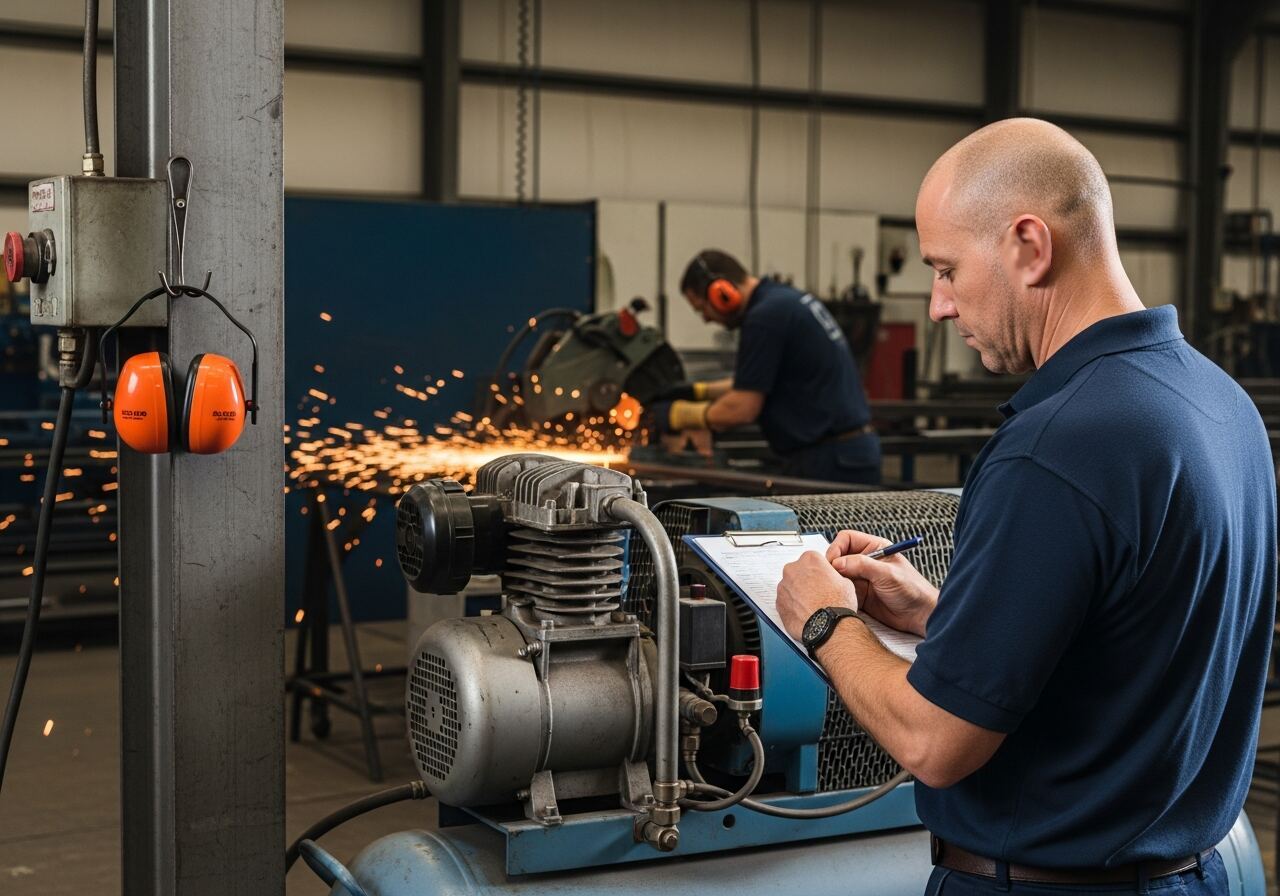
Occupational hearing loss is among the most common workplace injuries in the country, and it has a cruel property: it's painless, gradual, and permanent. Nobody stops work for it the way they would for a cut. The worker running the saw wears his muffs — it's the helper holding the other end of the stock, the supervisor who 'just stepped in for a minute,' and the tradesman working one bay over who accumulate the dose with bare ears, day after day, until the audiogram catches what nobody felt.
That's exactly the failure a photo shows. Not the decibels — no image can measure sound — but the pattern: loud equipment clearly running, one person protected, another inside the same noise with nothing on their ears, and the earmuffs that would fix it hanging unused in plain sight. Scanning loud work areas keeps the visible half honest; the checklist below covers the program half — monitoring, audiograms, and fit — that only records prove.
OSHA's occupational noise exposure standard (29 CFR 1910.95 for general industry; construction noise is addressed under 29 CFR 1926.52 and 1926.101) establishes a permissible exposure limit of 90 dBA as an 8-hour time-weighted average (TWA), with an action level of 85 dBA that triggers an audiometric testing program even if the PEL is not exceeded. The audiometric testing requirement — baseline audiogram before exposure, annual audiograms thereafter, and follow-up evaluation for standard threshold shifts — is the element most frequently missing in employer compliance programs. OSHA requires that audiometric testing be conducted by a qualified audiologist, otolaryngologist, or physician, or by a technician under their supervision using a calibrated audiometer.
Hearing protection selection involves more than providing earplugs. The Noise Reduction Rating (NRR) labeled on hearing protection is a laboratory measurement; OSHA's practical derating guidance (dividing NRR minus 7 by 2 for earmuffs) is used to estimate real-world protection. At high noise exposures, double protection — earplugs plus earmuffs — may be required. Construction's noise requirements are less comprehensive than general industry, creating a gap that OSHA addresses through the general duty clause at construction sites with continuous high noise exposure. Several state-plan states have adopted construction noise standards closer to the general industry requirements, including California, which applies a 90 dBA PEL and audiometric testing requirements to construction workers.
What the AI checks in a photo of cutting, grinding, compressed-air, or other visibly loud work.
Workers with nothing visible on or in their ears while saws, grinders, or pneumatic tools are clearly in use in the frame.
Earmuffs hanging on hooks or sitting on benches while the noise-producing work continues — issued equipment that isn't on anyone's head.
Multiple loud machines running at once — a saw over a compressor over a grinder — the combinations that push a loud shop past the action level.
Helpers, spotters, and passers-through standing within the operator's noise field without the protection the operator is wearing.
Scan a photo like the one above and this is the report you get — score, findings, OSHA references, and fixes. It is an illustrative example, clearly marked — not live scan data.
Compliance score
60
Lower means more potential hazards found
5 potential hazards found
1Supervisor standing in the noise zone — running compressor plus active cutting nearby — with no hearing protection visible
Possibly related to occupational noise exposure (29 CFR 1910.95)
Observed condition: The saw operator is protected, but a compressor at arm's length layered under metal cutting puts the supervisor in nearly the same noise field with bare ears — and supervisors 'just passing through' accumulate that dose every day.
Corrective action: Require hearing protection for everyone inside the noise zone while equipment runs — supervisors and visitors included — and post the area if the exposure is routine.
Medium confidenceNot fully clear from the photo — verify on site.
2Earmuffs available on a hook beside the work area but not in use by the exposed worker
Possibly related to hearing protector use and enforcement (29 CFR 1910.95(i))
Observed condition: Providing protectors is only half the requirement — OSHA expects them worn whenever exposures demand it, and muffs on a hook during the exposure is the gap inspectors photograph.
Corrective action: Find out why available protection isn't being worn — comfort, fit, or habit — and enforce use inside the noise zone while the work runs.
High confidence
Upload a photo like the one above and get a compliance score and hazard count in seconds. No account needed to scan — create a free account to unlock the full report.
Use the real site or facility name. If you save the scan after signup, it becomes the report name.
Three angles, one deeper scan
Only the wide shot is required — every extra angle gives the AI more places to look.
Required: Set the scene — one wide shot lets the AI sweep the whole area at once
Stand at the entry point and capture corner to corner: floors, ladders, scaffolds, and everyone at work
Drop a job-site photo or walkthrough video
Click to upload, drag & drop, or snap a photo on site. Photos scan free in about 15 seconds — no signup, no card. Video walkthroughs (up to 3 min) run on a free account.
Small habits, sharper scans
Set the scene
Start with context
Fill the frame
2–3 ft for close-ups; keep ladders, cords and workers fully in view.
Capture clearly
Make the frame usable
Light it right
Keep the sun or lights behind you — glare and shadows hide hazards.
Tap to focus
Tap the hazard on screen and hold still one second — blur can't be flagged.
Choose the useful view
Give the AI room to understand
Go landscape
Turn your phone sideways — a wider frame catches more of the scene.
Only upload photos you have permission to use, and avoid images showing personal, customer, or confidential information. Demo photos and results are held privately for up to 48 hours so you can save them to a free account; unclaimed photos are deleted automatically. Results are an AI-assisted preliminary review, not an official OSHA determination.
New: Video walkthrough scans
Record up to 3 minutes of your site — the AI extracts frames and categorizes findings with exact timestamps. Free account required.
Get the best results
Wide shot first
Stand at the entrance and photograph the entire work area so AI sees the full context
Hazard areas
Photograph elevated surfaces, equipment, electrical panels, and anywhere workers are active
Close-ups last
Move in close on anything damaged, missing, or that looks risky — the AI catches more detail
The full hearing conservation chain, from noise monitoring to recordkeeping. The first four are free — create a free account to unlock the rest and scan your own loud areas.
Free checklist — 12 points
Enter your email to unlock the full checklist
We'll also send you a printable PDF copy — no account required.
One email with the checklist, one follow-up. Unsubscribe anytime.
OSHA Scan reads a single photo. That makes it fast and easy for anyone on site — but it also means it has real limits. Here's an honest look at both.
Snap a photo of the job site, and the AI categorizes findings against OSHA standards in seconds.
Each finding includes consistent corrective actions and structured JHA outputs. Check items off as your crew resolves them.
Every inspection gets a deterministic 0-100 compliance score derived from hazard severity, so you can track sites at a glance.
A prioritization aid based on recorded findings—not a certification or a complete measure of site safety.
Generate detailed inspection reports and export data to Excel for record-keeping and stakeholders.
A qualified person must review AI-flagged items before making safety decisions. Do not replace required comprehensive safety walkthroughs with AI reports. Features, limits, and downloads depend on your account’s plan and permissions.
Illustrative AI-assisted workflows. Review the findings; they are not a compliance certification.
A scan is a fast first look, not the final word. Before treating this kind of area as safe, a competent person should still confirm:
Two thresholds matter under 29 CFR 1910.95. At an 8-hour average of 85 decibels — the action level — employers must run a hearing conservation program: noise monitoring, annual audiograms, free hearing protectors offered, and training. At 90 decibels — the permissible exposure limit — protector use and feasible engineering or administrative controls become mandatory. A practical field cue: if you must raise your voice to talk at arm's length, the area likely deserves measurement.
Neither is universally better — fit decides. A properly rolled and deeply inserted foam plug can outperform muffs; a shallowly inserted one can be nearly useless. Muffs are easier to verify at a glance and faster on and off for intermittent noise, but glasses arms and beards break their seal. OSHA requires offering a suitable variety so each worker gets a protector that seals for them, and very loud work — above roughly 100 decibels — typically calls for plugs and muffs together.
Not the sound itself — no image measures decibels, and OSHA compliance ultimately rests on dosimetry and audiometric records. What the scan flags are the visible proxies: bare ears next to equipment that's clearly running, protectors hanging unused during the exposure, stacked noise sources, and unprotected bystanders in the noise zone. Those are the gaps a walkthrough misses because everyone acclimates to the noise they work in.
Reviewed by OSHA Scan Editorial
This content is produced by the OSHA Scan Editorial team and reviewed with AI assistance. It is general safety information, not legal or compliance advice. OSHA Scan is an independent tool and is not affiliated with, endorsed by, or certified by OSHA or the U.S. Department of Labor.
More ways to see what an AI OSHA scan can do for your site.
The overview hub — how the scanner works and every job, site, and hazard it covers.
The tools producing the noise — guards, condition, and PPE in one scan.
The broader PPE scan — head, eye, hand, and hi-vis gaps in any photo.
A walkthrough of how unprotected noise exposure becomes permanent hearing loss.
See a complete labelled example of everything a scan returns.
Start with exactly 5 lifetime AI site scans — no credit card. Build JHA-ready reports and catch changing conditions sooner.
Start your free trial