
1
Set the scene
Start with context
Fill the frame
2–3 ft for close-ups; keep ladders, cords and workers fully in view.
A ladder safety inspection checks that the right ladder is being used the right way: correct angle and extension, secured footing, undamaged rails and rungs, and three points of contact. OSHA Scan adds a fast first pass — photograph the ladder setup and the AI flags visible problems like a ladder leaned at a dangerous angle, placed on unstable ground, or short of the required extension above a landing, referencing the OSHA standard each issue may relate to. It is an AI-assisted preliminary review of what is visible in the photo, not a formal compliance determination.
Free · No account needed to scan · Results in seconds
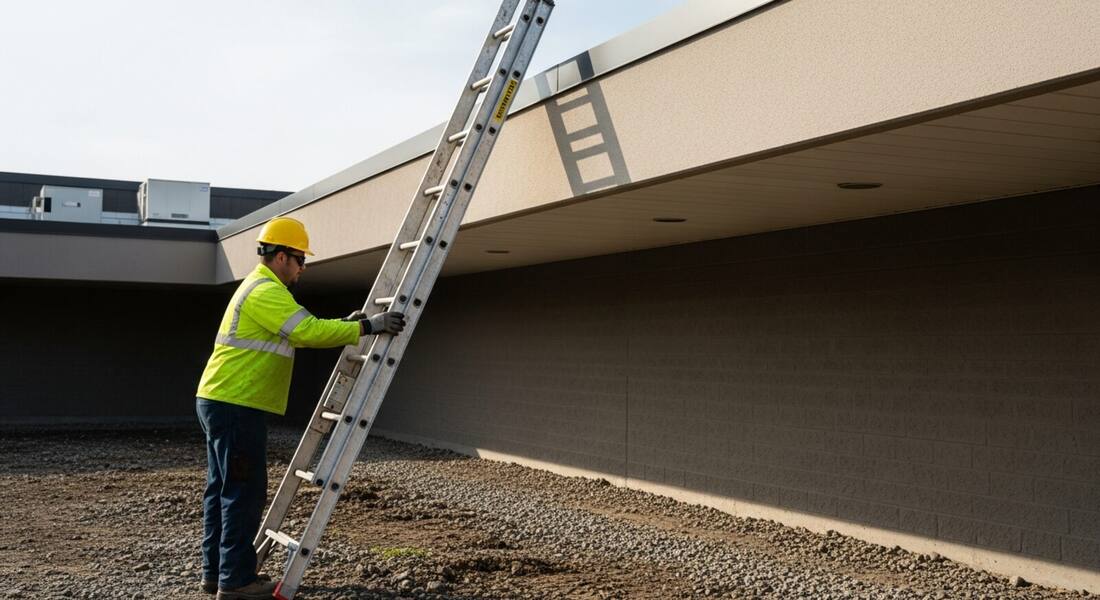
Most ladder incidents trace back to a setup problem that was visible before anyone stepped on a rung — the wrong ladder for the job, a base on loose ground, an angle that is too steep or too shallow, or a top that stops short of the landing. A checklist catches these, but only when someone actually runs it, and on a busy site the quick climb often wins.
A photo scan lowers the bar: snap the setup and get an immediate second opinion on what is visible — placement, angle, footing, and obvious damage — plus the checklist items a person still needs to verify by hand, like locked spreaders and rated capacity. It turns the ladder check from a form into a ten-second habit.
Portable ladders (29 CFR 1926.1053 for construction; 29 CFR 1910.23 for general industry) land on OSHA's top-ten most-cited list year after year — not because the standard is ambiguous, but because ladder shortcuts are normalized on busy sites. The most common citation categories are predictable: ladders used at the wrong angle, the top of a ladder not extending three feet above the landing, a ladder used as a platform or work surface, a damaged ladder still in service, and a ladder set up on unstable footing. Each one is exactly the visible condition a pre-climb photo captures.
The type-selection question matters for enforcement and injury prevention alike. A ladder rated for one user type or weight class used in a higher-duty application is both a citation and an increased fall risk. Extension ladders and step ladders have different rules for working near electrical equipment, and using a conductive aluminum ladder within reach of energized parts adds an electrical exposure on top of the fall exposure. OSHA's 2016 update to the general industry walking-working surfaces standard (1910.23) modernized ladder requirements and increased focus on ladder training documentation — inspectors now ask for training records, not just look at the ladder.
Visible setup and condition issues the AI checks in a ladder photo.
Ladders leaned too steep or too flat, and tops that appear to stop short of extending above the landing surface.
Bases set on visibly loose, sloped, or cluttered ground, or placed in walkways and doorways without protection.
Workers standing on top caps or rungs marked not for standing, overreaching, or carrying loads that prevent three points of contact.
Bent rails, missing or broken rungs, and makeshift repairs that are apparent in the photo.
Scan a photo like the one above and this is the report you get — score, findings, OSHA references, and fixes. It is an illustrative example, clearly marked — not live scan data.
Compliance score
46
Lower means more potential hazards found
5 potential hazards found
1Extension ladder set at a visibly steep angle against the structure
Possibly related to ladders (29 CFR 1926.1053)
Observed condition: A ladder pitched too steeply can tip backward under load, and one too flat can slide out at the base.
Corrective action: Reset the ladder to roughly a 4-to-1 rise-to-run angle and secure the top before use.
High confidence
2Ladder base resting on uneven, debris-covered ground
Possibly related to ladder stability requirements (29 CFR 1926.1053(b))
Observed condition: An unstable base is one of the most common causes of ladder slide-out and falls from height.
Corrective action: Clear the area, level the footing, and use the ladder's feet or a stable platform rated for the task.
Medium confidenceNot fully clear from the photo — verify on site.
Upload a photo like the one above and get a compliance score and hazard count in seconds. No account needed to scan — create a free account to unlock the full report.
Use the real site or facility name. If you save the scan after signup, it becomes the report name.
Three angles, one deeper scan
Only the wide shot is required — every extra angle gives the AI more places to look.
Required: Set the scene — one wide shot lets the AI sweep the whole area at once
Stand at the entry point and capture corner to corner: floors, ladders, scaffolds, and everyone at work
Drop a job-site photo or walkthrough video
Click to upload, drag & drop, or snap a photo on site. Photos scan free in about 15 seconds — no signup, no card. Video walkthroughs (up to 3 min) run on a free account.
Small habits, sharper scans
Set the scene
Start with context
Fill the frame
2–3 ft for close-ups; keep ladders, cords and workers fully in view.
Capture clearly
Make the frame usable
Light it right
Keep the sun or lights behind you — glare and shadows hide hazards.
Tap to focus
Tap the hazard on screen and hold still one second — blur can't be flagged.
Choose the useful view
Give the AI room to understand
Go landscape
Turn your phone sideways — a wider frame catches more of the scene.
Only upload photos you have permission to use, and avoid images showing personal, customer, or confidential information. Demo photos and results are held privately for up to 48 hours so you can save them to a free account; unclaimed photos are deleted automatically. Results are an AI-assisted preliminary review, not an official OSHA determination.
New: Video walkthrough scans
Record up to 3 minutes of your site — the AI extracts frames and categorizes findings with exact timestamps. Free account required.
Get the best results
Wide shot first
Stand at the entrance and photograph the entire work area so AI sees the full context
Hazard areas
Photograph elevated surfaces, equipment, electrical panels, and anywhere workers are active
Close-ups last
Move in close on anything damaged, missing, or that looks risky — the AI catches more detail
Run these points before every climb. The first four are free — create a free account to unlock the full checklist and scan your own ladder setups.
Free checklist — 12 points
Enter your email to unlock the full checklist
We'll also send you a printable PDF copy — no account required.
One email with the checklist, one follow-up. Unsubscribe anytime.
OSHA Scan reads a single photo. That makes it fast and easy for anyone on site — but it also means it has real limits. Here's an honest look at both.
Snap a photo of the job site, and the AI categorizes findings against OSHA standards in seconds.
Each finding includes consistent corrective actions and structured JHA outputs. Check items off as your crew resolves them.
Every inspection gets a deterministic 0-100 compliance score derived from hazard severity, so you can track sites at a glance.
A prioritization aid based on recorded findings—not a certification or a complete measure of site safety.
Generate detailed inspection reports and export data to Excel for record-keeping and stakeholders.
A qualified person must review AI-flagged items before making safety decisions. Do not replace required comprehensive safety walkthroughs with AI reports. Features, limits, and downloads depend on your account’s plan and permissions.
Illustrative AI-assisted workflows. Review the findings; they are not a compliance certification.
A scan is a fast first look, not the final word. Before treating this kind of area as safe, a competent person should still confirm:
The core items are: right ladder for the task, rated capacity, undamaged rails and rungs, functional feet and locks, stable and level footing, correct angle, secured top, three feet of extension above a landing used for access, and clear areas at the base and top. A photo scan covers the visible setup items instantly; the hands-on items still need a person.
It checks what is visible: angle, placement, footing, obvious damage, and how the ladder is being used in the frame. It cannot feel a wobbly rung or read a duty-rating sticker at distance, so treat the scan as a fast first pass that catches obvious setup problems before the climb — not as a replacement for the physical inspection.
Most construction ladder requirements live in 29 CFR 1926 Subpart X (1926.1053 for ladders, 1926.1060 for training). OSHA Scan references the standard each visible finding may relate to, so your crew can look up the exact requirement — the scan itself is a preliminary AI review, not an official determination.
Reviewed by OSHA Scan Editorial
This content is produced by the OSHA Scan Editorial team and reviewed with AI assistance. It is general safety information, not legal or compliance advice. OSHA Scan is an independent tool and is not affiliated with, endorsed by, or certified by OSHA or the U.S. Department of Labor.
More ways to see what an AI OSHA scan can do for your site.
The overview hub — how the scanner works and every job, site, and hazard it covers.
The broader fall hazards ladders feed into.
A deep dive on the most common ladder mistake.
Scan walking surfaces around ladder work.
Ladders are a top-cited standard — see what citations cost.
Where ladder safety fits in preventing falls above floor level.
See a complete labelled example of everything a scan returns.
Start with exactly 5 lifetime AI site scans — no credit card. Build JHA-ready reports and catch changing conditions sooner.
Start your free trial