
1
Set the scene
Start with context
Fill the frame
2–3 ft for close-ups; keep ladders, cords and workers fully in view.
A laboratory safety inspection checklist covers the OSHA-regulated workplace hazards in research, analytical, and industrial labs: chemical storage incompatibility and labeling, fume hood sash position and airflow indicators, emergency eyewash and shower accessibility, sharps disposal compliance, electrical safety near water, and exit route obstruction. OSHA Scan lets a lab supervisor or EHS officer photograph a bench area, a chemical storage room, a fume hood station, or a corridor and get an instant read on visible occupational-safety hazards, the OSHA standard each may relate to, and a suggested corrective action. It is an AI-assisted compliance tool, not a substitute for a licensed industrial hygienist.
Free · No account needed to scan · You may be asked for the free phone Access Pass
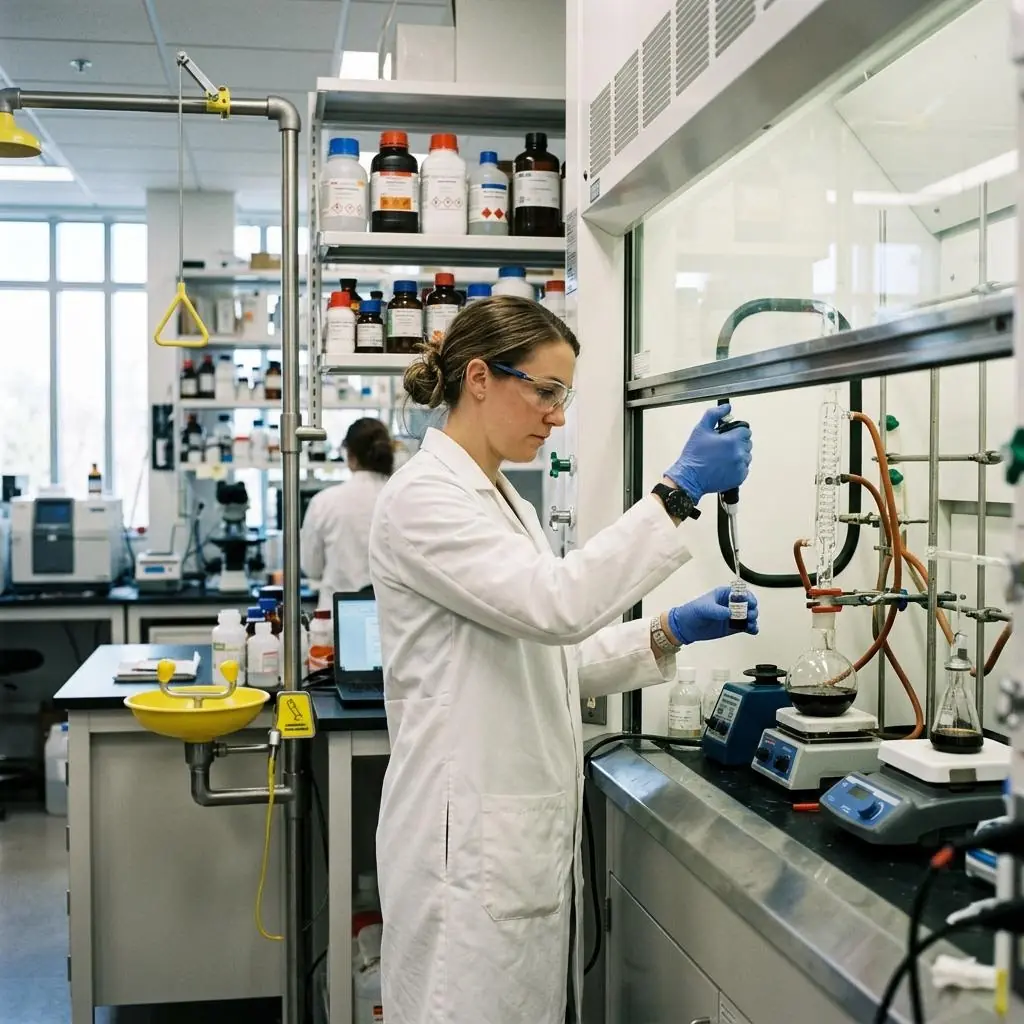
Laboratories accumulate safety hazards gradually — a fume hood sash left fully open when the hood is idle, incompatible chemicals sharing a storage cabinet because there was no room elsewhere, an eyewash station blocked by a cart moved during an experiment. OSHA's Laboratory standard (29 CFR 1910.1450) requires annual chemical hygiene plan reviews, but the day-to-day conditions that create real risk need more frequent monitoring than an annual audit provides.
The scanner reads visible conditions in bench areas, hood stations, chemical storage rooms, and lab corridors: the sash position on a working fume hood, whether secondary containment is in place for corrosives, whether the eyewash station is accessible and within reach of chemical-handling areas, and whether sharps containers are within capacity. It does not evaluate chemical hygiene plan content, exposure levels, or biological safety cabinet performance — those require a qualified industrial hygienist and certified equipment testing.
OSHA's occupational exposure to hazardous chemicals in laboratories standard (29 CFR 1910.1450), commonly called the Laboratory Standard, requires employers with laboratory-scale chemical use to develop and implement a written Chemical Hygiene Plan (CHP). The CHP must identify the laboratory's chemical hazards, the engineering controls and PPE required for specific operations, the procedures for working with particularly hazardous substances (carcinogens, reproductive toxins, highly acute toxins), the emergency procedures, and the training requirements. A Chemical Hygiene Officer must be designated to oversee the plan's implementation. The Lab Standard applies to research laboratories, university teaching labs, clinical laboratories, and any workplace where chemicals are used on a laboratory scale.
Fume hood face velocity is the most common laboratory engineering control, and OSHA expects fume hoods to be tested annually for adequate face velocity (typically 60–100 linear feet per minute). The sash position matters as much as the velocity reading: a hood with adequate flow at sash down can be ineffective when the sash is raised to work height. Chemical storage segregation — keeping incompatible chemicals physically separated, not just labeled — is the second most common laboratory citation area. Peroxide-forming chemicals (ethers, isopropanol, THF) require dated tracking and disposal before they exceed safe storage timeframes. State-plan states like California often impose additional requirements for specific chemical classes used in university and industrial labs.
Run through these steps before crews start — each one covers a visible gap the AI can help you catch.
Confirm every active fume hood has its sash at or below the marked working height, that the airflow indicator is functional and showing adequate flow, and that no volatile chemical work is happening outside a certified hood. Ventilation controls may relate to the laboratory standard, 29 CFR 1910.1450.
Walk the storage cabinets and confirm incompatibles are separated — acids from bases, oxidizers away from flammables — and that flammable liquids are in approved safety cabinets rather than shelved alphabetically. Improper storage and flammables may relate to 29 CFR 1910.106 and 1910.1450.
Check that each container, including secondary and waste containers, carries the chemical name, concentration, and hazard pictograms, and that satellite accumulation containers are closed and dated. Unlabeled containers may relate to hazard communication under 29 CFR 1910.1200.
Confirm eyewash stations are unobstructed and within 10 seconds of any chemical-handling area, flushed and logged weekly, and that emergency shower pull handles are accessible with clear floor space. Emergency equipment access may relate to 29 CFR 1910.151.
Photograph the bench, fume hood station, and chemical storage area and upload to OSHA Scan for an AI second pass. The scan flags visible hazards, references the OSHA standard each may relate to, and suggests a corrective action — a preliminary review a person still verifies on site. Free, no account needed (you may be asked for the free phone Access Pass).
The occupational-safety core of a laboratory inspection checklist, read from an image.
Incompatible chemicals stored together, unlabeled secondary containers, flammables outside approved safety cabinets, and chemicals stored above eye level without a step ladder.
Fume hoods operating with the sash above the working height mark, blocked eyewash stations, and emergency showers with obstructed pull cables.
Overfilled sharps containers, loose needles or broken glass on bench surfaces, and biohazard waste in unsealed or unlabeled bags.
Power strips on the floor in wet lab areas, damaged cords on analytical equipment, and outlets without GFCI protection near sinks and water lines.
Scan a photo like the one above and this is the report you get — score, findings, OSHA references, and fixes. It is an illustrative example, clearly marked — not live scan data.
Compliance score
83
Lower means more potential hazards found
Score uses visible confirmed findings only. Not a safety certification.
2 confirmed · 0 need review · 0 positive
1Chemical reagent bottles stored on open shelves above head height
Possibly related to hazard communication (29 CFR 1910.1200) and lab standard (29 CFR 1910.1450)
Observed condition: Glass reagent bottles stored high on open shelving can fall during retrieval or a bump — breakage above eye level sprays chemicals onto the face before anyone can react.
Corrective action: Move corrosives and solvents to shelving below shoulder height with lips or restraints; reserve high shelves for empty or inert containers.
High confidence
2Active work at the fume hood with the sash raised high
Possibly related to lab ventilation practices (29 CFR 1910.1450, ANSI Z9.5)
Observed condition: A raised sash reduces face velocity and containment — vapors escape into the operator's breathing zone, and the sash no longer acts as a blast shield.
Corrective action: Work with the sash at or below the marked working height; lower it fully when the hood is unattended; verify the hood's flow alarm is functional.
Medium confidenceNot fully clear from the photo — verify on site.
Upload a photo like the one above and get a compliance score and hazard count. No account needed to scan, though you may be asked for the free phone Access Pass — create a free account to unlock the full report.
Use the real site or facility name. If you save the scan after signup, it becomes the report name.
Three angles, one deeper scan
Only the wide shot is required — every extra angle gives the AI more places to look.
Required: Set the scene — one wide shot lets the AI sweep the whole area at once
Stand at the entry point and capture corner to corner: floors, ladders, scaffolds, and everyone at work
Drop a job-site photo or walkthrough video
Click to upload, drag & drop, or snap a photo on site. Photos scan free with no signup and no card — you may be asked for the free phone Access Pass. Video walkthroughs (up to 3 min) run on a free account.
Small habits, sharper scans
Set the scene
Start with context
Fill the frame
2–3 ft for close-ups; keep ladders, cords and workers fully in view.
Capture clearly
Make the frame usable
Light it right
Keep the sun or lights behind you — glare and shadows hide hazards.
Tap to focus
Tap the hazard on screen and hold still one second — blur can't be flagged.
Choose the useful view
Give the AI room to understand
Go landscape
Turn your phone sideways — a wider frame catches more of the scene.
Only upload photos you have permission to use, and avoid images showing personal, customer, or confidential information. Demo photos and results are held privately for up to 48 hours so you can save them to a free account; unclaimed photos are deleted automatically. Results are an AI-assisted preliminary review, not an official OSHA determination.
New: Video walkthrough scans
Record up to 3 minutes of your site — the AI extracts frames and categorizes findings with exact timestamps. Free account required.
Get the best results
Wide shot first
Stand at the entrance and photograph the entire work area so AI sees the full context
Hazard areas
Photograph elevated surfaces, equipment, electrical panels, and anywhere workers are active
Close-ups last
Move in close on anything damaged, missing, or that looks risky — the AI catches more detail
Walk bench areas, fume hood stations, chemical storage, and corridors with these points. The first four are free — create a free account to unlock the full checklist and scan your own lab photos.
Free checklist — 12 points
Enter your email to unlock the full checklist
Read the checklist here after entering your email. A free account is required to download the PDF.
One email with the checklist, one follow-up. Unsubscribe anytime.
OSHA Scan reads a single photo. That makes it fast and easy for anyone on site — but it also means it has real limits. Here's an honest look at both.
Snap a photo of the job site, and the AI categorizes findings against OSHA standards.
Each finding includes consistent corrective actions and structured JHA outputs. Check items off as your crew resolves them.
Every inspection gets a deterministic 0-100 compliance score derived from hazard severity, so you can track sites at a glance.
A prioritization aid based on recorded findings—not a certification or a complete measure of site safety.
Generate detailed inspection reports and export data to Excel for record-keeping and stakeholders.
A qualified person must review AI-flagged items before making safety decisions. Do not replace required comprehensive safety walkthroughs with AI reports. Features, limits, and downloads depend on your account’s plan and permissions.
Illustrative AI-assisted workflows. Review the findings; they are not a compliance certification.
A scan is a fast first look, not the final word. Before treating this kind of area as safe, a competent person should still confirm:
The primary standard is 29 CFR 1910.1450 (the Laboratory Standard / chemical hygiene), which requires a written Chemical Hygiene Plan, exposure monitoring, and specific provisions for particularly hazardous substances. Additional standards include hazard communication (1910.1200), means of egress (1910.37), and bloodborne pathogens (1910.1030) for biological labs. The scan references the most applicable standard for each visible finding.
Bench areas and fume hood stations should be checked at least weekly. Chemical storage rooms benefit from a monthly inspection. This sits between the formal EHS inspections and chemical hygiene plan reviews typically done annually — catching the everyday drift before it becomes a citation or incident.
No — chemical hygiene plan evaluation requires a qualified industrial hygienist reviewing written procedures, training records, and exposure data. OSHA Scan looks at visible, photo-detectable conditions: sash position, storage configuration, eyewash access, and container labeling.
Lab supervisors, principal investigators, and research coordinators can all run it as a routine check. The plain-language report with suggested fixes for each finding works without dedicated EHS support for the walk-through itself — though findings should be escalated to EHS when they involve chemical hygiene plan deviations.
Hazard communication (unlabeled containers and missing SDS), chemical hygiene plan deficiencies, means of egress violations, and inadequate PPE are consistently cited. Bloodborne pathogen violations are common in biological labs. The scan flags visible conditions associated with each of these categories.
Reviewed by OSHA Scan Editorial
This content is produced by the OSHA Scan Editorial team and reviewed with AI assistance. It is general safety information, not legal or compliance advice. OSHA Scan is an independent tool and is not affiliated with, endorsed by, or certified by OSHA or the U.S. Department of Labor.
More ways to see what an AI OSHA scan can do for your site.
The overview hub — how the scanner works and every job, site, and hazard it covers.
Chemical labeling, SDS, and HazCom compliance in labs and shops.
Flag missing or incorrect PPE in lab and industrial photos.
Sharps, biohazard waste, and exposure control in biological labs.
The full software platform behind every industry safety scan.
How AI-assisted audits compare to traditional safety audit programs.
Flammable-liquid storage, extinguishers, and egress for chemical-handling labs.
Build a living reagent inventory and SDS library from label scans.
See a complete labelled example of everything a scan returns.
Start with one lifetime use per eligible scan type — no credit card. Build JHA-ready reports and catch changing conditions sooner.
Start your free trial