
A Trench Cave-In Buries a Worker in Seconds
Catch the unprotected wall before it comes down
A single cubic yard of soil weighs as much as a small car, and an unprotected trench wall can collapse without warning, burying and crushing a worker before anyone can react. Cave-ins are the deadliest hazard in excavation work — and almost entirely preventable. OSHA Scan analyzes excavation photos to flag missing sloping, shoring, or shielding, unsafe spoil piles, and standing water before your crew steps down into the trench.
Free · No account needed to scan · Results in seconds
May relate to 29 CFR 1926.652
Weight of one cubic yard of soil
Depth that requires a protective system
Trench fatality rate vs. general construction
Typical time to get scan results
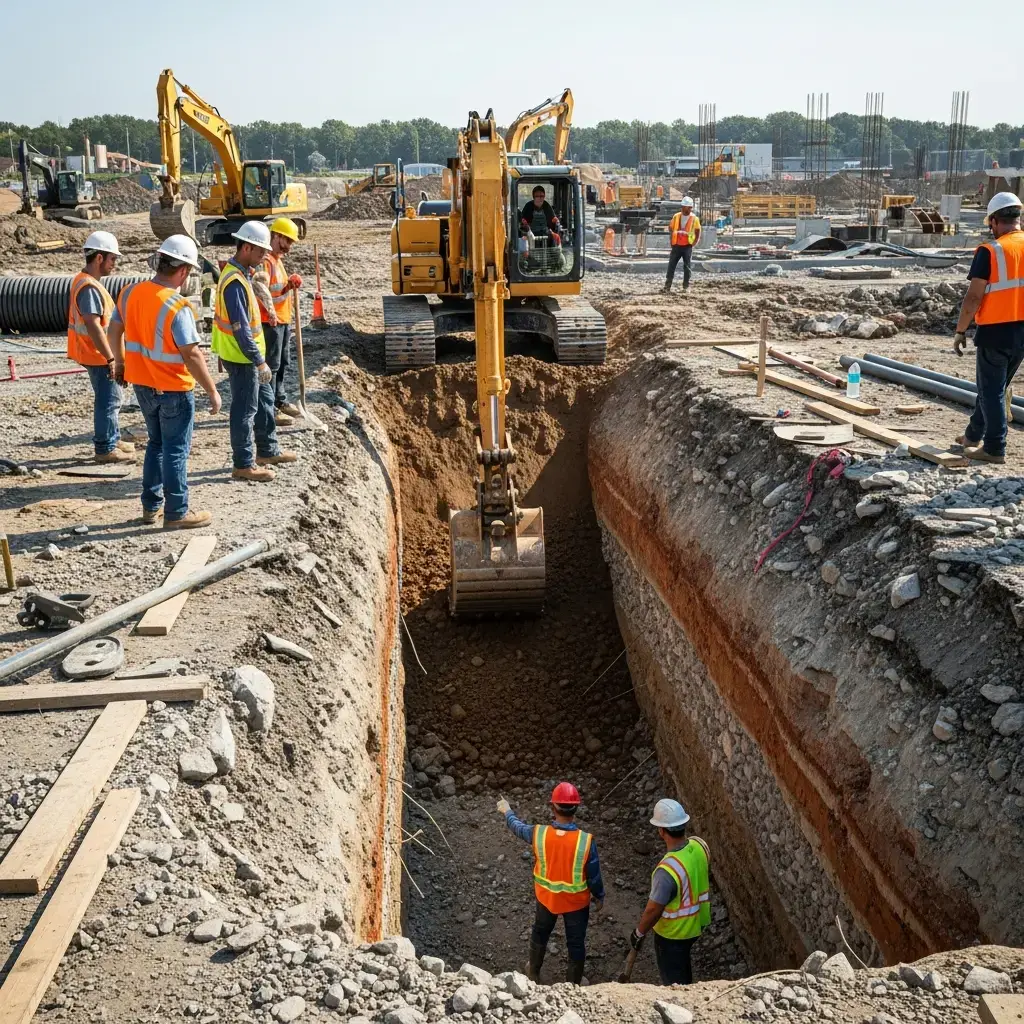
What this scenario looks like
A trench collapse is the sudden failure of an excavation wall, where soil breaks away and falls into the trench. OSHA requires a protective system — sloping, benching, shoring, or a trench shield (box) — in any trench five feet deep or more, and in shallower trenches where a competent person sees signs of instability.
On site the hazard shows up as vertical trench walls with no box or shoring, spoil piles heaped right at the edge, water pooling in the bottom, tension cracks running parallel to the trench, or previously disturbed soil that has been dug before. Vibration from nearby traffic or equipment and rain that saturates the soil make a marginal trench deadly.
The danger is that soil gives almost no warning. A wall can look solid all morning and fail in an instant — and a buried worker cannot dig out or breathe under thousands of pounds of dirt. That is why checking the trench with a photo before entry, every time, is critical.
A labelled example scan for this scenario
Here is what an OSHA Scan report looks like for trench collapse. It is an illustrative example built from this scenario's hazards — clearly marked, not live scan data.
Compliance score
64
Lower means more potential hazards found
3 potential hazards found
Trench Collapse
Confirmed violationCriticalPossibly related to Requirements for protective systems (29 CFR 1926.652)
Observed condition: A trench collapse is the sudden failure of an excavation wall, where soil breaks away and falls into the trench.
Corrective action: Use a trench shield (box) rated for the depth and soil type
High confidence
Trench Collapse: Specific excavation requirements
Needs reviewHighPossibly related to Specific excavation requirements (29 CFR 1926.651)
Observed condition: Covers utility location, spoil-pile setback, access and egress, atmospheric testing, water accumulation, and daily inspection by a competent person.
Corrective action: Shore trench walls with hydraulic or timber shoring where boxes cannot fit
Medium confidenceNot fully clear from the photo — verify on site.
Trench Collapse: Scope, application, and definitions
Confirmed violationMediumPossibly related to Scope, application, and definitions (29 CFR 1926.650)
Observed condition: Defines excavation and trenching terms and the role of the competent person responsible for classifying soil and authorizing protective systems.
Corrective action: Slope or bench walls to the angle required for the soil class
High confidence
See the workflow click into place
Illustrative AI-assisted workflows. Review the findings; they are not a compliance certification.
Why this scenario matters
Immediate consequences
A cave-in buries workers in seconds under crushing weight, causing suffocation, chest compression, and traumatic injury. Rescue is extremely difficult and often fatal despite fast response.
Legal & financial impact
Excavation and trenching are a National Emphasis Program for OSHA. A serious violation runs over $16,000, willful violations exceed $160,000, and a trench fatality frequently leads to criminal referral.
Operational impact
A collapse halts the project, triggers an OSHA investigation, and can bury equipment and utilities. Rescue and recovery, rework, and insurance spikes can dwarf the cost of a trench box.
Industry-specific concerns
Utility, pipeline, sewer, water, and foundation crews dig trenches daily, often under tight schedules that tempt teams to skip the box on a 'quick' job — the exact conditions where cave-ins kill.
How OSHA Scan detects this hazard
OSHA Scan uses an AI vision model to assess excavation hazards. Upload a photo of your trench and it identifies whether a protective system is in place, checks spoil-pile setback and standing water, flags unshored or unsloped walls and visible tension cracks with a severity rating, and cites the OSHA standard it may relate to — before any worker enters.
Analyze your first photo freeScan a photo for trench collapse now
Upload a real job-site photo and OSHA Scan detects visible hazards in seconds — no account needed to run your first scan.
- A flagged list of cave-in hazards in frame: unshored walls, edge spoil, pooled water
- The excavation standard like 29 CFR 1926.652 each visible hazard may relate to
- A dated report with a suggested trench-box or sloping fix, exportable to PDF or Excel
Use the real site or facility name. If you save the scan after signup, it becomes the report name.
Three angles, one deeper scan
Only the wide shot is required — every extra angle gives the AI more places to look.
Required: Set the scene — one wide shot lets the AI sweep the whole area at once
Stand at the entry point and capture corner to corner: floors, ladders, scaffolds, and everyone at work
Drop a job-site photo or walkthrough video
Click to upload, drag & drop, or snap a photo on site. Photos scan free in about 15 seconds — no signup, no card. Video walkthroughs (up to 3 min) run on a free account.
Accuracy boosters
Small habits, sharper scans
Set the scene
Start with context
Fill the frame
2–3 ft for close-ups; keep ladders, cords and workers fully in view.
Capture clearly
Make the frame usable
Light it right
Keep the sun or lights behind you — glare and shadows hide hazards.
Tap to focus
Tap the hazard on screen and hold still one second — blur can't be flagged.
Choose the useful view
Give the AI room to understand
Go landscape
Turn your phone sideways — a wider frame catches more of the scene.
Only upload photos you have permission to use, and avoid images showing personal, customer, or confidential information. Demo photos and results are held privately for up to 48 hours so you can save them to a free account; unclaimed photos are deleted automatically. Results are an AI-assisted preliminary review, not an official OSHA determination.
New: Video walkthrough scans
Record up to 3 minutes of your site — the AI extracts frames and categorizes findings with exact timestamps. Free account required.
Get the best results
Wide shot first
Stand at the entrance and photograph the entire work area so AI sees the full context
Hazard areas
Photograph elevated surfaces, equipment, electrical panels, and anywhere workers are active
Close-ups last
Move in close on anything damaged, missing, or that looks risky — the AI catches more detail
A 'quick' service line with no trench box
The situation
A two-person crew was tapping a water service line in a seven-foot trench. Believing the job would take only fifteen minutes, they skipped the trench box and stacked the spoil pile right at the trench lip to save time.
What went wrong
As one worker knelt at the bottom to make the connection, the vertical wall — loaded by the spoil pile and softened by an overnight rain — sheared off and buried him to the chest. It took responders over an hour to free him, and he suffered crushing internal injuries.
How OSHA Scan would have prevented it
A single photo of the open trench run through OSHA Scan before entry would have flagged the unshored seven-foot wall and the spoil pile at the edge as critical cave-in hazards, cited 29 CFR 1926.652, and prompted the crew to install a trench box and set the spoil back before anyone climbed down.
Lessons learned
The 'quick job' with no protective system is where trench workers die. Every trench five feet or deeper needs a protective system every time — a fast photo scan confirms it is in place before entry.
Prevention best practices
Layered controls, from most to least effective.
Engineering controls
Physically prevent the trench wall from reaching or crushing workers.
- Use a trench shield (box) rated for the depth and soil type
- Shore trench walls with hydraulic or timber shoring where boxes cannot fit
- Slope or bench walls to the angle required for the soil class
- Provide a ladder or ramp within 25 feet of every worker in a trench 4 feet or deeper
- Keep spoil piles and equipment at least 2 feet back from the trench edge
Administrative controls
Enforce the inspection and entry rules that keep trenches safe.
- Have a competent person inspect the trench before every entry and after rain
- Classify the soil and select the correct protective system
- Test the atmosphere in trenches deeper than 4 feet where hazardous air is possible
- Locate and de-energize underground utilities before digging
- Never allow entry into an unprotected trench for any reason
Personal protective equipment
Protection for workers in and around the excavation.
- High-visibility apparel around excavation equipment and traffic
- Hard hats for falling-object and struck-by protection in the trench
- Slip-resistant boots for muddy trench conditions
- Fall protection where workers cross or work above open excavations
OSHA compliance & citations
The federal standards this hazard may relate to.
Requirements for protective systems
Requires a protective system — sloping, benching, shoring, or shielding — for workers in trenches 5 feet or deeper, based on soil classification and site conditions.
Up to $16,550 per serious violation; $165,514 for willful or repeat
Specific excavation requirements
Covers utility location, spoil-pile setback, access and egress, atmospheric testing, water accumulation, and daily inspection by a competent person.
Up to $16,550 per serious violation
Scope, application, and definitions
Defines excavation and trenching terms and the role of the competent person responsible for classifying soil and authorizing protective systems.
Up to $16,550 per serious violation
Incident response protocol
If an incident occurs, act fast and in order.
Immediate actions (first 5 minutes)
- 1Call 911 and request trench-rescue-trained responders
- 2Do NOT enter the trench to dig by hand — secondary collapse is likely
- 3Stop all equipment and traffic vibration near the trench
- 4Keep the buried worker's airway clear if reachable from stable ground
- 5Assign someone to direct emergency responders to the exact location
Emergency response (5-30 minutes)
- 1Cooperate fully with trench-rescue teams and follow their direction
- 2Provide soil, depth, and utility information to responders
- 3Account for all other workers and clear the excavation zone
- 4Prevent bystanders from adding load near the trench edge
- 5Document the scene once rescue operations allow
Post-incident
- 1Notify OSHA within 8 hours for a fatality, or 24 hours for a hospitalization
- 2Launch an incident investigation within 24 hours
- 3Preserve the excavation, spoil pile, and protective equipment as evidence
- 4Interview witnesses and the competent person while details are fresh
- 5Review and update excavation procedures and retrain the crew
Team training module
Workers will understand how trench cave-ins occur, recognize unsafe excavation conditions, and verify that a correct protective system is in place before entering any trench.
Train before any excavation work, refresh annually, and reinforce with a toolbox talk before each dig using real photos of protected and unprotected trenches.
Training topics
- How cave-ins occur and their consequences
- OSHA depth triggers for protective systems
- Soil classification basics (Type A, B, C)
- Sloping, benching, shoring, and shielding methods
- Spoil-pile setback and load on trench walls
- Safe access and egress requirements
- Recognizing tension cracks, water, and previously dug soil
- Utility location before digging
- The competent person's inspection role
- Emergency response and why never to enter to dig by hand
Compliance checklist
Run these checks to stay ahead of citations.
Daily pre-work inspection
- Competent person has inspected the trench before entry
- Protective system in place for depth and soil type (box, shoring, or slope)
- Spoil pile and equipment set back at least 2 feet from the edge
- Ladder or ramp within 25 feet of workers in the trench
- Underground utilities located and marked
- No standing water; dewatering in place if needed
- Atmosphere tested where hazardous air is possible
- No visible tension cracks or wall sloughing
Unlock the full Trench Collapse checklist
10 more checklist points are waiting. Register with your email to reveal every item and download the complete OSHA compliance checklist as a printable PDF. Free, and it only takes a few seconds.
Already have an account? Sign in
Frequently asked questions
At what depth does OSHA require trench protection?
OSHA requires a protective system in any trench 5 feet or deeper (29 CFR 1926.652), and in shallower trenches when a competent person identifies signs of a potential cave-in. Trenches 20 feet or deeper require a registered professional engineer's design.
What are the accepted protective systems for a trench?
Sloping or benching the walls, shoring with hydraulic or timber supports, and shielding with a trench box are the accepted systems. The choice depends on soil classification, depth, and site conditions.
How far back must the spoil pile be from the trench?
Excavated soil, equipment, and materials must be kept at least 2 feet back from the trench edge to reduce the load on the wall and prevent material from rolling back into the trench.
Why is a trench so dangerous even at shallow depths?
Soil is extremely heavy — a cubic yard weighs about 3,000 pounds. Even a partial collapse can pin and suffocate a worker, and cave-ins happen with almost no warning, giving no time to escape.
Who must inspect a trench and how often?
A designated competent person must inspect the excavation, adjacent areas, and protective systems before each shift, after any rainstorm, and whenever conditions change. Work must stop if hazards are found.
What are the OSHA penalties for an unprotected trench?
A serious violation of 29 CFR 1926.652 can cost over $16,000, and willful or repeat violations can exceed $165,000 per instance. Trenching is an OSHA National Emphasis Program with heightened enforcement.
Does rain change the safety of a trench?
Yes. Rain saturates soil, adds weight, and reduces stability, greatly increasing cave-in risk. Trenches must be re-inspected by a competent person after any rain before workers re-enter.
How accurate is OSHA Scan at detecting trench hazards?
OSHA Scan flags unprotected trench walls. It checks for protective systems, spoil-pile setback, and standing water, returning the location and OSHA citation.
Protect your excavation crew today
Analyze a photo
Upload a photo of your trench and get instant, specific feedback on protective systems, spoil piles, and wall stability.
Get startedGet the prevention checklist
Put our expert excavation checklist to work on your next dig to stay ahead of cave-ins and citations.
Get startedTalk to our team
See how OSHA Scan fits your utility or foundation operation and get recommendations for your specific work.
Get startedJoin safety-first excavators
See how other trenching crews use OSHA Scan to confirm protection before anyone enters the trench.
Get startedAI photo hazard review
Snap a photo of the job site, and the AI categorizes findings against OSHA standards in seconds.
Consistent corrective actions & JHA
Each finding includes consistent corrective actions and structured JHA outputs. Check items off as your crew resolves them.
Emergency action plans
Access jurisdiction-specific guidelines and emergency action plan templates for your sites.
A qualified person must review AI-flagged items before making safety decisions. Do not replace required comprehensive safety walkthroughs with AI reports. Features, limits, and downloads depend on your account’s plan and permissions.
What the AI can and can't detect
OSHA Scan reads a single photo. That makes it fast and easy for anyone on site — but it also means it has real limits. Here's an honest look at both.
What it can catch from a photo
- Missing or incorrect PPE that is visible in the frame
- Unprotected edges, open holes, and visible fall hazards
- Housekeeping, trip, and blocked walkway or exit hazards
- Visible electrical, struck-by, and equipment-guarding hazards
What a photo can't tell it
- Hazards hidden from view or anything outside the photo
- Exact heights, distances, weights, or measurements
- Training records, procedures, or how equipment is actually used
- Full legal compliance or an official OSHA pass/fail determination
Reviewed by OSHA Scan Editorial
This content is produced by the OSHA Scan Editorial team and reviewed with AI assistance. It is general safety information, not legal or compliance advice. OSHA Scan is an independent tool and is not affiliated with, endorsed by, or certified by OSHA or the U.S. Department of Labor.
Ready to catch hazards before they become incidents?
Start with exactly 5 lifetime AI site scans — no credit card. Build JHA-ready reports and catch changing conditions sooner.
Start your free trial