
Secondary container labeling requirements — spray bottles, buckets, and the narrow exception
When you transfer a hazardous chemical out of its original container into a spray bottle, bucket, or day tank, OSHA requires that new container to carry a workplace label with the product identifier and the chemical's hazard information — either GHS-style words, pictograms, and statements, or your own consistent in-house system all workers are trained on. There's one narrow exception: a portable container filled by one worker for their own use within that same shift needs no label. The moment it's set down, left for the next shift, or handed off, the exception is gone. OSHA Scan can generate printable chemical safety signs for storage points from scanned label data — but small transfer containers still need a physical label the app doesn't print.
Free · No account needed to scan · You may be asked for the free phone Access Pass
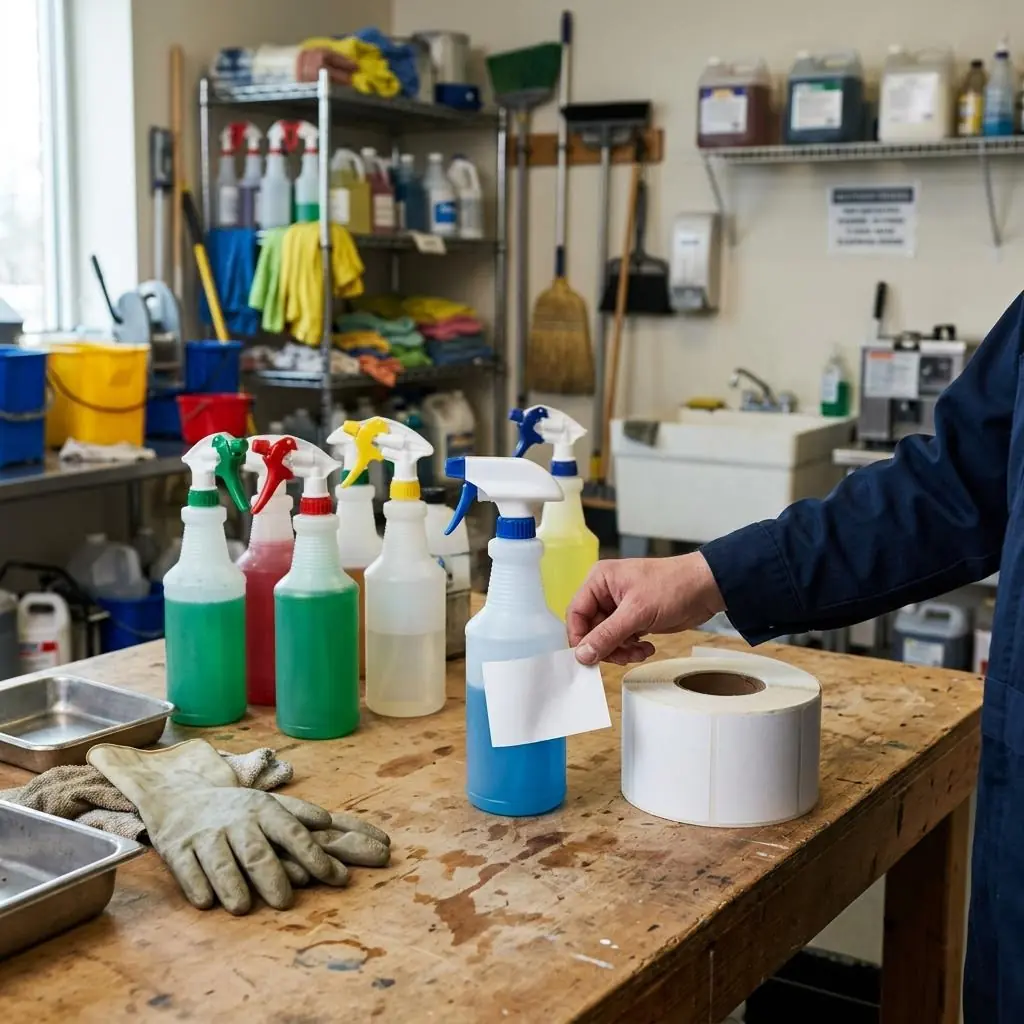
Spray bottles, buckets, and day tanks are where the labeling program quietly breaks
Secondary containers are the most-cited labeling gap in HazCom, and it's easy to see why. A worker pours degreaser from a labeled drum into a spray bottle to clean a machine, grabs a bucket of diluted sanitizer to mop a floor, or fills a day tank at the start of a run. In each case the original label — with all its hazard information — stays on the drum, and the new container heads off to the point of use with nothing on it. Multiply that across a shift and you have a shop full of unmarked bottles where nobody but the person who filled them knows what's inside. That's both a citation and a genuine exposure risk: an unidentified liquid is exactly what a coworker or a first responder can't safely handle.
The rule itself is straightforward. A secondary container needs a workplace label showing the product identifier and the chemical's hazard information. You can use full GHS elements, or an in-house system — color codes, numbers, words — as long as it conveys the hazards and every worker is trained on what it means. The confusion is almost always about the exception, which is far narrower than people assume: it covers only a portable container filled by one worker for that worker's immediate use during their own shift. Leave it on the bench overnight, hand it to the next person, or walk away from it, and it needs a label. OSHA Scan helps at the storage end — scan a product's label and it can generate a printable chemical safety sign for the cabinet or day tank — but it does not print bottle-sized stickers, so the small transfer containers still get labeled by hand from the checklist below.
HazCom's workplace labeling requirement: what 29 CFR 1910.1200(f) actually mandates
OSHA's Hazard Communication Standard at 29 CFR 1910.1200(f)(6) requires that any container of hazardous chemicals in the workplace — including secondary or transfer containers — be labeled with the product identifier and hazard information sufficient to warn workers of the chemical's hazards. The standard gives employers flexibility in format: full GHS-aligned labels (signal word, pictograms, hazard and precautionary statements) are one option, but an in-house labeling system that conveys the same hazard information is also acceptable provided it is used consistently and workers are trained on what each element means. What is not acceptable is a blank container, a container labeled only with a vague name like 'cleaner,' or a container that relies on workers' memory of what was poured into it.
Secondary container labeling is one of the most frequently cited HazCom violations because the gap is ubiquitous and easy to observe: unlabeled spray bottles on cleaning carts, unmarked jugs under maintenance sinks, and generic containers at mixing stations all appear in virtually every facility that uses chemical products. The immediate-use exception under 29 CFR 1910.1200(f)(8) — which allows a container to go unlabeled only when a single employee fills it for their own immediate personal use — is narrow enough that most real-world secondary containers do not qualify. OSHA inspectors are trained to ask workers directly — 'what is in that bottle and what are its hazards?' — as a test of whether the labeling system is actually working.
The enforcement gap between labeling intent and practice
Secondary container labeling citations often involve conditions that safety managers know about and intend to address — it is one of the few OSHA violation categories where the gap between written program requirements and floor practice is visible, acknowledged, and persistent. Written HazCom programs routinely specify that all secondary containers must be labeled before use. The floor reality in many facilities is a supply of blank spray bottles that get filled from labeled drums because there are no labels readily available at the fill station, or because applying a label is seen as a slow-down in a task someone is doing quickly. The compliance gap is a supply-and-habit problem, not an intent problem.
The most effective secondary container labeling programs address both sides of the gap: a supply of pre-printed or blank-but-available workplace labels at every fill station removes the friction, and a regular sweep for orphan containers ensures that bottles that were labeled correctly but had labels degrade or fall off in service are caught before they become a citation. Photo-based identification of unlabeled containers during routine inspection rounds catches the bottles that have drifted out of compliance between formal audits — exactly the condition that OSHA compliance officers find most frequently when they walk manufacturing floors and cleaning operations.
Secondary container labeling: step by step
Run through these steps before crews start — each one covers a visible gap the AI can help you catch.
- 1
Decide if the exception applies
Ask three questions: did one worker fill it, for their own immediate use, and will it be gone within their shift? Only a yes to all three skips the label. For anything shared, stored, or handed off, keep going.
- 2
Identify the chemical and its hazards
Scan the source container's label with OSHA Scan to capture the product name, signal word, and GHS pictograms, so the workplace label carries accurate hazard information back to the right SDS.
- 3
Choose your labeling system
Use full GHS elements, or a consistent in-house system of colors, numbers, or words — whichever you pick, apply it the same way everywhere and make sure workers are trained on it.
- 4
Apply a durable workplace label
Put the product identifier and hazard information on the secondary container with a label that resists the chemical it holds, so it won't dissolve, smear, or peel off in service.
- 5
Sign the storage points
Generate a printable chemical safety sign from the scanned label data for the cabinet, day tank, or reservoir the container is filled from, so the fixed hazard is marked even when bottles come and go.
- 6
Sweep for orphan containers
Walk the area on a schedule for unlabeled or faded containers — the bottle in the corner, the jug under the sink — and label or dispose of each one before it becomes an unidentified liquid.
Labeling problems the scanner and signs help you address
What OSHA Scan does with a chemical label, and the visible workplace-labeling gaps a photo can flag.
Unlabeled transfer containers
A photo can flag spray bottles, buckets, and jugs with no visible label — the classic secondary-container gap 1910.1200(f)(6) exists to close.
Faded or handwritten labels
Labels too worn, splashed, or vaguely hand-scrawled to convey the product identifier and hazard information get flagged for replacement.
Printable safety signs from scans
Scan a product's label and OSHA Scan reads the product name, signal word, and pictograms to generate a printable chemical safety sign for the storage point, cabinet, or day tank.
What stays manual
The app generates signs for fixed locations, not bottle-sized stickers — small transfer containers still need a physical workplace label you apply by hand.
Demo: the library entry a scanned label comes back with
An illustrative example for this trade — product identity, signal word, GHS pictograms, and hazard statements, filed and searchable.
Xylene solvent thinner (decanted into a spray bottle)
Example manufacturer
The unlabeled spray bottle someone filled from the drum is the exact secondary container that needs product identity and hazard words before it leaves your hand.
- H226 — Flammable liquid and vapour
- H312+H332 — Harmful in contact with skin or if inhaled
Now scan your own label — free
Photograph any chemical product on your shelf. The AI transcribes the label — no account needed to try it, though you may be asked for the free phone Access Pass.
- A scan that reads product, signal word, and pictograms from a label
- Printable chemical safety signs for storage points from that data
- A checklist for what every workplace label and transfer container needs
One lifetime free label scan
The 11-point secondary container labeling checklist
Everything a workplace label needs and exactly how narrow the same-shift exception is. The first four are free — create a free account or leave your email to unlock the rest and generate safety signs for your storage points.
Free checklist — 11 points
Enter your email to unlock the full checklist
Read the checklist here after entering your email. A free account is required to download the PDF.
One email with the checklist, one follow-up. Unsubscribe anytime.
What the AI can and can't detect
OSHA Scan reads a single photo. That makes it fast and easy for anyone on site — but it also means it has real limits. Here's an honest look at both.
What it can catch from a photo
- Transfer containers with no visible label in the photo
- Faded, splashed, or handwritten labels that no longer convey hazards
- Whether a storage point has hazard signage in frame
- Product name, signal word, and pictograms readable from a label scan
What a photo can't tell it
- Whether a container qualifies for the same-shift exception
- Whether an in-house labeling system is taught to every worker
- The chemical identity inside an unlabeled container
- Whether the label's hazard information matches the actual contents
SDS digital library
Build a searchable chemical library from label photos. Review manufacturer SDS matches when available and follow the status of missing documents.
Missing-document requests enter a review queue; they do not automatically contact suppliers.
Job-site locations
Organize inspections by location and compare safety performance across every site you manage.
Team roles & permissions
Invite admins, managers, and supervisors with role-based access that keeps the right people in control.
A qualified person must review AI-flagged items before making safety decisions. Do not replace required comprehensive safety walkthroughs with AI reports. Features, limits, and downloads depend on your account’s plan and permissions.
See the workflow click into place
Illustrative AI-assisted workflows. Review the findings; they are not a compliance certification.
Always confirmed by a person on site
A scan is a fast first look, not the final word. Before treating this kind of area as safe, a competent person should still confirm:
- Confirm each transfer container's label matches what's actually inside it
- Check that any in-house labeling system has a legend and trained workers
- Verify shared-station and stored bottles are labeled, not treated as same-shift
- Walk for orphan containers in closets, under sinks, and on carts
People also ask
Do I have to label a spray bottle I filled from a labeled drum?
In almost every case, yes. Transferring a hazardous chemical into a secondary container triggers the workplace-labeling requirement: the bottle needs the product identifier and the chemical's hazard information. The only time you can skip it is the same-shift exception — you filled it yourself, for your own immediate use, and it won't outlast your shift. A bottle at a shared cleaning station, one you set down and walk away from, or one the next shift will use does not qualify and must be labeled.
What exactly does a secondary container label have to say?
Two things: the product identifier (so it ties back to the SDS and inventory) and the chemical's hazard information. You can meet the hazard part with full GHS elements — signal word, pictograms, hazard statements — or with an in-house system like color codes or numbers, provided the system is used consistently and every worker is trained on what it means. What you can't do is leave the container blank or write a vague product name with no hazard information at all.
How narrow is the same-shift labeling exception really?
Very narrow. It applies only to a portable container into which a chemical is transferred from a labeled container, and only when it's intended for the immediate use of the employee who performed the transfer, within that work shift. That means one person, their own use, their own shift. Hand the bottle to a coworker, leave it for the next shift, or set it down unattended and the exception evaporates — the container now needs a label. Because so few real-world containers meet all three conditions, the safe default is to label everything.
Can OSHA Scan print the labels for my spray bottles?
Not for the bottles themselves — and it's worth being clear about that. OSHA Scan reads a product's label from a photo and can generate a printable chemical safety sign for a storage point like a cabinet, day tank, or reservoir. It does not print bottle-sized stickers, so your small transfer containers still get a physical workplace label applied by hand. Use the app to sign the storage areas and build the chemical library, and keep label stock at each fill station for the containers themselves.
Reviewed by OSHA Scan Editorial
This content is produced by the OSHA Scan Editorial team and reviewed with AI assistance. It is general safety information, not legal or compliance advice. OSHA Scan is an independent tool and is not affiliated with, endorsed by, or certified by OSHA or the U.S. Department of Labor.
Keep exploring
More ways to see what an AI OSHA scan can do for your site.
The AI OSHA inspection tool
The overview hub — how the scanner works and every job, site, and hazard it covers.
SDS scanner & chemical library
Scan labels to capture the hazard data your workplace labels and signs draw from.
Improper chemical labeling scenario
How an unlabeled transfer container turns into a real exposure incident.
Hazard communication checklist
The full HazCom chain that container labeling is one link in.
How to read an SDS
Where the hazard information on your workplace labels actually comes from.
OSHA 1910.1200 App C — Allocation of Label Elements
OSHA's mandatory appendix defining the GHS label elements referenced here.
Official resource — osha.govA full sample report
See a complete labelled example of everything a scan returns.
Related OSHA program guides
Ready to secure your job sites?
Start with one lifetime use per eligible scan type — no credit card. Build JHA-ready reports and catch changing conditions sooner.
Start your free trial