
The Wrong Label Sends Workers Into the Wrong Hazard
If the container lies, the crew pays for it
A mislabeled or unlabeled chemical container is a trap: a worker grabs what they think is water and gets acid, or uses a solvent near an ignition source because no pictogram warned them. OSHA's Hazard Communication Standard requires every container to carry accurate GHS information, and OSHA Scan reviews your photos to read labels, flag missing pictograms and signal words, and catch unmarked secondary containers before they cause harm.
Free · No account needed to scan · Results in seconds
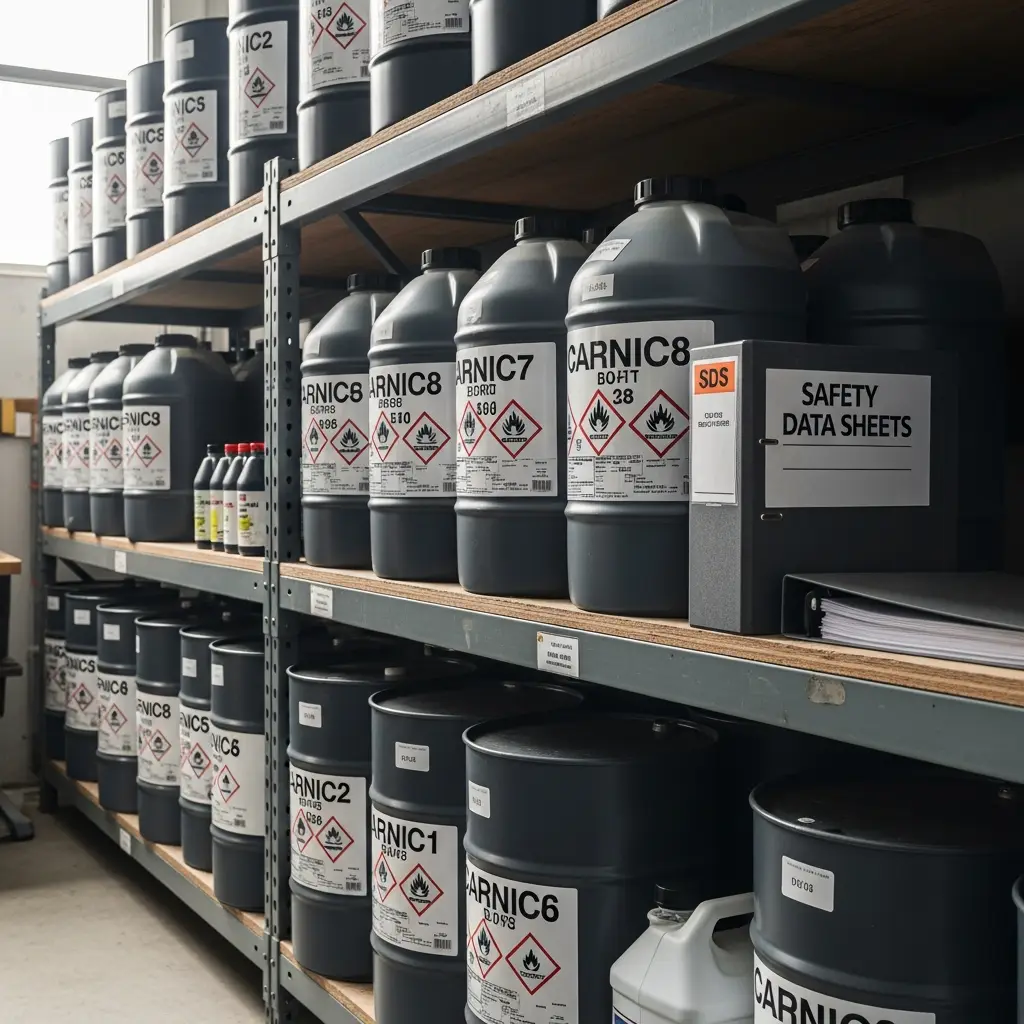
May relate to 29 CFR 1910.1200(f)
HazCom is OSHA's second most-cited standard
Per serious labeling violation
GHS elements required on every label
Typical time to get scan results
What this scenario looks like
Improper chemical labeling is any container of a hazardous chemical that lacks the required GHS information or carries information that is wrong, faded, or contradictory. A compliant label needs the product identifier, signal word, hazard statements, precautionary statements, pictograms, and the supplier identification — all legible and matching the contents.
On real sites this shows up as a spray bottle of degreaser labeled only 'cleaner,' a drum whose original label has weathered to nothing, or a secondary container filled from a bulk supply with no marking at all. It also appears when a container is reused for a different chemical but the old label is left in place, actively misleading anyone who reads it.
The hazard is that workers trust the label. A missing pictogram means no warning about flammability or corrosivity; a wrong label means confident handling of the wrong substance. Because the mistake is baked into the container itself, it travels with the chemical wherever it goes — which is exactly why reading and verifying labels from photos is so effective.
A labelled example scan for this scenario
Here is what an OSHA Scan report looks like for improper chemical labeling. It is an illustrative example built from this scenario's hazards — clearly marked, not live scan data.
Compliance score
64
Lower means more potential hazards found
3 potential hazards found
Improper Chemical Labeling
Confirmed violationCriticalPossibly related to Labels and other forms of warning (29 CFR 1910.1200(f))
Observed condition: Improper chemical labeling is any container of a hazardous chemical that lacks the required GHS information or carries information that is wrong, faded, or contradictory.
Corrective action: Use pre-printed GHS labels with all six required elements for common chemicals
High confidence
Improper Chemical Labeling: Safety data sheets
Needs reviewHighPossibly related to Safety data sheets (29 CFR 1910.1200(g))
Observed condition: Requires a current SDS for each hazardous chemical that matches the label and is readily accessible to employees in their work area.
Corrective action: Apply chemical- and weather-resistant labels that survive the work environment
Medium confidenceNot fully clear from the photo — verify on site.
Improper Chemical Labeling: Employee information and training
Confirmed violationMediumPossibly related to Employee information and training (29 CFR 1910.1200(h))
Observed condition: Requires training on how to read and interpret GHS labels and pictograms and how to respond to the hazards they communicate.
Corrective action: Provide labeled, dedicated secondary containers for each transferred chemical
High confidence
See the workflow click into place
Illustrative AI-assisted workflows. Review the findings; they are not a compliance certification.
Why this scenario matters
Immediate consequences
A worker relying on a wrong or missing label can be splashed, poisoned, or ignite a flammable without warning. Emergency responders may also apply the wrong treatment or suppression method.
Legal & financial impact
Container labeling failures are among the most common HazCom citations. Serious violations exceed $16,000 each, and repeated labeling gaps across a site can compound into willful penalties past $165,000.
Operational impact
Mislabeled chemicals can shut down chemical operations during an inspection, force a full relabeling effort, and expose weak links between the container, the SDS, and the inventory.
Industry-specific concerns
Painting, cleaning, manufacturing, and maintenance crews constantly transfer chemicals into spray bottles and buckets, making unlabeled secondary containers one of the most persistent labeling problems.
How OSHA Scan detects this hazard
OSHA Scan uses an AI vision model to read the labels in your photos and check them against the standard. It detects missing signal words and pictograms, flags faded or contradictory text, spots unmarked secondary containers, and cites 29 CFR 1910.1200 — so labeling gaps surface during a quick photo review instead of during an exposure.
Analyze your first photo freeScan a photo for improper chemical labeling now
Upload a real job-site photo and OSHA Scan detects visible hazards in seconds — no account needed to run your first scan.
- Container labels read for missing pictograms, signal words, and unmarked bottles
- 29 CFR 1910.1200 cited for each labeling gap the photo may relate to
- A dated, scored HazCom label report you can save and export to Excel
Use the real site or facility name. If you save the scan after signup, it becomes the report name.
Three angles, one deeper scan
Only the wide shot is required — every extra angle gives the AI more places to look.
Required: Set the scene — one wide shot lets the AI sweep the whole area at once
Stand at the entry point and capture corner to corner: floors, ladders, scaffolds, and everyone at work
Drop a job-site photo or walkthrough video
Click to upload, drag & drop, or snap a photo on site. Photos scan free in about 15 seconds — no signup, no card. Video walkthroughs (up to 3 min) run on a free account.
Accuracy boosters
Small habits, sharper scans
Set the scene
Start with context
Fill the frame
2–3 ft for close-ups; keep ladders, cords and workers fully in view.
Capture clearly
Make the frame usable
Light it right
Keep the sun or lights behind you — glare and shadows hide hazards.
Tap to focus
Tap the hazard on screen and hold still one second — blur can't be flagged.
Choose the useful view
Give the AI room to understand
Go landscape
Turn your phone sideways — a wider frame catches more of the scene.
Only upload photos you have permission to use, and avoid images showing personal, customer, or confidential information. Demo photos and results are held privately for up to 48 hours so you can save them to a free account; unclaimed photos are deleted automatically. Results are an AI-assisted preliminary review, not an official OSHA determination.
New: Video walkthrough scans
Record up to 3 minutes of your site — the AI extracts frames and categorizes findings with exact timestamps. Free account required.
Get the best results
Wide shot first
Stand at the entrance and photograph the entire work area so AI sees the full context
Hazard areas
Photograph elevated surfaces, equipment, electrical panels, and anywhere workers are active
Close-ups last
Move in close on anything damaged, missing, or that looks risky — the AI catches more detail
An unmarked secondary container of acid
The situation
A maintenance worker decanted a strong descaling acid from a bulk drum into an unlabeled clear bottle to carry it to a cleaning job across the facility. The bottle looked identical to the ones the crew used for water.
What went wrong
A second worker, thirsty and in a hurry, grabbed the bottle believing it was water and splashed acid on his hands and face when he opened it. Without a label, no pictogram or signal word warned him of the corrosive contents.
How OSHA Scan would have prevented it
A photo of the staging bench run through OSHA Scan would have flagged the unlabeled secondary container as a likely HazCom concern, referencing 29 CFR 1910.1200, and prompted the crew to apply a compliant label with the product identifier and corrosive pictogram before the bottle left the area.
Lessons learned
Secondary containers are where labeling quietly fails. Any chemical transferred out of its original packaging must be labeled immediately, and a quick photo audit of work benches catches the unmarked ones before someone trusts the wrong bottle.
Prevention best practices
Layered controls, from most to least effective.
Engineering controls
Design containers and labels so the hazard is always visible and durable.
- Use pre-printed GHS labels with all six required elements for common chemicals
- Apply chemical- and weather-resistant labels that survive the work environment
- Provide labeled, dedicated secondary containers for each transferred chemical
- Color-code storage areas to match hazard classes and reduce mix-ups
Administrative controls
Build labeling into every chemical transfer and inspection routine.
- Require immediate labeling of any secondary container before it leaves the fill point
- Verify each label against the SDS and chemical inventory
- Inspect containers for faded, damaged, or contradictory labels each shift
- Remove or overwrite old labels when a container is repurposed
- Train workers to never use an unlabeled or unclear container
Personal protective equipment
Protect workers who handle and label hazardous chemicals.
- Chemical-resistant gloves suited to the products being transferred
- Splash goggles or a face shield when decanting hazardous liquids
- An apron or chemical-resistant clothing for corrosives
- Inspect PPE before each transfer and replace any degraded gear
OSHA compliance & citations
The federal standards this hazard may relate to.
Labels and other forms of warning
Requires each container of hazardous chemicals to be labeled with the product identifier, signal word, hazard and precautionary statements, pictograms, and supplier information, and requires workplace labeling of secondary containers.
Up to $16,550 per serious violation; $165,514 for willful or repeat
Safety data sheets
Requires a current SDS for each hazardous chemical that matches the label and is readily accessible to employees in their work area.
Up to $16,550 per serious violation
Employee information and training
Requires training on how to read and interpret GHS labels and pictograms and how to respond to the hazards they communicate.
Up to $16,550 per serious violation
Incident response protocol
If an incident occurs, act fast and in order.
Immediate actions (first 5 minutes)
- 1Stop using the mislabeled or unlabeled container immediately
- 2Move any exposed worker to fresh air or a safe area
- 3Identify the actual contents using the SDS and inventory records
- 4Follow the correct first aid for the real chemical, not the label
- 5Call 911 for any serious exposure or corrosive contact
Emergency response (5-30 minutes)
- 1Provide responders with the SDS for the confirmed contents
- 2Isolate the container and prevent further use
- 3Flush affected skin or eyes for at least 15 minutes if directed
- 4Account for anyone who may have handled the container
- 5Document the container and label condition with photos
Post-incident
- 1Report any recordable exposure per OSHA requirements
- 2Investigate how the labeling failure occurred within 24 hours
- 3Relabel or dispose of the container properly before reuse
- 4Audit all secondary containers across the site for labeling
- 5Retrain workers on labeling requirements and pictograms
Team training module
Workers will understand the six required GHS label elements, recognize non-compliant or unmarked containers, and correctly label any chemical they transfer.
Train at hire and whenever labeling procedures change, refresh annually, and reinforce with toolbox talks that inspect real container labels on site.
Training topics
- The six required elements of a GHS label
- Understanding signal words and hazard statements
- Recognizing and interpreting GHS pictograms
- Labeling secondary and portable containers
- Matching labels to the SDS and inventory
- Handling faded, damaged, or contradictory labels
- Repurposing containers and removing old labels
- Alternative workplace labeling systems
- What to do when contents are unknown
- OSHA HazCom labeling requirements and penalties
Compliance checklist
Run these checks to stay ahead of citations.
Daily pre-work inspection
- All containers in use carry legible GHS labels
- Secondary containers labeled with identifier and hazards
- Pictograms and signal words present and correct
- Labels match the SDS and chemical inventory
- No unlabeled or unknown containers on the bench or in storage
- Faded or damaged labels flagged for replacement
- Workers briefed on the chemicals and hazards for today
- Labeling supplies available at fill points
Unlock the full Improper Chemical Labeling checklist
10 more checklist points are waiting. Register with your email to reveal every item and download the complete OSHA compliance checklist as a printable PDF. Free, and it only takes a few seconds.
Already have an account? Sign in
Frequently asked questions
What information must be on a GHS chemical label?
A compliant label needs six elements: the product identifier, a signal word (Danger or Warning), hazard statements, precautionary statements, pictograms, and the supplier's name and contact information. All must be legible and match the container's contents and its SDS.
Do secondary containers need labels?
Yes, in almost every case. When a chemical is transferred into a secondary container, it must be labeled with at least the product identifier and hazard information. The only exception is a portable container used immediately by the worker who filled it and emptied within the same shift.
What are the GHS pictograms and what do they mean?
GHS uses standardized red-bordered diamond pictograms for hazards such as flammable, corrosive, toxic, health hazard, oxidizer, and compressed gas. Each communicates a hazard class at a glance so workers can take the right precautions before handling the chemical.
What happens if a label is faded or damaged?
A container whose label is illegible is treated as unlabeled and is a violation. The container must be relabeled with all required GHS information, verified against the SDS, before it is used or moved.
What are the penalties for improper labeling?
A serious labeling violation of 29 CFR 1910.1200 can exceed $16,000 per instance, and repeated or willful labeling failures can climb past $165,000. Labeling is one of the most frequently cited parts of the Hazard Communication Standard.
Can I use my own workplace labeling system?
Employers may use alternative in-house labels for workplace containers as long as they convey the same hazard information, are consistent with the SDS, and workers are trained on the system. Shipped containers from suppliers must carry full GHS labels.
Who is responsible for labeling chemicals on site?
Manufacturers must label shipped containers, and employers must ensure workplace containers — including secondary containers — stay properly labeled. Any worker who transfers a chemical is responsible for labeling the new container immediately.
How accurate is OSHA Scan at detecting labeling problems?
OSHA Scan reads container labels and GHS pictograms, flagging missing signal words, absent pictograms, faded text, and unmarked secondary containers. It cites 29 CFR 1910.1200 so labeling gaps are caught during a routine photo review.
Get every container labeled right today
Analyze a photo
Upload a photo of your containers and get instant feedback on missing pictograms, signal words, and unlabeled containers in your exact environment.
Get startedGet the labeling checklist
Put our expert GHS labeling checklist to work so every container on site communicates its hazards correctly.
Get startedTalk to our team
See how OSHA Scan fits your chemical labeling program and get recommendations for your specific operation.
Get startedJoin safety-first employers
See how other operations use OSHA Scan to keep container labeling accurate and inspection-ready.
Get startedAI photo hazard review
Snap a photo of the job site, and the AI categorizes findings against OSHA standards in seconds.
Consistent corrective actions & JHA
Each finding includes consistent corrective actions and structured JHA outputs. Check items off as your crew resolves them.
Emergency action plans
Access jurisdiction-specific guidelines and emergency action plan templates for your sites.
A qualified person must review AI-flagged items before making safety decisions. Do not replace required comprehensive safety walkthroughs with AI reports. Features, limits, and downloads depend on your account’s plan and permissions.
What the AI can and can't detect
OSHA Scan reads a single photo. That makes it fast and easy for anyone on site — but it also means it has real limits. Here's an honest look at both.
What it can catch from a photo
- Missing or incorrect PPE that is visible in the frame
- Unprotected edges, open holes, and visible fall hazards
- Housekeeping, trip, and blocked walkway or exit hazards
- Visible electrical, struck-by, and equipment-guarding hazards
What a photo can't tell it
- Hazards hidden from view or anything outside the photo
- Exact heights, distances, weights, or measurements
- Training records, procedures, or how equipment is actually used
- Full legal compliance or an official OSHA pass/fail determination
Reviewed by OSHA Scan Editorial
This content is produced by the OSHA Scan Editorial team and reviewed with AI assistance. It is general safety information, not legal or compliance advice. OSHA Scan is an independent tool and is not affiliated with, endorsed by, or certified by OSHA or the U.S. Department of Labor.
Ready to catch hazards before they become incidents?
Start with exactly 5 lifetime AI site scans — no credit card. Build JHA-ready reports and catch changing conditions sooner.
Start your free trial