
HVAC SDS management — the SDS library for chemicals that live on the truck
HVAC SDS management means keeping a safety data sheet on file for every chemical a tech carries — refrigerants, coil cleaners, brazing alloys and flux, glues, and oils — and making each sheet reachable on a phone at a customer site where there is no binder. For an HVAC crew, the van is the chemical storage: the same shelf of products travels to attics, mechanical rooms, and rooftops all day, often with a tech working alone. OSHA Scan turns a phone into an SDS scanner: photograph a product label and the AI reads the product name, manufacturer, signal word, GHS pictograms, and hazards to build a searchable library, and you attach the manufacturer's SDS PDF. Scan the van shelf once and print a QR poster for the truck so any tech pulls up every product's sheet on site. It builds and organizes the library — it does not fetch sheets from a database or track revisions for you.
Free · No account needed to scan · You may be asked for the free phone Access Pass
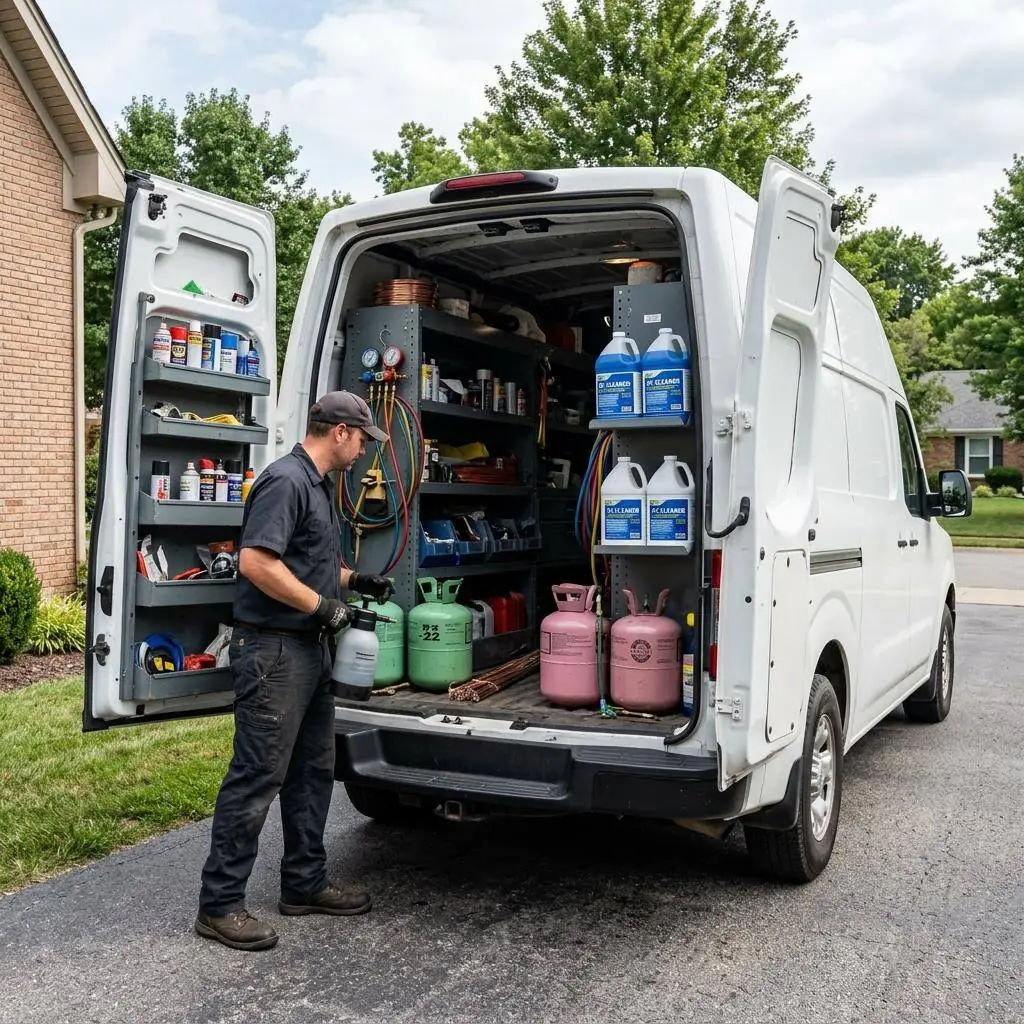
The van is the chemical storage, and the binder is nowhere
An HVAC tech's chemical inventory rides on a shelf in the van: refrigerant cylinders, coil and condenser cleaners, brazing alloys and flux, PVC and duct glues, compressor oils and lubricants, and leak detectors. Those products don't live in a warehouse with a binder next to them — they travel to a different customer site every job, into attics and crawlspaces and mechanical rooms where the tech is often working alone with no office and no reference material. When someone needs the hazards on a coil cleaner or the first-aid steps for flux in their eye, the sheet has to be on the phone, because there is no binder within a hundred feet.
The practical move is to scan the van shelf once. Photograph the label on each product and OSHA Scan reads it into a searchable library entry; you attach the manufacturer's SDS PDF, and print a QR poster to stick in the van. From then on, any tech on any job scans the poster and gets every product's signal word, pictograms, hazards, precautions, and attached sheet on their phone — the same library on every truck. The honest boundary: the app builds and stores the library and answers the accessibility problem, but it will not go find a manufacturer's refrigerant sheet for you or alert you when a product is reformulated, so sourcing current sheets stays a person's job.
Mobile HVAC crews and the SDS-access gap OSHA still expects you to close
HVAC service is a mobile trade, and that changes what compliance with hazard communication actually looks like. OSHA's requirement under 29 CFR 1910.1200(g) that safety data sheets be readily accessible to employees during each work shift doesn't relax because the 'workplace' is a customer's attic or a rooftop with no binder in sight. For a crew whose chemical storage is a shelf in the van — refrigerants, acidic coil cleaners, brazing flux, solvent glues, compressor oils — the accessible copy has to travel with the products. A binder locked in the shop does nothing for a tech connecting a manifold in a mechanical room across the county, and the lone-worker reality of the trade means there's often no coworker to ask.
There's a second layer specific to HVAC: refrigerant regulation under EPA Section 608 of the Clean Air Act runs in parallel with OSHA's HazCom standard, and the two are easy to conflate. Section 608 governs technician certification, recovery equipment, and refrigerant record-keeping; HazCom governs the hazard information — the SDS, the labels, the training. A tech can be fully 608-certified and still be out of compliance with HazCom if the sheet for the refrigerant on the cylinder isn't reachable at the job. The industry's ongoing shift to lower-GWP A2L refrigerants like R-32 and R-454B adds new handling and hazard considerations, which makes having the correct, current product sheet on the phone more valuable, not less. A tool that builds the library from a label scan and posts QR access on the truck closes the access gap; sourcing each manufacturer's current sheet and keeping training current remain the employer's job.
What the SDS scanner reads off an HVAC product label
Photograph the label on any product on the van shelf — the AI extracts the fields that build the library entry.
Product name and manufacturer
Reads the exact product and manufacturer off the label so a coil cleaner and a similar condenser cleaner each get their own entry, and each refrigerant is logged by its actual product.
Signal word and GHS pictograms
Captures the signal word and GHS pictograms on the container — the fast hazard read a tech needs before opening flux or an acidic coil cleaner in a tight mechanical room.
Hazard and precautionary statements
Pulls the label's hazard and precautionary statements into a searchable entry a lone tech can open on their phone in an attic, with no binder anywhere.
QR access on the truck
Assign the scanned products to the van and print a QR poster; a tech scans it on site and gets every product's chemicals and attached SDS PDFs with no login.
Demo: the library entry a scanned label comes back with
An illustrative example for this trade — product identity, signal word, GHS pictograms, and hazard statements, filed and searchable.
Acidic condenser coil cleaner concentrate
Example manufacturer
This coil cleaner rides the van shelf to every rooftop and mechanical room, so a lone tech opening it in a tight space needs the corrosive burn hazard on their phone.
- H314 — Causes severe skin burns and eye damage
- H335 — May cause respiratory irritation
Now scan your own label — free
Photograph any chemical product on your shelf. The AI transcribes the label — no account needed to try it, though you may be asked for the free phone Access Pass.
- A library entry from each label scan — product name, manufacturer, signal word, GHS pictograms, and hazards
- A place to attach each manufacturer's SDS PDF and a printable QR poster for the van shelf
- Every product's sheet on the tech's phone at a customer site — attic, mechanical room, or rooftop — where no binder exists
One lifetime free label scan
The 12-point HVAC SDS management checklist
The full workflow for chemicals that live on the truck and travel to every job. The first four are free — enter your email to unlock the rest and start scanning your own van-shelf labels.
Free checklist — 12 points
Enter your email to unlock the full checklist
Read the checklist here after entering your email. A free account is required to download the PDF.
One email with the checklist, one follow-up. Unsubscribe anytime.
What the AI can and can't detect
OSHA Scan reads a single photo. That makes it fast and easy for anyone on site — but it also means it has real limits. Here's an honest look at both.
What it can catch from a photo
- Product name and manufacturer printed on a chemical label
- Signal word and GHS pictograms on the container
- Hazard and precautionary statements shown on the label
- Whether a scanned product has an SDS PDF attached in the library
What a photo can't tell it
- Whether the attached SDS is the manufacturer's current revision
- A product restocked onto the van that was never scanned in
- The contents of an unlabeled or decanted container in the tool bin
- Whether the lone tech on a job has been trained on the chemical
SDS digital library
Build a searchable chemical library from label photos. Review manufacturer SDS matches when available and follow the status of missing documents.
Missing-document requests enter a review queue; they do not automatically contact suppliers.
Job-site locations
Organize inspections by location and compare safety performance across every site you manage.
Team roles & permissions
Invite admins, managers, and supervisors with role-based access that keeps the right people in control.
A qualified person must review AI-flagged items before making safety decisions. Do not replace required comprehensive safety walkthroughs with AI reports. Features, limits, and downloads depend on your account’s plan and permissions.
See the workflow click into place
Illustrative AI-assisted workflows. Review the findings; they are not a compliance certification.
Always confirmed by a person on site
A scan is a fast first look, not the final word. Before treating this kind of area as safe, a competent person should still confirm:
- The library matches what's physically on every van in the fleet
- Each attached SDS is the current version from the current supplier
- A tech alone at a site can actually reach the QR poster and open the sheet on their phone
- Refrigerant handling and recovery compliance — that is EPA 608 work, separate from SDS access
People also ask
How do HVAC techs access an SDS at a customer site with no binder?
Scan the van shelf once and print a QR poster for the truck. At any job — an attic, a rooftop, a mechanical room — the tech scans the poster with their phone and immediately sees every product's signal word, pictograms, hazards, precautions, and the attached SDS PDF, with no login. Because HVAC techs often work alone with no office reference, the phone is the SDS access point. OSHA Scan builds and stores that library; it does not fetch sheets automatically or track revisions, so an owner still sources current sheets on a schedule.
Do refrigerants and coil cleaners need safety data sheets under OSHA?
Yes. Refrigerants, coil and condenser cleaners, brazing flux, glues, and oils are hazardous chemicals under 29 CFR 1910.1200, so each needs an SDS on file that's readily accessible to the tech during the shift. That's separate from EPA Section 608, which governs refrigerant handling and recovery certification — 608 is about how you handle the refrigerant, HazCom is about the tech being able to reach the sheet. A mobile crew has to satisfy both.
Can I keep the same SDS library on every service truck?
That's the model this is built for. Scan each product's label to build a shared library, and every tech's phone pulls from the same set of entries and sheets — so when a product is added or swapped on one van, updating the library keeps the whole fleet in sync. Each truck also gets its own QR poster pointing at that shared library, so the sheets are reachable on the van itself, not just in an app someone has to log into.
Does OSHA Scan look up or write SDSs for a refrigerant I can't find a sheet for?
No. It does not fetch sheets from manufacturer databases and it does not author official SDSs — the chemical manufacturer or importer is responsible for their product's sheet. If no sheet is on file, the app can hold an AI-drafted chemical profile, always labeled as an internal draft and never a substitute for the manufacturer's authoritative SDS. You still source the real refrigerant or cleaner sheet from the manufacturer or your distributor.
How is this different from EPA 608 refrigerant compliance?
They cover different things. EPA Section 608 certifies technicians to handle and recover refrigerant and governs recovery equipment and record-keeping. SDS management under OSHA's HazCom standard is about having a safety data sheet on file for every chemical on the truck and making it accessible to the tech during the shift. OSHA Scan helps with the SDS-access side — building the library and posting QR access — and does not perform or replace any part of 608 refrigerant compliance.
Reviewed by OSHA Scan Editorial
This content is produced by the OSHA Scan Editorial team and reviewed with AI assistance. It is general safety information, not legal or compliance advice. OSHA Scan is an independent tool and is not affiliated with, endorsed by, or certified by OSHA or the U.S. Department of Labor.
Keep exploring
More ways to see what an AI OSHA scan can do for your site.
The AI OSHA inspection tool
The overview hub — how the scanner works and every job, site, and hazard it covers.
SDS scanner
Scan any product label to build the library entry every truck in the fleet shares.
HVAC safety inspection checklist
Run a mechanical-room and rooftop safety scan from a photo before the job.
HVAC job hazard analysis
Step-by-step hazard analysis for refrigerant, electrical, and confined-space HVAC work.
Missing SDS — what to do
The steps to take when a product on the truck has no sheet on file.
OSHA 1910.1200 — Hazard Communication
The federal standard requiring an SDS for every hazardous chemical, readily accessible to workers.
Official resource — osha.govA full sample report
See a complete labelled example of everything a scan returns.
Ready to secure your job sites?
Start with one lifetime use per eligible scan type — no credit card. Build JHA-ready reports and catch changing conditions sooner.
Start your free trial