
SDS for cleaning companies — a chemical library that travels with the crew
SDS management for a janitorial or commercial cleaning company means keeping a current safety data sheet for every cleaner, disinfectant, and concentrate the crews use — and making those sheets reachable at the customer site where the work happens, not in a binder back at the office the crew never sees. Cleaning is mobile: the same chemicals ride from building to building, so the SDS has to travel too, which is why a phone library beats a paper binder every time. With OSHA Scan a crew lead photographs each product's label into a searchable library, attaches the manufacturer's SDS PDF, and prints QR posters for the janitor closets — and because the whole app runs in English and Spanish, bilingual crews can read it.
Free · No account needed to scan · You may be asked for the free phone Access Pass
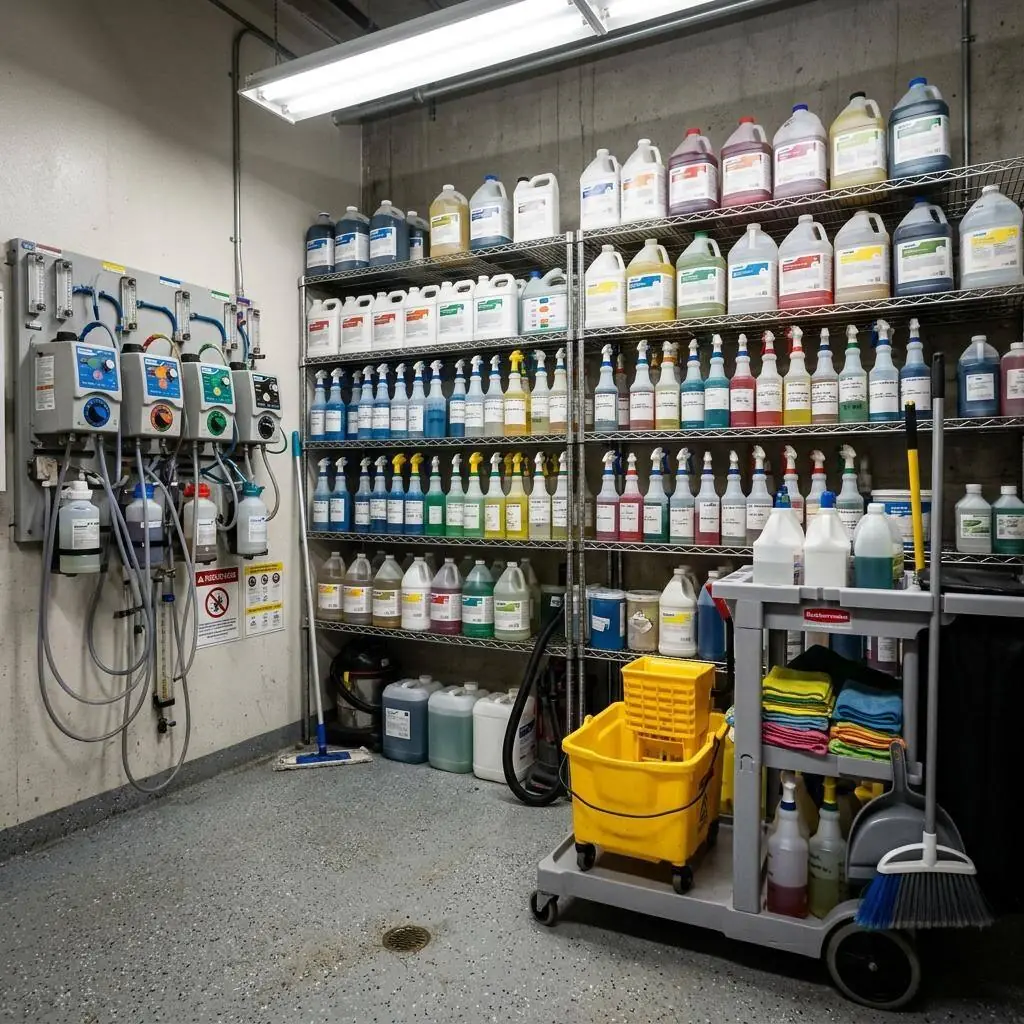
The crew's chemicals move all day — the paper binder never does
A commercial cleaning or janitorial company runs on a rotating shelf of chemicals: neutral floor cleaner, glass cleaner, all-purpose spray, bathroom acid, disinfectants and sanitizers, degreasers, stripper and finish, carpet spotters, and a wall of concentrates diluted into ready-to-use bottles. The crews are the moving part — the same cart of products rides from an office tower to a medical suite to a school across town in one shift. OSHA's HazCom standard still applies at each of those sites, and the safety data sheet has to be readily accessible where the work is happening. A binder sitting at the company office fails that test the moment the crew clocks in at a building it doesn't live in.
That mobility is exactly why a phone-based library wins for cleaning companies. With OSHA Scan a crew lead photographs each product once and it lands in a searchable list with the signal word, pictograms, and hazards read off the label; the library then travels on every crew member's phone to every site. Attach the manufacturer's SDS PDF, and print a QR poster for each janitor closet or supply room so a worker — or a facility's inspector — scans it and opens the SDSs on the spot with no login. Because so many cleaning crews are bilingual, it matters that the app runs in English and Spanish. The checklist below covers the dilution, labeling, and program pieces a scan can't handle for you.
Janitorial HazCom: mixing injuries, mobile access, and OSHA's expectation that information is understandable
Commercial cleaning and janitorial operations fall under OSHA's Hazard Communication Standard (29 CFR 1910.1200), and OSHA specifically calls out cleaning operations as a setting where employers commonly need a written HazCom program, a chemical inventory, container labels, safety data sheets, and training. The recurring injury in this trade is chemical mixing — most notoriously bleach-based disinfectants combined with acid bathroom cleaners, which releases chlorine gas. These events keep happening because the products live inches apart on a cart or in a closet, dilution happens in a hurry, and secondary bottles lose their labels. The two most common HazCom citations in janitorial work are unlabeled secondary containers and safety data sheets that workers can't actually reach at the site they're cleaning.
The access problem is structural for cleaning companies because the workforce is mobile. A binder at the company office satisfies nobody when the crew is in a client's building across town; OSHA's requirement that SDSs be readily accessible during the work shift has to be met at each site. A phone-based library plus a QR poster in each closet is a direct fit for that reality. OSHA also expects hazard information and training to be presented in a manner employees can understand — which, for the many bilingual and Spanish-speaking crews in this industry, means the information has to be available in a language the worker actually reads. Running the library and its hazard summaries in both English and Spanish is not a nicety; it goes to whether the communication in 'hazard communication' has actually happened. The written program and the training itself, though, remain the company's to build and document.
What one label scan captures for the crew's library
What OSHA Scan reads off a cleaning product label to build the searchable SDS library.
Product name & manufacturer
Reads the exact identifier off a disinfectant or concentrate so it files correctly and the crew can search it by name from any site — not a generic 'cleaner' guess.
Signal word & GHS pictograms
Danger on a bathroom acid or oxidizing disinfectant, the corrosive and health-hazard symbols on concentrates — captured as each product enters the library.
Hazards read in English & Spanish
The label's hazard and precautionary text lands in the entry, and the whole app runs in English and Spanish so a bilingual crew reads it in the language they work in.
SDS PDF attachment & QR reach
Attach the manufacturer's SDS PDF to each product; a QR poster in the janitor closet lets any crew member open that site's sheets with no login.
Demo: the library entry a scanned label comes back with
An illustrative example for this trade — product identity, signal word, GHS pictograms, and hazard statements, filed and searchable.
Acidic bathroom descaler concentrate (hydrochloric acid)
Example manufacturer
A janitorial crew carries this restroom descaler from account to account, so a cleaner about to open it in a tight stall needs the corrosive burn hazard on their phone.
- H314 — Causes severe skin burns and eye damage
- H335 — May cause respiratory irritation
Now scan your own label — free
Photograph any chemical product on your shelf. The AI transcribes the label — no account needed to try it, though you may be asked for the free phone Access Pass.
- A searchable chemical library on every crew member's phone — it travels site to site
- Signal word, pictograms, and hazards read off each disinfectant and concentrate
- QR posters for janitor closets and an app that runs in English and Spanish
One lifetime free label scan
The 12-point cleaning company SDS checklist
How a mobile cleaning crew keeps its chemical library and site access honest. The first four are free — create a free account or leave your email to unlock the rest and scan your own cart and closets.
Free checklist — 12 points
Enter your email to unlock the full checklist
Read the checklist here after entering your email. A free account is required to download the PDF.
One email with the checklist, one follow-up. Unsubscribe anytime.
What the AI can and can't detect
OSHA Scan reads a single photo. That makes it fast and easy for anyone on site — but it also means it has real limits. Here's an honest look at both.
What it can catch from a photo
- Product name and manufacturer on a cleaner, disinfectant, or concentrate label
- Signal word and GHS pictograms on the container
- Label hazard and precautionary statements as text for the library
- Whether a concentrate jug's label is torn, faded, or missing
What a photo can't tell it
- Whether every product on every crew's cart is in the library
- The exact chemical or dilution inside an unlabeled spray bottle
- Whether crews were trained, and in a language they understand
- Whether incompatible cleaners are being mixed or stored unsafely on site
SDS digital library
Build a searchable chemical library from label photos. Review manufacturer SDS matches when available and follow the status of missing documents.
Missing-document requests enter a review queue; they do not automatically contact suppliers.
Job-site locations
Organize inspections by location and compare safety performance across every site you manage.
Team roles & permissions
Invite admins, managers, and supervisors with role-based access that keeps the right people in control.
A qualified person must review AI-flagged items before making safety decisions. Do not replace required comprehensive safety walkthroughs with AI reports. Features, limits, and downloads depend on your account’s plan and permissions.
See the workflow click into place
Illustrative AI-assisted workflows. Review the findings; they are not a compliance certification.
Always confirmed by a person on site
A scan is a fast first look, not the final word. Before treating this kind of area as safe, a competent person should still confirm:
- Every product the crews carry has a matching, current SDS PDF in the library
- Each customer-site closet you work out of has a reachable QR SDS poster
- Training records cover every crew member, in the language they work in
- The written HazCom program names a live owner for labels, SDSs, and training
People also ask
Do commercial cleaning companies need SDSs for their chemicals?
Yes. Cleaners, disinfectants, sanitizers, degreasers, floor strippers, and acid bathroom products are hazardous chemicals under OSHA's HazCom standard, so a cleaning company needs a current safety data sheet for each one and must keep it accessible to crews during the shift. Because crews clean multiple sites, 'accessible' means the SDS travels with them — not that it sits in the office. With OSHA Scan the library lives on the crew's phones and can be posted in each closet by QR code.
How do cleaning crews access SDSs at a customer site?
Put the library on the phones they already carry and post a QR SDS poster in each janitor closet or supply room. A crew member scans the poster and the SDS PDFs for that location's products open on their phone with no account or login — which is how OSHA Scan handles the readily-accessible requirement for a mobile workforce. Keep a backup for a dead phone or no signal, which the standard expects for electronic access.
How do I handle SDSs for diluted concentrates and spray bottles?
Keep the SDS for the concentrate in the library, and treat each ready-to-use dilution as its own container that needs a workplace label with the product identifier and hazards. The unmarked spray bottle is the classic janitorial citation. OSHA Scan captures the concentrate's label into the library and prints chemical safety signs, and the checklist above walks through the secondary-labeling rule so your crews don't leave bottles blank.
Does OSHA Scan work for bilingual cleaning crews?
The app runs in both English and Spanish, so a Spanish-speaking crew member gets the same searchable library, QR access, and hazard summaries as everyone else. That matters in janitorial work, where crews are frequently bilingual and HazCom training and hazard information must be understandable to the worker. What OSHA Scan does not do is write your HazCom program or track training records — those stay manual company duties, and we're upfront about it.
Reviewed by OSHA Scan Editorial
This content is produced by the OSHA Scan Editorial team and reviewed with AI assistance. It is general safety information, not legal or compliance advice. OSHA Scan is an independent tool and is not affiliated with, endorsed by, or certified by OSHA or the U.S. Department of Labor.
Keep exploring
More ways to see what an AI OSHA scan can do for your site.
The AI OSHA inspection tool
The overview hub — how the scanner works and every job, site, and hazard it covers.
SDS scanner
Scan any product label to build the library and attach its SDS.
Hazard communication checklist
The full HazCom chain your cleaning program has to keep current.
Secondary container labeling
Generate workplace labels for the crew's diluted spray bottles.
SDS management for property management
For the buildings and portfolios your crews clean.
OSHA 3696 — Effective Hazard Communication Program
OSHA's guide to the written program, inventory, labels, SDS access, and training.
Official resource — osha.govA full sample report
See a complete labelled example of everything a scan returns.
Ready to secure your job sites?
Start with one lifetime use per eligible scan type — no credit card. Build JHA-ready reports and catch changing conditions sooner.
Start your free trial