
HazCom training requirements — when it's due and what it must cover
OSHA's hazard communication standard requires you to train every employee on chemical hazards at their initial assignment and again whenever a new hazard is introduced into their work area — not once a year on a fixed calendar. Training has to cover the label system in use, how to read and reach safety data sheets, the specific hazards of the chemicals present, and the protective measures that go with them. OSHA Scan is not a training platform and does not track completions. What it does is make training real: workers can pull up any chemical's SDS on their own phone, and a printed room QR poster lets you walk the crew to the exact storage area during the talk. Grab the free checklist below to build a session that holds up.
Free · No account needed to scan · You may be asked for the free phone Access Pass
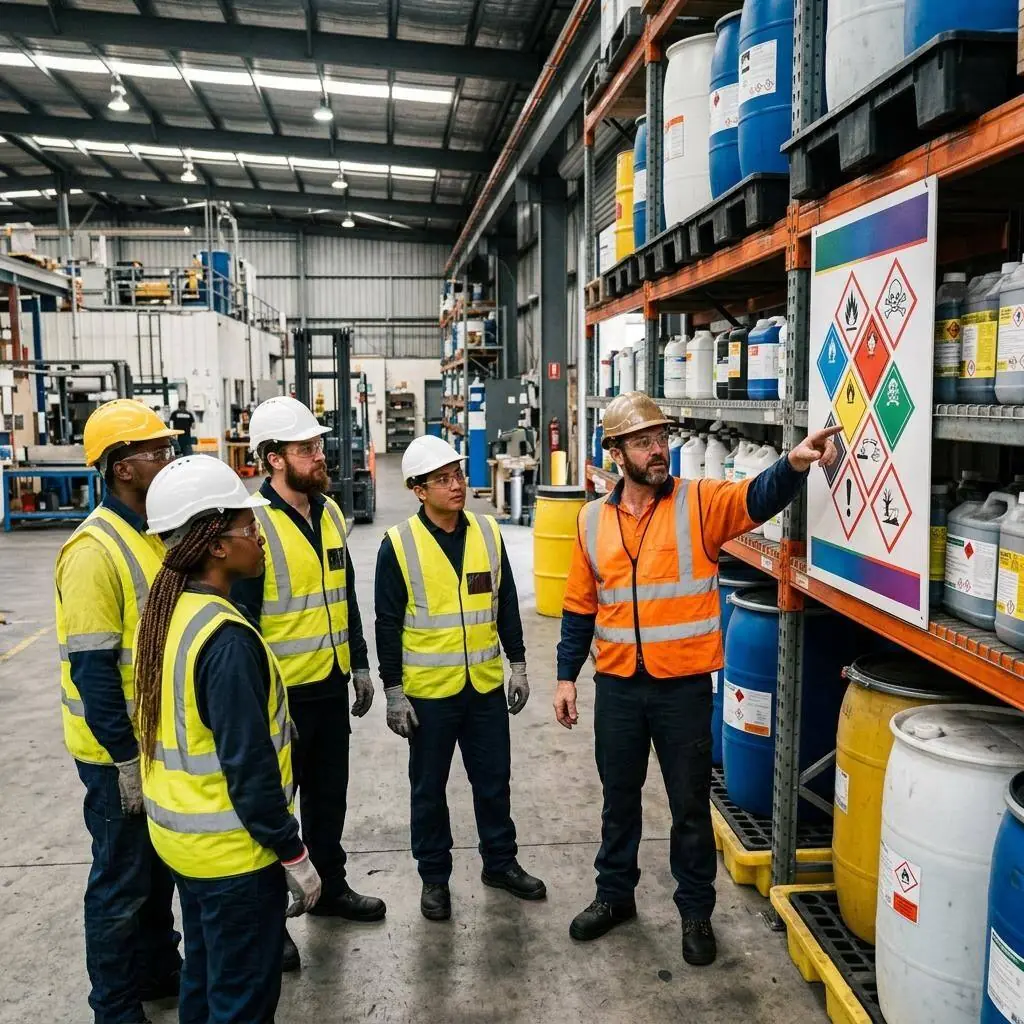
Most HazCom training fails on timing, not content
The single most common training gap isn't a missing topic — it's timing. OSHA does not require annual HazCom refreshers on a set date; it requires training at initial assignment, before a worker is exposed, and again whenever a new chemical hazard enters their work area. That second trigger is where sites drift. Purchasing swaps a degreaser for a stronger solvent, a new adhesive shows up for one project, a supplier reformulates a product — and nobody circles back to the crew already on the job. The people who needed the update most never got it.
The other failure is training that stays abstract. A slideshow about pictograms means little if a worker can't find the actual SDS for the drum in front of them. Effective HazCom training points at the chemicals in that specific workplace, shows where the labels and SDSs live, and lets people practice reaching them. That's the honest role OSHA Scan plays here: the SDS a worker needs is one phone scan or one QR poster away during the session, so 'how to access the SDS' stops being theory. The checklist below covers the full set of topics and the documentation OSHA expects you to keep.
Why HazCom training citations keep landing — and how enforcement reads them
Hazard communication is perennially among OSHA's most-cited standards, and the training paragraph, 29 CFR 1910.1200(h), is a recurring line item in those citations. Inspectors rarely cite training in isolation; it usually surfaces alongside labeling or SDS-access findings, because a compliance officer who finds an unlabeled secondary container or an SDS nobody can reach will naturally ask whether the crew was trained to handle exactly that situation. The pattern that draws citations is a site that trained everyone at hire, then changed its chemical lineup repeatedly without ever retraining the people already on the floor.
Enforcement also weighs effectiveness, not just paperwork. The standard requires training that employees understand, so a stack of English-only sign-in sheets on a predominantly Spanish-speaking crew is a documented gap waiting to be found. In state-plan states, which run their own OSHA-approved programs, the underlying requirement is at least as strict as federal HazCom and sometimes carries additional expectations. The durable defense is the same everywhere: train before exposure, retrain when hazards change, deliver it in a language the crew understands, and keep records that show what was actually covered — not just that a class was held.
What a photo review can — and can't — tell you about training readiness
OSHA Scan reviews visible chemical-storage conditions in a photo. It never verifies whether people were trained — but the visible gaps it flags are exactly the things training is supposed to fix.
Label systems workers must recognize
Flags containers with missing, faded, or turned labels — the real-world label conditions your training has to prepare people to interpret and report.
SDS access in the work area
Notes whether an SDS station or access point is visible near storage — training on 'how to reach the SDS' only works if there's actually a way to reach it.
Where the room QR poster belongs
Shows the storage areas where a printed OSHA Scan QR poster gives workers a no-login SDS view — a practical anchor for the access portion of training.
New or unfamiliar products in frame
Highlights chemicals that look freshly added — the trigger for new-hazard training that most sites forget to run after initial onboarding.
Demo: the library entry a scanned label comes back with
An illustrative example for this trade — product identity, signal word, GHS pictograms, and hazard statements, filed and searchable.
Sodium hydroxide drain-line opener
Example manufacturer
A corrosive like this is exactly what HazCom training must cover — reading the label, the signal word, and the pictogram before a new worker ever picks it up.
- H290 — May be corrosive to metals
- H314 — Causes severe skin burns and eye damage
Now scan your own label — free
Photograph any chemical product on your shelf. The AI transcribes the label — no account needed to try it, though you may be asked for the free phone Access Pass.
- A checklist of every topic OSHA expects a HazCom session to cover
- The two triggers for when training is due — initial assignment and new hazards
- Honest notes on what OSHA Scan supports (SDS on any phone, room QR access) and what stays your job
One lifetime free label scan
The HazCom training checklist — topics, timing, and records
Everything an effective hazard communication training session should cover, plus when it's due and what to document. The first four are free — leave your email to unlock the rest and build a session that stands up to review.
Free checklist — 12 points
Enter your email to unlock the full checklist
Read the checklist here after entering your email. A free account is required to download the PDF.
One email with the checklist, one follow-up. Unsubscribe anytime.
What the AI can and can't detect
OSHA Scan reads a single photo. That makes it fast and easy for anyone on site — but it also means it has real limits. Here's an honest look at both.
What it can catch from a photo
- Containers with missing, faded, or turned labels workers must interpret
- Whether an SDS access point is visible in the work area
- Storage arrangements that make label training hard to apply
- Freshly staged or unfamiliar products that may trigger new-hazard training
What a photo can't tell it
- Whether employees were actually trained or understood the material
- Training dates, attendance, or comprehension checks
- The language and reading level training was delivered at
- Whether new-hazard training ran after a product changed
SDS digital library
Build a searchable chemical library from label photos. Review manufacturer SDS matches when available and follow the status of missing documents.
Missing-document requests enter a review queue; they do not automatically contact suppliers.
Job-site locations
Organize inspections by location and compare safety performance across every site you manage.
Team roles & permissions
Invite admins, managers, and supervisors with role-based access that keeps the right people in control.
A qualified person must review AI-flagged items before making safety decisions. Do not replace required comprehensive safety walkthroughs with AI reports. Features, limits, and downloads depend on your account’s plan and permissions.
See the workflow click into place
Illustrative AI-assisted workflows. Review the findings; they are not a compliance certification.
Always confirmed by a person on site
A scan is a fast first look, not the final word. Before treating this kind of area as safe, a competent person should still confirm:
- Training happened before first exposure for every current employee
- Affected crews were retrained each time a new hazard was introduced
- Records show names, dates, and the specific topics and chemicals covered
- Training was delivered in a language every worker on the crew understands
People also ask
How often is HazCom training required?
OSHA does not set a fixed annual interval for hazard communication training. The requirement is trigger-based: train employees at their initial assignment before exposure, and retrain whenever a new chemical hazard is introduced into their work area. Many employers still run periodic refreshers as good practice, but the mandatory triggers are onboarding and new hazards — so the moment you add a new product to your library is a signal to check who needs an update.
What must HazCom training cover?
Training has to cover the operations where hazardous chemicals are present, the label system in use, how to read and access safety data sheets, the specific physical and health hazards of the chemicals in the workplace, the protective measures and PPE that apply, and the details of your written HazCom program. It must be delivered so employees genuinely understand it — which on many U.S. sites means providing it in Spanish as well as English.
Is a signed attendance sheet enough proof of training?
A sign-in sheet documents attendance but not effectiveness, and OSHA expects training to actually work. Keep records of names, dates, and the topics and chemicals covered, and build in a way to confirm understanding — a short walkthrough or having workers locate and open the SDS for a real container. OSHA Scan does not manage training records, so this documentation stays with you.
Does OSHA Scan provide HazCom training or track completions?
No. OSHA Scan is not a learning-management system and does not deliver courses, quizzes, or completion records. Where it helps is making the access part of training concrete: a worker can scan a chemical label to see its GHS data, pull the attached manufacturer SDS on any phone, or scan a printed room QR poster to view every chemical stored there — no login. That turns 'here's how you'd find the SDS' into something the crew actually does during the session.
Who has to be trained under the HazCom standard?
Every employee who may be exposed to a hazardous chemical under normal conditions or in a foreseeable emergency must be trained. That includes workers who don't handle chemicals directly but work nearby, temporary and seasonal staff, and reassigned employees moving into an area with different chemicals. On multi-employer sites, host and contractor employers each keep responsibility for training their own people.
Reviewed by OSHA Scan Editorial
This content is produced by the OSHA Scan Editorial team and reviewed with AI assistance. It is general safety information, not legal or compliance advice. OSHA Scan is an independent tool and is not affiliated with, endorsed by, or certified by OSHA or the U.S. Department of Labor.
Keep exploring
More ways to see what an AI OSHA scan can do for your site.
The AI OSHA inspection tool
The overview hub — how the scanner works and every job, site, and hazard it covers.
SDS scanner
Scan a chemical label to build the library workers pull SDSs from during training.
Hazard communication checklist
The full HazCom chain — labels, SDS, inventory, and program — training is one link of.
How to read an SDS
A plain-language walkthrough of the 16 sections your training has to explain.
Written hazard communication program
The written program your training has to reference and workers must be able to find.
GHS pictograms
The pictograms on chemical labels workers learn to read, including the one OSHA doesn't require.
OSHA — Hazard Communication
OSHA's official hazard communication page, including training expectations under 1910.1200.
Official resource — osha.govA full sample report
See a complete labelled example of everything a scan returns.
Related OSHA program guides
Ready to secure your job sites?
Start with one lifetime use per eligible scan type — no credit card. Build JHA-ready reports and catch changing conditions sooner.
Start your free trial