
GHS pictograms — all nine symbols, what each one warns about, and when it appears on a label
GHS pictograms are the red-bordered diamonds on chemical labels. OSHA's Hazard Communication standard (29 CFR 1910.1200) uses eight of them: health hazard, flame, exclamation mark, gas cylinder, corrosion, exploding bomb, flame over circle, and skull and crossbones. The ninth GHS symbol, environment (aquatic toxicity), isn't mandatory under OSHA, though suppliers may still print it. Each pictogram is a black symbol on a white background inside a red diamond frame, and it appears only once per label even when several hazards call for it. Precedence rules prevent doubling up: if the skull and crossbones is on the label, the exclamation mark isn't used for acute toxicity, and if the corrosion symbol is there, the exclamation mark isn't used for skin or eye irritation. OSHA Scan reads the pictograms, signal word, and hazard statements from a label photo into your chemical library and shows which pictograms each site has, so you can record the HazCom training that covers them. The free 10-point checklist below covers what to check on every label.
Photo scan: no account needed (you may be asked for the free phone Access Pass) · Template downloads: free account required
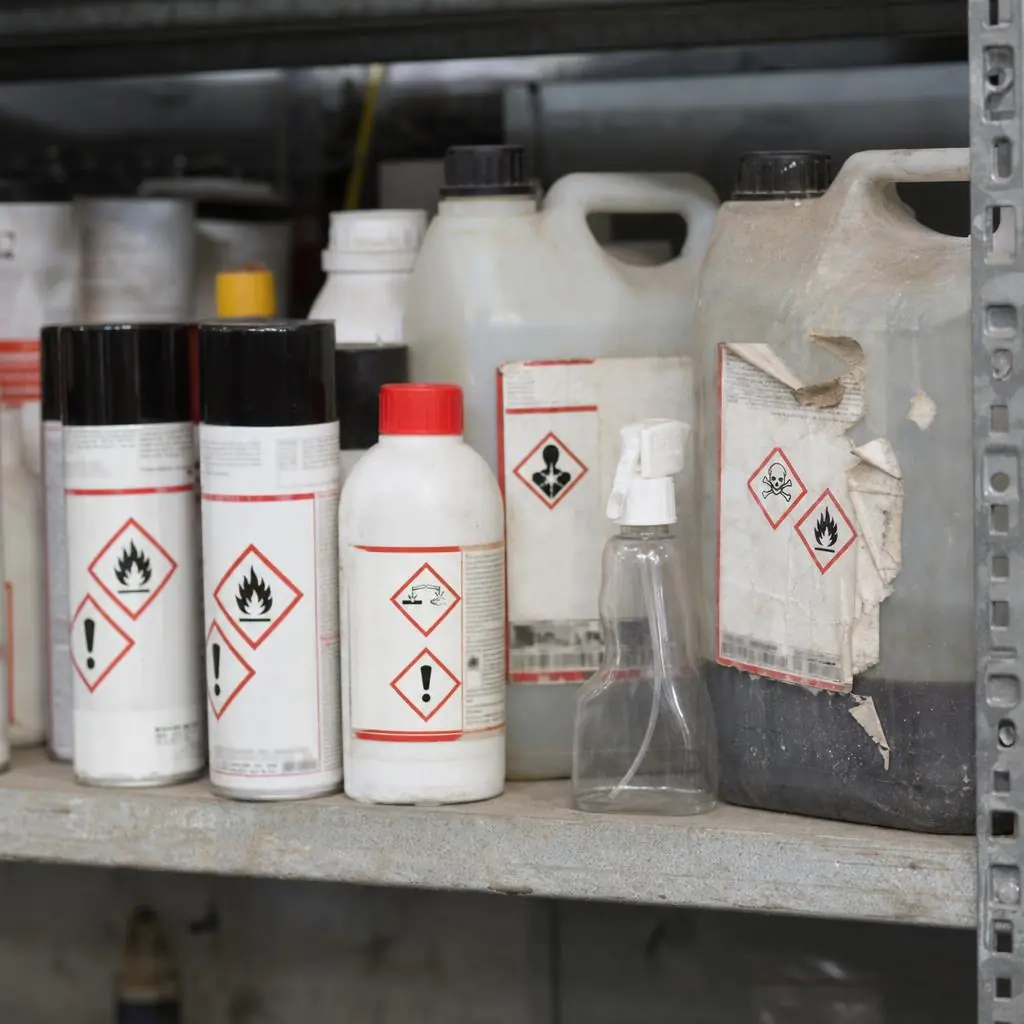
Workers learn the symbols in training — then meet torn and missing ones on the shelf
Most crews can name the flame and the skull and crossbones. Fewer can say what the health hazard symbol — the figure with the starburst on its chest — warns about, or why a corrosive cleaner might also carry the exclamation mark. Pictograms are designed to be read at a glance, but only if workers were trained on them and the labels in front of them are intact. OSHA's standard ties the two together: training has to explain the labels on shipped containers and your workplace labeling system, and labels have to stay legible and in English, with other languages allowed alongside.
On a real shelf, the problems are ordinary: a label peeling off a jug that sat in a damp corner, a spray bottle filled from a drum with nothing on it, a small bottle whose symbols don't match its SDS. Training rarely covers these, but each one leaves a worker without the warning the symbols were supposed to give. OSHA Scan helps at the shelf: photograph a label and it reads the pictograms, signal word, and hazard statements into a library entry next to the manufacturer's SDS, and a photo review flags containers with no visible label or a damaged one. Each site's Right-to-Know view then lists the pictograms present there and flags the site when a new one arrives after the last training session. The checklist below is what to check on every label.
Which pictogram goes with which hazard
Appendix C of OSHA's standard assigns label elements to each hazard class and category. Health hazard covers carcinogens, mutagens, reproductive toxicity, respiratory sensitizers, target organ toxicity, and aspiration hazards. Flame covers flammables, pyrophorics, self-heating chemicals, chemicals that emit flammable gas, self-reactives, organic peroxides, and desensitized explosives. Exclamation mark covers skin and eye irritation, skin sensitizers, harmful-level acute toxicity, narcotic effects, and respiratory tract irritation, and it may optionally mark a hazard not otherwise classified (with the words or the letters HNOC below it) or a hazard to the ozone layer. Gas cylinder covers gases and chemicals under pressure; corrosion covers skin burns, serious eye damage, and corrosion of metals; exploding bomb covers explosives, self-reactives, and organic peroxides; flame over circle covers oxidizers; and skull and crossbones covers acute toxicity at the fatal or toxic levels. The environment pictogram for aquatic toxicity is part of the global system but not mandatory under OSHA.
A few rules decide what actually ends up on a label. A pictogram must be a square set on its point, with a black symbol on a white background and a red frame wide enough to see; a red diamond with no symbol isn't a pictogram and isn't allowed. Each pictogram appears only once, even if two hazards call for it. Skull and crossbones displaces the exclamation mark for acute toxicity, corrosion displaces it for skin and eye irritation, and the health hazard symbol for respiratory sensitization displaces it for skin sensitization and irritation — the same way “Danger” displaces “Warning” as the signal word. On a shipped container that carries a Department of Transportation pictogram, the OSHA pictogram for the same hazard isn't required. Bottles of 100 ml or less that can't fit the full label must still show the product identifier, pictograms, signal word, and the manufacturer's name and phone number. And on containers filled at work, employers can use the full label or the product identifier plus words, pictures, or symbols that give general hazard information; copying the pictograms from the original label is one way to do that.
How to check the GHS pictograms on your labels
Run through these steps before crews start — each one covers a visible gap the AI can help you catch.
- 1
Bring every label into view
Turn containers so their labels face out, and set aside any with no label or one you can't read.
- 2
Name each pictogram
For every red diamond, identify the symbol and the hazard statement that goes with it.
- 3
Check the precedence rules
Where the exclamation mark sits beside the skull and crossbones or the corrosion symbol, confirm on the SDS which hazard it stands for.
- 4
Compare with the SDS
Match the label's pictograms, signal word, and hazard statements to Section 2 of the current SDS, and ask the supplier about any mismatch.
- 5
Relabel and record
Relabel damaged and unlabeled containers, then scan each label into OSHA Scan so its pictograms and SDS sit in one library entry.
What OSHA Scan does with the symbols on your labels
A scan can't classify a chemical or decide which pictograms it should carry. It reads the ones that are printed, keeps them with the SDS, and points out containers whose labels are missing or falling apart.
Pictograms read from the label
Photograph a label and its pictograms, signal word, and hazard statements go into a library entry, so nobody has to copy symbols by hand.
Damaged and missing labels flagged
A photo review of a shelf flags containers with no visible label and labels that are torn, peeling, or covered.
The SDS beside the symbols
Attach the manufacturer's SDS so its Section 2 is one tap away from the label it should match.
Workplace labels from your library
For containers filled on site, prepare an internal workplace label from a library entry after reviewing each safety field and its source. It doesn't replace the manufacturer's label or SDS.
Demo: the library entry a scanned label comes back with
An illustrative example for this trade — product identity, signal word, GHS pictograms, and hazard statements, filed and searchable.
Methanol (methyl alcohol)
Example manufacturer
Three pictograms, one for each hazard group: the flame for flammability, the skull and crossbones for acute toxicity, and the health hazard symbol for organ damage.
- H225 — Highly flammable liquid and vapour
- H301+H311+H331 — Toxic if swallowed, in contact with skin or if inhaled
Now scan your own label — free
Photograph any chemical product on your shelf. The AI transcribes the label — no account needed to try it, though you may be asked for the free phone Access Pass.
- The pictograms, signal word, and hazard statements read from your label photo
- A library entry where the symbols sit next to the manufacturer's SDS
- Honest notes on what a scan can't confirm — like whether a label matches the chemical's current SDS
One lifetime free label scan
The 10-point GHS pictogram label checklist
What to look for on every label, from the symbols to the SDS behind them. The first four are free — leave your email to unlock the rest and check your shelves label by label.
Free checklist — 10 points
Enter your email to unlock the full checklist
Read the checklist here after entering your email. A free account is required to download the PDF.
One email with the checklist, one follow-up. Unsubscribe anytime.
Free printable templatePDF · US Letter
GHS Label and Pictogram Checklist
Use this form to check container labels in a work area, including containers filled on site. Check labels when chemicals arrive, and walk each area at least once a year.
On the form
- 10 checklist items with Yes / No / N/A boxes and room for notes
- 4 points to confirm separately with records or a qualified person
- A corrective-action log and sign-off lines
- Federal references checked against the eCFR on October 10, 2026
A free account is required to download it.
Non-English documents are automated translations, not official OSHA translations. Citations, limits and names are kept as written.
OSHA Scan template — not an official government form and not legal advice.
Keep pictogram training records for each site
OSHA Scan shows the pictograms on each site's chemicals, fills in training topics from them, and records who attended and signed, including workers without accounts. It flags a site when a chemical with a new pictogram arrives after the last session. You run the training; the app keeps the record. Free accounts include training records.
Start training records freeWhat the AI can and can't detect
OSHA Scan reads a single photo. That makes it fast and easy for anyone on site — but it also means it has real limits. Here's an honest look at both.
What it can catch from a photo
- The pictograms, signal word, and hazard statements on a clear label photo
- Containers in a photo with no label visible
- Labels that are visibly torn, peeling, or covered
- Pictogram combinations worth checking against the SDS
What a photo can't tell it
- Whether a pictogram is correct for the chemical's actual classification
- What's inside an unlabeled or hand-labeled container
- Whether workers understand the symbols
- Pictograms too small, faded, or angled to read in the photo
SDS digital library
Build a searchable chemical library from label photos. Review manufacturer SDS matches when available and follow the status of missing documents.
Missing-document requests enter a review queue; they do not automatically contact suppliers.
Job-site locations
Organize inspections by location and compare safety performance across every site you manage.
Team roles & permissions
Invite admins, managers, and supervisors with role-based access that keeps the right people in control.
A qualified person must review AI-flagged items before making safety decisions. Do not replace required comprehensive safety walkthroughs with AI reports. Features, limits, and downloads depend on your account’s plan and permissions.
See the workflow click into place
Illustrative AI-assisted workflows. Review the findings; they are not a compliance certification.
Always confirmed by a person on site
A scan is a fast first look, not the final word. Before treating this kind of area as safe, a competent person should still confirm:
- Each label's pictograms match Section 2 of the current SDS
- Every container filled on site carries a product identifier and hazard information
- Workers were trained on the labels and the workplace labeling system they use
- Damaged labels were replaced and the product name is readable on every container
People also ask
How many GHS pictograms are there?
Nine. OSHA's Hazard Communication standard uses eight: health hazard, flame, exclamation mark, gas cylinder, corrosion, exploding bomb, flame over circle, and skull and crossbones. The ninth, environment, marks aquatic toxicity and isn't mandatory under OSHA, though you may still see it on labels.
What does each GHS pictogram mean?
Health hazard: long-term effects such as cancer, organ damage, or respiratory sensitization. Flame: chemicals that can catch fire. Exclamation mark: less severe hazards like irritation, skin sensitization, or harmful-level toxicity. Gas cylinder: contents under pressure. Corrosion: skin burns, serious eye damage, or corrosion of metals. Exploding bomb: explosives and some self-reactives and organic peroxides. Flame over circle: oxidizers. Skull and crossbones: acute toxicity that can kill or seriously poison. Environment: harm to aquatic life.
Can a label have both the corrosion and exclamation mark pictograms?
Yes, if the exclamation mark stands for a different hazard — for example, harmful if swallowed. What OSHA doesn't allow is the exclamation mark for skin or eye irritation once the corrosion pictogram is on the label. Each pictogram also appears only once, however many hazards call for it.
Do secondary containers need GHS pictograms?
Not necessarily. Containers filled at work need either the full label information or the product identifier plus words, pictures, or symbols that give general hazard information, backed by the rest of your program (29 CFR 1910.1200(f)(6)). Pictograms are one way to do that. A portable container filled for the immediate use of the worker who filled it doesn't need a label.
Where can I get official GHS pictogram images?
OSHA's Hazard Communication pictograms page offers each symbol as a free download in EPS, JPG, and PNG. OSHA Scan reads the pictograms on your existing labels into your chemical library, and it can prepare an internal workplace label from a reviewed library entry for containers filled on site. Each site's printable right-to-know notice includes a key to just the pictograms on that site's chemicals.
Reviewed by OSHA Scan Editorial
This content is produced by the OSHA Scan Editorial team and reviewed with AI assistance. It is general safety information, not legal or compliance advice. OSHA Scan is an independent tool and is not affiliated with, endorsed by, or certified by OSHA or the U.S. Department of Labor.
Keep exploring
More ways to see what an AI OSHA scan can do for your site.
The AI OSHA inspection tool
The overview hub — how the scanner works and every job, site, and hazard it covers.
Chemical right to know
Both sides of right to know — worker duties under OSHA and community reporting under EPCRA.
Right to know poster
Why a GHS wall chart isn't required, and what does have to be posted or told.
EPCRA Tier II reporting
Who files the yearly chemical inventory with local planners, and by when.
How to read an SDS
Section 2 lists the same pictograms, signal word, and hazard statements as the label.
OSHA: Hazard Communication pictograms
OSHA's page with each pictogram as a free download in EPS, JPG, and PNG, plus the rule for how pictograms must look.
Official resource — osha.govA full sample report
See a complete labelled example of everything a scan returns.
Related OSHA program guides
Ready to secure your job sites?
Start with one lifetime use per eligible scan type — no credit card. Build JHA-ready reports and catch changing conditions sooner.
Start your free trial