
EPCRA Tier II reporting — who files, the thresholds that trigger it, and the March 1 deadline
EPCRA Tier II is the yearly hazardous chemical inventory that covered facilities send to their State Emergency Response Commission, Local Emergency Planning Committee, and local fire department by March 1 (EPCRA section 312). It applies to any facility that must keep safety data sheets (SDSs) under OSHA's Hazard Communication standard and had a hazardous chemical on site at or above a threshold at any one time during the previous calendar year: 10,000 pounds for most hazardous chemicals, and 500 pounds or the Threshold Planning Quantity — whichever is lower — for Extremely Hazardous Substances. Retail gas stations have separate thresholds of 75,000 gallons of gasoline and 100,000 gallons of diesel in tanks kept entirely underground that met underground storage tank rules. Most states require the Tier II form rather than Tier I, and states can add chemicals, lower thresholds, and use their own format. OSHA Scan never files the report. In the app, you enter each site's amounts; it compares them with the federal thresholds, marks sites that may need to report, and builds a worksheet you copy into your state's system. The free 10-point checklist below covers what to gather.
Photo scan: no account needed (you may be asked for the free phone Access Pass) · Template downloads: free account required
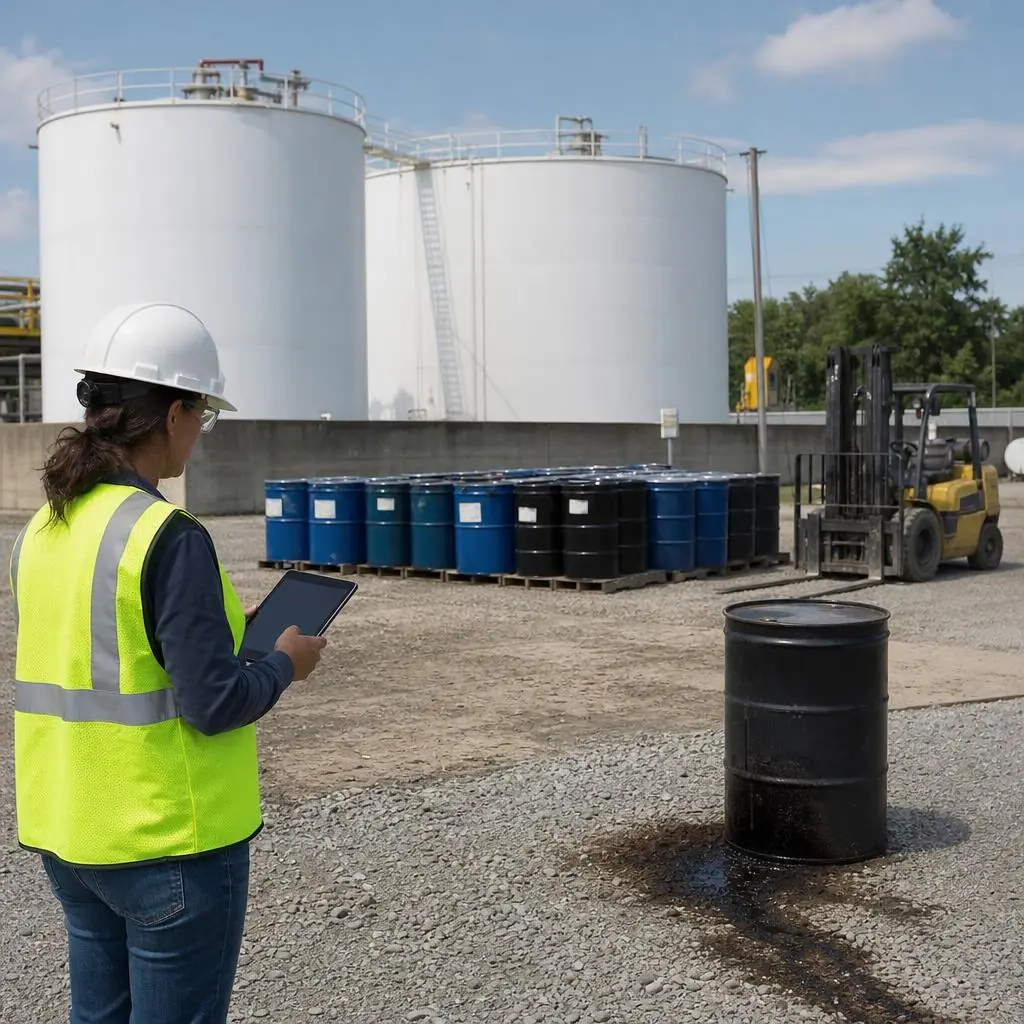
The drums are easy to see — the report starts in your SDS library
Tier II catches facilities that don't think of themselves as chemical companies: a contractor's yard with a few dozen drums of oil and solvent, a warehouse holding pallets of cleaning chemicals, a plant with bulk fuel tanks. The test isn't what you make. It's whether OSHA requires you to keep an SDS for a chemical, and whether the most you had on site at any one time last year reached the threshold — 10,000 pounds for most hazardous chemicals, far less for Extremely Hazardous Substances. Because the test uses the amount present at any one time, a single large delivery can bring a chemical over the line even if you usually hold less.
The report itself is arithmetic and paperwork: a name for each chemical as it appears on its SDS, the maximum and average daily amounts, how and where it's stored, and contacts for emergencies. The hard part is starting from a complete list. OSHA Scan helps there: photograph a drum or tote label and the product goes into a chemical library with its manufacturer's SDS, and a photo review of a storage yard flags unlabeled drums, leaks, and forklift traffic crowding the stock. Then enter each site's amounts: the app converts them to pounds, compares them with the federal thresholds, and builds a worksheet you copy into your state's system. It doesn't weigh containers or file anything. The checklist below covers what to gather before March 1.
What the Tier II form asks for, and where states differ
EPCRA's community right-to-know reporting has two parts. Under section 311, a covered facility sends its SDSs — or a list of its hazardous chemicals grouped by hazard category — to the state commission, the local planning committee, and the fire department one time; a new facility has three months after it becomes subject to OSHA's rules to send them. Under section 312, the same facility sends a hazardous chemical inventory to the same three recipients by March 1 every year, and that information must be made available to the public. EPA publishes two inventory forms: Tier I, which reports aggregate information by hazard type and is generally not accepted by states, and Tier II, which reports each chemical and is generally required. EPA's current Tier II form is used for reports due through March 1, 2027; an updated form applies starting with the report due March 1, 2028.
The thresholds are 10,000 pounds for most hazardous chemicals and, for Extremely Hazardous Substances listed in 40 CFR part 355, 500 pounds — about 55 gallons — or the Threshold Planning Quantity, whichever is lower. A Tier II report carries facility identification, emergency and non-emergency contacts, and, for each chemical, its name as shown on the SDS, the maximum amount present at any time during the previous calendar year, the average daily amount, a brief description of how it's stored, where it is on site, and whether you elect to withhold that location from public disclosure. Some substances are excluded, including FDA-regulated foods, drugs, and cosmetics and products used as packaged for the general public (40 CFR 370.13). States can go further: they can add chemicals, set lower thresholds, and require a form or format that asks for more than the federal fields. EPA keeps a page linking to each state's Tier II requirements and procedures — check it before you file.
How to prepare an EPCRA Tier II report
Run through these steps before crews start — each one covers a visible gap the AI can help you catch.
- 1
Build the chemical list
List every hazardous chemical you keep an SDS for, by storage area.
- 2
Flag the low-threshold chemicals
Mark each Extremely Hazardous Substance, which counts at 500 pounds or its Threshold Planning Quantity, whichever is lower.
- 3
Find the peak amounts
From purchase and usage records, find each chemical's maximum on site at any one time last year, and its average daily amount.
- 4
Check your state's requirements
Look up your state's Tier II page for added chemicals, lower thresholds, and how it wants the report submitted.
- 5
Submit by March 1
Send the Tier II report to your State Emergency Response Commission, Local Emergency Planning Committee, and local fire department.
Where OSHA Scan fits in a Tier II year
OSHA Scan doesn't measure what's on hand or file the report. It keeps the chemical list behind the report accurate, checks the amounts you enter against the federal thresholds, and keeps the storage areas in view.
Labels read from drums and totes
Photograph a drum or tote label and its product name, signal word, pictograms, and hazard statements go into a library entry.
The SDS behind each chemical
Tier II covers chemicals you must keep SDSs for and asks for each one's name as shown on its SDS. The library keeps the manufacturer's sheet on each entry.
Photo review of storage areas
A photo review of a yard or storeroom flags drums with no visible label, leaks and stains, and forklift traffic crowding stored containers.
A threshold check and worksheet — filing stays with you
Enter each site's maximum and average daily amounts and the app converts them to pounds, compares them with the federal thresholds, and marks sites that may need to report. It builds a Tier II worksheet in Excel and PDF; your state's rules and the submission stay with you.
Demo: the library entry a scanned label comes back with
An illustrative example for this trade — product identity, signal word, GHS pictograms, and hazard statements, filed and searchable.
Sulfuric acid, 93%
Example manufacturer
Sulfuric acid is an Extremely Hazardous Substance under EPCRA, so it counts toward Tier II at 500 pounds, not 10,000. The label and SDS identify it; you enter the amount on hand, and the app compares the site total with that lower threshold.
- H314 — Causes severe skin burns and eye damage
- H290 — May be corrosive to metals
Now scan your own label — free
Photograph any chemical product on your shelf. The AI transcribes the label — no account needed to try it, though you may be asked for the free phone Access Pass.
- The product name, signal word, pictograms, and hazard statements read from a drum or tote label
- A library entry with the manufacturer's SDS — the name your inventory form should use
- Honest notes on what a scan can't do: weigh, count, or report your chemicals
One lifetime free label scan
The 10-point EPCRA Tier II preparation checklist
What to pull together before March 1, from the SDS list to your state's requirements. The first four are free — leave your email to unlock the rest and work through it before the deadline.
Free checklist — 10 points
Enter your email to unlock the full checklist
Read the checklist here after entering your email. A free account is required to download the PDF.
One email with the checklist, one follow-up. Unsubscribe anytime.
Free printable templatePDF · US Letter
EPCRA Tier II Reporting Preparation Checklist
Use this form each year to prepare the Tier II report that is due by March 1 and covers the previous calendar year. Keep it with the inventory records you used.
On the form
- 10 checklist items with Yes / No / N/A boxes and room for notes
- 4 points to confirm separately with records or a qualified person
- A corrective-action log and sign-off lines
- Federal references checked against the eCFR on October 10, 2026
A free account is required to download it.
Non-English documents are automated translations, not official OSHA translations. Citations, limits and names are kept as written.
OSHA Scan template — not an official government form and not legal advice.
Check each site against the Tier II thresholds in OSHA Scan
Enter the amounts on hand at each site and see which chemicals are over, under, or still need information, with a reminder before March 1. The app builds a worksheet you copy into your state's system; it never files for you. A free account includes the threshold check and one worksheet download.
Start your Tier II check freeWhat the AI can and can't detect
OSHA Scan reads a single photo. That makes it fast and easy for anyone on site — but it also means it has real limits. Here's an honest look at both.
What it can catch from a photo
- The product name, signal word, and pictograms on a clear drum or tote label
- Drums and containers in a photo with no label visible
- Leaks, stains, and damaged containers in a storage area
- Forklift traffic crowding stored drums
What a photo can't tell it
- How many pounds or gallons of a chemical are on site
- Whether a chemical is an Extremely Hazardous Substance
- Whether your facility must file a Tier II report
- What your state adds to the federal requirements
SDS digital library
Build a searchable chemical library from label photos. Review manufacturer SDS matches when available and follow the status of missing documents.
Missing-document requests enter a review queue; they do not automatically contact suppliers.
Job-site locations
Organize inspections by location and compare safety performance across every site you manage.
Team roles & permissions
Invite admins, managers, and supervisors with role-based access that keeps the right people in control.
A qualified person must review AI-flagged items before making safety decisions. Do not replace required comprehensive safety walkthroughs with AI reports. Features, limits, and downloads depend on your account’s plan and permissions.
See the workflow click into place
Illustrative AI-assisted workflows. Review the findings; they are not a compliance certification.
Always confirmed by a person on site
A scan is a fast first look, not the final word. Before treating this kind of area as safe, a competent person should still confirm:
- Each chemical's maximum amount on site at any one time last year
- Every Extremely Hazardous Substance on site and its threshold
- Your state's added chemicals, thresholds, and submission method
- The report reached your state commission, local planning committee, and fire department by March 1
People also ask
Who has to file a Tier II report?
Any facility that OSHA requires to keep an SDS for a hazardous chemical, when that chemical was present at or above its threshold at any one time during the previous calendar year: 10,000 pounds for most hazardous chemicals, and 500 pounds or the Threshold Planning Quantity, whichever is lower, for Extremely Hazardous Substances. Retail gas stations use separate gallon thresholds for gasoline and diesel in underground tanks.
When is the Tier II report due?
By March 1 each year, covering the previous calendar year. It goes to your State Emergency Response Commission, Local Emergency Planning Committee, and local fire department. EPA's current Tier II form is used for reports due through March 1, 2027, and an updated form applies starting with the report due March 1, 2028.
What's the difference between Tier I and Tier II?
Tier I gives aggregate information by hazard type; Tier II gives specific information for each chemical. EPA says Tier I is generally not accepted by states and Tier II is generally required, so plan on Tier II — and check your state's own format.
What chemicals are exempt from Tier II?
Chemicals you don't need an SDS for, plus the exclusions in 40 CFR 370.13: FDA-regulated foods, drugs, and cosmetics; solids in manufactured items when there's no exposure in normal use; products used for personal, family, or household purposes or present in the same form and concentration as packaged for the public; substances used in a research lab or hospital under a technically qualified person's direct supervision; and substances used in routine agricultural operations or fertilizer held for sale by a retailer to the end customer.
Can OSHA Scan file my Tier II report?
No. OSHA Scan never files or submits anything. In its Right-to-Know area, you enter each site's amounts; it converts them to pounds, compares them with the federal thresholds — including the lower ones for Extremely Hazardous Substances, matched by CAS number — and marks sites that may need to report. It then builds a worksheet with the federal Tier II fields that you copy into your state's Tier II system, or EPA's Tier2 Submit software where your state accepts it. Your state may set lower thresholds or ask for more, so check its rules before you file.
Reviewed by OSHA Scan Editorial
This content is produced by the OSHA Scan Editorial team and reviewed with AI assistance. It is general safety information, not legal or compliance advice. OSHA Scan is an independent tool and is not affiliated with, endorsed by, or certified by OSHA or the U.S. Department of Labor.
Keep exploring
More ways to see what an AI OSHA scan can do for your site.
The AI OSHA inspection tool
The overview hub — how the scanner works and every job, site, and hazard it covers.
Chemical right to know
Both sides of right to know — worker duties under OSHA and community reporting under EPCRA.
Right to know poster
What has to be posted or told to workers, and why a HazCom poster isn't one of them.
GHS pictograms
The nine label symbols and what each one warns about.
Chemical inventory list
The HazCom list of every hazardous chemical on site — the starting point for Tier II.
EPA: Hazardous chemical inventory reporting (EPCRA 311–312)
EPA's page on who reports, the thresholds, the March 1 deadline, and the Tier I and Tier II forms.
Official resource — epa.govA full sample report
See a complete labelled example of everything a scan returns.
Related OSHA program guides
Ready to secure your job sites?
Start with one lifetime use per eligible scan type — no credit card. Build JHA-ready reports and catch changing conditions sooner.
Start your free trial