
Right to know poster — does OSHA require one, and what has to be posted instead?
Federal OSHA doesn't require a “right to know” poster. The Hazard Communication standard (29 CFR 1910.1200) has no posting rule: workers' right to know comes through container labels, safety data sheets (SDSs) they can reach during every shift, training, and a written program. What federal OSHA does require on the wall is the “Job Safety and Health — It's the Law” poster in each establishment (29 CFR 1903.2). A separate records rule (29 CFR 1910.1020) requires telling workers when they start and at least once a year about their exposure and medical records. Some states go further — New Jersey, for example, requires public employers to post its Right to Know poster. A GHS or HazCom wall chart can support training but replaces none of those duties. OSHA Scan prints room QR posters that open a room's SDSs on any phone, plus a free notice for each site that tells workers where the SDSs are kept and who to ask. The free 10-point checklist below separates what must be posted from what must be done.
Photo scan: no account needed (you may be asked for the free phone Access Pass) · Template downloads: free account required
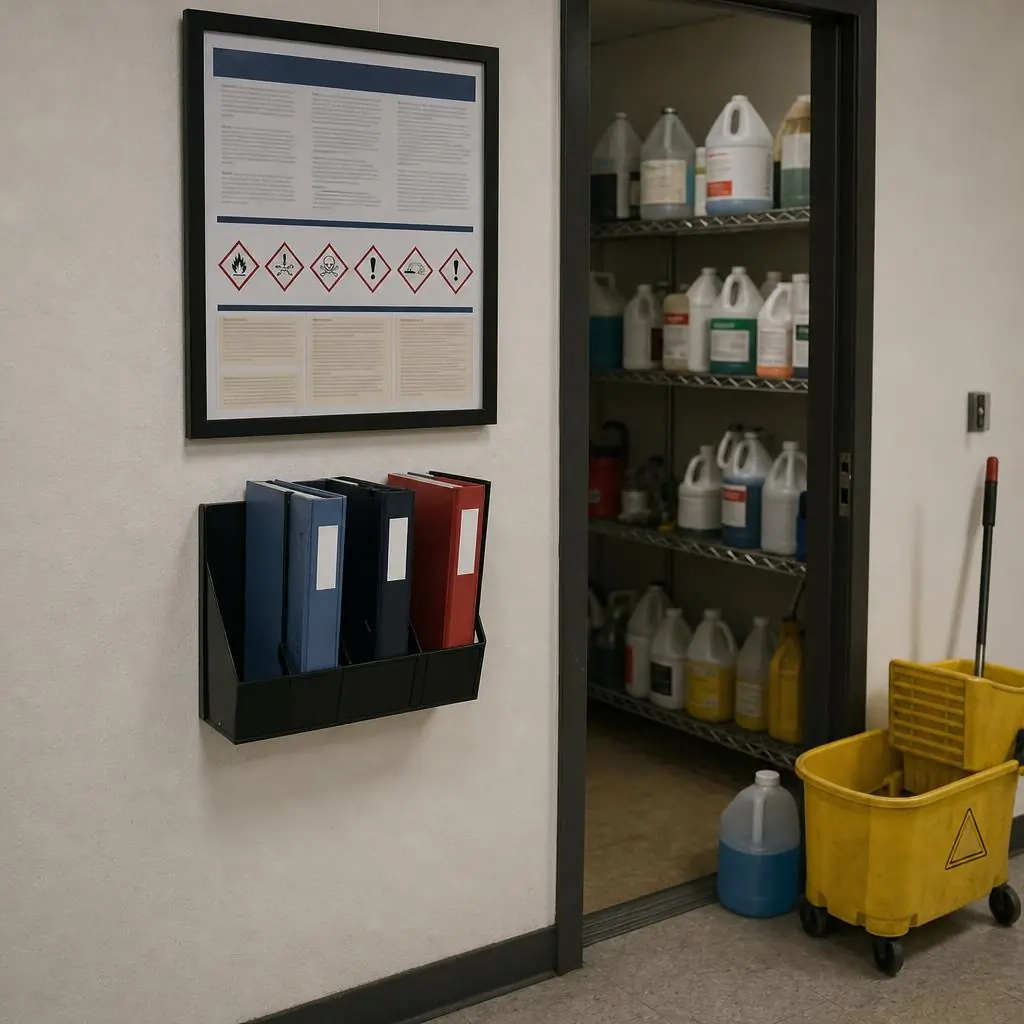
The poster is the easy part — and federal OSHA doesn't ask for one
Search for a right to know poster and you'll find plenty for sale: HazCom posters, GHS symbol charts, and “Employee Right to Know” notices. It's easy to assume one of them is required. Under federal OSHA, none is. The Hazard Communication standard delivers right to know at the container and the binder: labels on every container, an SDS for every hazardous chemical that workers can reach during the shift, training, and a written program. A wall chart can support that training, but it can't stand in for any of those four pieces.
What federal OSHA does require on the wall is the “It's the Law” poster, in each establishment, where notices to employees are usually posted. Separately, the access-to-records rule requires telling workers about their exposure and medical records when they start and every year. That rule doesn't set a format, so you can cover it at orientation and in a yearly reminder. Some states add their own poster: New Jersey's Right to Know poster is required for public employers. OSHA Scan helps with the SDS part — it keeps each product's sheet in a chemical library, prints a room QR poster that opens that room's sheets on any phone, and prints a site notice in English and Spanish showing where the sheets are kept, who to ask, and the pictograms on that site's chemicals. The checklist below separates what has to be posted from what has to be done.
Where right to know actually lives in the rules
Federal OSHA's posting rule is 29 CFR 1903.2. It requires the OSHA notice in each establishment, in a conspicuous place where notices to employees are customarily posted, not altered, defaced, or covered by other material. Reproductions count if they're at least 8½ by 14 inches with print of at least 10 point. Where work is spread out — construction, agriculture, transportation — the notice goes where employees report each day, and workers who don't report to one place see it where they operate from. In State Plan states, the state plan's own poster takes its place for covered employers. None of this mentions hazard communication: the OSHA poster tells workers about their protections and obligations under the OSH Act as a whole.
The chemical side has its own notice duty. Under 29 CFR 1910.1020, employers tell workers when they start and at least once a year that exposure and medical records exist, where they are, who keeps them, and that workers have a right to see them, and they keep a copy of the standard available on request. A safety data sheet indicating that a material may pose a health hazard counts as an exposure record, which ties this rule back to your SDS library. On top of the federal rules, some states have worker right-to-know laws. New Jersey's Worker and Community Right to Know Act covers public and private employers, and public employers must complete the state's Right to Know Survey, label containers, keep a Right to Know Central File, and post the Right to Know poster, which the state supplies free in English and Spanish, subject to availability. In other states, check the labor or health agency before buying a poster.
How to check right-to-know postings and notices
Run through these steps before crews start — each one covers a visible gap the AI can help you catch.
- 1
Find where notices are posted
Identify the spot in each establishment where employee notices go, or where crews report each day on spread-out jobs like construction and agriculture.
- 2
Post the federal OSHA poster
Display the “It's the Law” poster there — or your state plan's own version — unaltered and not covered by other notices.
- 3
Check your state's rules
Look up your state's labor or health agency for any right-to-know poster or notice. In New Jersey, public employers post the state's Right to Know poster.
- 4
Give the records notice
Tell workers at hire and every year about exposure and medical records: that they exist, where they're kept, who keeps them, and their access rights.
- 5
Back the wall with real access
Label every container and make SDSs reachable on each shift. OSHA Scan can print a room QR poster that opens the room's sheets on any phone; it doesn't make federal or state posters.
What OSHA Scan adds next to the posters
A photo can't tell you which posters your workplace needs, and OSHA Scan never reads poster text. What it does is make the SDS access behind the wall real.
Room QR posters
Print a poster for a storage room or work area that opens its safety data sheets on any phone, without logging in.
Labels behind the poster
Scan the containers in the room so the library — and the room poster — list the products that are actually there.
An SDS on each entry
Attach the manufacturer's SDS to each product so the sheet the QR poster opens is the current one.
Photo review of the room
A photo review flags containers with no visible label and clutter around the closet where those chemicals are kept.
Demo: the library entry a scanned label comes back with
An illustrative example for this trade — product identity, signal word, GHS pictograms, and hazard statements, filed and searchable.
Heavy-duty floor finish stripper
Example manufacturer
A janitorial closet product like this is where right to know actually happens: on the label, in the SDS, and in training — not on a wall chart.
- H314 — Causes severe skin burns and eye damage
- H302 — Harmful if swallowed
Now scan your own label — free
Photograph any chemical product on your shelf. The AI transcribes the label — no account needed to try it, though you may be asked for the free phone Access Pass.
- The label details from a container in the room — product name, signal word, pictograms, and hazard statements
- A library entry with the SDS attached, ready to include on a room QR poster
- Honest notes on what a room QR poster covers — SDS access — and what you still have to post or tell workers
One lifetime free label scan
The 10-point right-to-know posting checklist
What has to go on the wall, what has to be told, and what no poster can replace. The first four are free — leave your email to unlock the rest and check your postings and chemical access together.
Free checklist — 10 points
Enter your email to unlock the full checklist
Read the checklist here after entering your email. A free account is required to download the PDF.
One email with the checklist, one follow-up. Unsubscribe anytime.
Free printable templatePDF · US Letter
Right-to-Know Posting Area Checklist
Use this form to check the posting area and the chemical storage areas near it at least once a year and after any change in chemicals or layout. A poster supports your hazard communication program; it does not replace it.
On the form
- 10 checklist items with Yes / No / N/A boxes and room for notes
- 4 points to confirm separately with records or a qualified person
- A corrective-action log and sign-off lines
- Federal references checked against the eCFR on October 10, 2026
A free account is required to download it.
Non-English documents are automated translations, not official OSHA translations. Citations, limits and names are kept as written.
OSHA Scan template — not an official government form and not legal advice.
Print a right-to-know notice for each site
Free for every account: a notice in English and Spanish with the site's SDS QR code, where the sheets are kept, who to ask, and the pictograms on that site's chemicals. It supports SDS access and training; it doesn't replace the OSHA “It's the Law” poster or a state poster.
Make your site notice freeWhat the AI can and can't detect
OSHA Scan reads a single photo. That makes it fast and easy for anyone on site — but it also means it has real limits. Here's an honest look at both.
What it can catch from a photo
- Containers in the photo with no label visible
- Whether a binder rack, SDS station, or posted QR code appears in frame
- Label details on a scanned container, including its pictograms
- Clutter and storage problems around the posting area
What a photo can't tell it
- Which federal and state posters your workplace must display
- Whether a poster on the wall is current or the right one
- Whether the binders hold a current SDS for every product
- Whether workers got the yearly records notice or training
SDS digital library
Build a searchable chemical library from label photos. Review manufacturer SDS matches when available and follow the status of missing documents.
Missing-document requests enter a review queue; they do not automatically contact suppliers.
Job-site locations
Organize inspections by location and compare safety performance across every site you manage.
Team roles & permissions
Invite admins, managers, and supervisors with role-based access that keeps the right people in control.
A qualified person must review AI-flagged items before making safety decisions. Do not replace required comprehensive safety walkthroughs with AI reports. Features, limits, and downloads depend on your account’s plan and permissions.
See the workflow click into place
Illustrative AI-assisted workflows. Review the findings; they are not a compliance certification.
Always confirmed by a person on site
A scan is a fast first look, not the final word. Before treating this kind of area as safe, a competent person should still confirm:
- The OSHA poster, or your State Plan's version, hangs where notices to employees are usually posted
- Your state's right-to-know rules were checked, including any state poster
- Workers were told at hire and within the past year about exposure and medical records
- Every product in the room has a readable label and a current SDS
People also ask
Does OSHA require a right to know poster?
No federal OSHA standard requires a poster titled “right to know” or a Hazard Communication poster. The Hazard Communication standard (29 CFR 1910.1200) works through labels, safety data sheets, training, and a written program. Federal OSHA does require the “Job Safety and Health — It's the Law” poster in each establishment (29 CFR 1903.2), and some states have their own right-to-know posters.
What is a right to know poster?
The name usually refers to a state notice telling workers about their right to information on hazardous substances at work. New Jersey's poster, for example, describes a public employee's rights under the state's Right to Know law and who to contact for more information, and employers can order it free in English and Spanish, subject to availability. Generic HazCom or GHS posters sold online are training aids that federal OSHA doesn't require.
Do I need a GHS or HazCom poster in my chemical storage area?
Federal OSHA doesn't require one. A pictogram poster can help workers remember what the symbols mean, but it doesn't replace labeled containers, SDSs workers can reach during each shift, or training. Check your state's rules too.
What must employers tell workers about chemical exposure records?
Under 29 CFR 1910.1020, when workers start and at least once a year, employers must tell them that exposure and medical records exist, where they're kept, who is responsible for them, and the workers' right to see them. Employers must also keep a copy of the standard available on request. A safety data sheet indicating that a material may pose a health hazard counts as an exposure record.
Can OSHA Scan make a right to know poster?
Not a federal or state one. OSHA Scan prints room QR posters that open the safety data sheets for a storage room or work area on any phone, without logging in. It also prints a free right-to-know notice for each site, in English and Spanish, with the site's SDS QR code, where the sheets are kept, who to ask, and a key to the pictograms on that site's chemicals. Those support SDS access and training, but neither is the OSHA “It's the Law” poster or a state right-to-know poster — get those from OSHA or your state agency.
Reviewed by OSHA Scan Editorial
This content is produced by the OSHA Scan Editorial team and reviewed with AI assistance. It is general safety information, not legal or compliance advice. OSHA Scan is an independent tool and is not affiliated with, endorsed by, or certified by OSHA or the U.S. Department of Labor.
Keep exploring
More ways to see what an AI OSHA scan can do for your site.
The AI OSHA inspection tool
The overview hub — how the scanner works and every job, site, and hazard it covers.
Chemical right to know
Both sides of right to know — worker duties under OSHA and community reporting under EPCRA.
GHS pictograms
The nine label symbols a HazCom chart shows, and the rules for when each one appears.
EPCRA Tier II reporting
The community side: who files the yearly chemical inventory and by when.
SDS accessibility requirements
What readily accessible SDSs look like on every shift — the duty a poster can't meet.
New Jersey Department of Health: Right to Know
New Jersey's Right to Know program, with employer publications and the free English and Spanish poster order form.
Official resource — nj.govA full sample report
See a complete labelled example of everything a scan returns.
Related OSHA program guides
Ready to secure your job sites?
Start with one lifetime use per eligible scan type — no credit card. Build JHA-ready reports and catch changing conditions sooner.
Start your free trial