
1
Set the scene
Start with context
Fill the frame
2–3 ft for close-ups; keep ladders, cords and workers fully in view.
An AI OSHA inspection tool gives a U.S. general contractor, foreman, or superintendent a fast first look at visible potential hazards in a work-area photo. OSHA Scan flags what the model can see, references the OSHA standard each finding may relate to, assigns a 0-100 prioritization score, and suggests corrective actions in seconds. It is independent AI assistance—not OSHA-affiliated, an official inspection, a compliance verdict, or a replacement for a qualified safety professional.
Free · No account needed to scan · Results in seconds
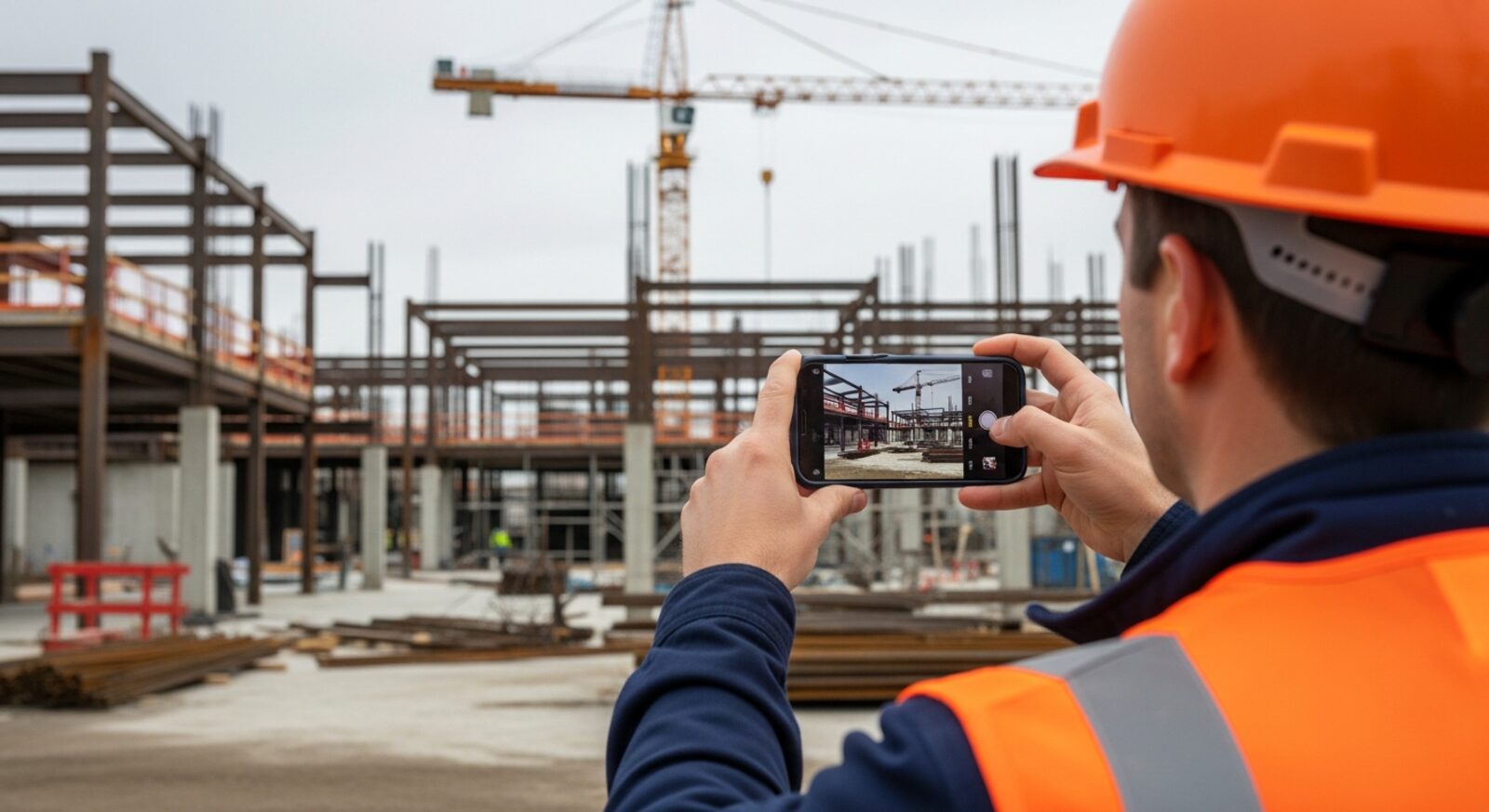
Product proof
Scan a photo like the one above and this is the report you get — score, findings, OSHA references, and fixes. It is an illustrative example, clearly marked — not live scan data.
Illustrative report format — not a live scan or real scan output. AI findings are drafts for a qualified person to verify; OSHA Scan is independent and not affiliated with OSHA.
Compliance score
52
Lower means more potential hazards found
5 potential hazards found
1Steel stock staged across a ground-level access route
Possibly related to housekeeping and materials storage (29 CFR 1926.25)
Observed condition: Materials across an access route create trip and struck-by exposure for everyone moving through the area.
Corrective action: Restack the steel in a marked staging area clear of walkways and access routes.
High confidence
2Unprotected leading edge with no guardrail
Possibly related to fall protection (29 CFR 1926.501)
Observed condition: Falls are the leading cause of construction fatalities; an open edge above six feet is a critical exposure.
Corrective action: Install a compliant guardrail or use a personal fall arrest system before work continues.
Medium confidenceNot fully clear from the photo — verify on site.
Built for U.S. GCs, foremen, superintendents, and safety teams: start with one job-site photo, then choose the trade, work setting, or hazard guide closest to your work.
How the AI reads a single image and turns it into a list of flagged hazards.
Falls, PPE, struck-by, and edge hazards on active construction sites.
Racking, forklifts, blocked aisles, and stacking hazards from a photo.
Leading edges, ladders, and fall-protection gaps on roofing work.
Wet floors, blocked exits, and kitchen hazards for food-service teams.
Missing hard hats, eye protection, and hi-vis spotted in the frame.
Obstructed exits, egress paths, and cluttered walkways in a photo.
Spills, trailing cords, clutter, and uneven surfaces at floor level.
Angle, footing, extension, and visible damage checked before the climb.
Guardrails, planking, and access checked between competent-person inspections.
Travel lanes, pedestrian routes, and load stacking around powered trucks.
Protective systems, spoil setback, and access on open excavations.
A U.S. superintendent or general contractor walking a site can only be in one place at a time, and formal inspections are scheduled — hazards are not. The AI OSHA inspection tool closes that gap by letting anyone on site turn a quick phone photo into a structured hazard review, so unsafe conditions get flagged the moment someone notices them rather than waiting for the next audit.
A foreman photographs a work platform before the crew climbs on. A warehouse lead snaps an aisle that looks cluttered. A restaurant manager checks a back-of-house walkway during a rush. In each case the same scanner reviews the frame, groups what it sees into hazard categories, and returns a report anyone can act on — with the OSHA standard each finding may relate to as a starting point for follow-up.
The point is not to replace the expert. It is to give every person on site a fast, consistent second set of eyes, so the obvious problems are caught and fixed before they turn into incidents — and so the safety professional's time goes to the judgment calls that actually need it.
Most OSHA citations cite a specific standard — 29 CFR 1926.501 for a missing guardrail, 29 CFR 1910.37 for a blocked exit. But the General Duty Clause (Section 5(a)(1) of the OSH Act) fills the gaps: it requires every employer to provide a workplace free from recognized hazards likely to cause death or serious physical harm, even when no specific regulation covers the exact condition. For inspectors, a recognized hazard is one the employer knew or should have known about — which means the hazard-identification step is itself an enforcement threshold. Employers who inspect systematically and document findings are demonstrating active recognition; employers who skip the inspection step face a 'you should have seen it' argument when something goes wrong.
The practical implication is that documentation of the finding-and-fixing cycle carries legal weight beyond its operational value. An OSHA compliance officer reviewing a post-incident employer file asks two questions: what did the employer know, and what did they do about it? A stream of dated, scored inspection records showing hazards found and corrective actions closed is the evidentiary answer to both. OSHA Scan is not affiliated with or endorsed by OSHA, but the inspection record it produces is the kind good-faith employer defenses are built from.
Twenty-nine states and territories operate OSHA-approved safety programs — including California (Cal/OSHA), Washington (L&I), Michigan (MIOSHA), and Oregon (OR-OSHA) — each of which must maintain standards at least as effective as the federal baseline. In practice many set stricter requirements: California's fall-protection thresholds for residential construction differ from federal, and Washington's heat-illness rules go further than current federal guidance. Employers operating across multiple states need inspection programs that account for state-plan requirements, not just the federal floor.
State plans also vary in citation practice: some issue willful citations more frequently and at higher per-violation penalties than federal regions for the same underlying condition. For industries concentrated in state-plan states — construction and general industry in California or Washington, for example — understanding local enforcement history is part of a complete compliance picture. The OSHA standard references on these pages apply the federal baseline as a starting point; anyone operating in a state-plan jurisdiction should verify which version their state has adopted.
OSHA classifies violations into tiers with very different financial consequences. Serious violations — where there is substantial probability the hazard could cause death or serious physical harm — and other-than-serious violations both carry maximums that OSHA adjusts annually for inflation; check OSHA's current penalty schedule for exact figures. Willful violations, where the employer knew of the hazard and made no reasonable effort to fix it, carry a substantially higher per-violation maximum. Repeat violations — citations for the same condition within the prior five years at any workplace the same employer controls — are a distinct classification that can carry the same elevated maximum as willful. Willful and repeat are separate categories, but both significantly exceed the serious-violation ceiling.
The repeat-violation exposure is the most consequential element for multi-site operations: a citation at one facility can make the same finding at a second facility a repeat violation even if the two sites are managed independently. This is why consistent photo inspection programs across all locations carry practical penalty-prevention value: a documented pattern of identifying and correcting the same hazard category at multiple sites is the strongest evidence against a repeat-violation classification.
Three steps, no training required — the same flow behind every page in this hub.
Snap or drop a photo of the area — a platform, an aisle, a worker, a piece of equipment. No forms, no configuration.
A vision model flags each hazard it can see and sorts it into a category such as fall protection, PPE, electrical, or housekeeping.
Every finding references the OSHA standard it may relate to and includes a suggested corrective action, plus a 0-100 prioritization score. The score is not a compliance verdict.
The 0-100 score is computed from the number and severity of visible hazards flagged, giving reviewers a consistent method for prioritizing a scan.
The AI OSHA inspection tool helps turn reviewed findings into an organized record. Saved scans roll up into a multi-site dashboard where safety managers can track corrective actions, monitor scores, and review exported reports from each facility.
Upload a photo like the one above and get a compliance score and hazard count in seconds. No account needed to scan — create a free account to unlock the full report.
Use the real site or facility name. If you save the scan after signup, it becomes the report name.
Three angles, one deeper scan
Only the wide shot is required — every extra angle gives the AI more places to look.
Required: Set the scene — one wide shot lets the AI sweep the whole area at once
Stand at the entry point and capture corner to corner: floors, ladders, scaffolds, and everyone at work
Drop a job-site photo or walkthrough video
Click to upload, drag & drop, or snap a photo on site. Photos scan free in about 15 seconds — no signup, no card. Video walkthroughs (up to 3 min) run on a free account.
Small habits, sharper scans
Set the scene
Start with context
Fill the frame
2–3 ft for close-ups; keep ladders, cords and workers fully in view.
Capture clearly
Make the frame usable
Light it right
Keep the sun or lights behind you — glare and shadows hide hazards.
Tap to focus
Tap the hazard on screen and hold still one second — blur can't be flagged.
Choose the useful view
Give the AI room to understand
Go landscape
Turn your phone sideways — a wider frame catches more of the scene.
Only upload photos you have permission to use, and avoid images showing personal, customer, or confidential information. Demo photos and results are held privately for up to 48 hours so you can save them to a free account; unclaimed photos are deleted automatically. Results are an AI-assisted preliminary review, not an official OSHA determination.
New: Video walkthrough scans
Record up to 3 minutes of your site — the AI extracts frames and categorizes findings with exact timestamps. Free account required.
Get the best results
Wide shot first
Stand at the entrance and photograph the entire work area so AI sees the full context
Hazard areas
Photograph elevated surfaces, equipment, electrical panels, and anywhere workers are active
Close-ups last
Move in close on anything damaged, missing, or that looks risky — the AI catches more detail
How to run a photo-first safety inspection end to end. The first four points are free — create a free account to unlock the full checklist and put it to work on your own site.
Define the scope before you walk
Decide which areas, trades, and hazard types this inspection covers, so the photo set is systematic instead of whatever caught your eye.
Photograph systematically, area by area
Wide shot first, then working shots of each activity — following the same route each time makes trends visible across inspections.
Capture people and PPE at working distance
PPE compliance findings need workers visible clearly in the frame — close enough to see hard hats, glasses, and connections.
Cover work at height
Ladders, scaffolds, lifts, edges, and openings — the hazard family behind the most serious construction injuries gets frames from useful angles.
See the illustrative report format before trying a scan on your own photo.
View sample reportOSHA Scan reads a single photo. That makes it fast and easy for anyone on site — but it also means it has real limits. Here's an honest look at both.
Snap a photo of the job site, and the AI categorizes findings against OSHA standards in seconds.
Each finding includes consistent corrective actions and structured JHA outputs. Check items off as your crew resolves them.
Every inspection gets a deterministic 0-100 compliance score derived from hazard severity, so you can track sites at a glance.
A prioritization aid based on recorded findings—not a certification or a complete measure of site safety.
Generate detailed inspection reports and export data to Excel for record-keeping and stakeholders.
A qualified person must review AI-flagged items before making safety decisions. Do not replace required comprehensive safety walkthroughs with AI reports. Features, limits, and downloads depend on your account’s plan and permissions.
Illustrative AI-assisted workflows. Review the findings; they are not a compliance certification.
A scan is a fast first look, not the final word. Before treating this kind of area as safe, a competent person should still confirm:
It is software that reviews a job-site photo with computer vision and returns a preliminary hazard report — flagged hazards, the OSHA standard each may relate to, a 0-100 prioritization score, and suggested fixes. OSHA Scan does this in seconds from a single image, with no safety training required to run it.
No. OSHA Scan is an independent tool and is not affiliated with, endorsed by, or certified by OSHA. A scan is an AI-assisted preliminary review to help you spot and prioritize hazards; it is not an official OSHA inspection or a determination of legal compliance.
No. You can run a scan and see a result without creating an account. A free account unlocks full saved reports, history, PDF and Excel export, and team features.
Any setting you can photograph — construction, warehousing, roofing, food service, manufacturing, and general facilities. The pages in this hub cover the most common jobs, sites, and specific hazards the scanner handles.
Reviewed by OSHA Scan Editorial
This content is produced by the OSHA Scan Editorial team and reviewed with AI assistance. It is general safety information, not legal or compliance advice. OSHA Scan is an independent tool and is not affiliated with, endorsed by, or certified by OSHA or the U.S. Department of Labor.
Free PDF checklist
33 critical checks across 7 categories — the same visible gaps the AI scanner looks for. Sent to your inbox as a free PDF.
More ways to see what an AI OSHA scan can do for your site.
Organize saved inspections by location and review scores, hazards, dated trends, and checklist progress.
Keep accepted findings pending until the correction is verified and marked completed.
The scanner applied to active construction sites.
Review a jobsite photo from your phone for visible concerns to verify.
A structured walk of an active site's Focus Four hazards.
A trade-focused guide for visible fall-protection and ladder conditions.
See a complete labelled illustration of the fields a scan report can contain — not a live scan result.
Start with exactly 5 lifetime AI site scans — no credit card. Build JHA-ready reports and catch changing conditions sooner.
Start your free trial