
Free auto repair shop workplace safety assessment
An auto repair shop workplace safety assessment, also called an auto repair risk assessment, reviews service bays, vehicle movement, lifting, tire work, batteries, chemicals and unfamiliar repairs for hazards to employees. Include bodywork and painting if your shop performs them. Use this free self-assessment guide to choose the tasks to review, screen fifteen hazard areas and build a basic assessment from your answers. It is a starting draft: your team completes it with the people who do the work, and a qualified person checks it.
Free to read. Your email opens the full guide, your work email and phone number show your basic assessment, and downloads need a free account.
Separate service jobs from refinishing work
A mechanical repair bay and a spray-painting task raise different exposure questions. Identify the services your shop actually performs. Bring equipment instructions and current manufacturer safety data sheets for the products used. Record when a vehicle system or task requires specialist knowledge. A general checklist cannot establish lift capacity, atmospheric conditions or electrical isolation.
How to do an auto repair safety assessment
- 1
Describe the job
Choose your workplace type and state, then write one task you want reviewed.
- 2
Flag your concerns
Choose the hazard areas that need review, or say you are not sure yet. Add who could be exposed and the controls already in use.
- 3
See your basic assessment
Enter your work email and phone number to see your starting draft on screen, with review questions, open areas and an action register. A free account lets you download it as a PDF.
- 4
Complete the workplace review
Walk the job with the people who do it, check the missing facts and record controls, owners, dates and evidence. A qualified person checks the finished assessment.
Auto repair safety assessment checklist: 15 hazard areas
Use these areas as a starting screen, not as proof that a hazard exists or is controlled. Flag the ones that apply to the task, then add anything the list misses.
- 1
Machinery and stored energy
Tire changers, wheel balancers, belt drives and compressed-air tools: pinch points, rotating parts, stored pressure and isolation before clearing jams or servicing.
- 2
Vehicles and material movement
Cars reversing into service bays, tow trucks unloading at the entrance, and technicians or customers walking through vehicle routes.
- 3
Slips, trips and falls
Oil and coolant on bay floors, air hoses across walking routes, creepers left beside lifts, and open service pits or uneven thresholds.
- 4
Electrical hazards
Damaged work-light cords, battery chargers, exposed terminals and hybrid or electric vehicle circuits requiring vehicle-specific isolation and qualified personnel.
The first four areas are open to everyone. Enter your email to read the rest of the guide.
Free basic assessment
Build your basic assessment
Three short steps. The draft is built from your answers and this page's guide, with no AI involved.
- 1Workplace, state and task
- 2Hazard areas
- 3Review
Step 1 of 3Workplace, state and task
Describe one real task: what is done, where and with what.
The full guide
Free written guide
Enter your email to read the full guide
Read the rest of this guide here: the jobs to include, hazard areas 5 to 15, choosing controls, what a photo can and cannot show, and how to prepare. Downloads need a free account.
One email with our general OSHA site checklist, and one follow-up. Unsubscribe anytime.
Blank risk assessment worksheet
Auto repair risk assessment worksheet
One task per copy: the jobs to include, all fifteen hazard areas with their questions, the hierarchy of controls, the action register and the sign-off. Ready to print in English or Spanish.
Needs your work email and phone number on this page, and a free OSHA Scan account with the same email.
Illustrative example
What a task review can look like
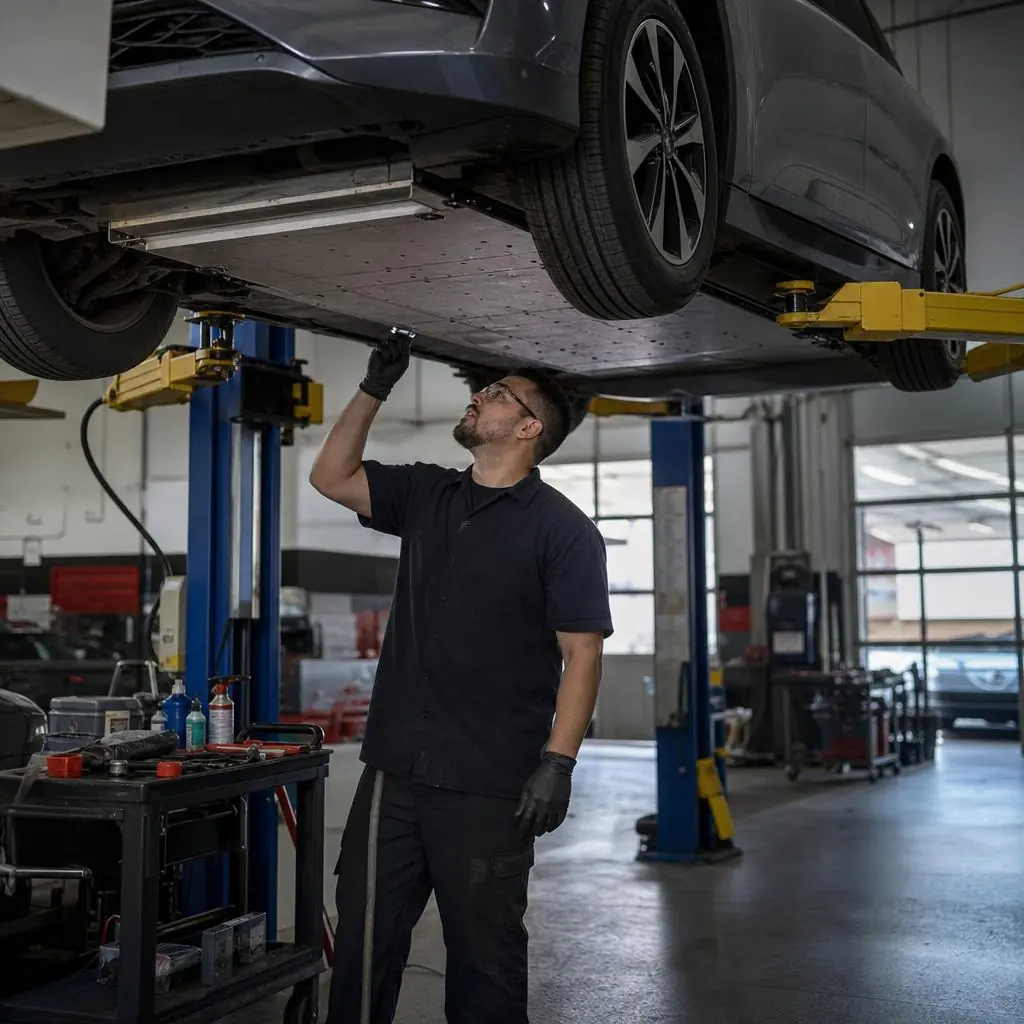
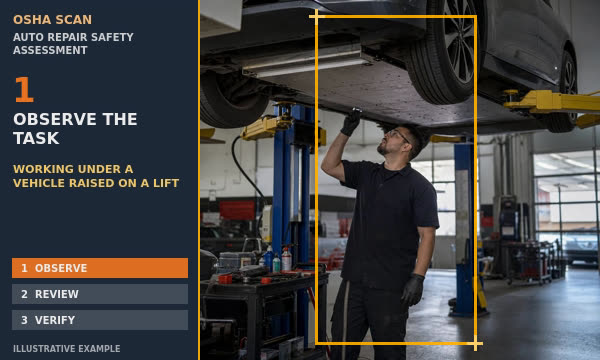
In this illustrative review, technicians plan an unfamiliar repair involving a raised vehicle and a new battery system. They record the tasks, equipment information, energy sources and people who need to verify the setup. Before reusing an earlier repair method, they refer the unresolved questions to the responsible people and record who will resolve each one.
Observe: planning an unfamiliar vehicle repair. Review: discuss hazards and existing controls with the people doing the job. Verify: assign an owner and check the arrangements during real work.
An illustrative example written for this page, not a customer case. The example scan shows how OSHA Scan's AI points out visible details for a person to check; it is a second set of eyes, not a finding.
Compliance score
83
Lower means more potential hazards found
Score uses visible confirmed findings only. Not a safety certification.
2 confirmed · 0 need review · 0 positive
1Overhead underbody work directly above the technician's face
MediumPossibly related to eye and face protection (29 CFR 1910.133(a)(1))
Observed condition: The technician is looking up and working against the underside of the car, where loosened dirt or particles could fall toward his eyes. Glasses are visible, but the photo cannot establish their rating or suitability for the task.
Corrective action: Check what the overhead task may release, position the work to limit falling debris, and verify that the eye or face protection suits the exposure.
Medium confidenceNot fully clear from the photo — verify on site.
2Loose hose hanging beside the technician's legs
MediumPossibly related to walking-working surfaces (29 CFR 1910.22(a)(3))
Observed condition: A hose hangs down from the tool-cart area beside the technician's legs and reaches the floor, where it could catch a foot as he steps back from the vehicle.
Corrective action: Route the hose away from the standing and walking area, take up unused length, and check that it stays clear as the technician changes position.
Medium confidenceNot fully clear from the photo — verify on site.
Observe, review, verify
Find your state's guide
How OSHA coverage is arranged differs by state. Each OSHA Scan state guide explains the arrangement there and links to official information.
- Alabama
- Alaska
- Arizona
- Arkansas
- California
- Colorado
- Connecticut
- Delaware
- Florida
- Georgia
- Hawaii
- Idaho
- Illinois
- Indiana
- Iowa
- Kansas
- Kentucky
- Louisiana
- Maine
- Maryland
- Massachusetts
- Michigan
- Minnesota
- Mississippi
- Missouri
- Montana
- Nebraska
- Nevada
- New Hampshire
- New Jersey
- New Mexico
- New York
- North Carolina
- North Dakota
- Ohio
- Oklahoma
- Oregon
- Pennsylvania
- Rhode Island
- South Carolina
- South Dakota
- Tennessee
- Texas
- Utah
- Vermont
- Virginia
- Washington
- Washington, DC
- West Virginia
- Wisconsin
- Wyoming
Related pages
- Free workplace safety assessmentAny workplace: start with one real job, then widen the review.
- Manufacturing safety assessmentProduction, setup, cleaning and maintenance tasks.
- Warehouse safety assessmentReceiving, picking, storage and loading tasks.
- Cleaning company safety assessmentProducts, floor care, waste and client-site tasks.
- Auto repair inspection checklistUse it alongside this safety assessment.
- SDS management for auto repairUse it alongside this safety assessment.
- Job safety analysisUse it alongside this safety assessment.
- Workplace safety assessment
Official sources
Use these official pages to complete the review. OSHA Scan is not affiliated with or endorsed by OSHA or any government agency.
Frequently asked questions
What is an auto repair shop safety assessment?
An auto repair shop safety assessment reviews the work your technicians and staff do: moving and lifting vehicles, tire and wheel work, batteries and electrical systems, fluids and chemicals, parts cleaning and, if you offer them, body and paint work. It lists the hazards in each task, the controls already in place and the actions still needed. On this page it is a free self-assessment your team completes, not an on-site assessment by a consultant or by OSHA.
How is an auto shop safety assessment different from a risk assessment, a JHA or a safety audit?
The terms overlap. An auto shop safety assessment and an auto repair risk assessment both review tasks and areas for hazards and controls; a risk assessment also weighs how likely and how serious harm could be. A job hazard analysis (JHA) breaks one job, such as replacing a transmission, into steps and lists the hazards and controls for each step. A safety audit checks the shop against set requirements or a program.
How often should an auto repair safety assessment be reviewed?
Review it on a schedule your team sets, and again when you add services, lifts or other equipment, take on new vehicle types such as hybrids or EVs, change products or staffing, after an injury or near miss, and when technicians raise a concern.
Does OSHA require an auto repair safety assessment?
There is no single universal OSHA form for one. Specific standards apply to shop work: the PPE standard requires a workplace hazard assessment for protective equipment and a written certification of it (29 CFR 1910.132(d)), and where respirators are needed, such as for some painting, the respiratory protection standard requires evaluating the respiratory hazards and a written respiratory protection program (29 CFR 1910.134). State Plans can add their own requirements.
Should a garage safety assessment cover vehicles running indoors?
Yes. Engines running in the bay give off carbon monoxide. Record when vehicles run indoors, how exhaust is removed, how doors and ventilation are used, and how vehicles are moved in and out of bays with people nearby.
Does this include auto body and paint hazards?
Include those operations if your shop performs them. Dust, welding fumes, paint ingredients and spray work may need separate exposure evaluation and specialist controls beyond a general mechanical repair review.
Can an independent garage use the assessment?
Yes. Adapt it to the services, equipment, vehicles and tasks your employees actually handle. Include work outside the usual routine and ask technicians where existing methods do not fit.
Should electric or hybrid vehicle tasks be identified?
Yes. Record the vehicle-specific task, battery system, energy sources and manufacturer procedures. Have people with the appropriate qualifications review isolation, stored energy and the work method before the task begins.
Does a completed form establish that a lift or tire machine is suitable?
No. Check the manufacturer's instructions, capacity, condition, maintenance records and suitability for the actual vehicle and task through the appropriate equipment-review process. A completed form does not replace those checks.
What is free on this page, and what needs my details?
Everyone can read how it works, the first four hazard areas, the example, these answers and the sources. Your email unlocks the rest of the written guide. To see your basic assessment, answer the three builder steps and enter your work email and phone number. Downloading the assessment as a PDF, or the blank worksheet in English or Spanish, needs a free OSHA Scan account. No credit card is needed.
Is this an official OSHA inspection or certification?
No. It is an educational starting draft. OSHA Scan is independent and is not affiliated with, endorsed by or certified by OSHA or the U.S. Department of Labor. A qualified person should complete and check the workplace assessment.
Reviewed by OSHA Scan Editorial
This content is produced by the OSHA Scan Editorial team and reviewed with AI assistance. It is general safety information, not legal or compliance advice. OSHA Scan is an independent tool and is not affiliated with, endorsed by, or certified by OSHA or the U.S. Department of Labor.
Start with one real task
Answer three short steps to see your basic assessment on this page. A free OSHA Scan account lets you download it and the blank worksheet as PDFs.
Start my free assessment