
Free warehouse workplace safety assessment
A warehouse workplace safety assessment, also called a warehouse risk assessment, reviews receiving, storage, picking, packing and loading for hazards to employees: vehicle crossings, dock edges, falling stock, conveyors and repeated handling. Use this free self-assessment guide to choose the tasks to review, screen fifteen hazard areas and build a basic assessment from your answers. It is a starting draft: your team completes it with the people who do the work, and a qualified person checks it.
Free to read. Your email opens the full guide, your work email and phone number show your basic assessment, and downloads need a free account.
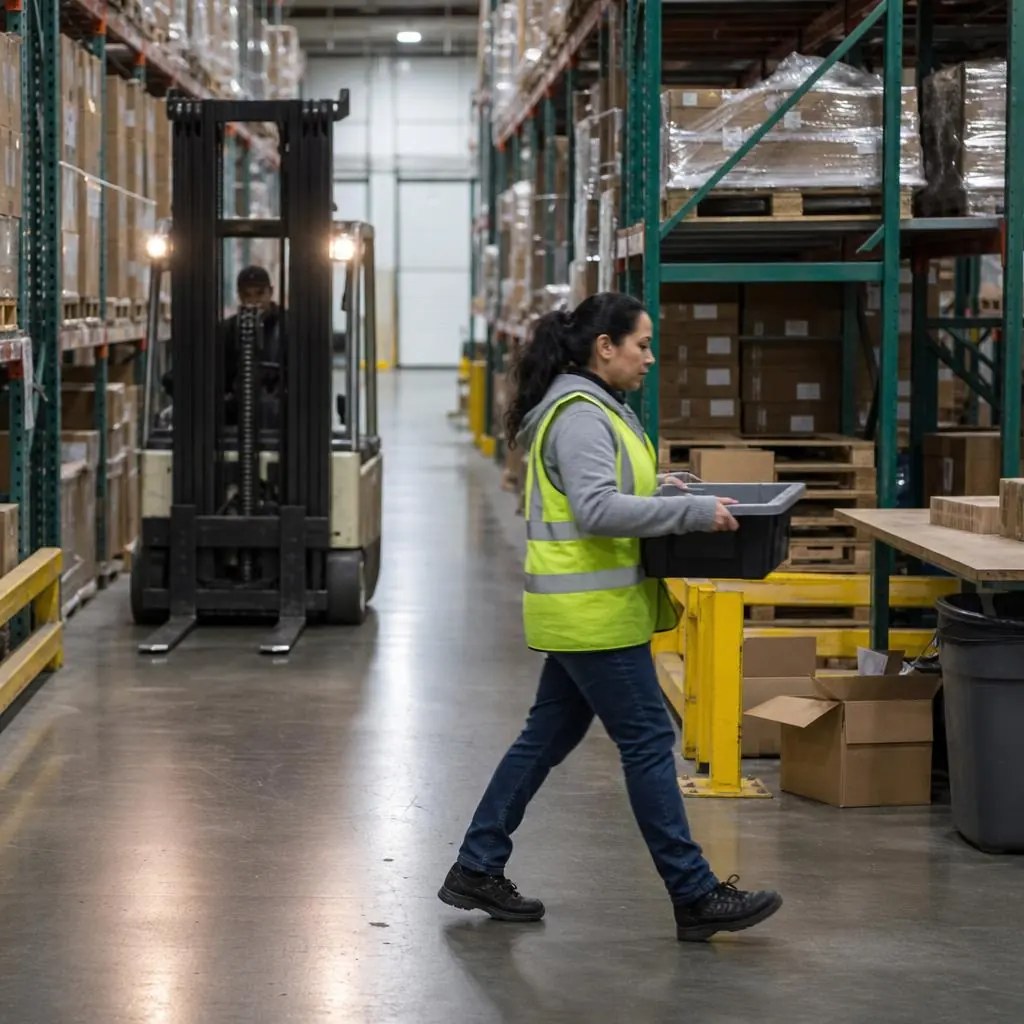
Assess the warehouse during actual work
Conditions can change when deliveries arrive or a shift changes. Review crossings, the transfer between trailers and docks, and temporary storage during the relevant activity. Keep truck examinations and operator training in their own applicable processes. Review how often loads are handled as well as the weight of each item, and refer rack design or capacity questions to qualified people.
How to do a warehouse safety assessment
- 1
Describe the job
Choose your workplace type and state, then write one task you want reviewed.
- 2
Flag your concerns
Choose the hazard areas that need review, or say you are not sure yet. Add who could be exposed and the controls already in use.
- 3
See your basic assessment
Enter your work email and phone number to see your starting draft on screen, with review questions, open areas and an action register. A free account lets you download it as a PDF.
- 4
Complete the workplace review
Walk the job with the people who do it, check the missing facts and record controls, owners, dates and evidence. A qualified person checks the finished assessment.
Warehouse safety assessment checklist: 15 hazard areas
Use these areas as a starting screen, not as proof that a hazard exists or is controlled. Flag the ones that apply to the task, then add anything the list misses.
- 1
Machinery and stored energy
Conveyor rollers, stretch wrappers, compactors and automated picking equipment: pinch points, unexpected movement and energy isolation before clearing jams or servicing.
- 2
Vehicles and material movement
Forklifts reversing out of rack aisles, pallet jacks at crossings, trailers at loading docks and visiting drivers walking through receiving.
- 3
Slips, trips and falls
Loose stretch wrap, broken pallets and spills in aisles, open dock edges, uneven trailer floors and ladders used for picking.
- 4
Electrical hazards
Damaged battery-charger leads, conveyor control panels, cords crossing packing stations and electrical equipment exposed to wash water or forklift impact.
The first four areas are open to everyone. Enter your email to read the rest of the guide.
Free basic assessment
Build your basic assessment
Three short steps. The draft is built from your answers and this page's guide, with no AI involved.
- 1Workplace, state and task
- 2Hazard areas
- 3Review
Step 1 of 3Workplace, state and task
Describe one real task: what is done, where and with what.
The full guide
Free written guide
Enter your email to read the full guide
Read the rest of this guide here: the jobs to include, hazard areas 5 to 15, choosing controls, what a photo can and cannot show, and how to prepare. Downloads need a free account.
One email with our general OSHA site checklist, and one follow-up. Unsubscribe anytime.
Blank risk assessment worksheet
Warehouse risk assessment worksheet
One task per copy: the jobs to include, all fifteen hazard areas with their questions, the hierarchy of controls, the action register and the sign-off. Ready to print in English or Spanish.
Needs your work email and phone number on this page, and a free OSHA Scan account with the same email.
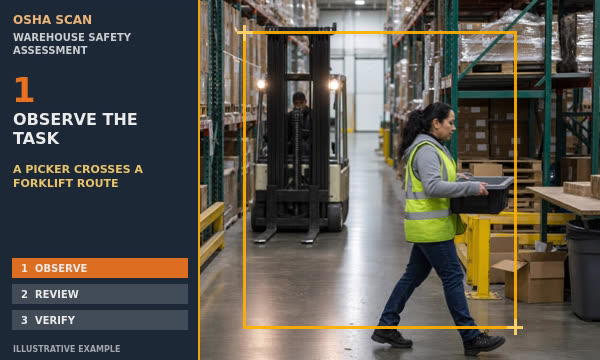
Illustrative example
What a task review can look like
Pickers cross a vehicle route to reach a temporary packing station. The team records when this happens and who uses the crossing. It considers relocating the station, separating routes and setting interim controls. The team assigns the changes and checks them during a delivery period to see whether they work when the area is busy.
Observe: picking across a busy delivery route. Review: discuss hazards and existing controls with the people doing the job. Verify: assign an owner and check the correction during real work.
An illustrative example written for this page, not a customer case. The example scan shows how OSHA Scan's AI points out visible details for a person to check; it is a second set of eyes, not a finding.
Compliance score
75
Lower means more potential hazards found
Score uses visible confirmed findings only. Not a safety certification.
2 confirmed · 0 need review · 0 positive
1Pedestrian crossing the aisle near a forklift
HighPossibly related to powered industrial truck travel (29 CFR 1910.178(n)(4))
Observed condition: The worker carrying a tote shares the open aisle with a forklift. No continuous barrier separates their paths at this crossing; the photo cannot establish vehicle speed or right-of-way behavior.
Corrective action: Review the crossing during receiving, consider moving the packing task or separating pedestrian routes, and check visibility and right-of-way arrangements with operators and pickers.
High confidence
2Open cardboard boxes on the floor beside the packing table
MediumPossibly related to housekeeping (29 CFR 1910.22(a)(1))
Observed condition: Open boxes sit on the floor at the aisle edge next to the packing table and barrier post, leaving a trip point where workers approach the station.
Corrective action: Move empty boxes to a designated collection point outside walking routes and arrange regular removal during packing work.
High confidence
Observe, review, verify
Find your state's guide
How OSHA coverage is arranged differs by state. Each OSHA Scan state guide explains the arrangement there and links to official information.
- Alabama
- Alaska
- Arizona
- Arkansas
- California
- Colorado
- Connecticut
- Delaware
- Florida
- Georgia
- Hawaii
- Idaho
- Illinois
- Indiana
- Iowa
- Kansas
- Kentucky
- Louisiana
- Maine
- Maryland
- Massachusetts
- Michigan
- Minnesota
- Mississippi
- Missouri
- Montana
- Nebraska
- Nevada
- New Hampshire
- New Jersey
- New Mexico
- New York
- North Carolina
- North Dakota
- Ohio
- Oklahoma
- Oregon
- Pennsylvania
- Rhode Island
- South Carolina
- South Dakota
- Tennessee
- Texas
- Utah
- Vermont
- Virginia
- Washington
- Washington, DC
- West Virginia
- Wisconsin
- Wyoming
Related pages
- Free workplace safety assessmentAny workplace: start with one real job, then widen the review.
- Manufacturing safety assessmentProduction, setup, cleaning and maintenance tasks.
- Retail store safety assessmentReceiving, stocking, checkout and backroom tasks.
- Cleaning company safety assessmentProducts, floor care, waste and client-site tasks.
- Warehousing safety solutionUse it alongside this safety assessment.
- Warehouse inspection checklistUse it alongside this safety assessment.
- Warehouse emergency-plan templateUse it alongside this safety assessment.
- Workplace safety assessment
Official sources
Use these official pages to complete the review. OSHA Scan is not affiliated with or endorsed by OSHA or any government agency.
Frequently asked questions
What is a warehouse safety assessment?
A warehouse safety assessment reviews the work your employees do across receiving, storage, picking, packing, loading and maintenance. It lists the hazards in each task, the controls already in place and the actions still needed. On this page it is a free self-assessment your team completes, not an on-site assessment by a consultant or by OSHA.
How is a warehouse safety assessment different from a risk assessment, a JHA or a safety audit?
The terms overlap. A warehouse safety assessment and a warehouse risk assessment both review tasks and areas for hazards and controls; a risk assessment also weighs how likely and how serious harm could be. A job hazard analysis (JHA) breaks one job, such as building a mixed pallet, into steps and lists the hazards and controls for each step. A safety audit checks the site against set requirements or a program.
How often should a warehouse safety assessment be reviewed?
Review it on a schedule your team sets, and again when racking, layout, equipment, products or staffing change, before peak season, after an injury or near miss, and when workers raise a concern. Include night shifts and peak periods, not just a quiet day.
Does OSHA require a warehouse safety assessment?
There is no single universal OSHA form for one. Specific standards apply to warehouse work: the PPE standard requires a workplace hazard assessment for protective equipment and a written certification of it (29 CFR 1910.132(d)), and the powered industrial truck standard requires operator training and evaluation and an examination of each truck before it is placed in service (29 CFR 1910.178). State Plans can add their own requirements.
Should a distribution center safety assessment cover the loading docks?
Yes. Docks bring together trailer movement, dock plates, edges, forklifts and people on foot. Record how trailers are secured before loading, who controls the dock doors, where pedestrians walk and how the dock looks at peak loading times, not just when it is quiet.
Is this a forklift inspection?
No. It reviews forklift-related tasks and interactions, including crossings, loading and people working nearby. Required truck examinations, operator training and equipment procedures remain separate.
Should night shifts be included?
Yes. Include relevant shifts and review differences in staffing, lighting, deliveries, maintenance and communication. A quiet daytime walkthrough may miss conditions that affect the night crew.
Can a distribution center use this assessment?
Yes. Adapt the job list to the actual conveyors, picking methods, automation, handling intensity and workforce. Include temporary workers, contractors and visiting drivers where their tasks overlap.
What if a hazard needs an immediate correction?
Use appropriate immediate controls and involve the responsible people now. Do not leave a serious danger unaddressed while waiting to finish this assessment or arrange a later review.
What is free on this page, and what needs my details?
Everyone can read how it works, the first four hazard areas, the example, these answers and the sources. Your email unlocks the rest of the written guide. To see your basic assessment, answer the three builder steps and enter your work email and phone number. Downloading the assessment as a PDF, or the blank worksheet in English or Spanish, needs a free OSHA Scan account. No credit card is needed.
Is this an official OSHA inspection or certification?
No. It is an educational starting draft. OSHA Scan is independent and is not affiliated with, endorsed by or certified by OSHA or the U.S. Department of Labor. A qualified person should complete and check the workplace assessment.
Reviewed by OSHA Scan Editorial
This content is produced by the OSHA Scan Editorial team and reviewed with AI assistance. It is general safety information, not legal or compliance advice. OSHA Scan is an independent tool and is not affiliated with, endorsed by, or certified by OSHA or the U.S. Department of Labor.
Start with one real task
Answer three short steps to see your basic assessment on this page. A free OSHA Scan account lets you download it and the blank worksheet as PDFs.
Start my free assessment