
Free hotel workplace safety assessment
A hotel workplace safety assessment, also called a hotel risk assessment, reviews housekeeping, laundry, kitchens, reception and maintenance for hazards to employees: repeated strain, cart handling, cleaning chemicals, wet floors, powered equipment and lone work. Use this free self-assessment guide to choose the tasks to review, screen fifteen hazard areas and build a basic assessment from your answers. It is a starting draft: your team completes it with the people who do the work, and a qualified person checks it.
Free to read. Your email opens the full guide, your work email and phone number show your basic assessment, and downloads need a free account.
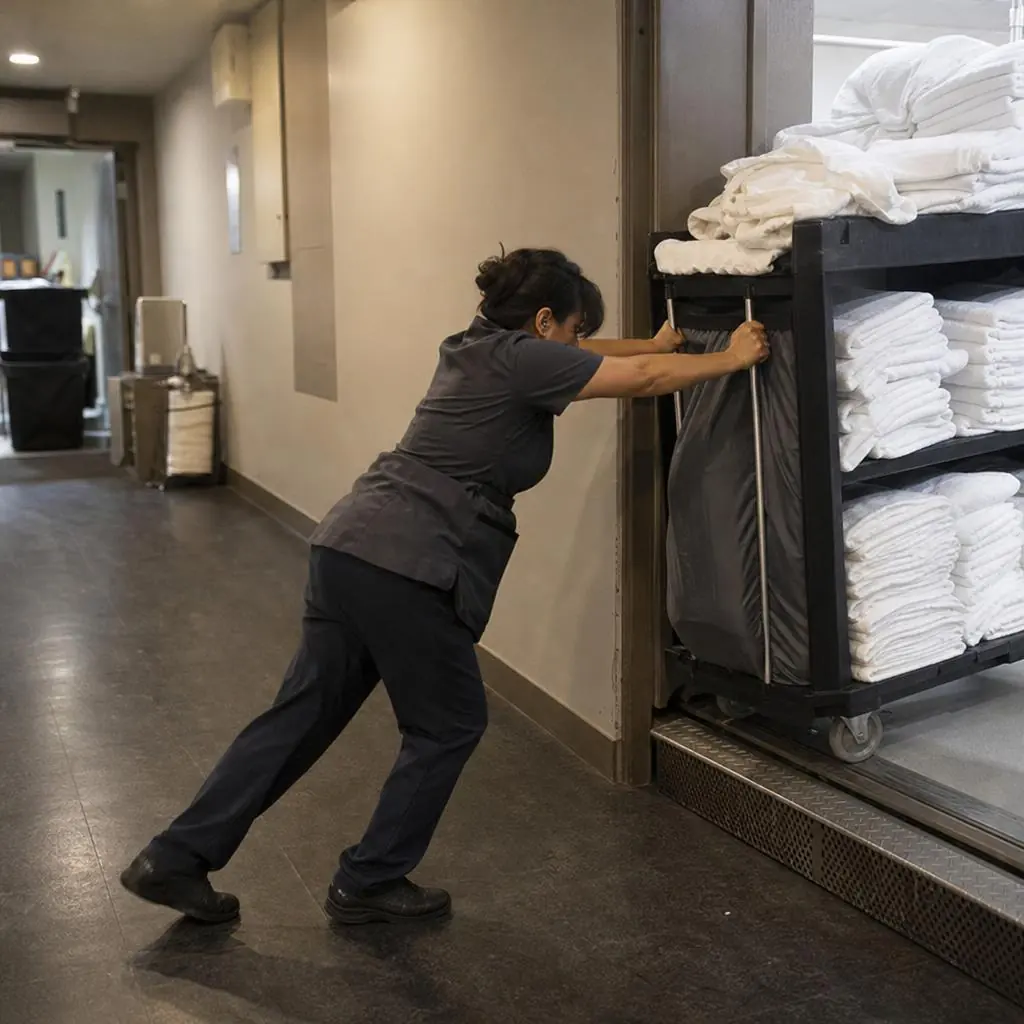
Review each department's actual jobs
Housekeeping, laundry, food service, reception and maintenance involve different tasks. Include outsourced services and shifts that do not overlap with daytime management. Ask workers about difficult handling and repeated strain, and record how tasks change during busy check-in periods, events or room turnover. Keep employee-safety findings separate from guest-service and room-quality checks.
How to do a hotel safety assessment
- 1
Describe the job
Choose your workplace type and state, then write one task you want reviewed.
- 2
Flag your concerns
Choose the hazard areas that need review, or say you are not sure yet. Add who could be exposed and the controls already in use.
- 3
See your basic assessment
Enter your work email and phone number to see your starting draft on screen, with review questions, open areas and an action register. A free account lets you download it as a PDF.
- 4
Complete the workplace review
Walk the job with the people who do it, check the missing facts and record controls, owners, dates and evidence. A qualified person checks the finished assessment.
Hotel safety assessment checklist: 15 hazard areas
Use these areas as a starting screen, not as proof that a hazard exists or is controlled. Flag the ones that apply to the task, then add anything the list misses.
- 1
Machinery and stored energy
Washers, dryers, linen folders, kitchen mixers and pool pumps: moving parts, guards and energy isolation before clearing jams, cleaning or maintenance.
- 2
Vehicles and material movement
Linen carts at elevator thresholds, luggage carts in lobbies, delivery trucks at service entrances and shuttle vehicles sharing routes with employees on foot.
- 3
Slips, trips and falls
Wet bathroom tiles, freshly mopped lobbies, poolside walkways, curled corridor rugs and ladders used to clean high windows or replace lamps.
- 4
Electrical hazards
Vacuum cords stretched across corridors, damaged irons in laundry areas, wet outlets near sinks and maintenance work on lighting or air-conditioning units.
The first four areas are open to everyone. Enter your email to read the rest of the guide.
Free basic assessment
Build your basic assessment
Three short steps. The draft is built from your answers and this page's guide, with no AI involved.
- 1Workplace, state and task
- 2Hazard areas
- 3Review
Step 1 of 3Workplace, state and task
Describe one real task: what is done, where and with what.
The full guide
Free written guide
Enter your email to read the full guide
Read the rest of this guide here: the jobs to include, hazard areas 5 to 15, choosing controls, what a photo can and cannot show, and how to prepare. Downloads need a free account.
One email with our general OSHA site checklist, and one follow-up. Unsubscribe anytime.
Blank risk assessment worksheet
Hotel risk assessment worksheet
One task per copy: the jobs to include, all fifteen hazard areas with their questions, the hierarchy of controls, the action register and the sign-off. Ready to print in English or Spanish.
Needs your work email and phone number on this page, and a free OSHA Scan account with the same email.
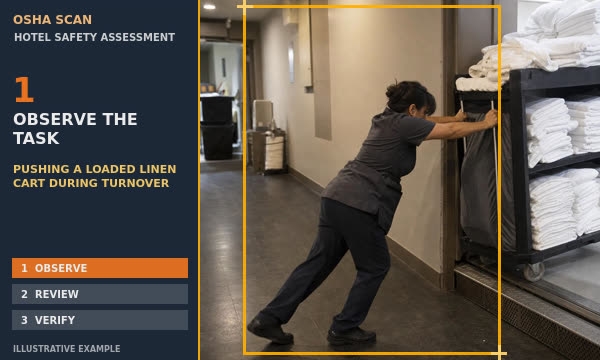
Illustrative example
What a task review can look like
Room attendants report difficulty moving heavily loaded linen carts over a threshold during peak room turnover. The team records the load, route, frequency and affected roles. It reviews the threshold, cart condition, handling methods and work organization, assigns changes and checks the result during the next turnover period.
Observe: moving a loaded linen cart during room turnover. Review: discuss hazards and existing controls with the people doing the job. Verify: assign an owner and check the correction during real work.
An illustrative example written for this page, not a customer case. The example scan shows how OSHA Scan's AI points out visible details for a person to check; it is a second set of eyes, not a finding.
Compliance score
75
Lower means more potential hazards found
Score uses visible confirmed findings only. Not a safety certification.
2 confirmed · 0 need review · 0 positive
1Raised threshold in the loaded linen cart's route
HighPossibly related to material-handling passageways (29 CFR 1910.176(a))
Observed condition: A cart caster is at the raised metal threshold while the attendant leans forward with arms extended. The level change may catch the wheels and make the load harder to control.
Corrective action: Review the threshold and cart route with facilities staff, check the casters and load, and arrange a smoother transfer before repeating the move. Measure the pushing force during the task.
Medium confidenceNot fully clear from the photo — verify on site.
2Loose linens piled above the cart's top shelf
MediumPossibly related to stable material storage (29 CFR 1910.176(b))
Observed condition: Loose bedding sits in an uneven pile above the cart's side rails. It could shift or fall as the cart crosses the threshold, prompting an awkward reach to catch it.
Corrective action: Reduce and secure the upper load within the cart's intended storage space. Keep the load stable and the travel view clear, using an additional trip when needed.
Medium confidenceNot fully clear from the photo — verify on site.
Observe, review, verify
Find your state's guide
How OSHA coverage is arranged differs by state. Each OSHA Scan state guide explains the arrangement there and links to official information.
- Alabama
- Alaska
- Arizona
- Arkansas
- California
- Colorado
- Connecticut
- Delaware
- Florida
- Georgia
- Hawaii
- Idaho
- Illinois
- Indiana
- Iowa
- Kansas
- Kentucky
- Louisiana
- Maine
- Maryland
- Massachusetts
- Michigan
- Minnesota
- Mississippi
- Missouri
- Montana
- Nebraska
- Nevada
- New Hampshire
- New Jersey
- New Mexico
- New York
- North Carolina
- North Dakota
- Ohio
- Oklahoma
- Oregon
- Pennsylvania
- Rhode Island
- South Carolina
- South Dakota
- Tennessee
- Texas
- Utah
- Vermont
- Virginia
- Washington
- Washington, DC
- West Virginia
- Wisconsin
- Wyoming
Related pages
- Free workplace safety assessmentAny workplace: start with one real job, then widen the review.
- Restaurant safety assessmentKitchen, service, delivery and closing tasks.
- Cleaning company safety assessmentProducts, floor care, waste and client-site tasks.
- Office safety assessmentDesk work, storage, deliveries and shared areas.
- Hotel inspection checklistUse it alongside this safety assessment.
- SDS management for hotelsUse it alongside this safety assessment.
- Hospitality emergency action plan templateUse it alongside this safety assessment.
- Workplace safety assessment
Official sources
Use these official pages to complete the review. OSHA Scan is not affiliated with or endorsed by OSHA or any government agency.
Frequently asked questions
What is a hotel safety assessment?
A hotel safety assessment reviews the work your employees do in housekeeping, laundry, the kitchen, the front desk, maintenance and events. It lists the hazards in each task, the controls already in place and the actions still needed. On this page it is a free self-assessment your team completes, not an on-site assessment by a consultant or by OSHA.
How is a hotel safety assessment different from a risk assessment, a JHA or a safety audit?
The terms overlap. A hotel safety assessment and a hotel risk assessment both review tasks and areas for hazards and controls; a risk assessment also weighs how likely and how serious harm could be. A job hazard analysis (JHA) breaks one job, such as turning over a guest room, into steps and lists the hazards and controls for each step. A safety audit checks the property against set requirements or a program.
How often should a hotel safety assessment be reviewed?
Review it on a schedule your team sets, and again when room layouts, carts, beds, laundry equipment, cleaning products or staffing change, before busy seasons or large events, after an injury or near miss, and when employees raise a concern.
Does OSHA require a hotel safety assessment?
There is no single universal OSHA form for one. Specific standards apply to hotel work: the PPE standard requires a workplace hazard assessment for protective equipment and a written certification of it (29 CFR 1910.132(d)), and the Hazard Communication standard covers labels, safety data sheets and a written program for hazardous chemicals, such as some cleaning products (29 CFR 1910.1200). Some State Plans add hotel rules; California, for example, has a housekeeping injury prevention standard.
Should housekeeping get its own hospitality safety assessment?
Yes. Room attendants repeat bending, reaching, lifting mattress corners, pushing carts and using cleaning products throughout each shift. Review housekeeping on its own, separately from kitchen, laundry, maintenance and front desk work, and include the rooms assigned per shift, cart condition and the tools available.
Which hotel departments can be included?
Include employee job hazards in housekeeping, laundry, food service, maintenance, reception, events and any other relevant work. Review each department's actual tasks, equipment and shifts rather than treating the whole hotel as one job.
Can a small motel use it?
Yes. Adapt the task list to the jobs your employees actually do. Include situations where one person covers several roles, works alone or takes on maintenance or cleaning outside their usual duties.
Should outsourced housekeeping be included?
Yes. Review how housekeeping work interacts with the premises, other departments and shared equipment. Clarify the relevant responsibilities with the employer providing the service, and assign follow-up actions to the responsible employer.
Does the assessment include handling and repeated strain?
Yes. Review force, posture, repetition, pushing and pulling in the actual job, including bed making, moving linen carts and event setup. Check equipment condition, routes, loads and work organization with the people doing the tasks.
What is free on this page, and what needs my details?
Everyone can read how it works, the first four hazard areas, the example, these answers and the sources. Your email unlocks the rest of the written guide. To see your basic assessment, answer the three builder steps and enter your work email and phone number. Downloading the assessment as a PDF, or the blank worksheet in English or Spanish, needs a free OSHA Scan account. No credit card is needed.
Is this an official OSHA inspection or certification?
No. It is an educational starting draft. OSHA Scan is independent and is not affiliated with, endorsed by or certified by OSHA or the U.S. Department of Labor. A qualified person should complete and check the workplace assessment.
Reviewed by OSHA Scan Editorial
This content is produced by the OSHA Scan Editorial team and reviewed with AI assistance. It is general safety information, not legal or compliance advice. OSHA Scan is an independent tool and is not affiliated with, endorsed by, or certified by OSHA or the U.S. Department of Labor.
Start with one real task
Answer three short steps to see your basic assessment on this page. A free OSHA Scan account lets you download it and the blank worksheet as PDFs.
Start my free assessment