
Welders Face Two Invisible Killers at Once
Catch fume and flash hazards before every strike of the arc
Welding exposes workers to a double threat: toxic metal fumes that scar the lungs over time and intense ultraviolet arc radiation that burns eyes and skin in an instant. Manganese, hexavalent chromium, and ozone build up silently in poorly ventilated spaces, while an unguarded arc flashes bystanders yards away. OSHA Scan analyzes welding-area photos to flag missing local exhaust ventilation, respirators, screens, and eye protection before the arc is struck.
Free · No account needed to scan · Results in seconds
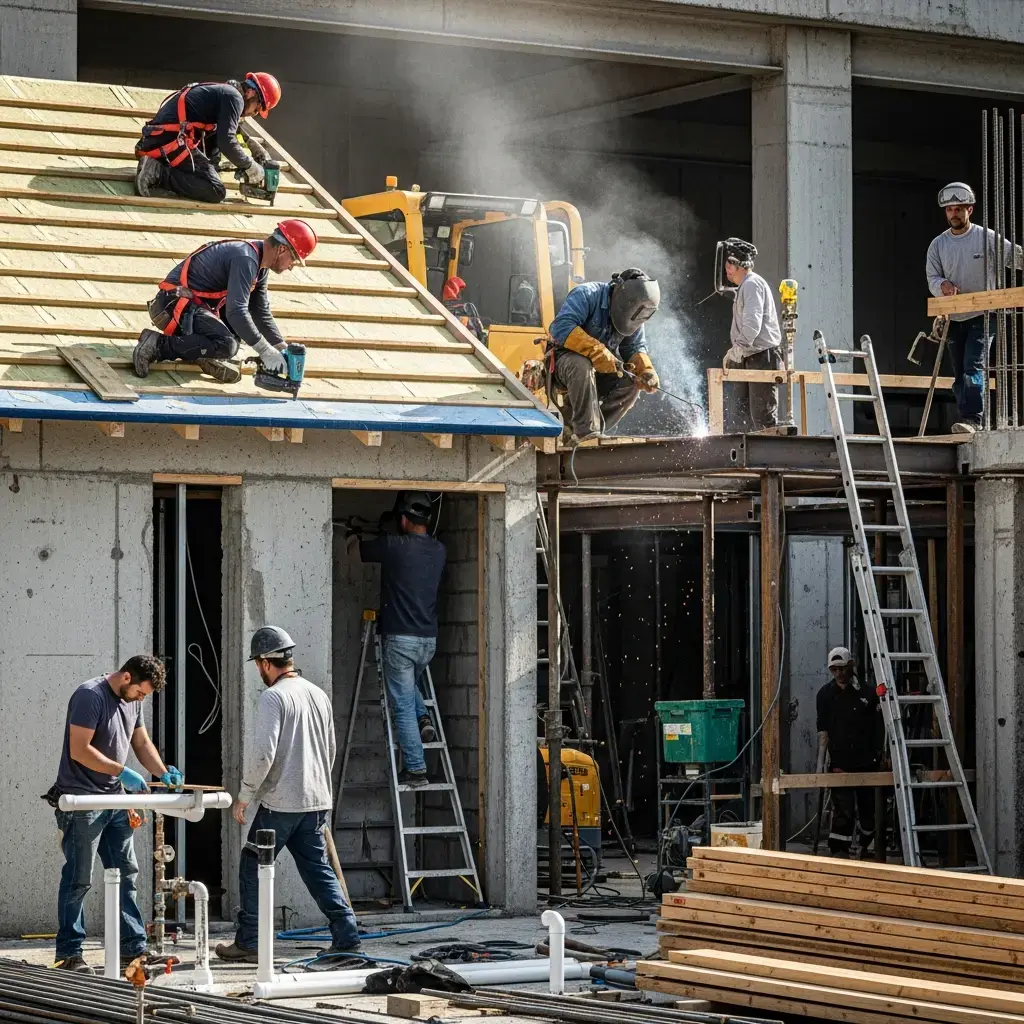
May relate to 29 CFR 1910.252
US welders exposed to fumes daily
Arc-eye emergency visits each year
Arc exposure that can burn unprotected eyes
Typical time to get scan results
What this scenario looks like
A welder fume and arc-flash hazard is any welding, cutting, or brazing operation where toxic fumes are not captured at the source and where the intense arc is not shielded from the welder and nearby workers. It shows up as haze hanging around the welder's head, an open arc with no screens, and helpers standing nearby in ordinary safety glasses instead of shaded protection.
In practice, the hazard forms when welding moves indoors or into a tank, duct, or pit without local exhaust ventilation, when a fan simply blows fume across the breathing zone, or when a rushed welder flips up the hood to reposition and takes a flash to the eyes. Galvanized, stainless, and coated metals dramatically raise fume toxicity, and confined spaces concentrate ozone and shielding gases to dangerous levels.
The danger is that both threats are deceptively quiet. Fume damage accumulates painlessly over years into lung disease and neurological effects, while a single arc flash may not hurt until hours later when the eyes feel full of sand. That delayed, invisible nature is exactly why photo-based detection of welding controls matters.
A labelled example scan for this scenario
Here is what an OSHA Scan report looks like for welder fume & arc flash. It is an illustrative example built from this scenario's hazards — clearly marked, not live scan data.
Compliance score
64
Lower means more potential hazards found
3 potential hazards found
Welder Fume & Arc Flash
Confirmed violationCriticalPossibly related to Welding, cutting, and brazing — general requirements (29 CFR 1910.252)
Observed condition: A welder fume and arc-flash hazard is any welding, cutting, or brazing operation where toxic fumes are not captured at the source and where the intense arc is not shielded from th…
Corrective action: Install local exhaust ventilation with source-capture hoods or fume guns at the arc
High confidence
Welder Fume & Arc Flash: Hexavalent chromium
Needs reviewHighPossibly related to Hexavalent chromium (29 CFR 1910.1026)
Observed condition: Sets the permissible exposure limit and requires monitoring, controls, and respiratory protection for welding on stainless steel and chromium-containing metals that release hexava…
Corrective action: Use welding screens and non-reflective curtains to contain arc radiation
Medium confidenceNot fully clear from the photo — verify on site.
Welder Fume & Arc Flash: Eye and face protection
Confirmed violationMediumPossibly related to Eye and face protection (29 CFR 1910.133)
Observed condition: Requires appropriate eye and face protection, including correctly shaded welding filters, for workers exposed to arc radiation, flying particles, and glare from welding operations.
Corrective action: Provide mechanical or supplied-air ventilation for confined-space welding
High confidence
See the workflow click into place
Illustrative AI-assisted workflows. Review the findings; they are not a compliance certification.
Why this scenario matters
Immediate consequences
A brief arc flash causes photokeratitis — painful 'arc eye' burns that can sideline a welder for days — while acute fume exposure triggers metal fume fever, dizziness, and, in confined spaces, asphyxiation from displaced oxygen.
Legal & financial impact
OSHA cites welding under 29 CFR 1910.252 and related fume standards, with serious violations exceeding $16,000. Long-term manganese and hexavalent chromium exposure fuels costly occupational-disease claims and litigation.
Operational impact
Fume-related illness and arc-eye injuries pull skilled welders off critical-path work, and ventilation shutdowns or air-monitoring failures can halt fabrication and trigger OSHA inspections that stall the whole project.
Industry-specific concerns
Structural steel, pipe fabrication, shipbuilding, and maintenance welders often work in tanks, ducts, and tight enclosures where fume concentrates fast and where multiple trades share the flash exposure of a single open arc.
How OSHA Scan detects this hazard
OSHA Scan uses an AI vision model to identify fume and arc-flash hazards in fabrication and field settings. Upload a photo and it detects active welding, checks for local exhaust ventilation, welding screens, respirators, and shaded eye protection, flags missing controls with a severity rating, and cites the OSHA standard it may relate to — in seconds, before the arc is struck.
Analyze your first photo freeScan a photo for welder fume & arc flash now
Upload a real job-site photo and OSHA Scan detects visible hazards in seconds — no account needed to run your first scan.
- Visible welding controls checked: source-capture exhaust, screens, shaded eye protection
- The welding standard like 29 CFR 1910.252 each missing control may relate to
- A verify-on-site note that a photo can't read fume levels, plus a dated exportable report
Use the real site or facility name. If you save the scan after signup, it becomes the report name.
Three angles, one deeper scan
Only the wide shot is required — every extra angle gives the AI more places to look.
Required: Set the scene — one wide shot lets the AI sweep the whole area at once
Stand at the entry point and capture corner to corner: floors, ladders, scaffolds, and everyone at work
Drop a job-site photo or walkthrough video
Click to upload, drag & drop, or snap a photo on site. Photos scan free in about 15 seconds — no signup, no card. Video walkthroughs (up to 3 min) run on a free account.
Accuracy boosters
Small habits, sharper scans
Set the scene
Start with context
Fill the frame
2–3 ft for close-ups; keep ladders, cords and workers fully in view.
Capture clearly
Make the frame usable
Light it right
Keep the sun or lights behind you — glare and shadows hide hazards.
Tap to focus
Tap the hazard on screen and hold still one second — blur can't be flagged.
Choose the useful view
Give the AI room to understand
Go landscape
Turn your phone sideways — a wider frame catches more of the scene.
Only upload photos you have permission to use, and avoid images showing personal, customer, or confidential information. Demo photos and results are held privately for up to 48 hours so you can save them to a free account; unclaimed photos are deleted automatically. Results are an AI-assisted preliminary review, not an official OSHA determination.
New: Video walkthrough scans
Record up to 3 minutes of your site — the AI extracts frames and categorizes findings with exact timestamps. Free account required.
Get the best results
Wide shot first
Stand at the entrance and photograph the entire work area so AI sees the full context
Hazard areas
Photograph elevated surfaces, equipment, electrical panels, and anywhere workers are active
Close-ups last
Move in close on anything damaged, missing, or that looks risky — the AI catches more detail
Stainless welding inside an unventilated tank
The situation
A welder was assigned to repair seams inside a stainless steel storage tank. The job was expected to take a full shift, and the crew set up a floor fan at the manway to 'keep air moving' rather than local exhaust ventilation.
What went wrong
Welding stainless produced hexavalent chromium and ozone that the fan simply stirred around the enclosed space. Within two hours the welder felt short of breath and dizzy; monitoring later showed fume levels far above the permissible limit, and a helper who glanced at the arc without shielding developed arc eye.
How OSHA Scan would have prevented it
A photo of the tank setup run through OSHA Scan would have flagged confined-space welding without local exhaust ventilation or a respirator and an unshielded arc near an unprotected helper as critical hazards, cited 29 CFR 1910.252, and prompted the crew to install source-capture ventilation, supplied-air respirators, and welding screens before striking an arc.
Lessons learned
General air movement is not ventilation. Confined and coated-metal welding demands source-capture exhaust and respiratory protection, and every open arc needs shielding — verify the full setup, ideally with a quick photo scan, before any welding begins.
Prevention best practices
Layered controls, from most to least effective.
Engineering controls
Capture fume and contain the arc so exposure is designed out of the task.
- Install local exhaust ventilation with source-capture hoods or fume guns at the arc
- Use welding screens and non-reflective curtains to contain arc radiation
- Provide mechanical or supplied-air ventilation for confined-space welding
- Substitute lower-fume processes or low-manganese consumables where feasible
- Position welding stations away from shared walkways and other trades
Administrative controls
Build the procedures that keep fume and flash exposure controlled.
- Conduct air monitoring for manganese, hexavalent chromium, and ozone
- Require confined-space permits and atmospheric testing before enclosed welding
- Post arc-flash and fume warning signage around active welding zones
- Run a hot-work permit program with fire watch and cleanup verification
- Train welders and helpers on fume toxicity and safe arc-shielding practice
Personal protective equipment
The last line of defense at the arc and in the breathing zone.
- Auto-darkening welding helmet with the correct shade for the process
- Air-purifying or supplied-air respirator matched to measured fume levels
- Flame-resistant welding jacket, gloves, and leathers to block UV and spatter
- Side-shielded safety glasses under the helmet for helpers and grinders
- Inspect helmets, respirators, and leathers before each use and replace damaged gear
OSHA compliance & citations
The federal standards this hazard may relate to.
Welding, cutting, and brazing — general requirements
Requires fire prevention, ventilation, and protection from fumes and gases for all welding, cutting, and brazing, including local exhaust or respiratory protection where contaminant limits are exceeded.
Up to $16,550 per serious violation; $165,514 for willful or repeat
Hexavalent chromium
Sets the permissible exposure limit and requires monitoring, controls, and respiratory protection for welding on stainless steel and chromium-containing metals that release hexavalent chromium.
Up to $16,550 per serious violation
Eye and face protection
Requires appropriate eye and face protection, including correctly shaded welding filters, for workers exposed to arc radiation, flying particles, and glare from welding operations.
Up to $16,550 per serious violation
Incident response protocol
If an incident occurs, act fast and in order.
Immediate actions (first 5 minutes)
- 1Stop welding and move the affected worker to fresh air
- 2Flush arc-eye injuries with clean water and shield eyes from light
- 3Check for breathing difficulty, dizziness, or metal fume fever symptoms
- 4Call 911 for severe respiratory distress or collapse in a confined space
- 5Account for helpers and bystanders who shared the fume or arc exposure
Emergency response (5-30 minutes)
- 1Arrange medical evaluation for eye burns or respiratory symptoms
- 2Ventilate or evacuate the space and confirm the atmosphere is safe
- 3Cooperate with responders and provide the metals and consumables involved
- 4Secure the welding area to prevent fire and further exposure
- 5Document the setup, ventilation, and PPE with photos
Post-incident
- 1Record any work-related illness or injury on the OSHA 300 log
- 2Investigate why ventilation, screens, or PPE were missing
- 3Repeat air monitoring to confirm exposure controls are adequate
- 4Retrain welders and helpers on fume and arc-flash protection
- 5Update welding and confined-space procedures as needed
Team training module
Welders and helpers will understand fume toxicity and arc-radiation hazards, recognize when controls are missing, and correctly set up ventilation, shielding, and respiratory and eye protection.
Train before welding begins, refresh annually, and reinforce with toolbox talks using real photos of welding setups and controls.
Training topics
- How welding fume and arc radiation harm the body
- Recognizing high-fume metals (stainless, galvanized, coated)
- Local exhaust ventilation and source-capture setup
- Confined-space welding and atmospheric testing
- Selecting respirators matched to measured fume levels
- Welding-helmet shade selection and arc-eye prevention
- Screens and barriers to protect nearby workers
- Hot-work permits and fire-watch procedures
- Air monitoring for manganese, chromium, and ozone
- OSHA welding requirements and penalties
Compliance checklist
Run these checks to stay ahead of citations.
Daily pre-work inspection
- Welding tasks, metals, and coatings identified for the shift
- Local exhaust ventilation set up and capturing fume at the source
- Welding screens or curtains in place to contain the arc
- Respirators available and matched to expected fume levels
- Auto-darkening helmets and correct filter shades in use
- Flame-resistant clothing, gloves, and leathers worn
- Hot-work permit and fire watch in place where required
- Confined-space permit and atmospheric test done for enclosed welding
Unlock the full Welder Fume & Arc Flash checklist
10 more checklist points are waiting. Register with your email to reveal every item and download the complete OSHA compliance checklist as a printable PDF. Free, and it only takes a few seconds.
Already have an account? Sign in
Frequently asked questions
What makes welding fumes so dangerous?
Welding fumes contain fine metal particles and gases such as manganese, hexavalent chromium, ozone, and nitrogen oxides. Inhaled over time they cause lung damage, neurological effects, and cancer, and in confined spaces shielding gases can displace oxygen and cause asphyxiation.
Is a regular fan enough ventilation for welding?
No. A general fan just stirs contaminated air through the breathing zone. OSHA expects local exhaust ventilation that captures fume at the source, and for confined or coated-metal welding you often need mechanical ventilation plus respiratory protection.
What is arc flash or arc eye in welding?
Arc eye, or photokeratitis, is a painful sunburn of the cornea caused by the intense ultraviolet light of the welding arc. It can occur from even a brief unshielded look at the arc and often is not felt until hours later, causing gritty, watering, light-sensitive eyes.
What are the OSHA penalties for unsafe welding operations?
A serious violation of 29 CFR 1910.252 or related fume and eye-protection standards can exceed $16,000 per instance, and willful or repeat violations can top $165,000. Overexposure to hexavalent chromium or manganese can also drive costly long-term disease claims.
Do welders always need a respirator?
Not always, but respirators are required when engineering controls cannot keep fume below permissible limits, and almost always for confined-space or stainless-steel welding. Air monitoring determines the exposure level and the correct type of respiratory protection.
How do you protect nearby workers from the arc?
Use welding screens, curtains, or portable barriers to contain arc radiation, and keep other trades outside the flash zone. Helpers and anyone who may glance at the arc need shaded eye protection appropriate to the welding process.
Why is welding coated or galvanized metal riskier?
Coatings and platings release far more toxic fume when heated — zinc from galvanizing causes metal fume fever, and chromium coatings release hexavalent chromium. These jobs require stronger source-capture ventilation and respiratory protection than welding bare steel.
How accurate is OSHA Scan at detecting welding hazards?
OSHA Scan detects welding fume and arc-flash hazards. It recognizes active welding, checks for ventilation, screens, respirators, and shaded protection, and returns the specific location and OSHA citation.
Protect your welders today
Analyze a photo
Upload a photo of your welding area and get instant, specific feedback on missing ventilation, screens, and protection in your exact environment.
Get startedGet the prevention checklist
Put our expert welding fume and arc-flash checklist to work on your next fabrication job to stay ahead of citations.
Get startedTalk to our team
See how OSHA Scan fits your welding operation and get recommendations for your specific fume and arc-flash risks.
Get startedJoin safety-first contractors
See how other fabricators use OSHA Scan to protect welders from fume and arc-flash hazards before they cause harm.
Get startedAI photo hazard review
Snap a photo of the job site, and the AI categorizes findings against OSHA standards in seconds.
Consistent corrective actions & JHA
Each finding includes consistent corrective actions and structured JHA outputs. Check items off as your crew resolves them.
Emergency action plans
Access jurisdiction-specific guidelines and emergency action plan templates for your sites.
A qualified person must review AI-flagged items before making safety decisions. Do not replace required comprehensive safety walkthroughs with AI reports. Features, limits, and downloads depend on your account’s plan and permissions.
What the AI can and can't detect
OSHA Scan reads a single photo. That makes it fast and easy for anyone on site — but it also means it has real limits. Here's an honest look at both.
What it can catch from a photo
- Missing or incorrect PPE that is visible in the frame
- Unprotected edges, open holes, and visible fall hazards
- Housekeeping, trip, and blocked walkway or exit hazards
- Visible electrical, struck-by, and equipment-guarding hazards
What a photo can't tell it
- Hazards hidden from view or anything outside the photo
- Exact heights, distances, weights, or measurements
- Training records, procedures, or how equipment is actually used
- Full legal compliance or an official OSHA pass/fail determination
Reviewed by OSHA Scan Editorial
This content is produced by the OSHA Scan Editorial team and reviewed with AI assistance. It is general safety information, not legal or compliance advice. OSHA Scan is an independent tool and is not affiliated with, endorsed by, or certified by OSHA or the U.S. Department of Labor.
Ready to catch hazards before they become incidents?
Start with exactly 5 lifetime AI site scans — no credit card. Build JHA-ready reports and catch changing conditions sooner.
Start your free trial