
1
Set the scene
Start with context
Fill the frame
2–3 ft for close-ups; keep ladders, cords and workers fully in view.
Fume exposure, fire, arc flash, and heat stress
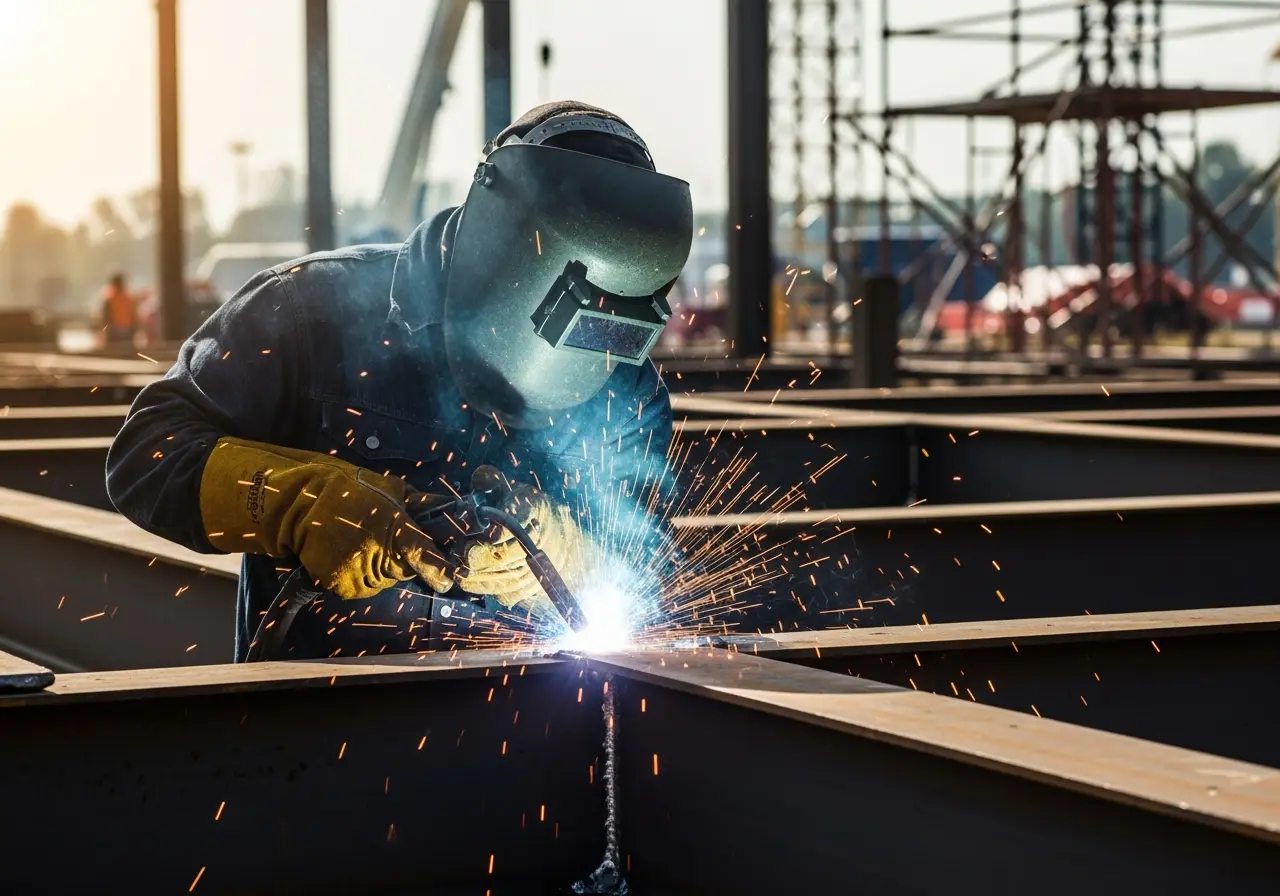
Welding endangers workers twice: instantly through fire, arc flash, and shock, and slowly through years of breathing toxic metal fumes. OSHA Scan analyzes photos of hot-work areas to catch missing ventilation, fire watch, and PPE before a spark or a lungful of manganese does lasting harm.
Free · No account needed to scan · Results in seconds
workers exposed to welding hazards in the U.S.
of welder injuries involve the eyes
average cost of a hot-work fire incident
toxic compounds found in welding fume
Upload a real job-site photo and OSHA Scan detects visible welding hazards in seconds — no account needed to run your first scan.
Use the real site or facility name. If you save the scan after signup, it becomes the report name.
Three angles, one deeper scan
Only the wide shot is required — every extra angle gives the AI more places to look.
Required: Set the scene — one wide shot lets the AI sweep the whole area at once
Stand at the entry point and capture corner to corner: floors, ladders, scaffolds, and everyone at work
Drop a job-site photo or walkthrough video
Click to upload, drag & drop, or snap a photo on site. Photos scan free in about 15 seconds — no signup, no card. Video walkthroughs (up to 3 min) run on a free account.
Small habits, sharper scans
Set the scene
Start with context
Fill the frame
2–3 ft for close-ups; keep ladders, cords and workers fully in view.
Capture clearly
Make the frame usable
Light it right
Keep the sun or lights behind you — glare and shadows hide hazards.
Tap to focus
Tap the hazard on screen and hold still one second — blur can't be flagged.
Choose the useful view
Give the AI room to understand
Go landscape
Turn your phone sideways — a wider frame catches more of the scene.
Only upload photos you have permission to use, and avoid images showing personal, customer, or confidential information. Demo photos and results are held privately for up to 48 hours so you can save them to a free account; unclaimed photos are deleted automatically. Results are an AI-assisted preliminary review, not an official OSHA determination.
Here is what an OSHA Scan report looks like for welding hazards. It is an illustrative example built from this trade's hazards — clearly marked, not live scan data.
Compliance score
64
Lower means more potential hazards found
3 potential hazards found
Hot-work fire
Possibly related to Welding, cutting, and brazing — general requirements (29 CFR 1910.252)
Observed condition: A welder cuts steel near stored cardboard and solvent without a fire watch.
Corrective action: Use local exhaust ventilation or fume-extraction guns at the arc
High confidence
Manganese fume overexposure
Possibly related to Hazard communication (29 CFR 1910.1200)
Observed condition: A welder works on manganese-alloy steel in an enclosed bay with no local exhaust.
Corrective action: Weld in designated bays with fire-resistant surroundings
Medium confidenceNot fully clear from the photo — verify on site.
Arc eye
Possibly related to Hexavalent chromium (29 CFR 1910.1026)
Observed condition: A helper watches an arc without eye protection for a few minutes.
Corrective action: Purge and test tanks and vessels before hot work
High confidence
Illustrative AI-assisted workflows. Review the findings; they are not a compliance certification.
Welding generates a dangerous combination of hazards. Welding fume is a mix of metal oxides — including manganese, hexavalent chromium, and zinc — that damages the lungs and nervous system over time and can cause metal-fume fever in the short term. The intense arc emits ultraviolet and infrared radiation that burns the eyes ('arc eye') and skin like a sunburn within minutes.
Primary OSHA standard: 29 CFR 1910.252
Welding generates a dangerous combination of hazards. Welding fume is a mix of metal oxides — including manganese, hexavalent chromium, and zinc — that damages the lungs and nervous system over time and can cause metal-fume fever in the short term. The intense arc emits ultraviolet and infrared radiation that burns the eyes ('arc eye') and skin like a sunburn within minutes.
The process is also a constant ignition source. Sparks and molten spatter travel up to 35 feet and can smolder unseen for hours, making fire and explosion — especially near flammables or in confined spaces — one of the leading causes of serious hot-work incidents. Arc welding equipment adds electrical shock risk, particularly in damp conditions.
Finally, welders work under heavy PPE near intense heat, creating real heat-stress risk, and often in awkward positions that cause musculoskeletal strain. These layered hazards mean effective welding safety has to address ventilation, fire control, radiation, shock, and heat all together.
OSHA regulates hot work, welding fume exposure, and hazard communication. Fires and overexposures draw citations and, increasingly, hexavalent-chromium enforcement.
Chronic fume exposure is linked to manganism, lung disease, and cancer, while arc radiation and burns cause immediate, painful injury.
A single hot-work fire can destroy a facility and a company. Insurers scrutinize hot-work permit programs closely.
Fabricators and contractors with strong fume-control and hot-work programs win work on projects with strict safety prequalification.
A welder cuts steel near stored cardboard and solvent without a fire watch. Spatter ignites the materials and a fire spreads before anyone notices, causing major property damage.
A welder works on manganese-alloy steel in an enclosed bay with no local exhaust. Months of exposure produce neurological symptoms consistent with manganism.
A helper watches an arc without eye protection for a few minutes. Hours later he suffers intense pain and temporary vision loss from ultraviolet burns to the cornea.
A welder repairs a tank that once held flammable liquid without purging or testing it. Residual vapor ignites and the confined space channels the explosion.
A welder works in damp conditions with a frayed electrode holder cable. Contact between the wet environment and the exposed conductor causes a shock.
The federal regulations that govern welding work.
Sets fire prevention, hot-work permit, ventilation, and personnel protection requirements for welding and cutting operations.
Requires SDS, labeling, and training for welding consumables and the metals being welded, including hexavalent chromium sources.
Limits exposure to hexavalent chromium generated when welding stainless and coated steels, requiring monitoring and controls.
Governs safe storage, handling, and use of compressed gas cylinders used in gas welding and cutting.
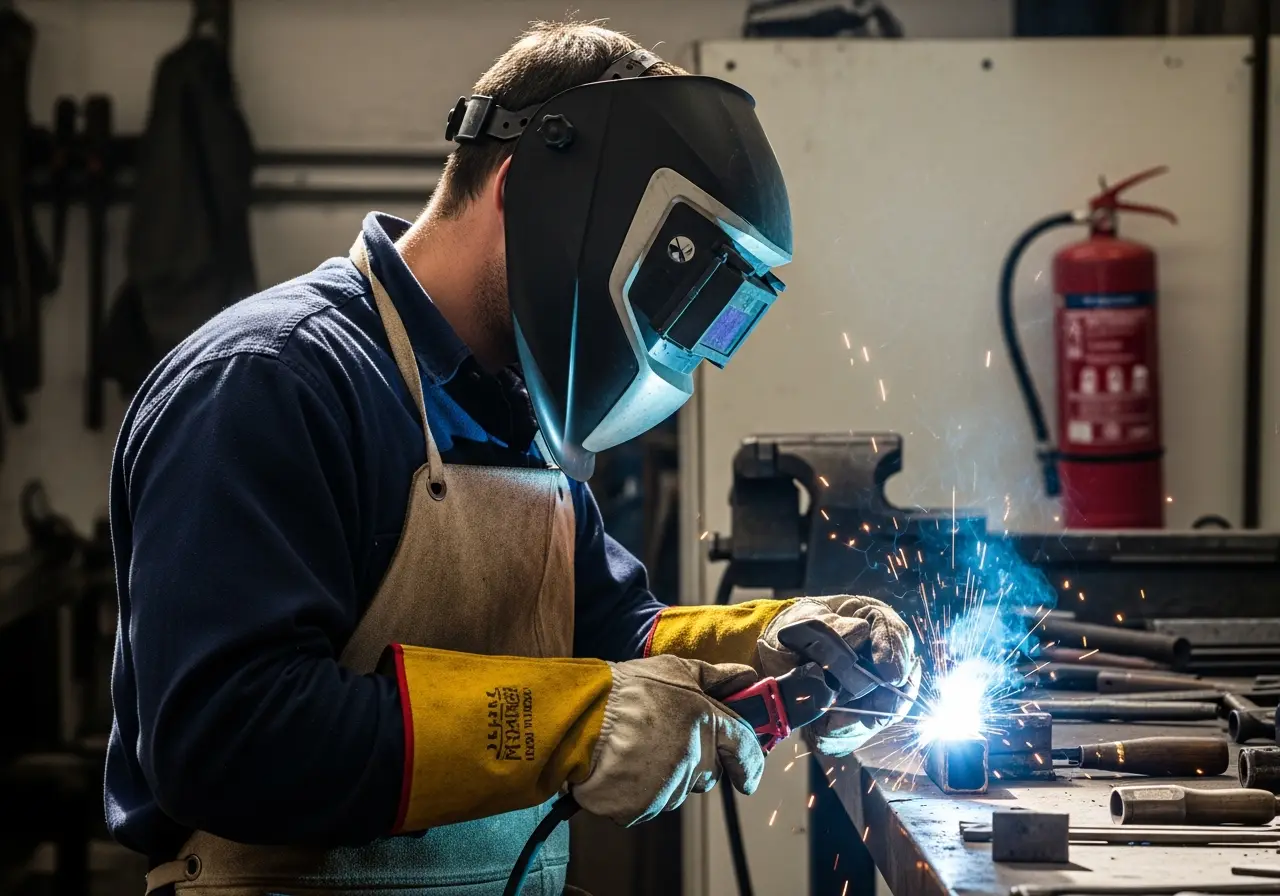
Work top-down through the hierarchy of controls — eliminate the hazard first, then fall back to procedures and PPE.
Capture fume and remove ignition risk at the source.
Control hot work with permits and a fire watch.
Protect against radiation, burns, and residual fume.
Only trained, qualified welders who understand fume, fire, and arc hazards can control them consistently on every job.
OSHA Scan analyzes photos of welding and cutting areas to flag combustibles within the spark zone, missing welding screens, absent local exhaust or fume extraction, and welders or helpers without proper eye and flame-resistant protection. Upload a photo of the bay or field setup and OSHA Scan returns an instant report citing the applicable OSHA standard for each finding, plus a corrective-action checklist covering fire watch, ventilation, and PPE before the arc is struck.
Welding fume is a fine mix of metal oxides that includes manganese, hexavalent chromium, nickel, and zinc depending on the base metal and consumable. Inhaled over time it is linked to manganism, lung disease, and cancer; in the short term high zinc exposure causes metal-fume fever. Local exhaust ventilation at the arc is the most effective control.
A hot-work permit is a documented authorization confirming that fire hazards have been controlled before welding or cutting begins outside a designated area. It requires removing or shielding combustibles within 35 feet, having fire extinguishing equipment ready, and posting a fire watch during and after the work.
Sparks and slag can smolder unseen and ignite materials up to hours later. OSHA and NFPA require a fire watch to remain for at least 30 minutes after hot work ends to catch any developing fire while it is still small and controllable.
Always use a welding helmet with the correct shade for the process and current, and never look at an arc — even briefly — without protection. Use welding screens to shield helpers and bystanders, since ultraviolet burns to the cornea can occur several feet away from someone else's arc.
Not without purging and testing it first. Containers that held flammable or unknown substances can retain explosive vapor, and welding on them is a leading cause of fatal explosions. The vessel must be cleaned, purged, and confirmed vapor-free, and confined-space rules may also apply.
It depends on the exposure. When ventilation cannot keep fume below permissible limits — common with stainless (hexavalent chromium) or manganese alloys or in confined spaces — welders need respiratory protection selected under a written program, with fit testing and medical clearance.
OSHA classifies most welding citations as serious, other-than-serious, or willful/repeat. Serious violations carry penalties in the thousands of dollars per instance, while willful or repeat violations can reach the statutory maximum of well over $160,000 each, and penalties are adjusted for inflation annually. Common welding-related citations involve missing hot-work fire prevention under 1910.252, inadequate hazard communication under 1910.1200, and overexposure to hexavalent chromium under 1910.1026. Beyond the fine itself, a hot-work fire or fume overexposure often triggers a broader inspection that uncovers additional citations, and willful violations tied to a fatality can lead to criminal referral. Insurers frequently raise premiums or decline coverage after a hot-work fire, so the true cost of a violation extends well past the OSHA penalty into higher operating costs and lost contracts.
Welders should complete initial training before performing hot work and receive documented refresher training at least annually on fire prevention, hazard communication, and respiratory protection. Welder performance qualification under AWS or a project welding procedure specification must be maintained; qualifications generally remain valid as long as the welder uses the process, but many employers requalify or verify continuity every six months and after any change in process, position, or base metal. Fire-watch personnel need training on extinguisher use and alarm procedures before being assigned. Respirator users require annual fit testing and medical evaluation under the respiratory-protection standard. Retraining is also required after any incident, near-miss, or observation of unsafe practice. Keeping signed attendance and qualification records is essential, because OSHA and general contractors routinely request proof of current welder and fire-watch training during audits and prequalification.
Every hot-work area needs a defined emergency response before the arc is struck. Workers must know the location of extinguishers and how to use them, the nearest alarm pull station, and evacuation routes. The fire watch should attempt to control only small, incipient fires and immediately sound the alarm and evacuate if the fire grows. For confined-space or tank work, a rescue plan and trained rescuers must be in place because a fire or explosion can trap the welder. Burn victims should be moved to safety, cooled, and given prompt medical care, while arc-eye cases need eye flushing and evaluation. The plan should list emergency contacts, the site address for responders, and shutoff locations for fuel gas and electrical supply. Practicing the plan and confirming extinguisher access are part of the hot-work permit process.
The cost of running a proper hot-work program is trivial next to the cost of a fire. Fire extinguishers, welding screens, fume extraction, and a fire watch add modest expense to a job, while permits and toolbox talks cost only time. By contrast, the average hot-work fire causes tens of thousands of dollars in property damage, and a major facility fire can run into the millions and end a business. Add OSHA penalties, workers' compensation for burns or manganese-related illness, higher insurance premiums, business interruption, and lost contracts, and the incident cost dwarfs prevention many times over. Fume-related illness carries long-tail medical and liability costs that surface years later. Insurers increasingly require documented permit programs, so compliance also protects coverage. Treating fume extraction, fire watch, and permits as standard cost of doing business is far cheaper than absorbing even one serious hot-work incident.
Run through this before, during, and after every job.
14 more checklist points are waiting. Register with your email to reveal every item and download the complete OSHA compliance checklist as a printable PDF. Free, and it only takes a few seconds.
Already have an account? Sign in
A maintenance welder made a quick repair to a steel bracket in a warehouse aisle near stored packaging. Because it was 'just a five-minute job,' no hot-work permit was issued and no fire watch was posted.
Spatter had landed in a pallet of cardboard and smoldered undetected. Ninety minutes after the welder left, the pallet burst into flames, and the fire spread through the storage racks before sprinklers and responders could contain it, causing significant losses.
The company implemented a strict hot-work permit program requiring combustible clearance, extinguishers, and a 30-minute post-work fire watch for any welding outside the shop. It adopted OSHA Scan to photo-verify that the spark zone was clear and a fire watch was staged before work began.
The facility recorded no further hot-work fires. Its insurer reduced premiums after reviewing the permit program, and supervisors credited the required photo check with catching several near-misses where combustibles had not yet been cleared.
Snap a photo of the job site, and the AI categorizes findings against OSHA standards in seconds.
Each finding includes consistent corrective actions and structured JHA outputs. Check items off as your crew resolves them.
Build a searchable chemical library from label photos. Review manufacturer SDS matches when available and follow the status of missing documents.
Missing-document requests enter a review queue; they do not automatically contact suppliers.
Invite admins, managers, and supervisors with role-based access that keeps the right people in control.
A qualified person must review AI-flagged items before making safety decisions. Do not replace required comprehensive safety walkthroughs with AI reports. Features, limits, and downloads depend on your account’s plan and permissions.
OSHA Scan reads a single photo. That makes it fast and easy for anyone on site — but it also means it has real limits. Here's an honest look at both.
Reviewed by OSHA Scan Editorial
This content is produced by the OSHA Scan Editorial team and reviewed with AI assistance. It is general safety information, not legal or compliance advice. OSHA Scan is an independent tool and is not affiliated with, endorsed by, or certified by OSHA or the U.S. Department of Labor.
Upload a photo of your welding job site and get an instant, OSHA-cited hazard report.
Start your free trial