
1
Set the scene
Start with context
Fill the frame
2–3 ft for close-ups; keep ladders, cords and workers fully in view.
High voltage, arc flash, and falls from height
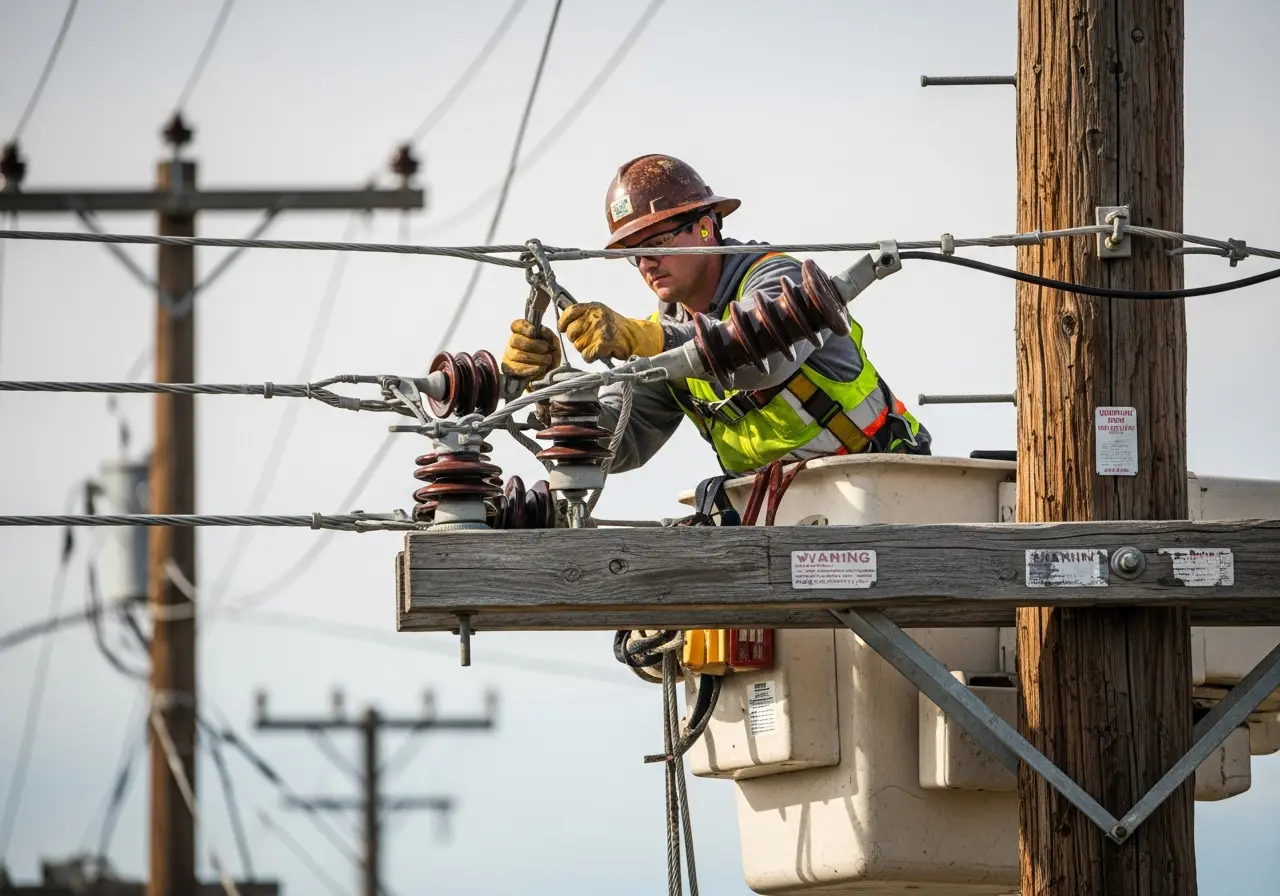
Line workers face lethal voltage, arc flash energy, and falls from poles and buckets — often all at once, and frequently far from immediate help. OSHA Scan helps utility crews verify grounding, clearances, and fall protection from a photo before energized work begins.
Free · No account needed to scan · Results in seconds
the fatality rate of the average U.S. job
transmission voltages line workers approach
typical working height on distribution poles
of electrocutions involve overhead power lines
Upload a real job-site photo and OSHA Scan detects visible utility and linework hazards in seconds — no account needed to run your first scan.
Use the real site or facility name. If you save the scan after signup, it becomes the report name.
Three angles, one deeper scan
Only the wide shot is required — every extra angle gives the AI more places to look.
Required: Set the scene — one wide shot lets the AI sweep the whole area at once
Stand at the entry point and capture corner to corner: floors, ladders, scaffolds, and everyone at work
Drop a job-site photo or walkthrough video
Click to upload, drag & drop, or snap a photo on site. Photos scan free in about 15 seconds — no signup, no card. Video walkthroughs (up to 3 min) run on a free account.
Small habits, sharper scans
Set the scene
Start with context
Fill the frame
2–3 ft for close-ups; keep ladders, cords and workers fully in view.
Capture clearly
Make the frame usable
Light it right
Keep the sun or lights behind you — glare and shadows hide hazards.
Tap to focus
Tap the hazard on screen and hold still one second — blur can't be flagged.
Choose the useful view
Give the AI room to understand
Go landscape
Turn your phone sideways — a wider frame catches more of the scene.
Only upload photos you have permission to use, and avoid images showing personal, customer, or confidential information. Demo photos and results are held privately for up to 48 hours so you can save them to a free account; unclaimed photos are deleted automatically. Results are an AI-assisted preliminary review, not an official OSHA determination.
Here is what an OSHA Scan report looks like for utility and linework hazards. It is an illustrative example built from this trade's hazards — clearly marked, not live scan data.
Compliance score
64
Lower means more potential hazards found
3 potential hazards found
Flashover from inadequate clearance
Possibly related to Electric power generation, transmission, and distribution (29 CFR 1910.269)
Observed condition: A worker in a bucket approaches an energized conductor closer than the minimum approach distance.
Corrective action: De-energize lines and apply protective grounds before work
High confidence
Improper grounding on de-energized line
Possibly related to Electric power transmission and distribution (construction) (29 CFR 1926 Subpart V)
Observed condition: A crew works a supposedly de-energized line without applying protective grounds.
Corrective action: Maintain minimum approach distances for the system voltage
Medium confidenceNot fully clear from the photo — verify on site.
Fall from a pole
Possibly related to Fall protection (29 CFR 1926.501)
Observed condition: A lineman's climbing gear fails or is improperly secured during a repositioning move, and the worker falls from the pole to the ground.
Corrective action: Use insulated aerial buckets, hotsticks, and line hose for live-line work
High confidence
Illustrative AI-assisted workflows. Review the findings; they are not a compliance certification.
Utility line work combines the deadliest hazards of several trades. Workers routinely approach energized conductors carrying thousands to hundreds of thousands of volts, where even nearby proximity — not just contact — can cause a flashover. Arc flash and arc blast release enormous heat and pressure, and a single mistake in grounding or clearance can be instantly fatal.
Primary OSHA standard: 29 CFR 1910.269
Utility line work combines the deadliest hazards of several trades. Workers routinely approach energized conductors carrying thousands to hundreds of thousands of volts, where even nearby proximity — not just contact — can cause a flashover. Arc flash and arc blast release enormous heat and pressure, and a single mistake in grounding or clearance can be instantly fatal.
The work happens at height, on poles and in aerial buckets 40 feet or more above ground, adding fall hazards to the electrical ones. Crews often work alongside traffic and heavy equipment such as digger derricks and bucket trucks, introducing struck-by and vehicle hazards, and they frequently respond to storms in poor weather and darkness.
What sets line work apart is the rescue problem: a worker incapacitated at the top of an energized pole cannot simply be pulled to safety. Pole-top and bucket rescue require specialized training and equipment, and delays cost lives — which is why prevention and correct de-energizing or grounding matter above all.
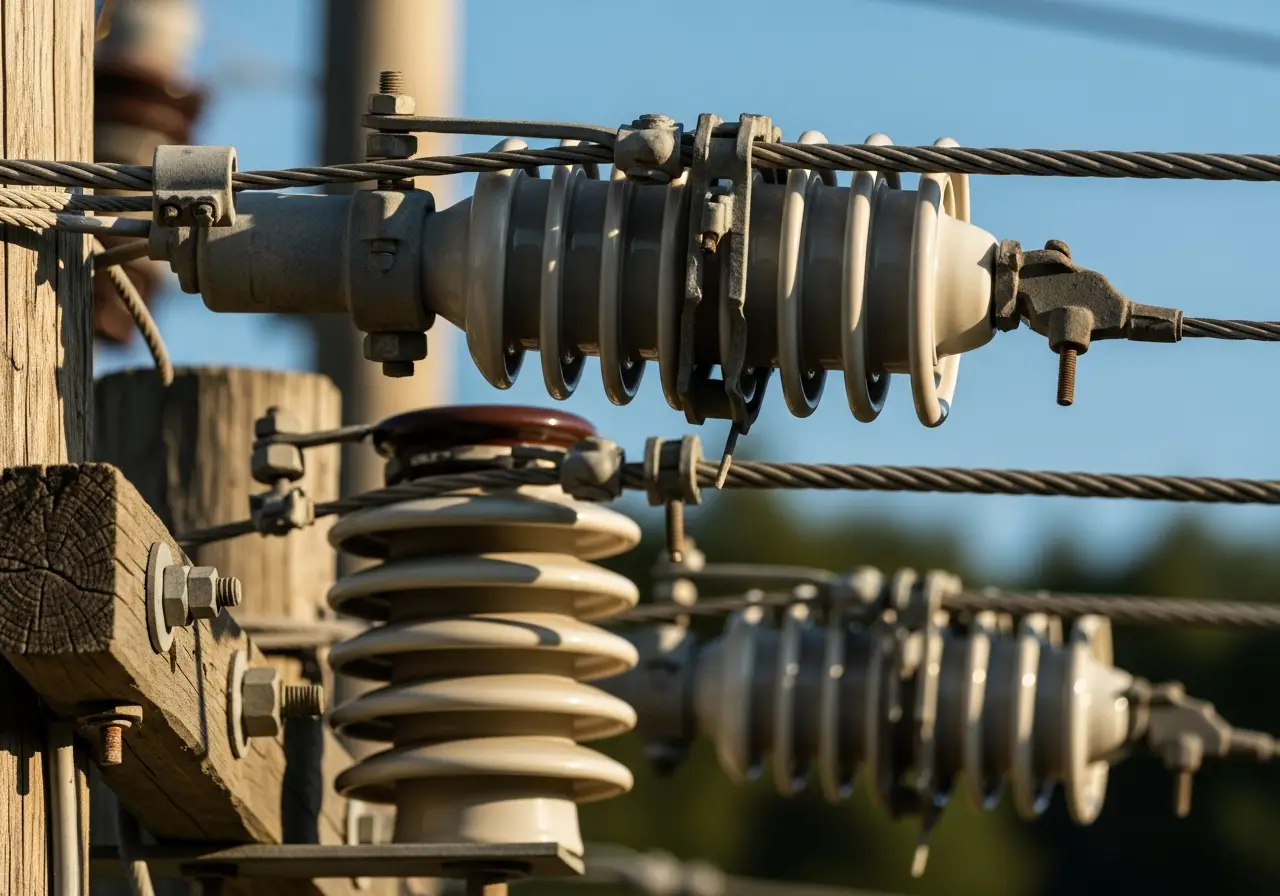
OSHA 1910.269 and 1926 Subpart V set strict minimum approach distances and grounding rules. Violations are treated as extremely serious given the fatality risk.
Contact with transmission voltage is almost always fatal, and arc flash survivors face catastrophic burns. Falls from poles compound the danger.
Utility and contractor safety records are scrutinized by regulators and clients; a fatality can end a contract and invite heavy penalties.
Utilities award mutual-aid and line-construction contracts to crews with proven, documented safety performance.
A worker in a bucket approaches an energized conductor closer than the minimum approach distance. The high voltage arcs across the gap, causing a fatal flashover without any direct contact.
A crew works a supposedly de-energized line without applying protective grounds. A backfeed from a customer generator re-energizes the line and electrocutes a worker.
A lineman's climbing gear fails or is improperly secured during a repositioning move, and the worker falls from the pole to the ground.
A ground worker is caught between a digger derrick outrigger and a structure while positioning a pole, suffering crushing injuries.
Responding at night to restore power, a crew misjudges a downed conductor still energized by an isolated section and a worker makes contact in the dark.
The federal regulations that govern utility linework work.
The core standard for utility work, covering minimum approach distances, grounding, host/contract employer coordination, and rescue requirements.
Governs construction of power lines, including clearances, protective grounding, and use of insulated equipment.
Requires fall protection for elevated work, including pole climbing and aerial-lift operations at height.
Requires isolation and grounding of de-energized lines and equipment before work to prevent accidental or backfed re-energization.
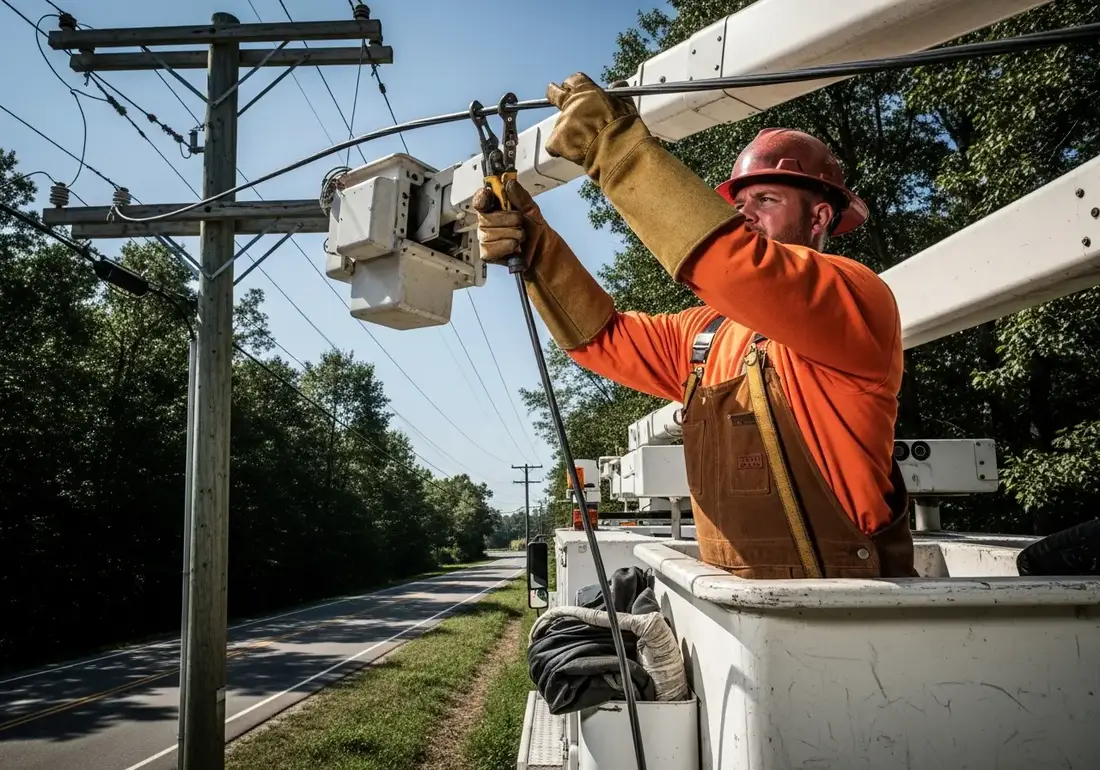
Work top-down through the hierarchy of controls — eliminate the hazard first, then fall back to procedures and PPE.
De-energize and ground whenever possible; isolate the worker from live parts.
Coordinate switching, grounding, and rescue before anyone goes up.
Protect against residual electrical, arc, and fall hazards.
Line work is unforgiving of error, so only apprenticeship-trained, qualified workers who can prove their competency in switching, grounding, and pole-top rescue should approach energized systems.
OSHA Scan reviews photos of utility job sites to flag visible hazards: workers positioned inside minimum approach distances, missing protective grounds, energized conductors left uncovered near the work, absent or unclipped fall protection on poles and in buckets, and ground crews standing in equipment crush zones. Each finding cites the relevant OSHA standard and generates a corrective-action checklist, giving crew leaders a fast way to catch a fatal setup before the work goes live.
The minimum approach distance is the closest a qualified worker may come to an energized conductor for a given voltage without insulation. It grows with voltage and is defined in OSHA 1910.269 tables. Crossing it risks a flashover even without contact, so the distance must be calculated and enforced for every job.
A de-energized line can be re-energized without warning by induction from parallel lines, lightning, switching errors, or backfeed from a customer's generator. Applying protective grounds creates a low-resistance path that trips protection and keeps the worker at the same potential, so grounding is required even when the line is believed dead.
Line workers use work-positioning systems for climbing and fall arrest systems where positioning alone is insufficient. Wood-pole fall protection must be capable of arresting a fall while allowing controlled movement, and all components are inspected before each use and after any fall.
Because an incapacitated worker cannot be reached from the ground, crews must be trained and equipped for pole-top and bucket rescue and able to lower a victim quickly. OSHA requires rescue capability to be planned and available before energized work begins, not improvised after an incident.
Most involve unexpected contact with or proximity to energized overhead conductors — misjudged clearances, un-grounded lines that were backfed, or equipment such as cranes contacting lines. Verifying de-energization, grounding, and clearances eliminates the large majority of these fatalities.
The hazards are amplified but the rules do not relax. Fatigue, darkness, and unknown circuit status make grounding, minimum approach distances, and job briefings more important, not less. Downed lines must be treated as energized until positively confirmed and grounded.
OSHA 1910.269 requires that line workers be trained and that their competency be verified before they perform qualified work, with retraining whenever a worker's job changes, new procedures or equipment are introduced, or an evaluation shows they are not following safe practices. Rescue capability is a specific focus: crews must be trained and able to perform pole-top and bucket rescue, and most utilities require documented hands-on rescue drills at least annually because an incapacitated worker at height cannot wait for outside help. First aid and CPR certification must be current for crew members, and switching, grounding, and minimum-approach-distance knowledge should be refreshed regularly. Every training and drill event must be documented with dates, participants, and demonstrated competency so the employer can prove qualification during an inspection or after an incident. Because line-work skills are high-consequence, frequent hands-on practice is what keeps them reliable.
Because line-work violations carry a high fatality risk, OSHA treats them as serious or willful, and penalties can reach into six figures per willful or repeat violation, with serious violations running into the thousands each. A fatality investigation frequently produces multiple stacked citations covering minimum approach distances, grounding, fall protection, and job briefings. Those direct fines are only part of the exposure: utilities and contractors also face litigation, sharply higher insurance costs, regulatory scrutiny from public utility commissions, and the loss of mutual-aid and line-construction contracts that are awarded on safety performance. A single serious incident can end a contractor's relationship with a utility. The practical lesson is that documented grounding, clearance enforcement, and rescue readiness are far cheaper than the combined regulatory, legal, and reputational cost of a contact or fall event.
Employers must document job briefings, switching and clearance orders, protective grounding, and the qualification and training records of every line worker. Test and inspection records for rubber goods — gloves, sleeves, line hose, and blankets — must be maintained because these items require periodic dielectric testing on defined intervals, and hotsticks and insulated aerial devices have their own testing schedules. Fall-protection inspections, rescue-drill records, and incident and near-miss reports round out the file. This documentation is not just bureaucracy: it proves that grounds were applied, clearances were held, and workers were qualified, which is central both to OSHA compliance and to defending the utility after an event. Photo-based tools such as OSHA Scan can capture and timestamp field conditions, creating durable evidence that grounds, covers, and fall protection were actually in place before the crew went live.
Stop work immediately if a line's status cannot be positively confirmed, if protective grounds have not been applied where required, if minimum approach distances cannot be maintained, or if a backfeed source such as a customer generator cannot be ruled out. Work should also halt when fall protection is missing or damaged, when rubber goods or hotsticks are out of test or show defects, when a rescue plan and capability are not in place, or when weather, darkness, or fatigue during storm response raises the risk beyond what the controls can manage. Every crew member has the authority and duty to stop a job that feels unsafe without fear of reprisal, and any downed conductor must be treated as energized until confirmed dead and grounded. A delayed restoration is always preferable to a contact or flashover fatality.
Run through this before, during, and after every job.
15 more checklist points are waiting. Register with your email to reveal every item and download the complete OSHA compliance checklist as a printable PDF. Free, and it only takes a few seconds.
Already have an account? Sign in
A distribution crew was replacing a damaged pole on a line they had switched out and confirmed de-energized. Under time pressure to restore service, they skipped applying protective grounds because the line was 'dead.'
A customer downstream had connected a portable generator to their home without a transfer switch, backfeeding the de-energized line. When a lineman contacted the conductor, it was live. He survived only because his rubber gloves were in place and limited the current path.
The utility made protective grounding mandatory on every de-energized job with no exceptions, expanded its public campaign on generator backfeed, and adopted OSHA Scan to photo-verify that grounds and PPE were in place before crews began work.
Grounding compliance reached 100% on audited jobs, and the utility reported no further backfeed contact incidents. The near-miss became a standing example in job briefings of why 'confirmed dead' is never a substitute for grounding.
Snap a photo of the job site, and the AI categorizes findings against OSHA standards in seconds.
Each finding includes consistent corrective actions and structured JHA outputs. Check items off as your crew resolves them.
Build a searchable chemical library from label photos. Review manufacturer SDS matches when available and follow the status of missing documents.
Missing-document requests enter a review queue; they do not automatically contact suppliers.
Invite admins, managers, and supervisors with role-based access that keeps the right people in control.
A qualified person must review AI-flagged items before making safety decisions. Do not replace required comprehensive safety walkthroughs with AI reports. Features, limits, and downloads depend on your account’s plan and permissions.
OSHA Scan reads a single photo. That makes it fast and easy for anyone on site — but it also means it has real limits. Here's an honest look at both.
Reviewed by OSHA Scan Editorial
This content is produced by the OSHA Scan Editorial team and reviewed with AI assistance. It is general safety information, not legal or compliance advice. OSHA Scan is an independent tool and is not affiliated with, endorsed by, or certified by OSHA or the U.S. Department of Labor.
Upload a photo of your utility linework job site and get an instant, OSHA-cited hazard report.
Start your free trial