
1
Set the scene
Start with context
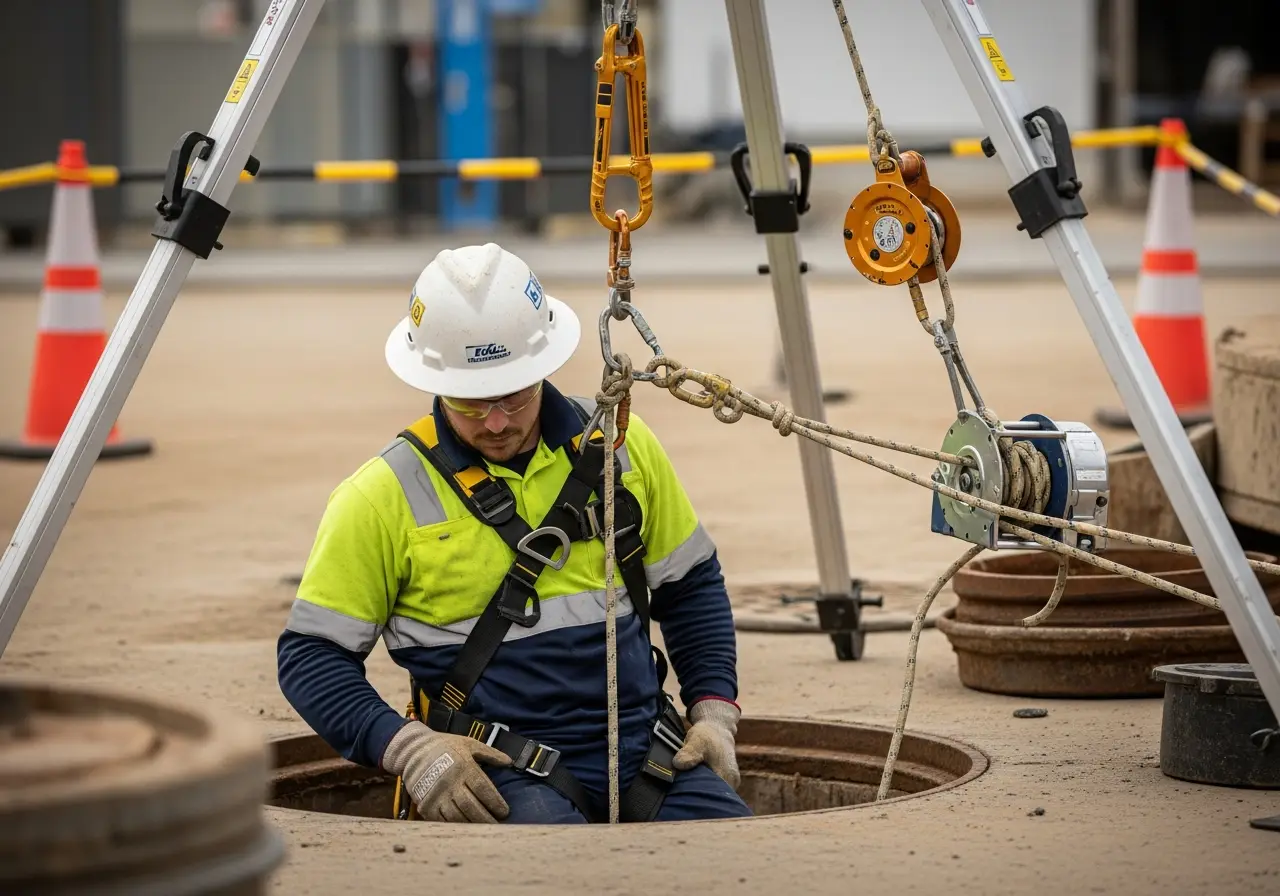
Fill the frame
2–3 ft for close-ups; keep ladders, cords and workers fully in view.
Atmospheric hazards, engulfment, and rescue failures
More than 60% of confined space fatalities are would-be rescuers who rushed in without protection. Oxygen deficiency, toxic gas, and engulfment can kill in minutes and give no warning. OSHA Scan helps you spot unpermitted entries and missing controls before a worker ever goes in.
Free · No account needed to scan · Results in seconds
of confined space deaths are untrained rescuers
to lose consciousness in low-oxygen air
confined space fatalities in the U.S. each year
minimum safe oxygen level for entry
Upload a real job-site photo and OSHA Scan detects visible confined space hazards in seconds — no account needed to run your first scan.
Use the real site or facility name. If you save the scan after signup, it becomes the report name.
Three angles, one deeper scan
Only the wide shot is required — every extra angle gives the AI more places to look.
Required: Set the scene — one wide shot lets the AI sweep the whole area at once
Stand at the entry point and capture corner to corner: floors, ladders, scaffolds, and everyone at work
Drop a job-site photo or walkthrough video
Click to upload, drag & drop, or snap a photo on site. Photos scan free in about 15 seconds — no signup, no card. Video walkthroughs (up to 3 min) run on a free account.
Small habits, sharper scans
Set the scene
Start with context
Fill the frame
2–3 ft for close-ups; keep ladders, cords and workers fully in view.
Capture clearly
Make the frame usable
Light it right
Keep the sun or lights behind you — glare and shadows hide hazards.
Tap to focus
Tap the hazard on screen and hold still one second — blur can't be flagged.
Choose the useful view
Give the AI room to understand
Go landscape
Turn your phone sideways — a wider frame catches more of the scene.
Only upload photos you have permission to use, and avoid images showing personal, customer, or confidential information. Demo photos and results are held privately for up to 48 hours so you can save them to a free account; unclaimed photos are deleted automatically. Results are an AI-assisted preliminary review, not an official OSHA determination.
Here is what an OSHA Scan report looks like for confined space hazards. It is an illustrative example built from this trade's hazards — clearly marked, not live scan data.
Compliance score
64
Lower means more potential hazards found
3 potential hazards found
Oxygen deficiency in a tank
Possibly related to Permit-required confined spaces (29 CFR 1910.146)
Observed condition: A worker enters a steel storage tank to clean it.
Corrective action: Eliminate entry by using remote tools, cameras, or vacuum equipment
High confidence
Hydrogen sulfide in a sewer
Possibly related to Confined spaces in construction (29 CFR 1926.1200–1213)
Observed condition: A crew opens a manhole and a worker descends without a gas monitor.
Corrective action: Provide continuous forced-air ventilation before and during entry
Medium confidenceNot fully clear from the photo — verify on site.
The fatal rescue attempt
Possibly related to Lockout/tagout (29 CFR 1910.147)
Observed condition: A coworker sees the first worker down and climbs in to help without a harness, monitor, or air supply.
Corrective action: Lock out and blank off all lines that could introduce energy or material
High confidence
Illustrative AI-assisted workflows. Review the findings; they are not a compliance certification.
A confined space is large enough for a worker to enter and perform work, has limited means of entry or exit, and is not designed for continuous occupancy — think tanks, vaults, sewers, silos, pits, and crawl spaces. A permit-required confined space adds a serious hazard: a dangerous atmosphere, engulfment potential, an inward-converging shape, or any other recognized safety risk.
Primary OSHA standard: 29 CFR 1910.146
A confined space is large enough for a worker to enter and perform work, has limited means of entry or exit, and is not designed for continuous occupancy — think tanks, vaults, sewers, silos, pits, and crawl spaces. A permit-required confined space adds a serious hazard: a dangerous atmosphere, engulfment potential, an inward-converging shape, or any other recognized safety risk.
Atmospheric hazards are the leading killer. Oxygen can be displaced by other gases or consumed by rust and decomposition, dropping below the 19.5% needed to stay conscious. Toxic gases such as hydrogen sulfide and carbon monoxide are often odorless at lethal concentrations. Flammable vapors can turn the space into a bomb.
Engulfment is the second great danger: flowing grain, sand, or liquid can bury and suffocate a worker in seconds. What makes confined spaces uniquely deadly is that the hazard is invisible and the instinct to rescue a downed coworker leads untrained bystanders to their own deaths.
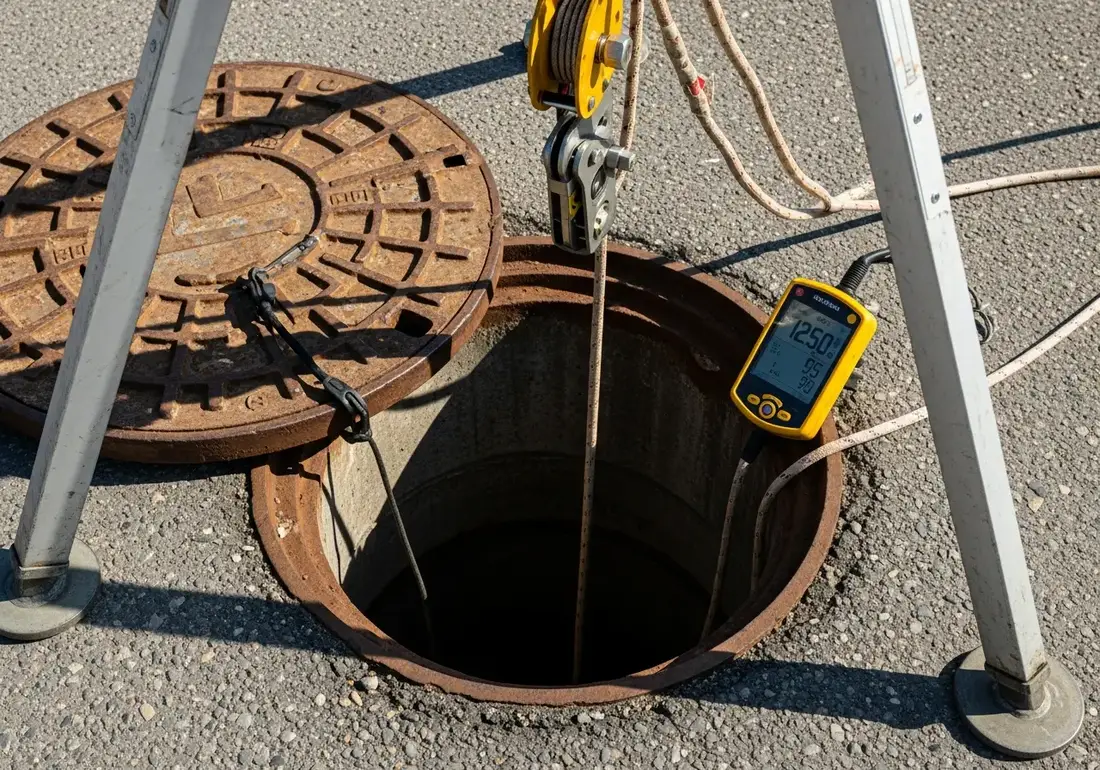
OSHA 1910.146 is prescriptive and strictly enforced. Missing permits, atmospheric testing, or an attendant are willful-violation territory.
Atmospheric hazards cause rapid loss of consciousness and death. Survivors of oxygen deprivation can suffer permanent brain injury.
A confined space fatality typically triggers a full OSHA investigation, work stoppage, and litigation that can threaten the company's survival.
Owners of industrial facilities demand documented entry programs from every contractor before allowing work on site.
A worker enters a steel storage tank to clean it. Rust has consumed the oxygen inside. Without testing the atmosphere, the worker collapses within a minute and cannot be reached.
A crew opens a manhole and a worker descends without a gas monitor. Hydrogen sulfide at high concentration deadens the sense of smell and the worker loses consciousness before signaling distress.
A coworker sees the first worker down and climbs in to help without a harness, monitor, or air supply. He is overcome by the same atmosphere, doubling the fatality.
A worker enters a silo to break up bridged grain while the unloading auger runs. The grain flows out beneath the surface, pulling the worker under and burying him in seconds.
Solvent residue in a vessel creates a flammable atmosphere. A worker uses a non-rated light or tool, a spark ignites the vapor, and the confined space channels the blast.
The federal regulations that govern confined space work.
Requires employers to identify permit spaces, evaluate hazards, issue entry permits, test the atmosphere, provide ventilation and rescue, and station an attendant outside the space.
The construction-specific rule adding continuous atmospheric monitoring, coordinated entry among multiple employers, and enhanced rescue provisions.
Any mechanical or electrical energy — augers, mixers, feed lines — must be isolated and locked out before entry to prevent engulfment or entrapment.
When an atmosphere cannot be made safe, entry requires supplied-air or self-contained breathing apparatus, fit testing, and a written program.
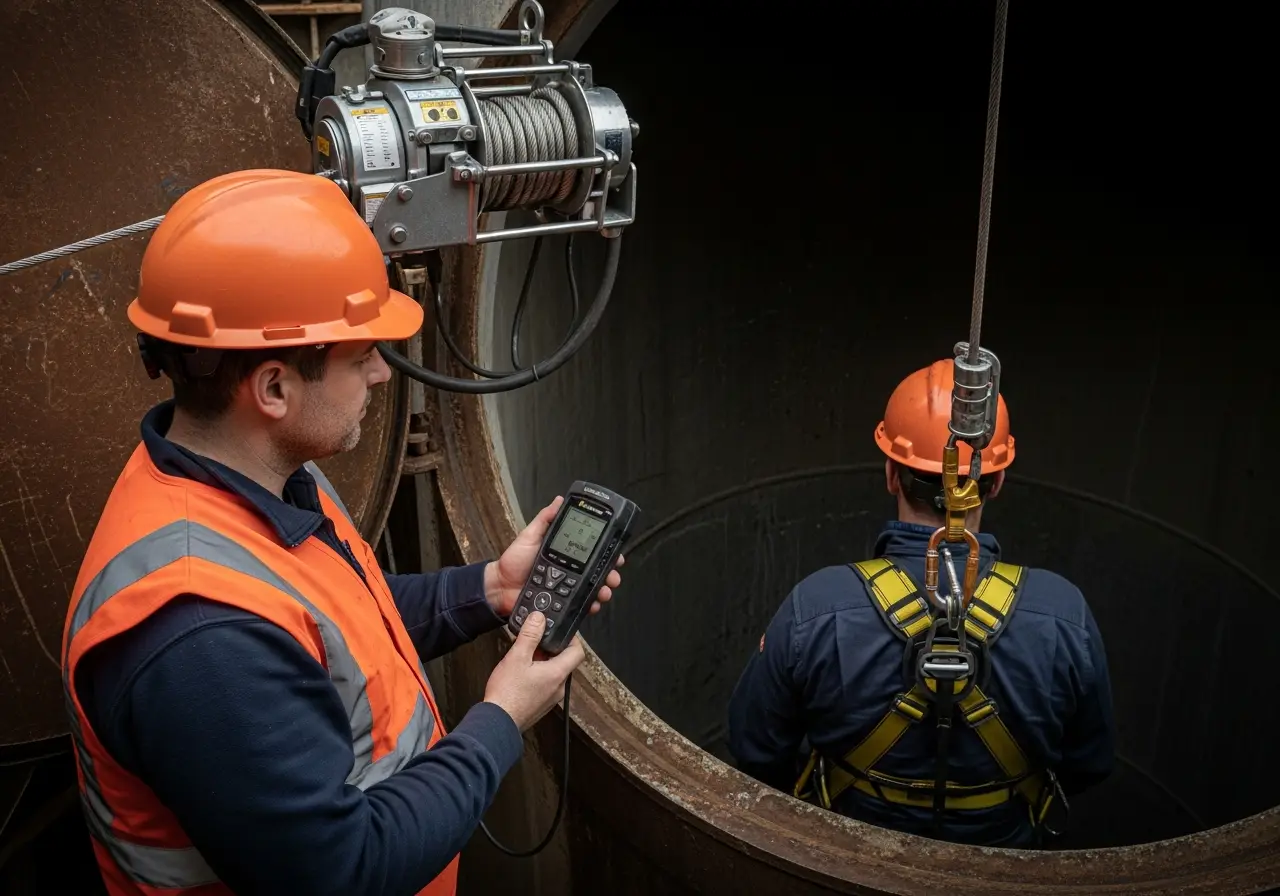
Work top-down through the hierarchy of controls — eliminate the hazard first, then fall back to procedures and PPE.
Reduce or remove the need to enter, and make the atmosphere safe before anyone does.
A disciplined permit program is the backbone of confined space safety.
Protect the entrant and enable non-entry rescue.
Confined space fatalities are overwhelmingly caused by untrained people making split-second decisions, so verified competency for entrants, attendants, and rescuers is the single most important control.
OSHA Scan reviews photos of confined space work to flag the tell-tale signs of an unsafe entry: an open manhole or vessel with a worker inside and no attendant, missing atmospheric monitors, absent ventilation blowers, entrants without harnesses or retrieval lines, and no posted permit. Each finding is tied to the exact clause of OSHA 1910.146 and turned into a corrective-action checklist, so a supervisor can catch a fatal setup from a phone photo before the entry happens.
A confined space becomes permit-required when it contains or could contain a hazardous atmosphere, has engulfment potential, has an inward-converging or sloped floor that could trap a worker, or contains any other recognized serious safety or health hazard. Permit spaces demand testing, a permit, an attendant, and a rescue plan.
Oxygen must be between 19.5% and 23.5%. Flammable gas or vapor must be below 10% of the lower explosive limit. Toxic contaminants such as hydrogen sulfide and carbon monoxide must be below their permissible exposure limits. The atmosphere must be tested before entry and monitored continuously during it.
No. OSHA requires a trained attendant stationed outside the space at all times during entry. The attendant monitors conditions, maintains communication, and initiates rescue — but never enters to perform the rescue unless relieved and properly equipped.
Because the atmospheric hazard that downed the first worker is still present and invisible. Coworkers instinctively rush in to help without a monitor, harness, or air supply and are overcome themselves. This is why non-entry rescue and trained rescue teams are mandatory, not optional.
Test before entry to confirm the space is safe, then monitor continuously throughout the entry because conditions can change quickly as work disturbs residues or ventilation shifts. Test in the order oxygen, flammability, then toxics, and at multiple depths since gases stratify.
Employers must have a rescue plan before entry. The preferred method is non-entry retrieval using a harness and mechanical hoist. If entry rescue is needed, a trained and equipped rescue team must be available to respond promptly — relying on the local fire department without confirming their capability is not acceptable.
No. Continuous forced-air ventilation reduces atmospheric hazards, but you must still test to confirm the atmosphere is actually safe and keep monitoring during entry. Ventilation and testing work together; neither replaces the other.
OSHA requires training before an employee is first assigned confined space duties, whenever their duties change, whenever a new hazard arises, and whenever an evaluation shows deviations from the entry procedures or gaps in the worker's knowledge. In practice, most employers refresh entrant, attendant, and entry-supervisor training annually, and OSHA effectively requires rescue teams to practice at least once every twelve months on representative permit spaces using mannequins or actual entrants. Monitor calibration training and hands-on retrieval drills should be part of that cadence. Every session must be documented with the employee's name, the dates, and the topics covered so the employer can prove competency during an inspection. Because confined space work is high-consequence and infrequent for many crews, frequent hands-on refreshers are what keep the skills sharp enough to prevent the panic-driven mistakes that cause most fatalities.
Employers must complete a written entry permit for every permit-required entry, documenting the space, the purpose, the atmospheric test results, the isolation and ventilation measures, the attendant and entrants, the rescue provisions, and the authorizing supervisor. The permit is valid only for the duration of the specific task and must be canceled and retained when the job ends. OSHA requires that canceled permits be kept for at least one year so the program can be reviewed and improved. Employers must also keep atmospheric monitor calibration logs, training and competency records, and any incident or near-miss documentation. A yearly review of canceled permits is mandatory and is used to identify recurring problems and update procedures. Photo-based tools such as OSHA Scan can capture and timestamp the pre-entry conditions, creating a durable record that ventilation, monitors, and attendants were actually in place.
An entry must be halted the moment atmospheric readings move outside safe limits, a monitor alarms or fails, ventilation stops, communication with the attendant is lost, or any condition arises that was not covered by the permit. The attendant has the authority and the duty to order an immediate evacuation, and entrants must exit without hesitation even if the task is unfinished. Entry should also be stopped before it begins if the permit is incomplete, the rescue team is unavailable, the atmosphere has not been tested, or isolation and lockout cannot be verified. Never allow a rescue attempt by an untrained or unequipped worker; that instinct is what turns a single fatality into a double one. Restarting requires re-testing the atmosphere, correcting the condition, and issuing a new or revalidated permit.
Run through this before, during, and after every job.
15 more checklist points are waiting. Register with your email to reveal every item and download the complete OSHA compliance checklist as a printable PDF. Free, and it only takes a few seconds.
Already have an account? Sign in
A food-processing plant needed a residue tank cleaned. A worker entered through the top hatch to scrape the walls. No atmospheric test had been performed and no attendant was posted.
Decomposing residue had consumed the oxygen inside the tank. The worker collapsed within a minute. A coworker who saw him down climbed in to help without any protection and was overcome by the same atmosphere. Both required emergency rescue and one suffered lasting injury.
The plant implemented a full permit-required confined space program: calibrated multi-gas monitors, forced-air ventilation, written permits, trained attendants, and non-entry retrieval systems on every tank. It used OSHA Scan to photo-verify that ventilation, monitors, and attendants were in place before any hatch was opened.
The plant recorded no further confined space incidents. Entry times actually improved because crews stopped improvising and followed a repeatable, documented process, and the facility passed its next OSHA inspection with no confined space citations.
Snap a photo of the job site, and the AI categorizes findings against OSHA standards in seconds.
Each finding includes consistent corrective actions and structured JHA outputs. Check items off as your crew resolves them.
Build a searchable chemical library from label photos. Review manufacturer SDS matches when available and follow the status of missing documents.
Missing-document requests enter a review queue; they do not automatically contact suppliers.
Invite admins, managers, and supervisors with role-based access that keeps the right people in control.
A qualified person must review AI-flagged items before making safety decisions. Do not replace required comprehensive safety walkthroughs with AI reports. Features, limits, and downloads depend on your account’s plan and permissions.
OSHA Scan reads a single photo. That makes it fast and easy for anyone on site — but it also means it has real limits. Here's an honest look at both.
Reviewed by OSHA Scan Editorial
This content is produced by the OSHA Scan Editorial team and reviewed with AI assistance. It is general safety information, not legal or compliance advice. OSHA Scan is an independent tool and is not affiliated with, endorsed by, or certified by OSHA or the U.S. Department of Labor.
Upload a photo of your confined space job site and get an instant, OSHA-cited hazard report.
Start your free trial