
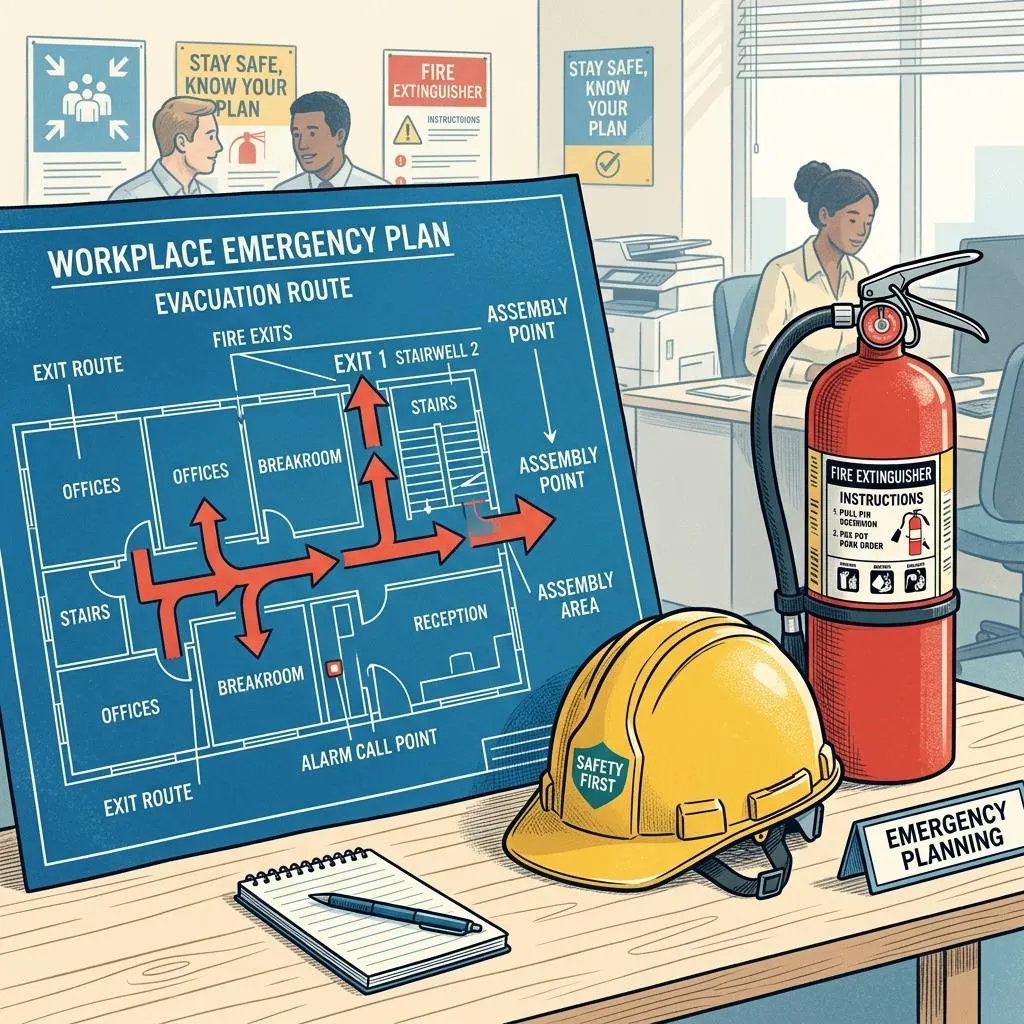
AI-generated editorial illustration. Not a customer site or evidence of compliance.
OSHA Scan Editorial · AI-assisted educational guide
Based on the official sources linked below. No site-specific or independent professional review is implied. Confirm applicability and current federal or State Plan requirements with a qualified professional.
This sequence covers selected general-industry discovery steps, not every OSHA, State Plan, fire, building, environmental, or workers' compensation duty. Thresholds and exceptions require a fact-specific review.
A safety program is easier to run when the first pass is a discovery exercise rather than a promise that one checklist fits every facility. This Quick Start follows OSHA's seven-step general-industry sequence. It identifies selected requirements that may apply, then connects each decision to a document, owner, and next review. Start with the establishment's actual work, equipment, chemicals, employees, and contractors; do not assume that a Part 1910 rule applies simply because another employer uses it.
Use the guide to build an applicability register: note the operation, the trigger you found, the controlling standard, the responsible owner, and the evidence that will be kept. Federal OSHA is a minimum; a State Plan may be at least as effective and may be more stringent. Construction work generally belongs in Part 1926, so a general-industry threshold or exception should not be carried across without checking scope.
The resulting library should make work visible: a current hazard assessment, controlled procedures, training rosters, inspections, corrective actions, and required reports. A photo review can help surface a visible condition, but it cannot prove exposure, fit, isolation, training, or that a program is operating over time.
Who does this apply to?
- Use for a U.S. general-industry establishment evaluating selected Part 1904 and Part 1910 duties. Confirm the OSHA jurisdiction, industry classification, and exact standard before treating an item as a requirement.
- Step 1 describes requirements that apply to most employers, not every employer. Steps 2 and 3 are trigger-based: chemicals, noise, respirators, powered trucks, fall hazards, permit spaces, electrical work, and other operations add their own rules.
- A written emergency action or fire prevention plan is required when a Part 1910 standard requires one; employers with 10 or fewer employees may communicate a required plan orally under 1910.38 and 1910.39, subject to the standard's conditions.
- Part 1904 has size-based and industry-based partial recordkeeping exemptions, but those do not erase severe-event reporting duties. Report a work-related fatality within 8 hours and an in-patient hospitalization, amputation, or loss of an eye within 24 hours when the reporting rule applies.
Implementation Steps
OSHA Requirements That Apply to Most General Industry Employers
Begin with a short register of baseline topics rather than copying every plan found online. Check the recordkeeping framework, hazard communication when covered chemicals are present, workplace conditions, training, and the general duties that fit the actual work. Record the Part 1910 subpart or Part 1904 section you checked and mark uncertain items for qualified review. Useful fields are establishment, process, trigger fact, source URL or section, decision, owner, open question, and evidence location. Implementation question: if a reviewer disagrees with a row, can they see which fact led to the decision and what new fact would reopen it?
- Name the establishment, jurisdiction, work processes, shifts, and employee groups before assigning standards.
- Create one applicability row per topic with a trigger, citation to verify, owner, and status.
- Separate a legal requirement from an OSHA recommendation, eTool, appendix, or internal best practice.
OSHA Requirements That May Apply to Your Workplace
Interview the people who maintain equipment, handle materials, respond to emergencies, and supervise work. Their answers reveal conditional programs: lockout/tagout for servicing, respiratory protection when respirators are necessary or required, hearing conservation at the action level, fall protection at the applicable surface or equipment trigger, and permit-space duties where a qualifying space exists. The trigger, not the plan's name, decides what belongs in scope.
- Inventory chemicals, machines, powered trucks, elevated surfaces, noise sources, respirators, sharps, and spaces.
- Ask whether contractors, temporary workers, visitors, or multiple employers change coordination or communication duties.
- Flag construction, agriculture, maritime, laboratory, healthcare, and State Plan work for a separate scope check.
Survey Your Workplace for Additional Hazards
Walk each task and route with employees, then turn observations into a risk-ranked work list. Look beyond what a camera can see: energy sources, line-of-fire exposure, atmospheric conditions, sound dose, chemical compatibility, emergency access, and changes between shifts require records or measurement. A job safety analysis can connect each step to a control, person, and verification method. Illustrative scenario: a photo shows a clear aisle on day shift, while the night walk finds staging carts narrowing the route; the record names the shift, affected roles, temporary control, owner, and field check. Escalate when the observation suggests exposure, isolation, fit, atmosphere, or another fact that requires qualified assessment rather than visual review.
- Document task, hazard, affected people, existing controls, additional control, responsible owner, due date, and closure evidence.
- Review machine guarding, electrical working space, exits, housekeeping, storage, emergency equipment, and contractor interfaces.
- Repeat the survey after a process, material, equipment, layout, staffing, or incident change.
Develop a Comprehensive Jobsite Safety and Health Program
Convert the register into a manageable program architecture: a policy, topic-specific procedures, training paths, inspections, corrective-action workflow, and document control. “Comprehensive” means the system addresses the hazards found; it does not mean every employer needs every named OSHA plan. Give each procedure an owner, revision date, affected work, and escalation path. Build a cross-reference with trigger, procedure, form, training, verifier, retention or posting instruction, and superseded-version location. Decide who can approve an exception, what evidence is sufficient to close an action, and when an unresolved question stops the job instead of being carried as a note.
- Link a hazard or trigger to its procedure, form, training, inspection, and required retention or posting rule.
- Define who can stop work, who approves a change, who contacts emergency services, and who verifies closure.
- Keep current documents at the point of use and archive superseded versions without letting them remain the active copy.
Train Your Employees
Build training from job duties and the procedures employees must perform, not from attendance alone. Include new-hire, reassignment, new-equipment, refresher, and incident-driven paths where the applicable standard calls for them. Demonstration and evaluation matter for tasks such as respirator use, forklift operation, energy control, emergency roles, and PPE selection. For onboarding, map each role, task, hazard, and standard; use language and vocabulary employees understand; and record demonstrated skill, trainer/date, and the rule-specific renewal or change trigger. Coordinate site and task training between host supervisors and staffing agencies for temporary workers; an agreement does not transfer OSHA duties.
- Map each role to required topics, instructor or evaluator, practical demonstration, and record.
- Provide information employees can understand and make required training available at no cost and during working time where the standard requires it.
- Re-train when a worker lacks understanding or skill, a process changes, or an inspection identifies a gap.
- Keep current safety procedures accessible to staff who need them, while restricting medical and incident records containing personal information to authorized users.
Recordkeeping, Reporting and Posting
Keep these verbs separate. Determine whether an injury or illness is recordable under Part 1904; report severe events on the required deadline; post notices or summaries when required; and retain program records according to their own rules. A company with no more than 10 employees at any time in the last calendar year may qualify for a routine-recordkeeping exemption, but that is not an exemption from severe-event reporting. An event file should identify the facts known, decision-maker, standard or official instruction consulted, notification time, posting location or reason not applicable, and follow-up owner. Implementation question: who can make the first call on a weekend, and how does that person hand the recordability decision to the recordkeeper without exposing restricted medical detail?
- Maintain a decision log for recordability and a rapid escalation card for 8-hour and 24-hour reports.
- Post the OSHA 300A annual summary from February 1 through April 30 when required, and verify current electronic-submission duties separately.
- Track abatement, training, inspection, medical, exposure, and confidential records under the retention rule that applies to each.
Find Additional Compliance Assistance Information
Use OSHA's standard text, compliance-assistance pages, consultation resources, and State Plan information to resolve open questions. Save the source and access date in the applicability register so a later owner can retrace the decision. For an incident, exposure, citation, energized task, or permit-space entry, use the controlling text and obtain qualified safety, legal, or medical advice rather than treating this overview as a determination. Completion evidence is a dated decision trail: source checked, site fact confirmed, reviewer, affected document or training, communication audience, and verification after implementation. If the source is unclear or facts conflict, record the uncertainty and escalate rather than converting a recommendation into a requirement.
- Attach the official source to each open question and write what fact would change the conclusion.
- Schedule a qualified review for high-consequence or technically complex work before the job proceeds.
- Turn confirmed answers into controlled documents, role-based training, and a dated review trigger.
Document planning checklist
Use this planning list to organize applicable records. Suggested owners and review triggers are workflow recommendations; the linked standards determine which documents and retention periods are legally required.
| Document / Record | Purpose | Owner | Review Cadence |
|---|---|---|---|
| Applicability register | Records the operation, trigger, standard to verify, owner, open question, and decision. | Safety coordinator with operations leads | At startup and after a process, jurisdiction, or standard change |
| Workplace hazard survey and action log | Connects observed and measured hazards to controls, owners, due dates, and closure evidence. | Area supervisors | On a risk-based recommended cadence and after change, incident, or employee concern |
| Controlled program and procedure index | Shows which active procedures, forms, and training paths govern each hazard. | Program administrator | When a procedure changes and at a scheduled document review |
| Training matrix and evaluations | Maps duties to required instruction, demonstrations, refreshers, and attendance records. | Supervisors and training coordinator | At assignment, transfer, process change, or demonstrated skill gap |
| Inspection and corrective-action records | Preserves recurring checks, responsible owners, interim controls, and verified closure. | Area owners | On each inspection and whenever a corrective action changes |
| Part 1904 recordkeeping and reporting file | Separates logs, annual summaries, severe-event reports, and recordability decisions. | Employer recordkeeper | After each event and before posting or reporting deadlines |
Common Pitfalls
Treating every plan as universal
A plan name is not a trigger. EAPs, fire prevention plans, respiratory programs, and permit-space programs apply when their standard and workplace facts call for them.
Using a photo as the whole survey
A frame cannot measure noise or atmosphere, establish exposure, show a deenergized circuit, prove a respirator seal, or demonstrate that training and corrective action occurred.
Blending record, report, post, and retain
A partial recordkeeping exemption does not cancel severe-event reporting, and a posted summary is not the same record as a confidential medical file or a completed abatement certification.
Frequently Asked Questions
Does every general-industry employer need a written safety plan?
Is the four-foot fall threshold part of every workplace?
If the company is small, can it ignore OSHA records?
Can an AI scan confirm that our program is complete?
What the AI can and can't detect
OSHA Scan reads a single photo. That makes it fast and easy for anyone on site — but it also means it has real limits. Here's an honest look at both.
What it can catch from a photo
- Missing or incorrect PPE that is visible in the frame
- Unprotected edges, open holes, and visible fall hazards
- Housekeeping, trip, and blocked walkway or exit hazards
- Visible electrical, struck-by, and equipment-guarding hazards
What a photo can't tell it
- Hazards hidden from view or anything outside the photo
- Exact heights, distances, weights, or measurements
- Training records, procedures, or how equipment is actually used
- Full legal compliance or an official OSHA pass/fail determination