
1
Set the scene
Start with context
Fill the frame
2–3 ft for close-ups; keep ladders, cords and workers fully in view.
An HVAC safety inspection checklist covers the hazards that injure HVAC technicians and building occupants most: refrigerant handling compliance, electrical safety at air handlers and condensers, confined space conditions in mechanical rooms, fall hazards on rooftop equipment, CO exposure from combustion appliances, and PPE gaps for chemical and electrical tasks. OSHA Scan lets an HVAC contractor or facilities manager photograph an air handler room, a rooftop condenser, a boiler room, or an attic install and get an instant read on visible occupational-safety hazards, the OSHA standard each may relate to, and a suggested fix. It is an AI-assisted first look, not a licensed EPA refrigerant or equipment certification.
Free · No account needed to scan · Results in seconds
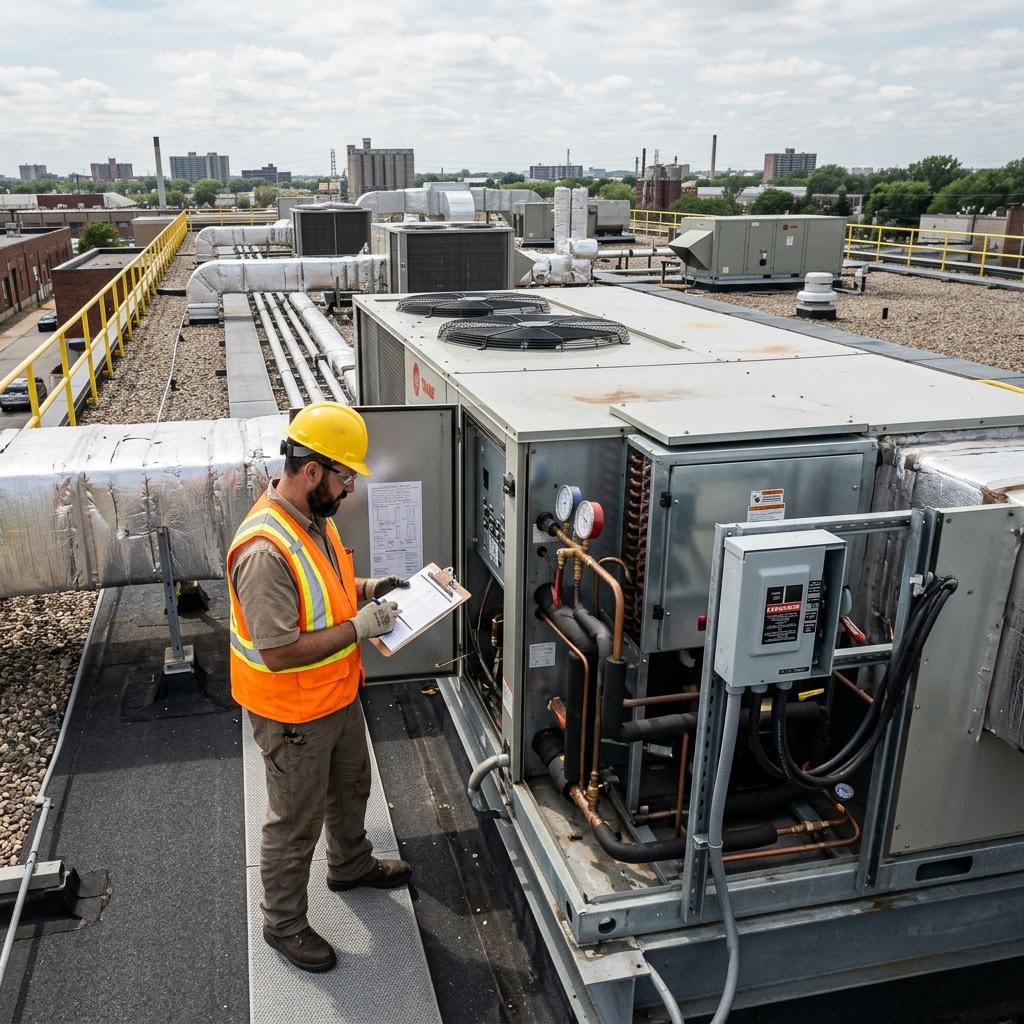
HVAC technicians face a concentrated mix of hazards: electrical work at air handlers and condensers, refrigerant release in enclosed spaces, rooftop fall exposure, confined-space conditions in mechanical rooms, and CO risk from combustion appliances. Most small HVAC contractors do not have a dedicated safety officer — the lead tech or owner sets the safety standard on every job. A photo-based check before work begins lets them document conditions without a clipboard.
The scanner reads visible conditions in mechanical rooms, air handler units, rooftop equipment pads, and boiler rooms: an electrical panel with missing knockouts, refrigerant cylinders stored without valve caps, a rooftop condenser with no guardrail on the access path, or a combustion appliance vented with a disconnected flue pipe. It surfaces the OSHA standard most likely to apply and a specific suggested fix.
HVAC technicians work across multiple OSHA standard categories in a single job: electrical (1910 Subpart S for wiring and panel work), lockout/tagout (1910.147 for de-energizing systems before maintenance), confined space (1910.146 for mechanical rooms, air handling units, and roof equipment with permit-required attributes), and fall protection (1910.28 or 1926 Subpart M for rooftop and elevated equipment access). Refrigerant handling adds EPA Section 608 compliance requirements — technician certification, proper recovery equipment, and refrigerant record-keeping — that operate independently of OSHA but are inspected by EPA and state environmental agencies.
The growth of refrigerant transitions toward lower-GWP alternatives (A2L mildly flammable refrigerants like R-32 and R-454B) is introducing new safety considerations for HVAC maintenance — these refrigerants require different handling practices, leak detection procedures, and ignition-source controls compared to the HFC refrigerants they replace. OSHA has not yet issued refrigerant-specific guidance for the A2L class, but the general duty clause applies to refrigerant-related hazards, and ASHRAE Standard 15 (Safety Standard for Refrigeration Systems) provides the engineering and operational reference that courts and inspectors use to evaluate whether employer practices were adequate.
Run through these steps before crews start — each one covers a visible gap the AI can help you catch.
Before opening any air handler or condenser, confirm the disconnect is off and locked, voltage is verified absent, and panels have no open knockouts or exposed live parts. Electrical work at HVAC equipment may relate to 29 CFR 1910.303, and de-energizing may relate to lockout/tagout under 1910.147.
Confirm refrigerant cylinders are capped, chained upright, and stored in a ventilated area away from heat, with no visible signs of release in enclosed rooms. Compressed-gas storage may relate to 29 CFR 1910.101 and the guidance in ASHRAE 15.
Verify flue pipe joints are connected and intact, that combustion appliances in confined spaces have adequate combustion air, and that a functional CO detector is present. Missing venting and CO controls may relate to the general duty clause and 29 CFR 1910.1000.
On the path to rooftop condensers, confirm a guardrail or warning line at least 6 ft from any unprotected edge, or each tech in a harness clipped to a rated anchor, and ladders secured to the roof hatch. Rooftop fall exposures may relate to 29 CFR 1910.28 and 1926.501.
Photograph the mechanical room, rooftop unit, or boiler room and upload it to OSHA Scan for an AI second-pass. The AI flags visible hazards it can see, notes the OSHA standard each may relate to, and suggests a fix — treat the findings as a draft to verify on site. Free, no account needed.
The occupational-safety core of an HVAC inspection, read from an image.
Refrigerant cylinders without valve caps, improper storage in non-ventilated spaces, and visible signs of release in enclosed mechanical rooms.
Disconnected or damaged flue pipes, combustion appliances in confined spaces without adequate combustion air, and missing CO detectors in mechanical rooms.
Missing knockouts or covers on electrical panels, unguarded rotating equipment, and energized components accessible without lockout/tagout procedures.
Rooftop condenser units with unguarded roof edges on access paths, no anchor points for fall arrest, and ladders not properly secured to roof hatches.
Scan a photo like the one above and this is the report you get — score, findings, OSHA references, and fixes. It is an illustrative example, clearly marked — not live scan data.
Compliance score
71
Lower means more potential hazards found
5 potential hazards found
1Rooftop unit access panels open with no lockout device visible on the adjacent disconnect
HighPossibly related to control of hazardous energy (29 CFR 1910.147) and electrical safety (29 CFR 1910.303)
Observed condition: Open panels expose energized wiring and rotating components — without a lock and tag on the disconnect, the unit can be re-energized while the technician's hands are inside the compartment.
Corrective action: Apply lockout/tagout at the unit disconnect before opening access panels; verify zero energy with a meter; close and secure panels before leaving the unit.
Medium confidenceNot fully clear from the photo — verify on site.
2Exposed refrigerant piping and wiring in the open service compartment beside the walkway
MediumPossibly related to compressed gas / refrigerant safety (ASHRAE 15) and 29 CFR 1910.101
Observed condition: Pressurized refrigerant lines and low-voltage wiring left exposed next to a walking path can be snagged or struck — a ruptured line releases refrigerant that can cause frostbite and displace oxygen near the unit.
Corrective action: Keep service compartments closed when not actively working in them; route hoses and test gauges away from walk paths; cap service ports when disconnecting.
Medium confidenceNot fully clear from the photo — verify on site.
Upload a photo like the one above and get a compliance score and hazard count in seconds. No account needed to scan — create a free account to unlock the full report.
Use the real site or facility name. If you save the scan after signup, it becomes the report name.
Three angles, one deeper scan
Only the wide shot is required — every extra angle gives the AI more places to look.
Required: Set the scene — one wide shot lets the AI sweep the whole area at once
Stand at the entry point and capture corner to corner: floors, ladders, scaffolds, and everyone at work
Drop a job-site photo or walkthrough video
Click to upload, drag & drop, or snap a photo on site. Photos scan free in about 15 seconds — no signup, no card. Video walkthroughs (up to 3 min) run on a free account.
Small habits, sharper scans
Set the scene
Start with context
Fill the frame
2–3 ft for close-ups; keep ladders, cords and workers fully in view.
Capture clearly
Make the frame usable
Light it right
Keep the sun or lights behind you — glare and shadows hide hazards.
Tap to focus
Tap the hazard on screen and hold still one second — blur can't be flagged.
Choose the useful view
Give the AI room to understand
Go landscape
Turn your phone sideways — a wider frame catches more of the scene.
Only upload photos you have permission to use, and avoid images showing personal, customer, or confidential information. Demo photos and results are held privately for up to 48 hours so you can save them to a free account; unclaimed photos are deleted automatically. Results are an AI-assisted preliminary review, not an official OSHA determination.
New: Video walkthrough scans
Record up to 3 minutes of your site — the AI extracts frames and flags every hazard with exact timestamps. Free account required.
Get the best results
Wide shot first
Stand at the entrance and photograph the entire work area so AI sees the full context
Hazard areas
Photograph elevated surfaces, equipment, electrical panels, and anywhere workers are active
Close-ups last
Move in close on anything damaged, missing, or that looks risky — the AI catches more detail
Walk mechanical rooms, air handler units, rooftop equipment, and boiler rooms with these points. The first four are free — create a free account to unlock the full checklist and scan your own HVAC photos.
Free checklist — 12 points
Enter your email to unlock the full checklist
We'll also send you a printable PDF copy — no account required.
One email with the checklist, one follow-up. Unsubscribe anytime.
OSHA Scan reads a single photo. That makes it fast and easy for anyone on site — but it also means it has real limits. Here's an honest look at both.
A scan is a fast first look, not the final word. Before treating this kind of area as safe, a competent person should still confirm:
HVAC work is covered by OSHA's General Industry and Construction standards depending on the work setting. Key standards include lockout/tagout (29 CFR 1910.147), electrical safety (1910.303–399), confined spaces (1910.146 for general industry; 1926.1200 for construction), fall protection (1926.502 for rooftop work), and hazard communication (1910.1200). Refrigerant handling is also regulated by EPA Section 608 under the Clean Air Act.
Falls from rooftop equipment and ladders are the leading cause of HVAC fatalities. Electrical contact at condensers and air handler panels is the second major cause. Refrigerant release in confined mechanical rooms creates asphyxiation and frostbite risk. CO exposure from combustion appliances and heat stress from working in attics round out the top injury categories.
Safety conditions should be assessed at the start of every service call — mechanical rooms and equipment can change between visits. Formal preventive maintenance inspections are typically done seasonally (pre-heating season and pre-cooling season). Rooftop equipment and fall hazard conditions should be assessed at the start of each rooftop visit.
Any HVAC contractor, lead technician, or facilities manager can run it. The report gives a specific fix for each finding in plain language — no EHS certification required. For confined-space entry and refrigerant compliance, the report will note that those require certified verification.
No. OSHA Scan flags visible safety conditions — cylinders without valve caps, storage in non-ventilated spaces, signs of potential release. EPA 608 refrigerant compliance requires certified technicians using calibrated recovery equipment and manifold gauges. The photo scan is a first-look occupational safety tool, not a refrigerant compliance audit.
Reviewed by OSHA Scan Editorial
Last updated August 29, 2026
This content is produced by the OSHA Scan Editorial team and reviewed with AI assistance. It is general safety information, not legal or compliance advice. OSHA Scan is an independent tool and is not affiliated with, endorsed by, or certified by OSHA or the U.S. Department of Labor.
More ways to see what an AI OSHA scan can do for your site.
The overview hub — how the scanner works and every job, site, and hazard it covers.
Entry procedures for mechanical rooms that meet permit-required criteria.
De-energizing air handlers and condensers before electrical work.
Flag panel gaps, exposed wiring, and lockout/tagout gaps from a photo.
Portable and fixed ladder safety for HVAC rooftop and attic access.
The step-by-step JHA behind these HVAC checklist items.
The complete hub of every hazard type and industry the scanner covers.
Build the SDS library for refrigerants, coil cleaner, and flux by scanning van-shelf labels.
See a complete labelled example of everything a scan returns.
Start with 5 included AI site scans plus a one-time 10-scan signup bonus — no credit card. Build JHA-ready reports and catch changing conditions sooner.
Start your free trial