
1
Set the scene
Start with context
Fill the frame
2–3 ft for close-ups; keep ladders, cords and workers fully in view.
An auto repair shop safety inspection checklist covers the hazards that injure automotive technicians most: vehicle lift operation and restraint compliance, flammable fuel and solvent storage, exhaust ventilation in enclosed bays, PPE for battery, brake dust, and chemical tasks, and housekeeping conditions that create slip and fire exposure. OSHA Scan lets a shop owner or service manager photograph a bay, a parts storage area, a lift station, or a fluid-storage room and get an instant read on visible occupational-safety hazards, the OSHA standard each may relate to, and a suggested fix. It is an AI-assisted first look, not a lift manufacturer's certification inspection.
Free · No account needed to scan · Results in seconds
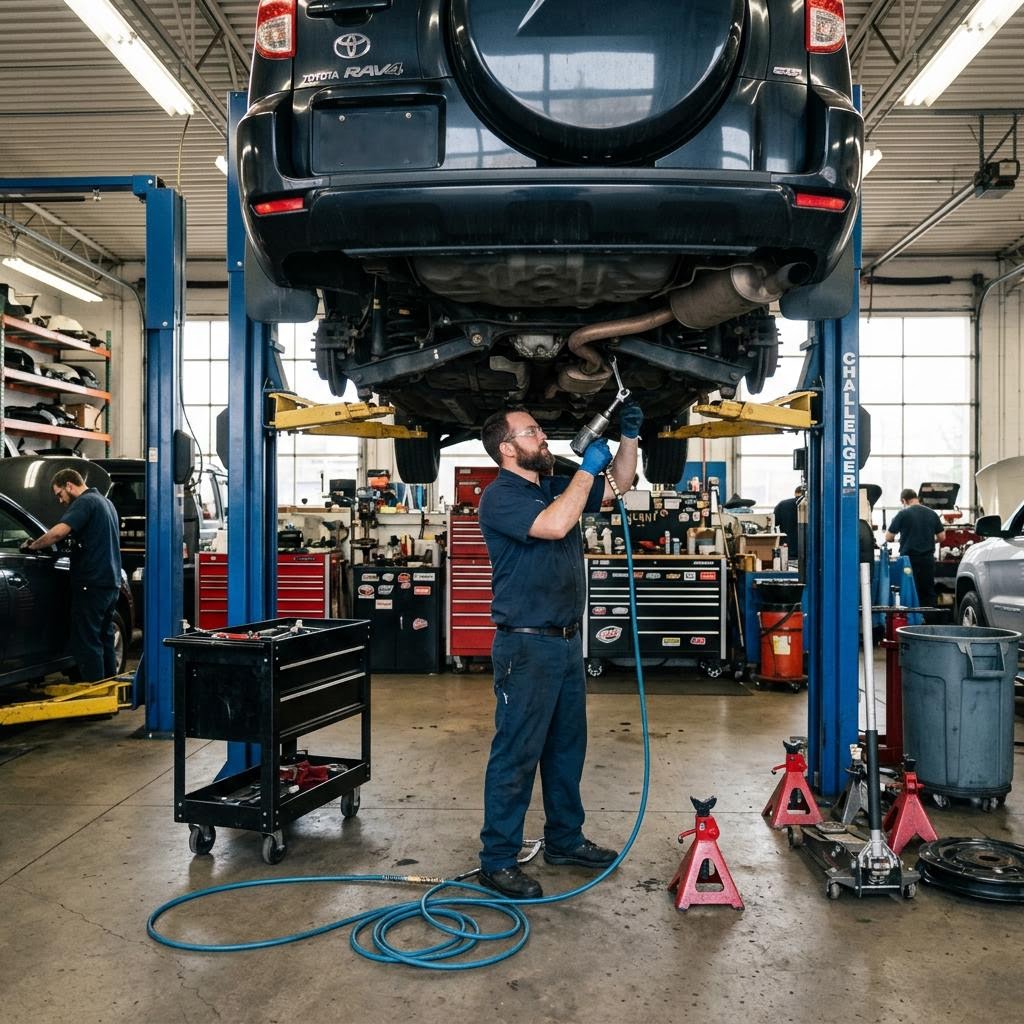
Auto repair shops pack a high density of hazards into a small space: vehicles on lifts, flammable fuels and solvents, carbon monoxide from running engines, lead in brake dust, battery acid, and power tools. Many shops operate without a dedicated safety officer — the shop owner or service manager is the de-facto safety lead. A photo-based check before the day starts lets them document what they see without a clipboard.
The scanner reads visible conditions in bays, lift stations, parts rooms, and fluid-storage areas: a lift without its safety lock engaged, a gasoline container stored near an ignition source, insufficient exhaust hose routing for a running engine, or a technician working under a raised vehicle without the safety stands visible. It surfaces the OSHA standard most likely to apply and a specific suggested fix.
Automotive service and repair operations are regulated under OSHA's general industry standards, with the most active enforcement areas being hazard communication (chemical inventories in auto repair include motor oil, brake fluid, battery acid, gasoline, solvent degreasers, and aerosol products — all requiring current SDS and proper labeling), personal protective equipment, and walking-working surfaces (oil accumulation on shop floors is a leading slip-and-fall source). OSHA's general industry vehicle servicing standard (29 CFR 1910.177 for servicing multi-piece rim wheels) applies to tire work, and improper tire mounting and inflation practices are a source of serious injuries at tire shops.
Carbon monoxide from running engines is the most acutely dangerous invisible hazard in enclosed repair bays. OSHA has cited auto repair shops for CO exposure under the general duty clause, and NIOSH has investigated multiple fatalities at shops where CO accumulated due to inadequate ventilation, engine-on diagnostics in enclosed spaces, and disabled CO alarms. OSHA's permissible exposure limit for CO is 50 ppm as an 8-hour TWA — a concentration that running engines in enclosed spaces can exceed rapidly. Lead exposure from brake dust, particularly during drum brake grinding and shoe replacement, is addressed under OSHA's lead standard (1910.1025) when exposure exceeds the action level of 30 µg/m³. Many small auto repair shops are unaware that lead exposure monitoring and medical surveillance requirements apply to brake service operations.
Run through these steps before crews start — each one covers a visible gap the AI can help you catch.
Start at each raised vehicle. Confirm the lift's mechanical safety locks are engaged and that rated jack stands carry any vehicle raised on a floor jack — no one should be under a vehicle held only by hydraulics. Lift and support conditions may relate to the general duty clause and ANSI/ALI ALOIM standards.
Look at where gasoline, solvents, and cleaning agents are kept. Confirm they are in UL-listed safety containers in a ventilated area away from ignition sources, and that flammable waste is handled the same way. Flammable liquid storage may relate to 29 CFR 1910.106.
Confirm an exhaust evacuation hose is connected to the tailpipe before any engine runs indoors, that the CO detector is functional, and that bay doors allow airflow during extended runs. CO exposure may relate to the general duty clause and 29 CFR 1910.1000.
Walk the bay floors for oil, coolant, and fluid spills that create slip and fire exposure, and confirm absorbent is deployed and used absorbent is in a sealed metal container. Walking-surface hazards may relate to 29 CFR 1910.22.
Photograph the bay, lift station, or fluid-storage area and upload it to OSHA Scan for an AI second-pass. The AI flags visible hazards it can see, notes the OSHA standard each may relate to, and suggests a fix — treat the findings as a draft to verify on site. Free, no account needed.
The occupational-safety core of an automotive shop inspection, read from an image.
Lifts with missing or disengaged mechanical locks, vehicles raised without safety stands in place, and positioning that loads the lift unevenly.
Gasoline and flammable solvents stored in non-approved containers or near ignition sources, and flammable-material waste improperly handled.
Oil, coolant, and fluid spills on bay floors creating slip hazards, and absorbent materials not deployed or not picked up.
Technicians working with brake dust, battery acid, or chemicals without appropriate gloves, eye protection, or respirator for the task.
Scan a photo like the one above and this is the report you get — score, findings, OSHA references, and fixes. It is an illustrative example, clearly marked — not live scan data.
Compliance score
67
Lower means more potential hazards found
5 potential hazards found
1Air hose coiled across the walking path of the service bay
MediumPossibly related to walking-working surfaces (29 CFR 1910.22)
Observed condition: Hoses and cords across a bay floor are a classic trip hazard — a fall next to a raised vehicle or onto staged jack stands turns a stumble into a serious injury.
Corrective action: Route air lines overhead on a hose reel or along the bay perimeter; coil and hang hoses between uses; keep the area under and around the lift clear.
High confidence
2Jack stands and floor jack staged in the walk path beside the lift bay
MediumPossibly related to housekeeping and struck-by prevention (29 CFR 1910.22(a))
Observed condition: Equipment staged in the walkway forces techs to step around it while carrying tools under a raised vehicle — increasing both trip risk and the chance of striking the lift or vehicle.
Corrective action: Store jacks and stands in a marked equipment zone outside the working footprint of the bay; return them to storage as soon as the vehicle is on the lift.
High confidence
Upload a photo like the one above and get a compliance score and hazard count in seconds. No account needed to scan — create a free account to unlock the full report.
Use the real site or facility name. If you save the scan after signup, it becomes the report name.
Three angles, one deeper scan
Only the wide shot is required — every extra angle gives the AI more places to look.
Required: Set the scene — one wide shot lets the AI sweep the whole area at once
Stand at the entry point and capture corner to corner: floors, ladders, scaffolds, and everyone at work
Drop a job-site photo or walkthrough video
Click to upload, drag & drop, or snap a photo on site. Photos scan free in about 15 seconds — no signup, no card. Video walkthroughs (up to 3 min) run on a free account.
Small habits, sharper scans
Set the scene
Start with context
Fill the frame
2–3 ft for close-ups; keep ladders, cords and workers fully in view.
Capture clearly
Make the frame usable
Light it right
Keep the sun or lights behind you — glare and shadows hide hazards.
Tap to focus
Tap the hazard on screen and hold still one second — blur can't be flagged.
Choose the useful view
Give the AI room to understand
Go landscape
Turn your phone sideways — a wider frame catches more of the scene.
Only upload photos you have permission to use, and avoid images showing personal, customer, or confidential information. Demo photos and results are held privately for up to 48 hours so you can save them to a free account; unclaimed photos are deleted automatically. Results are an AI-assisted preliminary review, not an official OSHA determination.
New: Video walkthrough scans
Record up to 3 minutes of your site — the AI extracts frames and flags every hazard with exact timestamps. Free account required.
Get the best results
Wide shot first
Stand at the entrance and photograph the entire work area so AI sees the full context
Hazard areas
Photograph elevated surfaces, equipment, electrical panels, and anywhere workers are active
Close-ups last
Move in close on anything damaged, missing, or that looks risky — the AI catches more detail
Walk bays, lift stations, parts rooms, and fluid-storage areas with these points. The first four are free — create a free account to unlock the full checklist and scan your own shop photos.
Free checklist — 12 points
Enter your email to unlock the full checklist
We'll also send you a printable PDF copy — no account required.
One email with the checklist, one follow-up. Unsubscribe anytime.
OSHA Scan reads a single photo. That makes it fast and easy for anyone on site — but it also means it has real limits. Here's an honest look at both.
A scan is a fast first look, not the final word. Before treating this kind of area as safe, a competent person should still confirm:
Auto repair is covered by OSHA's General Industry standards. Key standards include flammable liquids (29 CFR 1910.106), hazard communication (1910.1200), walking-working surfaces (1910.22), electrical safety (1910.303), and personal protective equipment (1910.132). Vehicle lift safety is primarily governed by ANSI/ALI ALOIM standards, which OSHA incorporates by reference.
Vehicle lift failures and working under unsupported vehicles are the most lethal. Carbon monoxide from running engines in enclosed bays is a leading cause of fatalities. Fire from flammable fuel and solvent mishandling is a high-frequency risk. Slips on fluid-covered floors and chemical exposure round out the top injury categories.
Lift areas and flammable storage should be checked at the start of every work day. Floors and spill conditions should be monitored continuously during operation. Formal lift inspections should be done annually or per the lift manufacturer's schedule.
Any shop owner, service manager, or lead technician can run it. The report gives a specific fix for each finding in plain language — no EHS certification required.
ALI (Automotive Lift Institute) recommends annual lift inspections by a certified lift inspector. OSHA's General Duty Clause requires lifts to be maintained in a safe condition. The photo scan can flag visible conditions — missing lock bars, uneven loading — but a certified inspection is needed to verify mechanical components and certification status.
Reviewed by OSHA Scan Editorial
Last updated August 29, 2026
This content is produced by the OSHA Scan Editorial team and reviewed with AI assistance. It is general safety information, not legal or compliance advice. OSHA Scan is an independent tool and is not affiliated with, endorsed by, or certified by OSHA or the U.S. Department of Labor.
More ways to see what an AI OSHA scan can do for your site.
The overview hub — how the scanner works and every job, site, and hazard it covers.
Flammable liquid storage, extinguishers, and egress requirements.
De-energizing lifts, chargers, and shop equipment before service.
Chemical labeling and SDS compliance for shop chemicals.
Flag oil, fluid, and floor hazards across the shop.
The full software platform behind every industry safety scan.
The complete hub of every hazard type and industry the scanner covers.
Scan the shelf to build an SDS library and post QR access on the cabinet.
See a complete labelled example of everything a scan returns.
Start with 5 included AI site scans plus a one-time 10-scan signup bonus — no credit card. Build JHA-ready reports and catch changing conditions sooner.
Start your free trial