
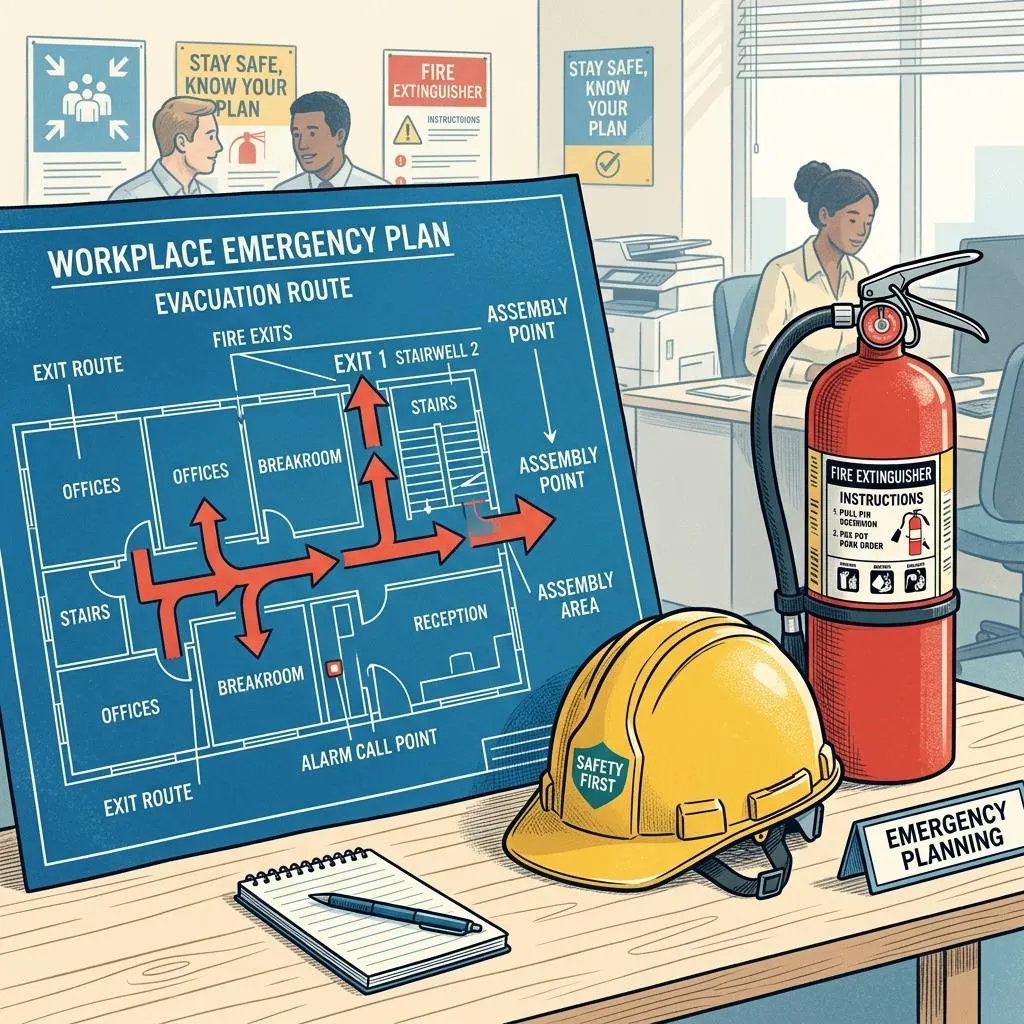
AI-generated editorial illustration. Not a customer site or evidence of compliance.
OSHA Scan Editorial · AI-assisted educational guide
Based on the official sources linked below. No site-specific or independent professional review is implied. Confirm applicability and current federal or State Plan requirements with a qualified professional.
This is educational information, not an emergency plan approval, fire-code determination, alarm design, or promise that an evacuation will be safe. OSHA Scan is not affiliated with or endorsed by OSHA or the U.S. Department of Labor. For an active emergency, follow emergency services and site procedures; have qualified safety and fire professionals review the facility.
A useful fire and evacuation program answers simple questions: How do I report the emergency? Which route do I take? Who accounts for people? Who has a rescue or medical role? The answer belongs in the emergency action plan, fire prevention plan, alarm system, and practice—not an untested poster.
The 10-employee rule is frequently misunderstood. Under 1910.38 and 1910.39, an employer with 10 or fewer employees may communicate a required plan orally. Having 11 or more does not itself create the requirement; local fire and building rules can impose separate duties.
Extinguisher use is a separate decision. A total-evacuation policy with an EAP and FPP can exempt a workplace from 1910.157 unless another rule requires extinguishers. Employee-use extinguishers require education and designated-user training.
Who does this apply to?
- Use this guide when a Part 1910 standard requires an emergency action plan or fire prevention plan, and coordinate with local fire, building, alarm, insurance, and landlord rules.
- Employers with 10 or fewer employees may communicate a required plan orally under 1910.38 and 1910.39.
- EAP minimums include reporting, evacuation, critical operations, accounting, rescue or medical duties, and contacts.
- Fire prevention planning addresses hazards, storage, ignition, waste, safeguards, and responsible job titles.
Implementation Steps
1. Identify triggers, occupants, and credible emergencies
List applicable Part 1910 provisions and local rules, then identify fire, smoke, explosion, chemical release, utility loss, severe weather, and medical scenarios. Map occupants and critical operations. Do not infer an OSHA trigger from headcount alone.
- Assign an owner to verify OSHA, State Plan, fire-code, and landlord requirements.
- Walk each occupied area, including mezzanines, docks, and remote rooms.
2. Write the EAP around decisions under stress
State how to report an emergency, which alarm is used, which evacuation type and routes apply, who may perform critical operations, how people are accounted for, and who has rescue or medical duties. Name plan contacts and keep the plan available. Add fields for each shift, visitor and contractor handoff, accessible route, alternate assembly point, accountability source, missing-person escalation, and the person who can authorize re-entry. Implementation questions: can a new worker identify the alarm and route without a supervisor, and what happens if the normal assembly area or communication method is unavailable?
- Post route assignments and assembly locations.
- Define an alternate route for blocked exits and a visitor method.
3. Build the FPP from fuel and ignition controls
Describe major fire hazards, storage, ignition controls, needed equipment, combustible-waste controls, and heat-producing safeguards. Assign job titles for ignition and fuel-source control. A keep-it-clean sentence does not tell a supervisor what to inspect.
- Inventory hot work, charging, cooking, batteries, flammables, dust, and waste.
- Set storage, housekeeping, inspection, and impairment controls.
4. Validate alarms, routes, and assembly
Maintain a distinctive employee alarm where required and test whether employees can hear, understand, and act. Keep exits and routes usable, marked, and free of storage. At assembly, account for employees and report missing people without sending anyone back inside. Illustrative scenario: a pallet blocks the usual route during a shift change; the observer records the obstruction, alternate route, alarm audibility, headcount source, and escalation to the area owner. Completion evidence is the route walk and corrective closure, not a map revision alone. Escalate immediately when an exit is locked, an alarm is not understood, accountability is incomplete, or a critical operation cannot stop safely.
- Test alarms under controlled conditions and record corrective work.
- Walk routes with shift, contractor, and accessibility representatives.
5. Train, practice, and decide the extinguisher role
Train employees on fire hazards and FPP self-protection at initial assignment; train evacuation helpers in their duties. Where extinguishers are provided for employee use, 1910.157(g) requires initial and annual employee education on extinguisher principles and incipient-stage firefighting hazards. Designated users also need initial and annual equipment-use training. A total-evacuation policy should state roles and be checked against applicable exemptions. Keep the scenario, shifts represented, alarm and route observations, accountability result, questions, corrective owner, and follow-up date in the exercise record. If the policy changes from employee use to total evacuation, update signs, training, plan language, and local coordination together.
- Brief new hires, reassigned employees, and contractors before exposure.
- Practice an alarm and accountability scenario without a live-fire hazard.
6. Review after change and keep local coordination active
Review the EAP when developed, when a responsibility changes, and when the plan changes. Review the FPP when hazards, storage, processes, equipment, or roles change. Reconcile OSHA language with local fire and building requirements; a federal minimum does not guarantee local approval. Close a review by naming the changed fact, source or authority consulted, affected map or procedure, training audience, and field verification. An annual internal review may be useful, but do not describe it as a universal OSHA mandate where the rule specifies different review triggers.
- Set an owner and review trigger for each plan section.
- Record alarm impairments, blocked routes, near misses, and corrective dates.
Document planning checklist
Use this planning list to organize applicable records. Suggested owners and review triggers are workflow recommendations; the linked standards determine which documents and retention periods are legally required.
| Document / Record | Purpose | Owner | Review Cadence |
|---|---|---|---|
| Emergency action plan | Defines reporting, alarms, routes, critical operations, accountability, and duties. | Emergency coordinator | Review on development, responsibility or plan change, exercise, incident, or alteration. |
| Fire prevention plan | Controls fire hazards, ignition, waste, storage, safeguards, and roles. | Facility manager | Review after process, fuel, storage, hot-work, equipment, or role change. |
| Exit-route and assembly map | Shows routes, alarms, and accountability. | Facilities manager | Walk after layout, occupancy, construction, exit, or assembly change. |
| Alarm and evacuation exercise record | Records scenario, participation, gaps, and corrections. | Emergency coordinator | Complete after each exercise or alarm test. |
| Fire equipment and impairment log | Tracks extinguisher role, inspections, impairments, and controls. | Facilities or equipment owner | Update at inspection, impairment, repair, relocation, or change. |
Common Pitfalls
Treating 10 employees as the EAP trigger
The threshold generally changes written versus oral communication for a required plan; it does not create the plan requirement. First identify the OSHA trigger and local rules.
Assuming every extinguisher requires firefighting
A total-evacuation policy can change 1910.157 applicability, while employee-use extinguishers require education and training. State the policy and roles clearly.
Posting a map without testing the route
A stored pallet, locked door, noisy room, or changed assembly area can defeat a map. Walk routes on each shift and after facility changes.
Frequently Asked Questions
Does having 11 employees automatically require a written EAP?
Must employees fight a fire when extinguishers are present?
How often should employees practice evacuation?
Can an oral plan be used for a small workplace?
What the AI can and can't detect
OSHA Scan reads a single photo. That makes it fast and easy for anyone on site — but it also means it has real limits. Here's an honest look at both.
What it can catch from a photo
- Missing or incorrect PPE that is visible in the frame
- Unprotected edges, open holes, and visible fall hazards
- Housekeeping, trip, and blocked walkway or exit hazards
- Visible electrical, struck-by, and equipment-guarding hazards
What a photo can't tell it
- Hazards hidden from view or anything outside the photo
- Exact heights, distances, weights, or measurements
- Training records, procedures, or how equipment is actually used
- Full legal compliance or an official OSHA pass/fail determination