
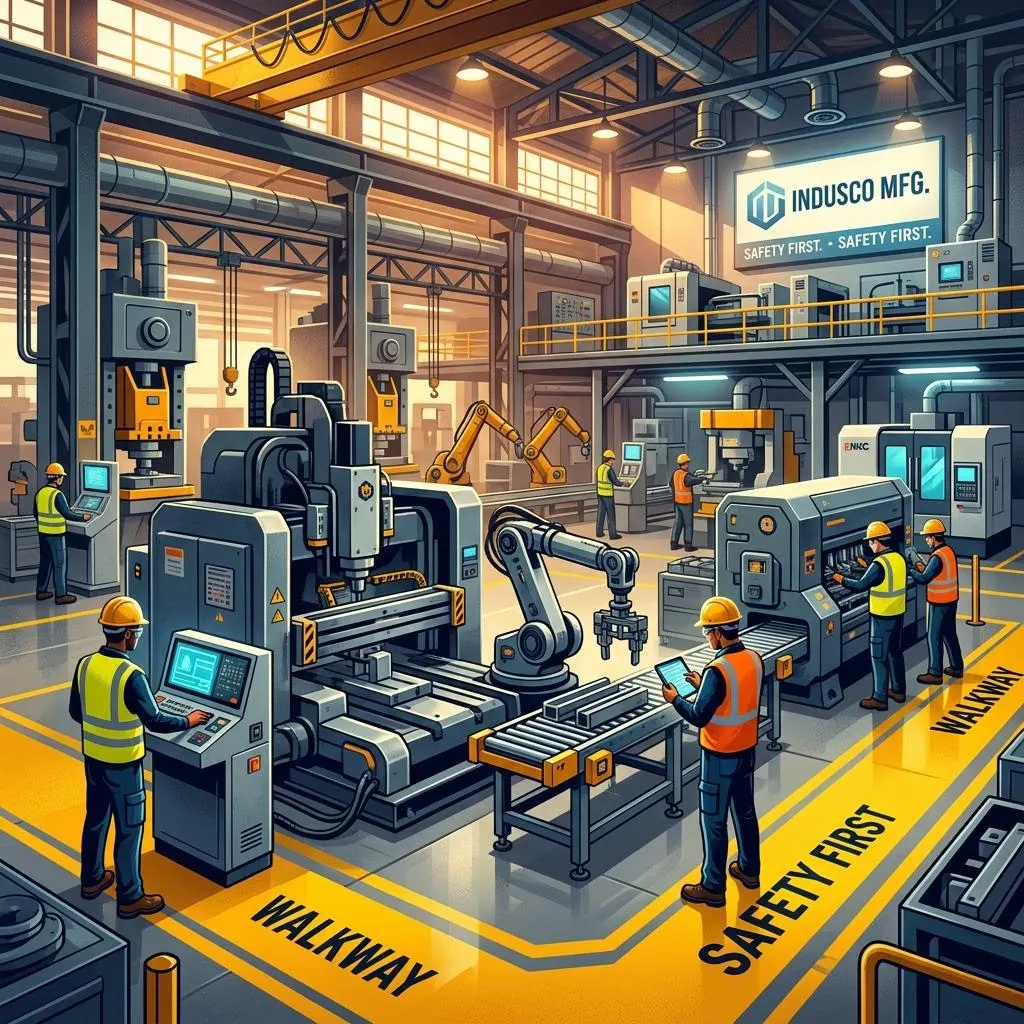
AI-generated editorial illustration. Not a customer site or evidence of compliance.
OSHA Scan Editorial · AI-assisted educational guide
Based on the official sources linked below. No site-specific or independent professional review is implied. Confirm applicability and current federal or State Plan requirements with a qualified professional.
Not a full HAZWOPER program or HASP, engineering design, rescue plan, electrical authorization, or compliance determination.
“Comprehensive” should describe coverage and ownership, not promise one document satisfies every OSHA standard. Connect each trigger to its procedure, inspection, training, record, and escalation path. This guide highlights Part 1904, emergency and fire planning, electrical safety, machine guarding, and general-industry permit spaces.
Keep scope honest: 1910.146 is general industry and excludes agriculture, construction, and shipyard employment. A fan does not automatically make a permit space safe, a checklist does not authorize energized work, and a photo cannot prove atmosphere, deenergization, guarding function, rescue, or recordkeeping. This is not a full HAZWOPER program or site-specific HASP; add specialized programs and qualified expertise when triggered.
Who does this apply to?
- Use for a U.S. general-industry employer coordinating Part 1904 and applicable Part 1910 programs. Confirm jurisdiction and work classification.
- Routine records have exemptions, but severe-event reporting remains: fatality within 8 hours; in-patient hospitalization, amputation, or loss of an eye within 24 hours.
- Emergency and fire plans are required when a Part 1910 standard requires them; 10 or fewer employees may communicate a required plan orally under 1910.38 and 1910.39. Specialized electrical, machine, chemical, confined-space, and HAZWOPER scope needs separate review.
Implementation Steps
Set the scope and operating picture
Define establishment, jurisdiction, shifts, employees, contractors, and work that crosses into construction or another sector. Build a hazard register naming trigger, standard, task, interim control, owner, and evidence. Add a program-interface column showing which document hands off to another: for example, a chemical change may affect HazCom, PPE, emergency response, and waste; a machine change may affect guarding, energy control, training, and inspection. Implementation questions: which owner accepts the handoff, what fact reopens the scope decision, and where is the active version kept?
- Map processes, machinery, electrical systems, chemicals, elevated work, vehicles, emergency roles, and spaces.
- Separate production, maintenance, emergency, and contractor work; flag State Plan, fire, environmental, HAZWOPER, and substance questions.
Make recordkeeping and response time visible
Create an event pathway separating first aid, recordability, severe-event reporting, posting, and corrective action. A company with no more than 10 employees at any time in the last calendar year may qualify for routine exemption, but that does not cancel severe-event reporting. Give the event card fields for time discovered, location, work being performed, immediate protection, notification owner, decision source, restricted-record location, and verifier. Keep the corrective-action clock separate from the recordkeeping decision so uncertainty about one does not silently delay the other.
- Assign a trained recordkeeper and an escalation contact for every shift, including weekends and nights.
- Use separate recordability and severe-event decisions; track 300A posting from February 1 through April 30 when required.
Build emergency and fire coordination
Where required, an emergency action or fire prevention plan covers reporting, evacuation, accountability, rescue or medical duties, critical operations, fire hazards, ignition controls, waste, equipment, and responsible roles. A small employer may communicate a required plan orally, but duties still need to be understood and practiced.
- Define alarm, evacuation, accountability, accessibility, communication, and trained-helper arrangements.
- Decide whether employees evacuate rather than fight fires; extinguisher duties depend on policy and standard.
Control electrical and machine hazards
Maintain electrical equipment and access, follow listing and labeling, control deenergization, and restrict exposed energized work to qualified persons. A part not locked or tagged under 1910.333 is treated as energized; test for deenergization, induced voltage, and backfeed. Guard machine points of operation, nip points, rotating parts, chips, and sparks. Illustrative scenario: a jam-clearing task needs a guard removed and a reset at the panel; the supervisor maps the energy-control procedure, authorized role, guard-restoration check, and test result before release. Escalate when a control, interlock, or guard is bypassed, a source is not identified, or the task changes from routine operation to servicing.
- Inspect working space, panels, cords, disconnects, guards, interlocks, anchoring, and access by task and equipment.
- Keep electrical PPE under its own rules and use lockout/tagout or machine procedures for servicing; a push button is not isolation.
Evaluate and manage confined spaces
Identify spaces large enough for entry, with limited entry or exit, and not designed for continuous occupancy. Determine whether atmosphere, engulfment, inward convergence, or another serious hazard makes a space permit-required. Entry programs need permits, testing, attendant and entrant duties, isolation, communication, rescue, and training. The inventory should identify the space, access, process connections, known or possible hazards, isolation points, entry method, equipment, and decision owner. Escalate when the classification is uncertain, conditions change, monitoring is unavailable, or the planned rescue capability does not match the space and shift.
- Inventory tanks, pits, bins, vaults, and crawl spaces; inform employees when required.
- Use alternate entry only when every 1910.146(c)(5) condition is met. Match testing, isolation, retrieval, and rescue controls to the actual entry method, hazards, and applicable requirements; permit-entry rescue duties are not universal c(5) prerequisites.
Train, inspect, and improve the system
Give each role training and demonstration for electrical tasks, guarding, energy control, entry roles, emergency duties, records, and contractor coordination. Review after changes, incidents, concerns, and overdue actions; close controls only after field verification. Completion evidence should link the observed task to the controlling procedure, worker or evaluator, equipment or space, finding, interim protection, corrected condition, and verifier. A framework is working when an operator can find the active procedure and a supervisor can explain the escalation path—not merely when every register row has a checkmark.
- Map role, task, trainer or evaluator, initial training, refresher trigger, and record.
- Use interim protection, owner, due date, verification, and a post-change hazard-register review.
Run HR onboarding, training, and risk-based audits
Before assignment, map each role, task, hazard, and controlling standard; identify site/task training for temporary workers; and coordinate the host supervisor with the staffing agency. Use language and vocabulary the worker understands and check comprehension or demonstrated skill, not an attendance signature alone. A training matrix should record role/task/hazard, standard, understandable instruction, demonstrated skill, trainer/date, and the rule-specific renewal or change trigger. Follow each standard; retrain when a rule, task, equipment, worker understanding, or inspection finding calls for it. Assign PPE issuance, fit, replacement, cleaning, and inspection owners; supervisors monitor use and escalate defects. Run risk-based audits based on hazards, shifts, turnover, incidents, and prior findings; this recommended cadence is not a blanket annual OSHA mandate. Each corrective action names an owner, due date, interim protection when needed, verifier, and closure evidence. Assign responsibility for OSHA, State Plan, and other regulator updates; route changes into procedures and training. Name an inspection point of contact and backup; keep an inspection request and response log. Give staff access to current safety procedures, emergency contacts, and SDSs, while restricting medical and incident records containing personal information to authorized users.
- Reconcile the HR roster, role matrix, orientation, qualifications, and temporary-worker contacts at onboarding or transfer.
- Sample audits by risk and shift; record finding, owner, due date, verifier, evidence, and overdue escalation.
- Log the regulator source, decision, affected documents, and training change when monitoring identifies an update.
Document planning checklist
Use this planning list to organize applicable records. Suggested owners and review triggers are workflow recommendations; the linked standards determine which documents and retention periods are legally required.
| Document / Record | Purpose | Owner | Review Cadence |
|---|---|---|---|
| Comprehensive hazard and applicability register | Connects work, trigger, standard, owner, interim control, and open question. | Safety coordinator with operations leaders | At startup, on a risk-based recommended cadence, and after a process, jurisdiction, or incident change |
| Recordkeeping and severe-event response card | Separates Part 1904 decisions, 8-hour and 24-hour reports, posting, and corrective action. | Employer recordkeeper | After every event and before required reporting or posting |
| Emergency action and fire-prevention materials | Assigns alarms, evacuation, accountability, fire hazards, ignition controls, and roles where required. | Emergency coordinator and facilities lead | On development, assignment or responsibility change, drill, and plan change |
| Electrical safe-work and energy-control procedures | Documents deenergization, lock/tag, testing, qualified-person limits, and machine isolation. | Qualified electrical lead and maintenance manager | Before affected work and after equipment, method, or incident change |
| Confined-space inventory and entry program | Classifies spaces, permits, testing, isolation, roles, communication, and rescue. | Permit-space program administrator | Before entry and after space, process, equipment, or rescue change |
| HR onboarding and training matrix | Maps role/task/hazard, standard, understandable instruction, demonstrated skill, trainer/date, and rule-specific renewal or change trigger. | HR training coordinator with supervisors | At onboarding, transfer, change, skill gap, or applicable standard update |
| PPE issuance and inspection ownership log | Assigns fit, issue, maintenance, replacement, and field inspection responsibility. | Area supervisors with the safety lead | At issue, observation, defect, or task change |
| Corrective-action and regulator-update register | Links risk-based findings and regulator updates to owners, due dates, evidence, and verified closure. | Safety lead and compliance coordinator | After each finding or applicable update |
Common Pitfalls
Calling a single binder comprehensive
A binder can contain stale pages and miss a trigger. Coverage requires a current register, owners, field verification, revision control, and technical programs.
Using exemption language to skip reporting
Routine Part 1904 size or industry exemptions do not erase the 8-hour fatality or 24-hour hospitalization, amputation, or loss-of-eye duties.
Pretending a fan or checklist is a rescue plan
Ventilation does not automatically qualify alternate entry; a named rescuer without equipment, access, training, and practice is not rescue capability.
Using attendance as competence
A signed roster does not prove understandable instruction or demonstrated skill. Capture comprehension and practical evaluation for the task.
Imposing a blanket audit or refresher cadence
Do not impose an annual refresher or annual audit where the applicable rule does not. Set a risk-based recommended cadence and follow rule-specific triggers.
Opening restricted records to everyone
Make current safety information accessible to staff who need it, but restrict medical and incident records containing personal information to authorized users.
Frequently Asked Questions
Does one comprehensive safety plan replace topic-specific programs?
Does a small company have to keep OSHA logs?
Is 1910.146 the confined-space rule for construction?
Can a photo confirm safe isolation, guarding, or an atmosphere?
How should temporary-worker training be coordinated?
How often should HR audit safety programs?
Which safety records should staff be able to access?
What the AI can and can't detect
OSHA Scan reads a single photo. That makes it fast and easy for anyone on site — but it also means it has real limits. Here's an honest look at both.
What it can catch from a photo
- Missing or incorrect PPE that is visible in the frame
- Unprotected edges, open holes, and visible fall hazards
- Housekeeping, trip, and blocked walkway or exit hazards
- Visible electrical, struck-by, and equipment-guarding hazards
What a photo can't tell it
- Hazards hidden from view or anything outside the photo
- Exact heights, distances, weights, or measurements
- Training records, procedures, or how equipment is actually used
- Full legal compliance or an official OSHA pass/fail determination