
Quick Start
General Industry Safety Quick Start Guide
A practical discovery sequence for turning general-industry safety obligations into owned programs, training, and records.
U.S. Compliance Documents & Programs
Start with OSHA’s General Industry Quick Start, explore 11 program guides, and turn the requirements that apply to your workplace into organized documents and review-ready drafts.
OSHA Scan Editorial
Practical safety documentation, steps, and templates for U.S. employers. Not a generic legal encyclopedia — action-oriented guides for building your site-specific safety programs.

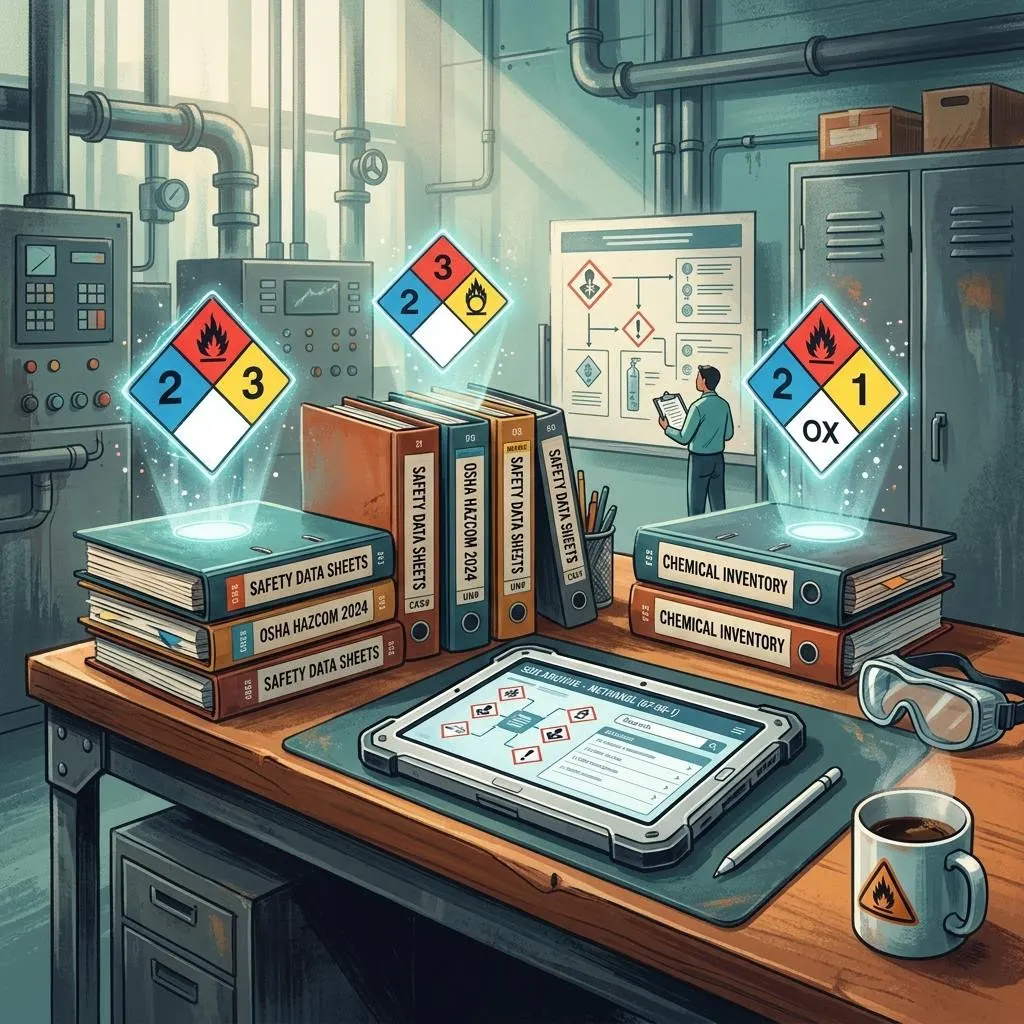
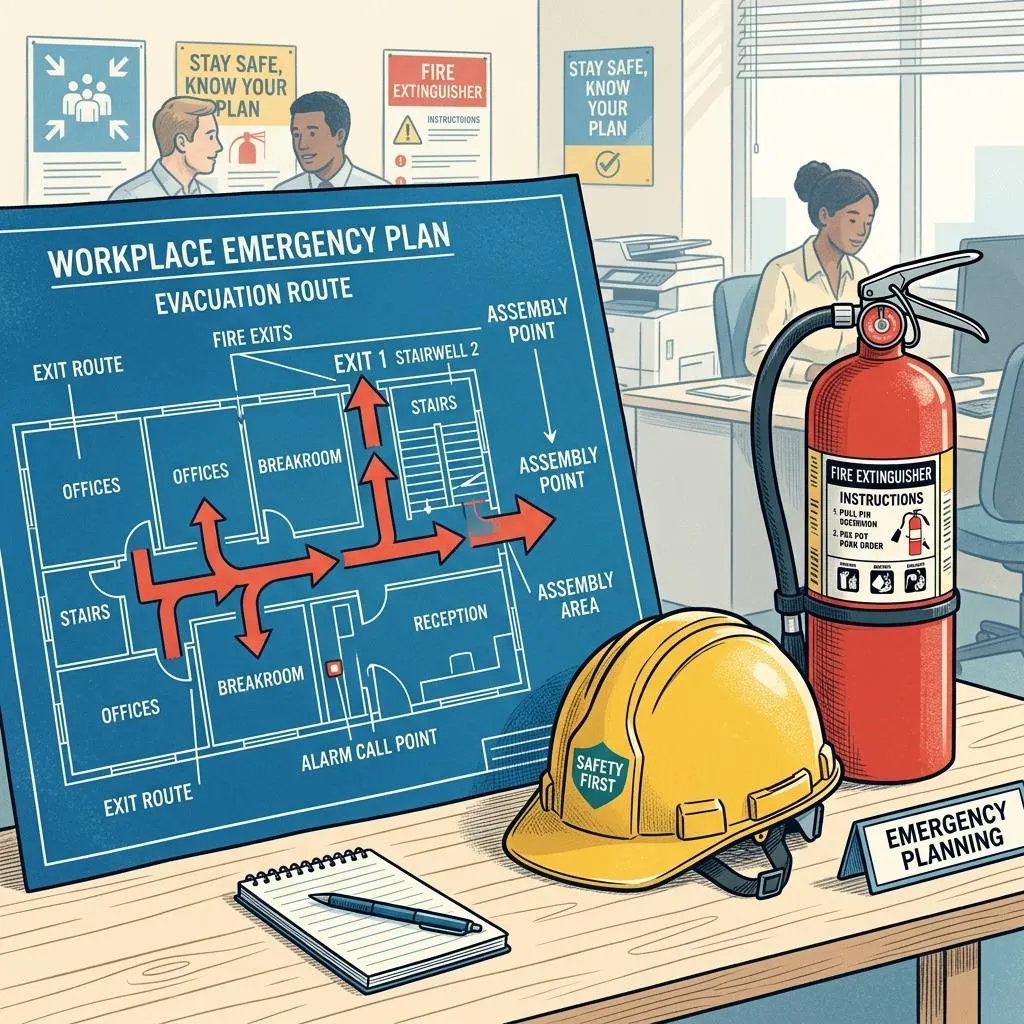
AI-generated editorial illustrations, not customer sites or evidence of compliance.
A practical discovery sequence for turning general-industry safety obligations into owned programs, training, and records.
Begin with a short register of baseline topics rather than copying every plan found online. Check the recordkeeping framework, hazard communication when covered chemicals are present, workplace conditions, training, and the general duties that fit the actual work. Record the Part 1910 subpart or Part 1904 section you checked and mark uncertain items for qualified review. Useful fields are establishment, process, trigger fact, source URL or section, decision, owner, open question, and evidence location. Implementation question: if a reviewer disagrees with a row, can they see which fact led to the decision and what new fact would reopen it?
Interview the people who maintain equipment, handle materials, respond to emergencies, and supervise work. Their answers reveal conditional programs: lockout/tagout for servicing, respiratory protection when respirators are necessary or required, hearing conservation at the action level, fall protection at the applicable surface or equipment trigger, and permit-space duties where a qualifying space exists. The trigger, not the plan's name, decides what belongs in scope.
Walk each task and route with employees, then turn observations into a risk-ranked work list. Look beyond what a camera can see: energy sources, line-of-fire exposure, atmospheric conditions, sound dose, chemical compatibility, emergency access, and changes between shifts require records or measurement. A job safety analysis can connect each step to a control, person, and verification method. Illustrative scenario: a photo shows a clear aisle on day shift, while the night walk finds staging carts narrowing the route; the record names the shift, affected roles, temporary control, owner, and field check. Escalate when the observation suggests exposure, isolation, fit, atmosphere, or another fact that requires qualified assessment rather than visual review.
Convert the register into a manageable program architecture: a policy, topic-specific procedures, training paths, inspections, corrective-action workflow, and document control. “Comprehensive” means the system addresses the hazards found; it does not mean every employer needs every named OSHA plan. Give each procedure an owner, revision date, affected work, and escalation path. Build a cross-reference with trigger, procedure, form, training, verifier, retention or posting instruction, and superseded-version location. Decide who can approve an exception, what evidence is sufficient to close an action, and when an unresolved question stops the job instead of being carried as a note.
Build training from job duties and the procedures employees must perform, not from attendance alone. Include new-hire, reassignment, new-equipment, refresher, and incident-driven paths where the applicable standard calls for them. Demonstration and evaluation matter for tasks such as respirator use, forklift operation, energy control, emergency roles, and PPE selection. For onboarding, map each role, task, hazard, and standard; use language and vocabulary employees understand; and record demonstrated skill, trainer/date, and the rule-specific renewal or change trigger. Coordinate site and task training between host supervisors and staffing agencies for temporary workers; an agreement does not transfer OSHA duties.
Keep these verbs separate. Determine whether an injury or illness is recordable under Part 1904; report severe events on the required deadline; post notices or summaries when required; and retain program records according to their own rules. A company with no more than 10 employees at any time in the last calendar year may qualify for a routine-recordkeeping exemption, but that is not an exemption from severe-event reporting. An event file should identify the facts known, decision-maker, standard or official instruction consulted, notification time, posting location or reason not applicable, and follow-up owner. Implementation question: who can make the first call on a weekend, and how does that person hand the recordability decision to the recordkeeper without exposing restricted medical detail?
Use OSHA's standard text, compliance-assistance pages, consultation resources, and State Plan information to resolve open questions. Save the source and access date in the applicability register so a later owner can retrace the decision. For an incident, exposure, citation, energized task, or permit-space entry, use the controlling text and obtain qualified safety, legal, or medical advice rather than treating this overview as a determination. Completion evidence is a dated decision trail: source checked, site fact confirmed, reviewer, affected document or training, communication audience, and verification after implementation. If the source is unclear or facts conflict, record the uncertainty and escalate rather than converting a recommendation into a requirement.
Give HR, supervisors, and the safety lead clear responsibilities before work starts. These are practical coordination tips; the applicable standard determines training, documentation, and renewal requirements.
A practical discovery sequence for turning general-industry safety obligations into owned programs, training, and records.
A practical, jurisdiction-aware process for contesting, posting, and documenting an OSHA citation.
A practical written HazCom program for chemical inventories, labels, SDS access, and role-based training.
A machine-specific hazardous-energy program for authorized employees, affected employees, inspections, and group work.
A program design guide for hazard assessment, protective selection, employee fit, training, payment, and review.
A practical framework for emergency action plans, fire prevention controls, alarms, evacuation, and accountability.
A powered-industrial-truck program connecting operator training, evaluations, inspections, pedestrians, loads, and site changes.
Build a fall-protection workflow that starts with the walking-working surface and ends with inspected equipment, training, and rescue decisions.
Set up exposure monitoring, engineering controls, audiometry, and worker follow-through without confusing the action level with the permissible exposure limit.
Connect hazard evaluation, respirator selection, medical clearance, fit testing, training, and program evaluation in the order workers need them.
Create an exposure-based BBP program for the people whose assigned duties can reasonably bring them into contact with blood or other potentially infectious materials.
A practical framework for linking recordkeeping, emergency planning, electrical safety, machine guarding, confined spaces, and task controls without claiming one plan covers every hazard.
Site-specific starter drafts
Choose an existing document type, add your project context after creating a free account, and prepare review-ready instructions for the organization library.
Start an EAP around evacuation, assembly, emergency communications, accountability, and site arrangements.
Capture task steps, hazards, controls, PPE, equipment, and stop-work considerations for a specific scope.
Organize safety responsibilities, training and communication, inspections, records, and review cadence.
How the workflow works
Details
Add the site, scope, and supported industry or jurisdiction context.
Draft
Review populated instructions before a manager chooses Generate draft.
Qualified review
Select relevant standards/resources and verify applicability and completeness before use.
Bring all your critical safety documents into a single, organized library. OSHA Scan securely stores your custom policies alongside official government guidance so your team always knows exactly where to look.
Your safety resource library
Your organization’s documents
Policies, site plans, and reviewed procedures.
Official safety guidance
OSHA publications, QuickCards, and source links.
Safety information is useless if it's locked in the office. Provide your supervisors and workers with instant access to critical documents directly from their mobile devices while on the job site.
Ensure your team is always using the most up-to-date procedures. Maintain a single source of truth for your safety program, making it easy to archive old policies and publish new ones across all your locations.
Last verified: Today
These printable resources are account-protected. Create a free account to instantly download our most popular checklists and guides.
Printable checklist covering key job-site hazard categories.
A quick reference for OSHA/GHS hazard communication pictograms.
An overview of OSHA Scan’s safety inspection workflow and capabilities.
Print individual talks, sign-in sheets, categories, or the complete library.
Find and download print-ready federal and state workplace posters.
Browse checklists, QuickCards, official guidance, and reusable compliance templates.
Choose an industry-specific EAP template, then return here to manage your resources.
Join OSHA Scan to centralize your policies, access official guidance, and support your U.S. workplace safety program.