
1
Set the scene
Start with context
Fill the frame
2–3 ft for close-ups; keep ladders, cords and workers fully in view.
Plumbing hazard detection means spotting the hazards plumbers meet on service calls and job sites before the work starts: cords and tools near water, torch soldering and gas cylinders, open floor drains and pits, ladders, trenches for sewer and water lines, solvent cements, and pipe offcuts underfoot. With OSHA Scan, a plumbing contractor or lead plumber photographs a mechanical room, a basement, a rough-in, or a trench, and AI hazard detection acts as a second set of eyes, listing the visible hazards, the OSHA standard each may relate to, and a suggested fix. It does not test the air in a confined space, confirm GFCI protection, or replace a competent person's trench inspection; the safety inspection checklist below covers what a photo cannot show.
Photo scan: no account needed (you may be asked for the free phone Access Pass) · Template downloads: free account required
Plumbers move between very different workplaces in a single week: finished basements, crawl spaces, new construction, commercial mechanical rooms, and trenches for sewer and water lines. Each brings its own hazards — water near electricity, open flames near framing, holes and pits, ladders, solvent fumes, and on some jobs a trench or a confined space. Many plumbing companies are small, and the lead plumber is the one deciding whether a setup is safe.
OSHA Scan's hazard detection reads what is visible in a job photo: a cord lying in water, a drain or cleanout left open, gas cylinders on a cluttered bench, solvent cans left open, pipe offcuts across the walkway, or a ladder set up in a crowded spot. For each finding it notes the OSHA standard it may relate to and a specific fix to confirm on site.
Plumbing work changes setting constantly, and the OSHA rules that apply change with it. Most installation, alteration, and repair work falls under the construction standards in 29 CFR 1926: ground-fault protection for cord-and-plug tools (1926.404(b)(1)), protection for holes and openings (1926.501(b)(4)), ladders (1926.1053), fire prevention during torch work (1926.352), housekeeping (1926.25), and the excavation standard for sewer and water-line trenches (Subpart P). Hazard communication applies to the primers, cements, fluxes, and drain chemicals plumbers use every day, which means labeled containers, safety data sheets, and training.
Two plumbing hazards are hard to judge by eye. Trench walls can collapse without warning, which is why the excavation standard calls for daily inspections by a competent person and protective systems at 5 feet and deeper. Confined spaces — vaults, pits, tanks, and some crawl spaces — can hold low oxygen or sewer gases such as hydrogen sulfide, and they are covered by the confined spaces in construction standard (Subpart AA). A photo scan helps with the visible part — cords in water, open drains, cylinder storage, clutter — while trench and air checks still need a qualified person with the right instruments.
Run through these steps before crews start — each one covers a visible gap the AI can help you catch.
Look for cords, extension reels, and tools on wet floors or near open water, and confirm everything is plugged into GFCI protection. Electrical hazards on job sites may relate to 29 CFR 1926.404(b)(1) and 1926.405(g).
Put drain, cleanout, and pit covers back when no one is working in them, and barricade any opening that has to stay open. Holes may relate to 29 CFR 1926.501(b)(4).
Clear or shield combustibles, keep an extinguisher within reach, and store gas cylinders upright and secured away from heat and clutter. Torch work may relate to 29 CFR 1926.350 and 1926.352.
Have a competent person check trenches and confirm a protective system at 5 feet and deeper, set ladders on level, clear ground, and test the air before entering a vault or pit where required. These may relate to 29 CFR 1926 Subpart P, 1926.1053, and Subpart AA.
Photograph the mechanical room, basement, rough-in, or trench and upload it to OSHA Scan for a second pass with AI hazard detection. The AI flags visible hazards, notes the OSHA standard each may relate to, and suggests a fix — treat the findings as a draft to verify on site. Free, no account needed (you may be asked for the free phone Access Pass).
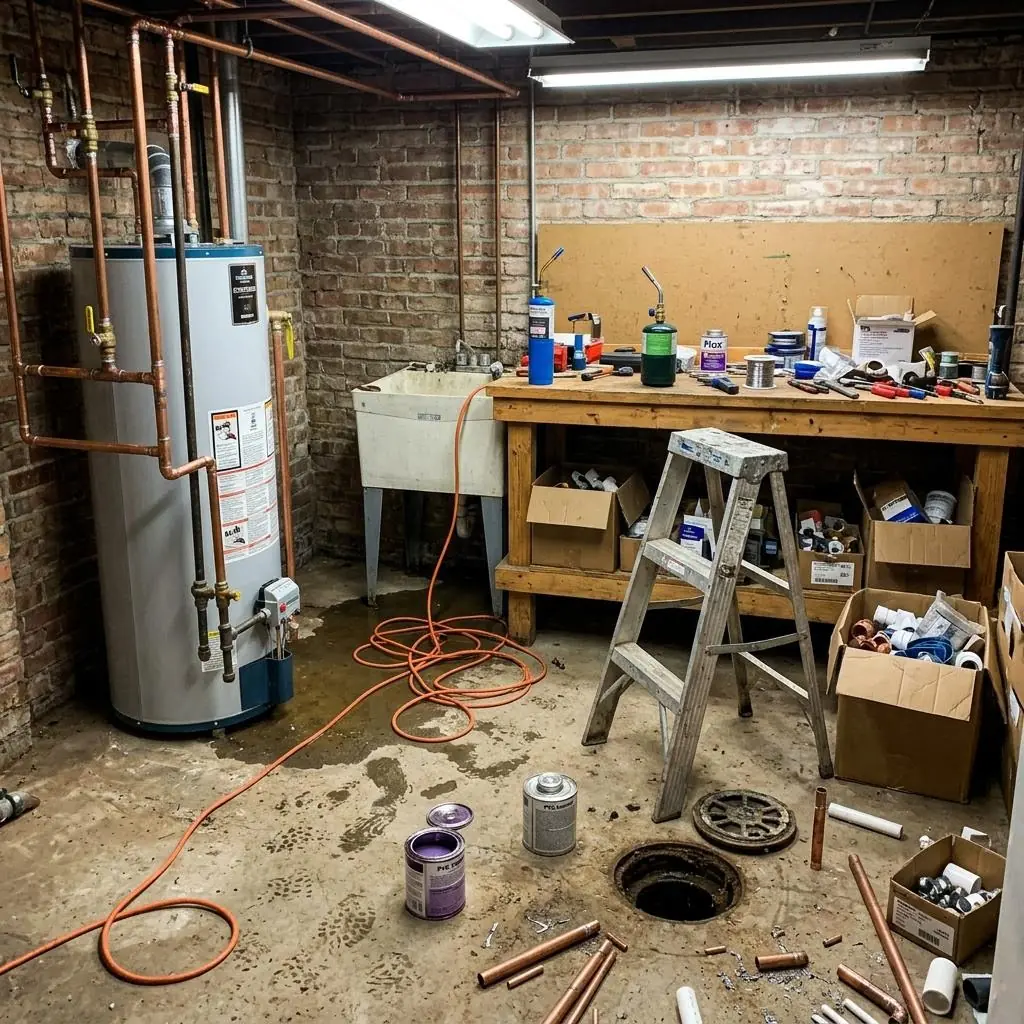
The visible job-site conditions a plumber can fix before work starts, detected from one image.
Extension cords and power tools on wet floors or near open water, with no visible GFCI, and damaged cords or plugs.
Soldering torches and gas cylinders left on cluttered benches or near combustibles, and torch work close to wood framing or insulation.
Open floor drains, cleanouts, and pits without covers, stepladders set up in cluttered spots, and trench walls with no visible protection.
Open cans of PVC primer and cement, pipe offcuts in walkways, and crowded work areas that add trip and fume exposure.
Scan a photo like the one above and this is the report you get — score, findings, OSHA references, and fixes. It is an illustrative example, clearly marked — not live scan data.
Compliance score
75
Lower means more potential hazards found
Score uses visible confirmed findings only. Not a safety certification.
2 confirmed · 0 need review · 0 positive
1Extension cord coiled on a wet floor next to the water heater
Possibly related to ground-fault protection (29 CFR 1926.404(b)(1)) and flexible cord use (29 CFR 1926.405(g))
Observed condition: Water on the floor and a cord lying in it put anyone who steps there or handles a tool at risk of shock, especially if a connection or the cord jacket is damaged. The photo cannot show whether the circuit is GFCI-protected.
Corrective action: Lift the cord off the wet floor or reroute it around the water, plug tools into a GFCI-protected outlet or a portable GFCI, and check the cord and its ends for damage before use. Find and stop the source of the water.
High confidence
2Open floor drain with its cover removed and left beside the hole
Possibly related to protection from holes (29 CFR 1926.501(b)(4)(ii))
Observed condition: An uncovered drain opening in a dim basement is easy to step into, especially for someone carrying pipe or a ladder. A foot dropping into the hole can mean a fall, an ankle or knee injury, or a cut on the drain edge.
Corrective action: Put the cover back whenever no one is working in the drain. While it is open, cover it with a secured temporary cover or surround it with a barricade, and keep the walkway around it clear.
High confidence
Upload a photo like the one above and get a compliance score and hazard count. No account needed to scan, though you may be asked for the free phone Access Pass — create a free account to unlock the full report.
Use the real site or facility name. If you save the scan after signup, it becomes the report name.
Three angles, one deeper scan
Only the wide shot is required — every extra angle gives the AI more places to look.
Required: Set the scene — one wide shot lets the AI sweep the whole area at once
Stand at the entry point and capture corner to corner: floors, ladders, scaffolds, and everyone at work
Drop a job-site photo or walkthrough video
Click to upload, drag & drop, or snap a photo on site. Photos scan free with no signup and no card — you may be asked for the free phone Access Pass. Video walkthroughs (up to 3 min) run on a free account.
Small habits, sharper scans
Set the scene
Start with context
Fill the frame
2–3 ft for close-ups; keep ladders, cords and workers fully in view.
Capture clearly
Make the frame usable
Light it right
Keep the sun or lights behind you — glare and shadows hide hazards.
Tap to focus
Tap the hazard on screen and hold still one second — blur can't be flagged.
Choose the useful view
Give the AI room to understand
Go landscape
Turn your phone sideways — a wider frame catches more of the scene.
Only upload photos you have permission to use, and avoid images showing personal, customer, or confidential information. Demo photos and results are held privately for up to 48 hours so you can save them to a free account; unclaimed photos are deleted automatically. Results are an AI-assisted preliminary review, not an official OSHA determination.
New: Video walkthrough scans
Record up to 3 minutes of your site — the AI extracts frames and categorizes findings with exact timestamps. Free account required.
Get the best results
Wide shot first
Stand at the entrance and photograph the entire work area so AI sees the full context
Hazard areas
Photograph elevated surfaces, equipment, electrical panels, and anywhere workers are active
Close-ups last
Move in close on anything damaged, missing, or that looks risky — the AI catches more detail
Walk the mechanical room, basement, rough-in, or trench with these points before work starts. The first four are free — create a free account to unlock the full checklist and scan your own job photos.
Free checklist — 12 points
Enter your email to unlock the full checklist
Read the checklist here after entering your email. A free account is required to download the PDF.
One email with the checklist, one follow-up. Unsubscribe anytime.
Free printable templatePDF · US Letter
Walk the work area with this form before work starts and again whenever you move to a new area or conditions change.
On the form
A free account is required to download it.
Non-English documents are automated translations, not official OSHA translations. Citations, limits and names are kept as written.
OSHA Scan template — not an official government form and not legal advice.
OSHA Scan reads a single photo. That makes it fast and easy for anyone on site — but it also means it has real limits. Here's an honest look at both.
Snap a photo of the job site, and the AI categorizes findings against OSHA standards.
Each finding includes consistent corrective actions and structured JHA outputs. Check items off as your crew resolves them.
Every inspection gets a deterministic 0-100 compliance score derived from hazard severity, so you can track sites at a glance.
A prioritization aid based on recorded findings—not a certification or a complete measure of site safety.
Generate detailed inspection reports and export data to Excel for record-keeping and stakeholders.
A qualified person must review AI-flagged items before making safety decisions. Do not replace required comprehensive safety walkthroughs with AI reports. Features, limits, and downloads depend on your account’s plan and permissions.
Illustrative AI-assisted workflows. Review the findings; they are not a compliance certification.
A scan is a fast first look, not the final word. Before treating this kind of area as safe, a competent person should still confirm:
Take one photo that shows the whole work area — the mechanical room, the basement, the rough-in, or the trench — and upload it. The AI looks for hazards it can see, such as cords lying in water, open drains, and unsecured gas cylinders, and lists each one with the OSHA standard it may relate to and a suggested fix. It works only from what is in the picture: it cannot confirm GFCI protection, test the air in a crawl space, or check trench soil, so a person on site still confirms every finding.
Most plumbing installation, alteration, and repair work on job sites falls under OSHA's construction standards (29 CFR 1926). Common ones include ground-fault protection (1926.404(b)(1)), holes and openings (1926.501(b)(4)), ladders (1926.1053), gas welding, cutting, and heating with its fire-prevention rules (1926.350 and 1926.352), excavations (Subpart P), confined spaces in construction (Subpart AA), and hazard communication for primers, cements, and drain chemicals. In-house maintenance plumbers at a facility usually fall under the general industry standards (29 CFR 1910) instead.
On construction sites, OSHA requires either ground-fault circuit interrupters on 120-volt, single-phase, 15- and 20-amp receptacle outlets that are not part of the building's permanent wiring, or an assured equipment grounding conductor program (29 CFR 1926.404(b)(1)). For plumbers, who often work around water, a GFCI-protected outlet or a portable GFCI is the practical way to meet this. A photo cannot confirm GFCI protection — test it.
Under OSHA's excavation standard, trenches 5 feet deep or more need a protective system — sloping, shoring, or a trench box — unless they are entirely in stable rock. Trenches deeper than 20 feet need a system designed by a registered professional engineer. Shallower trenches still need protection if a competent person sees signs of a possible cave-in (29 CFR 1926.652).
Yes. Torch soldering and brazing fall under OSHA's construction rules for gas welding, cutting, and heating, including fire prevention (29 CFR 1926.350 and 1926.352). That means clearing or shielding combustibles, keeping a suitable fire extinguisher ready, and watching for fire during and after the work when normal precautions are not enough.
No. Oxygen levels and toxic or flammable gases are invisible in a photo. Vaults, pits, and some crawl spaces need to be evaluated as possible confined spaces, with the air tested by a calibrated meter before entry where required (29 CFR 1926 Subpart AA). The scan can flag visible problems around the entry, such as a missing cover or guard.
Reviewed by OSHA Scan Editorial
This content is produced by the OSHA Scan Editorial team and reviewed with AI assistance. It is general safety information, not legal or compliance advice. OSHA Scan is an independent tool and is not affiliated with, endorsed by, or certified by OSHA or the U.S. Department of Labor.
More ways to see what an AI OSHA scan can do for your site.
The overview hub — how the scanner works and every job, site, and hazard it covers.
Common plumbing hazards and how crews control them.
Cave-in protection, spoil piles, and access for line trenches.
Vaults, pits, and tanks before anyone goes in.
Fire prevention for torch soldering and brazing.
Stepladder setup and condition checks.
Damaged cords and wet-location electrical hazards.
The complete hub of every hazard type and industry the scanner covers.
See a complete labelled example of everything a scan returns.
Start with one lifetime use per eligible scan type — no credit card. Build JHA-ready reports and catch changing conditions sooner.
Start your free trial