
1
Set the scene
Start with context
Fill the frame
2–3 ft for close-ups; keep ladders, cords and workers fully in view.
An injury or illness is OSHA-recordable when it is work-related, is a new case, and meets at least one general recording criterion: death, days away from work, restricted work or job transfer, medical treatment beyond first aid, loss of consciousness, or a significant injury or illness diagnosed by a physician or other licensed health care professional (29 CFR 1904.7). First aid — bandages, butterfly strips, non-prescription medication at non-prescription strength, hot or cold therapy, and the rest of OSHA's 14-item list — does not make a case recordable on its own. A photo can never decide recordability: the answer depends on treatment, work status, and medical facts no camera can see. In a signed-in account, OSHA Scan's injury log asks these questions in order and shows the 29 CFR 1904 rule behind each, but its answer is a suggestion you confirm. Its photo scans check the area where an injury happened so you can find and fix the condition behind it. The free checklist below walks through the test step by step.
Photo scan: no account needed (you may be asked for the free phone Access Pass) · Template downloads: free account required
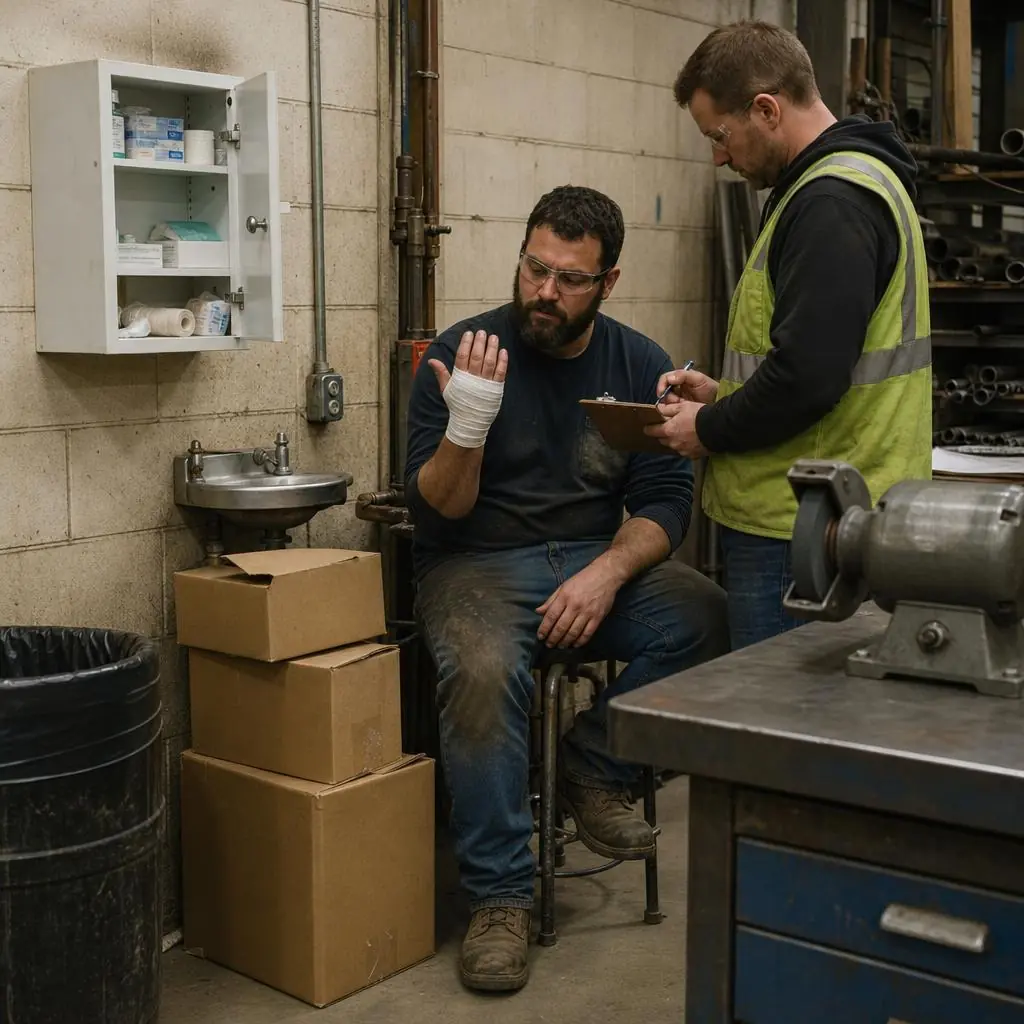
Recordability is decided by what happens after the injury, not by how bad it looked. A deep cut closed with butterfly strips is first aid; the same cut closed with three stitches is medical treatment and goes on the log. A sprain wrapped in an elastic bandage is first aid; a rigid splint prescribed to immobilize it is not. A worker sent home for the rest of the shift is not a days-away case, because counting starts the day after the injury — but a doctor's note to stay home tomorrow is, even if the worker comes in anyway. Those details live in treatment notes, work-status slips, and the supervisor's memory, so they need to be written down while they are fresh.
The other half of the job is preventing the next case. In this example, a supervisor documents a hand injury beside a bench grinder with the side of its wheel exposed, while boxes stacked against the hand sink make it hard to wash a wound. Whether the injury is recordable depends on facts outside the frame: what treatment was given and whether the worker can still do their routine job. What the photo can show are the conditions that may have caused the injury or made it worse. A photo scan doesn't decide anything about the case. It flags those conditions so you can fix them and keep a dated record of the fix.
Most recordability arguments come down to a few lines in 1904.7. Medication: an over-the-counter drug at over-the-counter strength is first aid, but a recommendation from a physician or other licensed health care professional to take it at prescription strength is medical treatment. Wound closure: butterfly bandages and Steri-Strips are first aid, while sutures and staples are medical treatment. Supports: elastic wraps and non-rigid back belts are first aid, while devices with rigid stays designed to immobilize a body part are medical treatment. Who gives the treatment doesn't matter — a first-aid item stays first aid when a doctor applies it, and medical treatment stays medical treatment when someone else provides it.
Work status has its own traps. Days away and restricted days are calendar days, counted from the day after the injury, including weekends and days off the worker couldn't have worked; you may stop at 180. A restriction is recordable only if it keeps the worker from one or more routine job functions — work activities they regularly perform at least once a week — or from a full workday. And when an event or exposure happened in the work environment, work-relatedness is presumed unless a listed exception applies. When a case is close, write down how you decided: treatment notes, the work-status slip, and dated photos of the area help you explain the decision later.
Run through these steps before crews start — each one covers a visible gap the AI can help you catch.
Check whether an event or exposure in the work environment caused, contributed to, or significantly aggravated the condition, and whether one of the exceptions in 1904.5(b)(2) applies.
Look for an earlier recorded case of the same type on the same body part. If the worker had fully recovered and a new workplace event brought the symptoms back, it is a new case.
Death, days away, restricted work or job transfer, medical treatment beyond first aid, loss of consciousness, or a significant diagnosed injury or illness — any one makes the case recordable.
Use the complete list in 1904.7(b)(5)(ii). If every treatment given or recommended is on it and no other criterion applies, the case is not recordable.
Enter recordable cases on the 300 log and complete a 301 within 7 calendar days, then scan and correct the conditions where the injury happened.
A scan can't tell you whether a case is recordable. It can show the conditions around the injury that need correcting, whatever the log decision turns out to be.
Grinder wheels, belts, and blades with missing or incomplete guards, and work rests set too far from the wheel.
Hand sinks, eyewash stations, and first-aid cabinets blocked by boxes or carts, so nobody can reach them quickly.
Stacked boxes, clutter, and stored material crowding the work area and the path around the injury site.
Each scan is time-stamped, so the fix you make after an incident is documented with the date it was made.
Scan a photo like the one above and this is the report you get — score, findings, OSHA references, and fixes. It is an illustrative example, clearly marked — not live scan data.
Compliance score
72
Lower means more potential hazards found
Score uses visible confirmed findings only. Not a safety certification.
3 confirmed · 0 need review · 0 positive
1Bench grinder with the side of the wheel and the flange exposed
Possibly related to abrasive wheel guarding (29 CFR 1910.215(a)(2) and (a)(4))
Observed condition: A guard that leaves the wheel side, spindle end, and flange open puts hands close to a spinning wheel, and a work rest set too far from the wheel can let a part jam and break it.
Corrective action: Tag the grinder out of service until a full guard is in place, then set the work rest no more than 1/8 inch from the wheel and recheck the gap as the wheel wears.
Medium confidenceNot fully clear from the photo — verify on site.
2Cardboard boxes stacked against the hand sink
Possibly related to housekeeping and washing facilities (29 CFR 1910.22(a)(1) and 1910.141(d))
Observed condition: Workers need to reach the sink right away to clean a wound or wash off a contaminant. Boxes stacked in front of it slow that down and add clutter to the work area.
Corrective action: Move the boxes to a storage area, keep the space in front of the sink clear, and add the sink to your weekly walkthrough.
High confidence
3Worker with a bandaged hand — whether the case is recordable needs a human check
Possibly related to the general recording criteria (29 CFR 1904.7)
Observed condition: A bandage alone is first aid under 1904.7(b)(5)(ii)(D). Stitches, prescription medication, days away, or restricted work would make the case recordable, and none of those show in a photo. This is flagged for review, not as a finding about your log.
Corrective action: Ask what treatment was given or recommended and whether the worker can do their routine job. If the case meets a recording criterion, enter it on the 300 log and complete a 301 within 7 calendar days.
Medium confidenceNot fully clear from the photo — verify on site.
Upload a photo like the one above and get a compliance score and hazard count. No account needed to scan, though you may be asked for the free phone Access Pass — create a free account to unlock the full report.
Use the real site or facility name. If you save the scan after signup, it becomes the report name.
Three angles, one deeper scan
Only the wide shot is required — every extra angle gives the AI more places to look.
Required: Set the scene — one wide shot lets the AI sweep the whole area at once
Stand at the entry point and capture corner to corner: floors, ladders, scaffolds, and everyone at work
Drop a job-site photo or walkthrough video
Click to upload, drag & drop, or snap a photo on site. Photos scan free with no signup and no card — you may be asked for the free phone Access Pass. Video walkthroughs (up to 3 min) run on a free account.
Small habits, sharper scans
Set the scene
Start with context
Fill the frame
2–3 ft for close-ups; keep ladders, cords and workers fully in view.
Capture clearly
Make the frame usable
Light it right
Keep the sun or lights behind you — glare and shadows hide hazards.
Tap to focus
Tap the hazard on screen and hold still one second — blur can't be flagged.
Choose the useful view
Give the AI room to understand
Go landscape
Turn your phone sideways — a wider frame catches more of the scene.
Only upload photos you have permission to use, and avoid images showing personal, customer, or confidential information. Demo photos and results are held privately for up to 48 hours so you can save them to a free account; unclaimed photos are deleted automatically. Results are an AI-assisted preliminary review, not an official OSHA determination.
New: Video walkthrough scans
Record up to 3 minutes of your site — the AI extracts frames and categorizes findings with exact timestamps. Free account required.
Get the best results
Wide shot first
Stand at the entrance and photograph the entire work area so AI sees the full context
Hazard areas
Photograph elevated surfaces, equipment, electrical panels, and anywhere workers are active
Close-ups last
Move in close on anything damaged, missing, or that looks risky — the AI catches more detail
Work through each case in order, from work-relatedness to the 7-day deadline. The first four are free — create a free account to unlock the rest and scan the area where the injury happened.
Confirm the case is work-related
An event or exposure in the work environment caused or contributed to the condition, or significantly aggravated a pre-existing one. Work-relatedness is presumed unless an exception in 1904.5(b)(2) applies.
Check the work-relatedness exceptions
Examples: the worker was there as a member of the public, the injury came solely from eating or drinking for personal consumption, or it was a motor vehicle accident in the company parking lot during the commute.
Decide whether it is a new case
It is new if the worker has no earlier recorded case of the same type on the same body part, or had fully recovered and a workplace event or exposure brought the symptoms back (1904.6).
Check for death, days away, or restricted work
Any one of these makes the case recordable. Restricted work means the worker can't do one or more routine job functions or a full workday. A restriction only on the day of the injury doesn't count.
Free printable templatePDF · US Letter
Work through this form for each injury or illness to decide whether it goes on the OSHA 300 Log. Use the case number only; employee details belong on the OSHA forms or equivalent forms, not here.
On the form
A free account is required to download it.
Non-English documents are automated translations, not official OSHA translations. Citations, limits and names are kept as written.
OSHA Scan template — not an official government form and not legal advice.
The injury log's helper asks the 29 CFR 1904 recording questions in order, shows the rule behind each, counts calendar days up to the 180-day cap, and gives a suggestion that you confirm before anything goes on the log. A free account includes on-screen use and one form download.
Start your injury log freeOSHA Scan reads a single photo. That makes it fast and easy for anyone on site — but it also means it has real limits. Here's an honest look at both.
Snap a photo of the job site, and the AI categorizes findings against OSHA standards.
Each finding includes consistent corrective actions and structured JHA outputs. Check items off as your crew resolves them.
Every inspection gets a deterministic 0-100 compliance score derived from hazard severity, so you can track sites at a glance.
A prioritization aid based on recorded findings—not a certification or a complete measure of site safety.
Generate detailed inspection reports and export data to Excel for record-keeping and stakeholders.
A qualified person must review AI-flagged items before making safety decisions. Do not replace required comprehensive safety walkthroughs with AI reports. Features, limits, and downloads depend on your account’s plan and permissions.
Illustrative AI-assisted workflows. Review the findings; they are not a compliance certification.
A scan is a fast first look, not the final word. Before treating this kind of area as safe, a competent person should still confirm:
Three things together: it is work-related (29 CFR 1904.5), it is a new case (1904.6), and it meets at least one general recording criterion in 1904.7 — death, days away from work, restricted work or job transfer, medical treatment beyond first aid, loss of consciousness, or a significant injury or illness diagnosed by a physician or other licensed health care professional. Separate rules in 1904.8 through 1904.11 also cover needlestick and sharps injuries, medical removal, hearing loss, and tuberculosis.
No. First aid alone never makes a case recordable, and OSHA's list in 1904.7(b)(5)(ii) is complete: non-prescription medication at non-prescription strength, tetanus shots, cleaning or soaking surface wounds, bandages and butterfly strips, hot or cold therapy, non-rigid supports such as elastic wraps, temporary splints used for transport, draining a blister or drilling a nail, eye patches, removing something from the eye with only irrigation or a cotton swab, removing splinters by simple means, finger guards, massages, and drinking fluids for heat stress. Anything else is medical treatment.
Not by itself. A visit solely for observation or counseling is not medical treatment, and neither are diagnostic procedures such as x-rays and blood tests. What matters is the treatment given or recommended. If a physician or other licensed health care professional recommends medical treatment — stitches or a prescription, for example — you must record the case even if the worker doesn't follow the recommendation.
Companies with 10 or fewer employees at all times during the last calendar year are partially exempt (29 CFR 1904.1), and the count is company-wide, not per location. Establishments in certain industries listed in Appendix A to Subpart B are also partially exempt (1904.2), and that exemption applies establishment by establishment. Either exemption ends if OSHA or the Bureau of Labor Statistics asks you in writing to keep records, and neither one covers severe-injury reporting: every employer must report a work-related fatality, in-patient hospitalization, amputation, or loss of an eye (1904.39).
Not on its own. Recordability depends on facts a photo can't show: the treatment given, the worker's job status, medical diagnoses, and the case history. The injury log in a signed-in OSHA Scan account asks the recording questions in order — work-relatedness, new case, the general recording criteria, and OSHA's first aid list — shows the 29 CFR 1904 rule behind each, and counts calendar days up to the 180-day cap. Its answer is a suggestion that a person confirms; the recordability decision stays with you. Photo scans are separate: they review the work area for visible hazards — like the exposed grinder wheel in this example — so you can correct the condition behind an injury and keep a dated record of the fix.
Reviewed by OSHA Scan Editorial
This content is produced by the OSHA Scan Editorial team and reviewed with AI assistance. It is general safety information, not legal or compliance advice. OSHA Scan is an independent tool and is not affiliated with, endorsed by, or certified by OSHA or the U.S. Department of Labor.
More ways to see what an AI OSHA scan can do for your site.
The overview hub — how the scanner works and every job, site, and hazard it covers.
Where recordable cases go — who keeps the log and how to fill out each column.
The case report due within 7 calendar days of each recordable injury.
The year-end totals of your recordable cases, posted February 1 to April 30.
Find missing and incomplete guards like the exposed grinder wheel in this example.
The full recording criteria, including OSHA's complete first-aid list.
Official resource — osha.govSee a complete labelled example of everything a scan returns.
Start with one lifetime use per eligible scan type — no credit card. Build JHA-ready reports and catch changing conditions sooner.
Start your free trial