
1
Set the scene
Start with context
Fill the frame
2–3 ft for close-ups; keep ladders, cords and workers fully in view.
Landscaping hazard detection means spotting the hazards lawn care and landscape crews face every day before the mowers start: mowers on slopes and near drop-offs, trimmers and blowers throwing debris, hoses and tools left across walkways, fuel cans in the trailer, trailer ramps and tie-downs, noise, and heat. With OSHA Scan, an owner or crew leader photographs a property, a slope, or the trailer setup, and AI hazard detection acts as a second set of eyes, listing the visible hazards, the OSHA rule each may relate to, and a suggested fix. Landscaping has no dedicated OSHA standard, and pesticide use is regulated mainly by the EPA and state agencies, so the scan points to the general rules that may apply. It cannot measure a slope or confirm a product's label rules; the safety inspection checklist below covers what a photo cannot show.
Photo scan: no account needed (you may be asked for the free phone Access Pass) · Template downloads: free account required
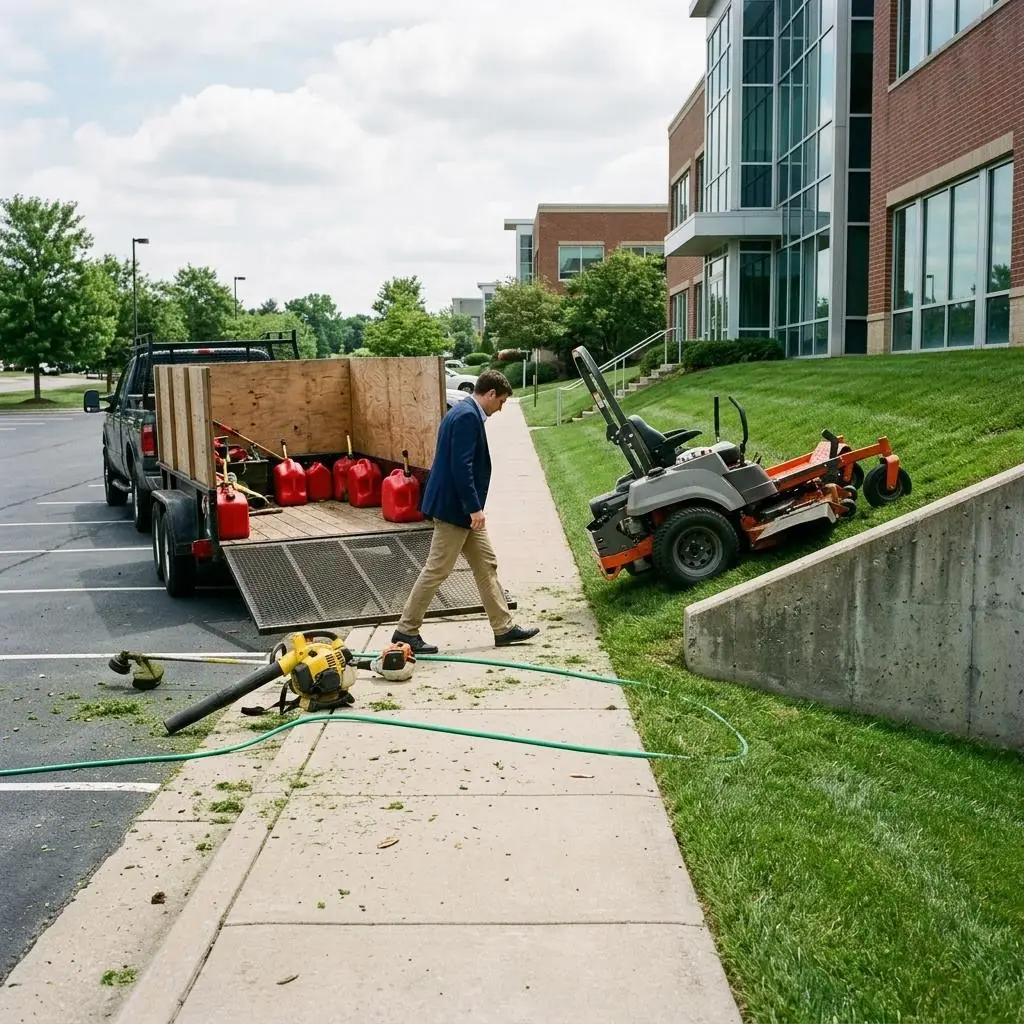
Lawn care and landscape crews work on someone else's property, often with the public around: office parks, schools, apartment complexes, and homes. The equipment is fast and loud — ride-on and zero-turn mowers, string trimmers, blowers, edgers — and much of the work happens on slopes, near water, or along walkways and parking lots. Crews visit several properties a day, so setup decisions are made quickly at the curb.
OSHA Scan's hazard detection reads what is visible in a photo: a mower working or parked on a steep grade near a retaining wall, a hose or tools left across a sidewalk where people walk, fuel cans standing loose in the trailer, a ramp left down beside a walkway, or crew members without eye or hearing protection. For each finding it notes the OSHA rule it may relate to and a specific fix to confirm on site.
Landscaping has no dedicated OSHA standard, so a lawn care company's safety program is built from general rules. Walking-working surfaces (29 CFR 1910.22) cover the trip hazards a crew creates, the PPE standards starting at 1910.132 require a hazard assessment and the right protection for each task, and the noise standard (1910.95) requires a hearing conservation program when mowers, blowers, and trimmers expose workers at or above its action level. Fuel storage and handling relate to the flammable liquids standard (1910.106). For hazards without a specific rule — mower rollovers on slopes or heat illness — OSHA can use the General Duty Clause, and some states have their own heat rules.
Pesticides and fertilizers sit mostly outside OSHA. The EPA regulates pesticide products through their labels, and state agencies license commercial applicators and enforce use rules. A photo scan helps crews with what they can see at each property — a mower close to a drop-off, a hose across a sidewalk, fuel loose in the trailer — while slope measurements, label requirements, and noise levels still need checking by someone on site.
Run through these steps before crews start — each one covers a visible gap the AI can help you catch.
Before mowing, note steep banks, retaining walls, ditches, and water, and pick up rocks and sticks. Mower rollovers may relate to the OSHA General Duty Clause and the mower maker's slope limits.
Keep hoses, cords, and tools off sidewalks, put out cones where the crew works beside foot traffic, and keep the trailer ramp up when not loading. Trip hazards may relate to 29 CFR 1910.22.
Strap down fuel cans and equipment, refuel with engines off and cool, and confirm pesticide products are stored and applied as the label says. Fuel handling may relate to 29 CFR 1910.106; pesticides are regulated by the EPA and state agencies.
Check eye, hearing, and foot protection for each task, and on hot days make sure water, rest, and shade are available. PPE may relate to 29 CFR 1910.132; heat illness may relate to the General Duty Clause, and some states have their own heat rules.
Photograph the slope, the walkway, or the trailer setup and upload it to OSHA Scan for a second pass with AI hazard detection. The AI flags visible hazards, notes the rule each may relate to, and suggests a fix — treat the findings as a draft to verify on site. Free, no account needed (you may be asked for the free phone Access Pass).
The visible setup problems a lawn or landscape crew can fix on arrival, detected from one image.
Ride-on and zero-turn mowers on steep grades or close to retaining walls, ditches, or water, and machines left parked on a slope.
Hoses, cords, blowers, and trimmers left across sidewalks and parking areas, and clippings or debris on paths people use.
Fuel cans riding loose in the trailer, containers without labels, and lawn chemicals stored or mixed out in the open.
Ramps left down beside walkways, equipment not tied down, and trailers parked where the crew unloads in traffic.
Scan a photo like the one above and this is the report you get — score, findings, OSHA references, and fixes. It is an illustrative example, clearly marked — not live scan data.
Compliance score
75
Lower means more potential hazards found
Score uses visible confirmed findings only. Not a safety certification.
2 confirmed · 0 need review · 0 positive
1Zero-turn mower on a steep grass slope near the top of a retaining wall
Possibly related to the OSHA General Duty Clause (Section 5(a)(1)) and the mower maker's maximum slope rating
Observed condition: Ride-on mowers can slide or roll over on steep grades, and a drop-off such as a retaining wall leaves no room to recover. The actual slope angle cannot be measured from a photo.
Corrective action: Measure the slope and compare it with the mower's maximum rating before mowing. Mow steep banks and the strip along the wall with a walk-behind mower or string trimmer, keep the roll bar up and the seat belt fastened where the mower has them, and never park a ride-on mower on the slope.
Medium confidenceNot fully clear from the photo — verify on site.
2Hose, blower, and trimmer left across the sidewalk as a pedestrian walks past
Possibly related to walking-working surface housekeeping (29 CFR 1910.22(a))
Observed condition: Tools and hoses across a walkway are a trip hazard for the crew and for anyone using the sidewalk, and a person stepping around them may walk into the trailer ramp or the parking lot.
Corrective action: Run the hose along the edge of the walkway or use a hose ramp, keep blowers and trimmers on the trailer or the grass when not in use, and set out a cone or sign while the crew works beside a sidewalk.
High confidence
Upload a photo like the one above and get a compliance score and hazard count. No account needed to scan, though you may be asked for the free phone Access Pass — create a free account to unlock the full report.
Use the real site or facility name. If you save the scan after signup, it becomes the report name.
Three angles, one deeper scan
Only the wide shot is required — every extra angle gives the AI more places to look.
Required: Set the scene — one wide shot lets the AI sweep the whole area at once
Stand at the entry point and capture corner to corner: floors, ladders, scaffolds, and everyone at work
Drop a job-site photo or walkthrough video
Click to upload, drag & drop, or snap a photo on site. Photos scan free with no signup and no card — you may be asked for the free phone Access Pass. Video walkthroughs (up to 3 min) run on a free account.
Small habits, sharper scans
Set the scene
Start with context
Fill the frame
2–3 ft for close-ups; keep ladders, cords and workers fully in view.
Capture clearly
Make the frame usable
Light it right
Keep the sun or lights behind you — glare and shadows hide hazards.
Tap to focus
Tap the hazard on screen and hold still one second — blur can't be flagged.
Choose the useful view
Give the AI room to understand
Go landscape
Turn your phone sideways — a wider frame catches more of the scene.
Only upload photos you have permission to use, and avoid images showing personal, customer, or confidential information. Demo photos and results are held privately for up to 48 hours so you can save them to a free account; unclaimed photos are deleted automatically. Results are an AI-assisted preliminary review, not an official OSHA determination.
New: Video walkthrough scans
Record up to 3 minutes of your site — the AI extracts frames and categorizes findings with exact timestamps. Free account required.
Get the best results
Wide shot first
Stand at the entrance and photograph the entire work area so AI sees the full context
Hazard areas
Photograph elevated surfaces, equipment, electrical panels, and anywhere workers are active
Close-ups last
Move in close on anything damaged, missing, or that looks risky — the AI catches more detail
Walk the property and the trailer with these points when the crew arrives. The first four are free — create a free account to unlock the full checklist and scan your own job photos.
Free checklist — 12 points
Enter your email to unlock the full checklist
Read the checklist here after entering your email. A free account is required to download the PDF.
One email with the checklist, one follow-up. Unsubscribe anytime.
Free printable templatePDF · US Letter
Go through this form at the start of the day and at each new property before mowing, trimming, or spraying.
On the form
A free account is required to download it.
Non-English documents are automated translations, not official OSHA translations. Citations, limits and names are kept as written.
OSHA Scan template — not an official government form and not legal advice.
OSHA Scan reads a single photo. That makes it fast and easy for anyone on site — but it also means it has real limits. Here's an honest look at both.
Snap a photo of the job site, and the AI categorizes findings against OSHA standards.
Each finding includes consistent corrective actions and structured JHA outputs. Check items off as your crew resolves them.
Every inspection gets a deterministic 0-100 compliance score derived from hazard severity, so you can track sites at a glance.
A prioritization aid based on recorded findings—not a certification or a complete measure of site safety.
Generate detailed inspection reports and export data to Excel for record-keeping and stakeholders.
A qualified person must review AI-flagged items before making safety decisions. Do not replace required comprehensive safety walkthroughs with AI reports. Features, limits, and downloads depend on your account’s plan and permissions.
Illustrative AI-assisted workflows. Review the findings; they are not a compliance certification.
A scan is a fast first look, not the final word. Before treating this kind of area as safe, a competent person should still confirm:
Photograph the area the crew is about to work — a slope, a walkway, or the trailer — and upload it. The AI looks for visible hazards such as a mower on a steep grade near a drop-off, hoses or tools across a sidewalk, and loose fuel cans, and lists each with the OSHA rule it may relate to and a suggested fix. It cannot measure a slope's angle, read a pesticide label, or judge heat conditions, so the crew leader still makes those calls.
There is no single OSHA standard written for landscaping. Lawn and landscape work is covered by OSHA's general industry rules, such as walking-working surfaces (29 CFR 1910.22), personal protective equipment (1910.132 to 1910.138), noise (1910.95), and flammable liquids (1910.106). When landscape crews work on a construction project, the construction standards in 29 CFR 1926 apply. Where no specific rule applies — mower rollovers on slopes, for example — OSHA can use the General Duty Clause.
Pesticide use is regulated mainly by the U.S. EPA through product labels and by state pesticide agencies, which certify and license applicators. The label lists the required PPE and handling rules, and following it is a legal requirement. OSHA's hazard communication rules still cover other workplace chemicals, such as fuel.
It depends on the mower. Each manufacturer sets a maximum slope in the operator's manual, and some banks are too steep for any ride-on mower. Measure the slope with a slope gauge or inclinometer, compare it with the rating, and use walk-behind mowers or trimmers on steeper banks and next to drop-offs, ditches, and water. A photo cannot measure slope.
It depends on the task, which is why OSHA requires a workplace hazard assessment (29 CFR 1910.132(d)). Typical needs are safety glasses for trimming and blowing, hearing protection for mowers and blowers, sturdy footwear, gloves, and chaps for chainsaw work. Pesticide work needs the PPE listed on the product label.
Yes. Any owner or crew leader can run it from a phone on arrival. Findings come back in plain language with a suggested fix. Treat them as a draft for someone on site to confirm.
Reviewed by OSHA Scan Editorial
This content is produced by the OSHA Scan Editorial team and reviewed with AI assistance. It is general safety information, not legal or compliance advice. OSHA Scan is an independent tool and is not affiliated with, endorsed by, or certified by OSHA or the U.S. Department of Labor.
More ways to see what an AI OSHA scan can do for your site.
The overview hub — how the scanner works and every job, site, and hazard it covers.
Power lines, drop zones, chippers, and aerial lifts for tree crews.
Water, rest, shade, and acclimatization for outdoor crews.
Noise from mowers, blowers, and trimmers.
Guards, blades, and cords on trimmers and edgers.
Hoses, cords, and debris on walkways.
Labels and safety data sheets for fuel and other chemicals.
The complete hub of every hazard type and industry the scanner covers.
See a complete labelled example of everything a scan returns.
Start with one lifetime use per eligible scan type — no credit card. Build JHA-ready reports and catch changing conditions sooner.
Start your free trial