
1
Set the scene
Start with context
Fill the frame
2–3 ft for close-ups; keep ladders, cords and workers fully in view.
Auto body shop hazard detection means spotting the hazards collision repair shops deal with every day: paint, solvents, and thinners near the spray booth, frame racks pulling under heavy tension, sanding dust and spray mist, welding near flammable materials, air hoses across the floor, and paints that need respiratory protection. With OSHA Scan, a shop owner or manager photographs the shop floor, and AI hazard detection acts as a second set of eyes, listing the visible hazards, the OSHA standard each may relate to, and a suggested fix. It cannot test spray booth airflow, measure isocyanate or dust exposure, or confirm frame-rack equipment is rated for the pull; the safety inspection checklist below covers what a photo cannot show.
Photo scan: no account needed (you may be asked for the free phone Access Pass) · Template downloads: free account required
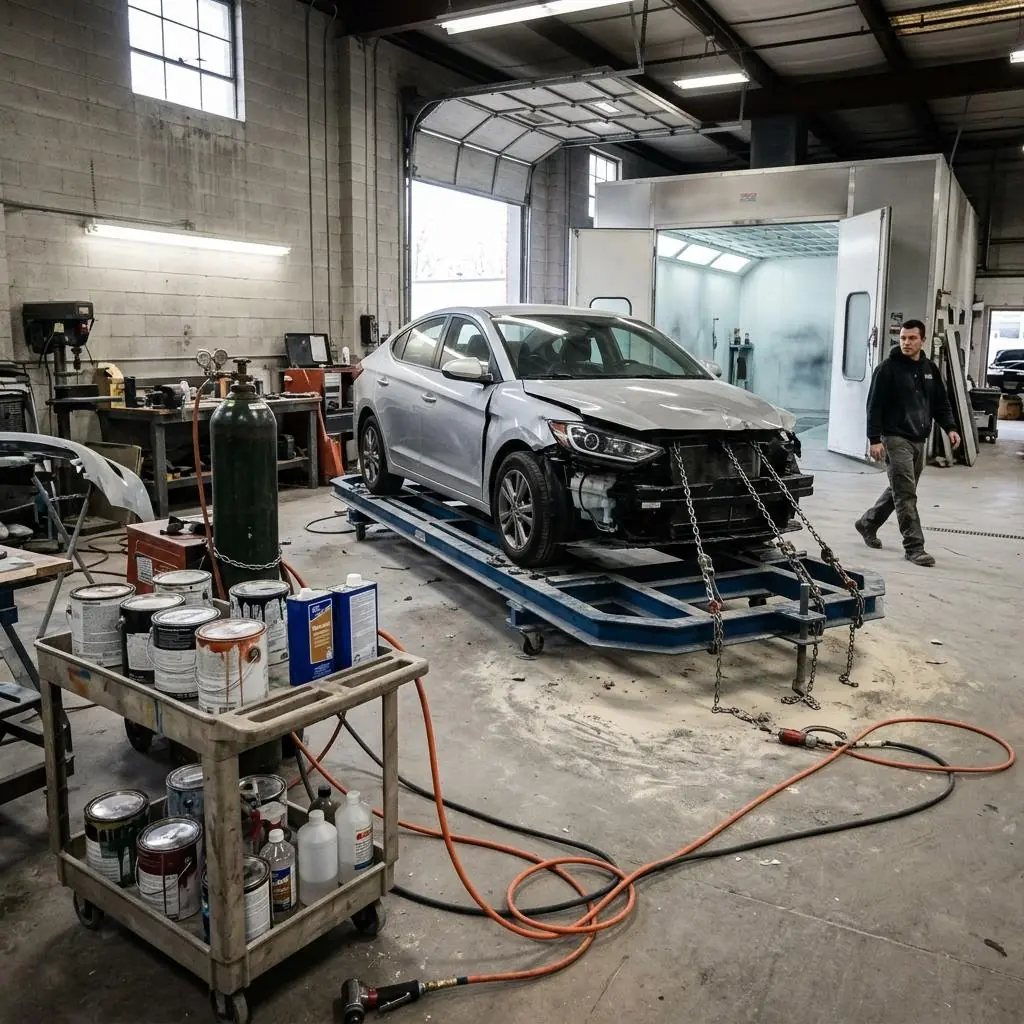
Collision repair shops combine several serious hazards on one floor: flammable paints, solvents, and thinners around the spray booth, frame racks pulling damaged cars with chains under heavy tension, welding and cutting on panels, sanding that fills the air with dust, and air hoses running between bays. Jobs move from body work to prep to paint, so the same area can be a welding bay in the morning and a prep station by the afternoon.
OSHA Scan's hazard detection reads what is visible in a photo: paint and solvent cans on open carts near the booth, more flammable liquid out than a shift needs, frame-rack chains without visible safety cables, welding gear next to paint or sanding dust, dust built up on floors, hoses across walkways, or painters and sanders without visible respirators. For each finding it notes the OSHA standard it may relate to and a specific fix to confirm on site.
Fire is one of the main hazards in a collision repair shop. OSHA's spray finishing standard (29 CFR 1910.107) limits flammable liquids near spraying to about a day's or shift's supply, keeps open flames and spark-producing equipment at least 20 feet from spraying areas unless a partition separates them, and requires approved metal waste cans for rags soaked with finishing material. The flammable liquids standard (1910.106) covers storage cabinets and mixing rooms.
Breathing hazards are the other big category. Many automotive paints contain isocyanates, and sanding body filler and paint creates fine dust, so the respiratory protection standard (1910.134) often applies to painters and preppers. Frame racks have no dedicated OSHA standard, so the maker's instructions and the General Duty Clause apply. A photo scan helps catch the visible part — cans near the booth, chains without safety cables, welding gear beside paint, dust on the floor — while booth airflow, exposure levels, and respirator fit still need checks on site.
Run through these steps before crews start — each one covers a visible gap the AI can help you catch.
Return extra paint, solvent, and thinner to approved storage, close open containers, and keep no more than a day's or shift's supply near the booth. Storage may relate to 29 CFR 1910.107(e)(2) and 1910.106.
Confirm safety cables or restraints are on every chain and clamp, and keep everyone out of line with the pull. Frame-rack hazards may relate to the General Duty Clause and the maker's instructions.
Keep welding and grinding at least 20 feet from spraying areas or behind a partition, and secure cylinders. Hot work near spraying may relate to 29 CFR 1910.107(c)(2) and 1910.252.
Vacuum sanding dust, route hoses off walkways, and confirm painters and sanders have the respirators the program calls for. Respiratory protection may relate to 29 CFR 1910.134.
Photograph the booth area, the frame rack, and the prep bays and upload it to OSHA Scan for a second pass with AI hazard detection. The AI flags visible hazards, notes the OSHA standard each may relate to, and suggests a fix — treat the findings as a draft to verify on site. Free, no account needed (you may be asked for the free phone Access Pass).
The visible shop-floor problems a collision repair shop can fix during a walkthrough, detected from one image.
Paint, solvent, and thinner cans left out near the booth, containers stored outside flammable cabinets, and more than a shift's supply on the floor.
Pulling chains under tension with no visible safety cables, people standing in line with the pull, and worn chains or clamps.
Sanding without dust extraction, dust built up on floors and surfaces, and painters or sanders without visible respirators.
Welding and cutting gear next to paint, solvent, or sanding dust, sparks near the spraying area, and cylinders not secured.
Scan a photo like the one above and this is the report you get — score, findings, OSHA references, and fixes. It is an illustrative example, clearly marked — not live scan data.
Compliance score
67
Lower means more potential hazards found
Score uses visible confirmed findings only. Not a safety certification.
2 confirmed · 0 need review · 0 positive
1Paint and solvent cans on an open cart on the shop floor, outside a flammable storage cabinet
Possibly related to flammable liquid quantities near spray finishing (29 CFR 1910.107(e)(2)) and flammable liquid storage (29 CFR 1910.106)
Observed condition: Solvent and paint vapors can ignite from a spark, a grinder, or a welding arc. Containers left out on the open floor add fuel and vapor in a shop where grinding and welding happen. The photo cannot show whether the cans are open or how much liquid they hold.
Corrective action: Keep only the amount needed for the day or shift near the booth, close containers when not in use, and return the rest to an approved flammable storage cabinet or mixing room. Keep welding, grinding, and other spark sources at least 20 feet from the spraying area unless a partition separates them.
Medium confidenceNot fully clear from the photo — verify on site.
2Frame-rack pulling chains under tension with no visible safety cables
Possibly related to the General Duty Clause (Section 5(a)(1)) and the frame-rack maker's safety instructions
Observed condition: A chain, clamp, or anchor that fails under pulling force can whip with enough energy to seriously injure or kill anyone in line with the pull. There is no OSHA standard written for frame straighteners, so the maker's instructions set the safe setup.
Corrective action: Attach the safety cables or restraints the frame-rack maker specifies to every chain and clamp before pulling, keep people out of line with the pull, and inspect chains, hooks, and clamps for wear before each use.
Medium confidenceNot fully clear from the photo — verify on site.
Upload a photo like the one above and get a compliance score and hazard count. No account needed to scan, though you may be asked for the free phone Access Pass — create a free account to unlock the full report.
Use the real site or facility name. If you save the scan after signup, it becomes the report name.
Three angles, one deeper scan
Only the wide shot is required — every extra angle gives the AI more places to look.
Required: Set the scene — one wide shot lets the AI sweep the whole area at once
Stand at the entry point and capture corner to corner: floors, ladders, scaffolds, and everyone at work
Drop a job-site photo or walkthrough video
Click to upload, drag & drop, or snap a photo on site. Photos scan free with no signup and no card — you may be asked for the free phone Access Pass. Video walkthroughs (up to 3 min) run on a free account.
Small habits, sharper scans
Set the scene
Start with context
Fill the frame
2–3 ft for close-ups; keep ladders, cords and workers fully in view.
Capture clearly
Make the frame usable
Light it right
Keep the sun or lights behind you — glare and shadows hide hazards.
Tap to focus
Tap the hazard on screen and hold still one second — blur can't be flagged.
Choose the useful view
Give the AI room to understand
Go landscape
Turn your phone sideways — a wider frame catches more of the scene.
Only upload photos you have permission to use, and avoid images showing personal, customer, or confidential information. Demo photos and results are held privately for up to 48 hours so you can save them to a free account; unclaimed photos are deleted automatically. Results are an AI-assisted preliminary review, not an official OSHA determination.
New: Video walkthrough scans
Record up to 3 minutes of your site — the AI extracts frames and categorizes findings with exact timestamps. Free account required.
Get the best results
Wide shot first
Stand at the entrance and photograph the entire work area so AI sees the full context
Hazard areas
Photograph elevated surfaces, equipment, electrical panels, and anywhere workers are active
Close-ups last
Move in close on anything damaged, missing, or that looks risky — the AI catches more detail
Walk the shop with these points at the start of each shift. The first four are free — create a free account to unlock the full checklist and scan your own shop photos.
Free checklist — 12 points
Enter your email to unlock the full checklist
Read the checklist here after entering your email. A free account is required to download the PDF.
One email with the checklist, one follow-up. Unsubscribe anytime.
Free printable templatePDF · US Letter
Walk the shop, paint area, and frame rack with this form at the start of each shift.
On the form
A free account is required to download it.
Non-English documents are automated translations, not official OSHA translations. Citations, limits and names are kept as written.
OSHA Scan template — not an official government form and not legal advice.
OSHA Scan reads a single photo. That makes it fast and easy for anyone on site — but it also means it has real limits. Here's an honest look at both.
Snap a photo of the job site, and the AI categorizes findings against OSHA standards.
Each finding includes consistent corrective actions and structured JHA outputs. Check items off as your crew resolves them.
Every inspection gets a deterministic 0-100 compliance score derived from hazard severity, so you can track sites at a glance.
A prioritization aid based on recorded findings—not a certification or a complete measure of site safety.
Generate detailed inspection reports and export data to Excel for record-keeping and stakeholders.
A qualified person must review AI-flagged items before making safety decisions. Do not replace required comprehensive safety walkthroughs with AI reports. Features, limits, and downloads depend on your account’s plan and permissions.
Illustrative AI-assisted workflows. Review the findings; they are not a compliance certification.
A scan is a fast first look, not the final word. Before treating this kind of area as safe, a competent person should still confirm:
Photograph the booth area, the frame rack, or a prep bay and upload the picture. The AI looks for visible hazards such as solvent cans on an open cart near the booth, frame-rack chains without safety cables, and welding next to sanding dust, and lists each with the OSHA standard it may relate to and a suggested fix. It cannot test booth airflow, measure isocyanate or dust exposure, or confirm the rack is rated for the pull, so the shop manager still checks those.
Collision repair shops fall under OSHA's general industry standards. Common ones include spray finishing (29 CFR 1910.107) and its ventilation rules (1910.94(c)), flammable liquids (1910.106), respiratory protection (1910.134), hazard communication (1910.1200), welding and cutting (1910.252 to 1910.255), PPE (1910.132 to 1910.138), and walking-working surfaces (1910.22). Hazards with no specific standard, such as frame-rack pulling, may relate to the General Duty Clause.
OSHA's spray finishing standard says the amount of flammable or combustible liquid kept near spraying should be the minimum needed and ordinarily no more than a supply for one day or one shift (29 CFR 1910.107(e)(2)). The rest belongs in approved storage, such as a flammable storage cabinet or a mixing room, under the flammable liquids standard (1910.106).
Often, yes. Many automotive paints and clear coats contain isocyanates, which can cause occupational asthma. When respirators are needed, OSHA's respiratory protection standard (29 CFR 1910.134) requires a written program, medical evaluation, fit testing, and training. The paint maker's safety data sheet lists the respiratory protection it recommends.
There is no OSHA standard written specifically for frame racks or frame straighteners. OSHA can cite serious recognized hazards under the General Duty Clause, and the equipment maker's instructions set the safe setup, including safety cables or restraints on pulling chains and keeping people out of line with the pull.
Yes. Any owner or shop manager can run it from a phone during a walkthrough. Findings come back in plain language with a suggested fix. Treat them as a draft for someone on site to confirm.
Reviewed by OSHA Scan Editorial
This content is produced by the OSHA Scan Editorial team and reviewed with AI assistance. It is general safety information, not legal or compliance advice. OSHA Scan is an independent tool and is not affiliated with, endorsed by, or certified by OSHA or the U.S. Department of Labor.
More ways to see what an AI OSHA scan can do for your site.
The overview hub — how the scanner works and every job, site, and hazard it covers.
Lifts, bays, and mechanical repair hazards.
Common paint fume and fire hazards and how crews control them.
Respirator programs for painters and sanders.
Extinguishers, flammable storage, and exits.
Fire watch and cylinder checks for hot work.
Keep safety data sheets for paints and solvents organized.
The complete hub of every hazard type and industry the scanner covers.
See a complete labelled example of everything a scan returns.
Start with one lifetime use per eligible scan type — no credit card. Build JHA-ready reports and catch changing conditions sooner.
Start your free trial