
The Incidents That Happen at Noon Start With a Skipped 7 a.m. Check
Verify the site is ready before the first boot hits the deck
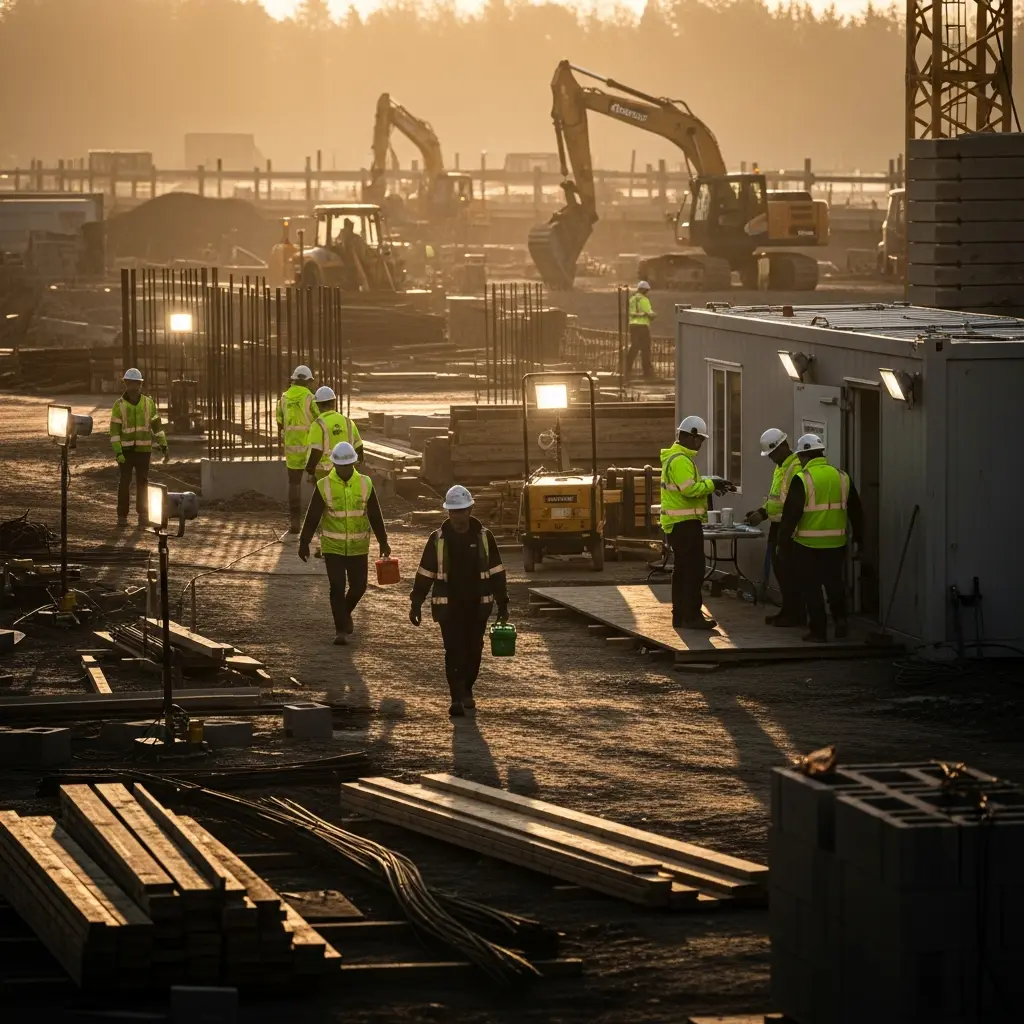
Most job-site injuries trace back to a condition that was present — and missable — at the start of the shift. A rushed or skipped morning safety check lets a missing guardrail, an untagged cord, or an unguarded opening survive into the workday. OSHA Scan lets a foreman photograph the work area at sunrise and get an instant hazard read, turning the pre-shift walk into a documented, repeatable habit instead of a formality.
Free · No account needed to scan · Results in seconds
May relate to 29 CFR 1926.20
Of incidents tied to a known pre-shift hazard
Per serious OSHA general-duty violation
A documented pre-shift scan takes
OSHA rule making pre-shift inspection the employer's duty
What this scenario looks like
A morning safety check failure is any start-of-shift where the required inspection, hazard assessment, or toolbox talk is skipped, rushed, or done on paper without ever looking at the actual conditions. OSHA 1926.20 makes the employer responsible for frequent and regular inspections by a competent person — the morning walk is where that obligation lives or dies.
In practice it looks like a crew clocking in and heading straight to task because the schedule is tight, a foreman signing yesterday's checklist without walking the site, or a night-crew hazard (a removed rail, a spilled solvent, an open trench) carried silently into the day shift. The inspection exists as a form, but the eyes never hit the deck.
The danger is that the site changes overnight and between shifts, yet the assumption of 'everything's how we left it' persists. A skipped morning check does not cause the fall — it just guarantees nobody catches the condition that will. That is exactly why a fast, photo-based verification belongs in every start-of-shift routine.
A labelled example scan for this scenario
Here is what an OSHA Scan report looks like for morning safety check failure. It is an illustrative example built from this scenario's hazards — clearly marked, not live scan data.
Compliance score
64
Lower means more potential hazards found
3 potential hazards found
Morning Safety Check Failure
Confirmed violationCriticalPossibly related to General safety and health provisions (29 CFR 1926.20)
Observed condition: A morning safety check failure is any start-of-shift where the required inspection, hazard assessment, or toolbox talk is skipped, rushed, or done on paper without ever looking at…
Corrective action: Install permanent hole covers and guardrails that stay in place across shifts
High confidence
Morning Safety Check Failure: Safety training and education
Needs reviewHighPossibly related to Safety training and education (29 CFR 1926.21)
Observed condition: Requires employers to instruct each worker in recognizing and avoiding unsafe conditions, directly supporting the pre-shift hazard briefing.
Corrective action: Use lockable panels and barriers so overnight changes require deliberate reversal
Medium confidenceNot fully clear from the photo — verify on site.
Morning Safety Check Failure: Duty to have fall protection
Confirmed violationMediumPossibly related to Duty to have fall protection (29 CFR 1926.501)
Observed condition: Applies when a skipped morning check leaves floor holes, open edges, or removed guardrails unprotected at start of shift.
Corrective action: Provide fixed lighting at all access points for early-morning low-light checks
High confidence
See the workflow click into place
Illustrative AI-assisted workflows. Review the findings; they are not a compliance certification.
Why this scenario matters
Immediate consequences
A hazard that survives the morning check is live for the entire shift. The first worker to encounter it — often before full alertness sets in — absorbs the consequence, whether that is a fall, a shock, or a struck-by injury.
Legal & financial impact
OSHA 1926.20 requires programmed inspections by a competent person, and failure to inspect is routinely cited alongside the underlying hazard. A serious violation exceeds $16,000, and a documented pattern of skipped checks supports willful classifications above $165,000.
Operational impact
Undetected morning hazards cause mid-shift work stoppages, rework, and investigations that blow the schedule the rushed check was meant to protect. The five minutes saved at sunrise costs hours by afternoon.
Industry-specific concerns
Multi-crew and multi-shift sites — general contractors, warehousing, and manufacturing — face the highest exposure because conditions change hands overnight and no single person owns the handoff.
How OSHA Scan detects this hazard
OSHA Scan turns the morning walk into a documented check: the foreman photographs each work zone and the AI vision model flags missing guardrails, open holes, untagged equipment, blocked exits, and PPE gaps, each with a severity rating and the specific OSHA citation that may apply. Every scan is time-stamped, giving you proof the pre-shift inspection actually happened, not just that a box was checked.
Analyze your first photo freeScan a photo for morning safety check failure now
Upload a real job-site photo and OSHA Scan detects visible hazards in seconds — no account needed to run your first scan.
- Open holes, missing rails, and untagged cords caught in your start-of-shift photo
- The inspection-duty standard each start-of-shift hazard may relate to
- A dated, scored report standing as proof the pre-shift walk happened
Use the real site or facility name. If you save the scan after signup, it becomes the report name.
Three angles, one deeper scan
Only the wide shot is required — every extra angle gives the AI more places to look.
Required: Set the scene — one wide shot lets the AI sweep the whole area at once
Stand at the entry point and capture corner to corner: floors, ladders, scaffolds, and everyone at work
Drop a job-site photo or walkthrough video
Click to upload, drag & drop, or snap a photo on site. Photos scan free in about 15 seconds — no signup, no card. Video walkthroughs (up to 3 min) run on a free account.
Accuracy boosters
Small habits, sharper scans
Set the scene
Start with context
Fill the frame
2–3 ft for close-ups; keep ladders, cords and workers fully in view.
Capture clearly
Make the frame usable
Light it right
Keep the sun or lights behind you — glare and shadows hide hazards.
Tap to focus
Tap the hazard on screen and hold still one second — blur can't be flagged.
Choose the useful view
Give the AI room to understand
Go landscape
Turn your phone sideways — a wider frame catches more of the scene.
Only upload photos you have permission to use, and avoid images showing personal, customer, or confidential information. Demo photos and results are held privately for up to 48 hours so you can save them to a free account; unclaimed photos are deleted automatically. Results are an AI-assisted preliminary review, not an official OSHA determination.
New: Video walkthrough scans
Record up to 3 minutes of your site — the AI extracts frames and categorizes findings with exact timestamps. Free account required.
Get the best results
Wide shot first
Stand at the entrance and photograph the entire work area so AI sees the full context
Hazard areas
Photograph elevated surfaces, equipment, electrical panels, and anywhere workers are active
Close-ups last
Move in close on anything damaged, missing, or that looks risky — the AI catches more detail
A day crew inheriting a night crew's open floor hole
The situation
On a multi-story fit-out, the night electrical crew removed a plywood cover from a floor penetration to run conduit and left it open when they clocked out at 6 a.m. The day-shift foreman ran his usual verbal roll call but skipped the floor walk to keep the crew on schedule.
What went wrong
Ninety minutes into the shift, a laborer carrying drywall stepped backward into the uncovered 14-inch penetration, dropping a full story and fracturing his pelvis. The hole had been open and unmarked since before the day crew ever arrived.
How OSHA Scan would have prevented it
A two-minute photo scan of each floor at start of shift would have flagged the uncovered penetration as a critical fall hazard, cited 29 CFR 1926.501 and the inspection duty under 1926.20, and prompted the foreman to cover and mark it before releasing the crew to work.
Lessons learned
Shift handoffs are where morning checks matter most. Any multi-shift site needs a documented, condition-based walk — not a verbal roll call — and a quick photo scan makes that walk fast enough to actually happen every day.
Prevention best practices
Layered controls, from most to least effective.
Engineering controls
Set up the site so start-of-shift hazards are visible and hard to miss.
- Install permanent hole covers and guardrails that stay in place across shifts
- Use lockable panels and barriers so overnight changes require deliberate reversal
- Provide fixed lighting at all access points for early-morning low-light checks
- Stage a designated, photographed inspection route through each work zone
Administrative controls
Make the morning check a required, documented, condition-based routine.
- Require a competent-person walk of every active zone before any task begins
- Run a structured shift-handoff log noting all overnight changes and open work
- Hold a start-of-shift toolbox talk tied to the day's specific hazards
- Document each pre-shift inspection with a time-stamped photo scan
- Prohibit task start until the inspection is completed and signed off
Personal protective equipment
Confirm PPE readiness as part of the morning check, not after work starts.
- Verify each worker has task-appropriate PPE before releasing them to work
- Inspect fall arrest, respiratory, and hearing gear during the morning walk
- Stock spare PPE at the check-in point so gaps are corrected on the spot
- Confirm high-visibility apparel for low-light early-shift conditions
OSHA compliance & citations
The federal standards this hazard may relate to.
General safety and health provisions
Requires employers to initiate and maintain accident-prevention programs, including frequent and regular inspections of the job site, materials, and equipment by a designated competent person.
Up to $16,550 per serious violation; $165,514 for willful or repeat
Safety training and education
Requires employers to instruct each worker in recognizing and avoiding unsafe conditions, directly supporting the pre-shift hazard briefing.
Up to $16,550 per serious violation
Duty to have fall protection
Applies when a skipped morning check leaves floor holes, open edges, or removed guardrails unprotected at start of shift.
Up to $16,550 per serious violation
Incident response protocol
If an incident occurs, act fast and in order.
Immediate actions (first 5 minutes)
- 1Call 911 if a worker is injured
- 2Stop all work in the affected zone
- 3Establish a safe perimeter around the hazard or incident
- 4Provide first aid if trained
- 5Assign someone to direct emergency responders to the exact location
Emergency response (5-30 minutes)
- 1Cooperate fully with arriving emergency responders
- 2Correct or barricade the hazard the morning check missed
- 3Account for all workers and pause related tasks site-wide
- 4Document the condition with photos before it is disturbed
- 5Notify the site safety lead and project management
Post-incident
- 1Notify OSHA within 8 hours for a fatality or 24 hours for an in-patient hospitalization
- 2Launch an investigation into why the pre-shift check missed the hazard
- 3Preserve the shift-handoff log and all inspection records
- 4Interview the outgoing and incoming crews about the handoff
- 5Revise the pre-shift inspection procedure and retrain supervisors
Team training module
Supervisors will understand why pre-shift inspections prevent downstream incidents, know how to walk and document each work zone, and be able to run a condition-based morning check and handoff every shift.
Train all supervisors at onboarding, refresh annually, and reinforce daily by requiring a documented photo-scan walk before any crew is released to task.
Training topics
- Why skipped morning checks drive later incidents
- The competent person's inspection duty under OSHA 1926.20
- How to walk and assess each active work zone
- Running an effective start-of-shift toolbox talk
- Managing multi-shift handoffs and change logs
- Recognizing overnight hazards carried into the day
- Documenting inspections with time-stamped photos
- Verifying PPE readiness before releasing the crew
- Correcting hazards before work begins
- OSHA inspection requirements and penalties
Compliance checklist
Run these checks to stay ahead of citations.
Daily pre-work inspection
- Every active work zone physically walked by a competent person
- Overnight changes reviewed against the shift-handoff log
- All floor holes, edges, and openings covered and marked
- Equipment and cords inspected and properly tagged
- Access points, exits, and walkways clear and lit
- PPE verified for every worker before task start
- Start-of-shift toolbox talk delivered on the day's hazards
- Inspection documented with a time-stamped photo scan
Unlock the full Morning Safety Check Failure checklist
10 more checklist points are waiting. Register with your email to reveal every item and download the complete OSHA compliance checklist as a printable PDF. Free, and it only takes a few seconds.
Already have an account? Sign in
Frequently asked questions
Does OSHA legally require a morning safety check?
OSHA 1926.20 requires frequent and regular inspections of the job site by a competent person. While it does not dictate a specific clock time, a documented start-of-shift inspection is the standard way employers meet this duty before workers are exposed.
Who should perform the pre-shift inspection?
A competent person — someone trained to identify hazards and authorized to correct them. On multi-crew sites, the shift foreman or a designated safety lead typically walks each active work zone before releasing the crew to task.
What is the difference between a toolbox talk and a morning check?
A toolbox talk is a short verbal briefing on hazards and procedures. A morning check is a physical walk of the site to verify actual conditions. You need both: the talk communicates the plan, the walk confirms the site matches it.
Why do morning checks get skipped so often?
Schedule pressure is the leading cause. Crews want to start earning production immediately, so checks get reduced to a signed form. Making the walk fast — such as a five-minute photo scan — removes the time excuse that drives skipping.
How do overnight changes create morning hazards?
Night crews and other trades alter conditions — removing guardrails, opening floors, staging materials — that the day crew never sees happen. Without a condition-based walk and handoff log, these hazards carry silently into the next shift.
How should I document that a morning check happened?
Keep a time-stamped record tied to actual conditions, not just a signature. A dated photo scan of each work zone proves the inspection occurred, shows what was reviewed, and creates a defensible record if OSHA asks.
What are the penalties for failing to inspect the site?
A serious violation of 29 CFR 1926.20 can exceed $16,000, and OSHA frequently cites the inspection failure alongside the hazard it allowed. A documented pattern of skipped checks supports willful or repeat classifications over $165,000.
How accurate is OSHA Scan at catching morning hazards?
OSHA Scan runs an AI-assisted preliminary review of start-of-shift hazards from a photo. It flags open holes, missing guardrails, untagged equipment, and PPE gaps with a severity rating and the specific OSHA citation that may apply. It is a second set of eyes, not a substitute for a competent person's inspection.
Make every morning check count
Analyze a photo
Photograph your work zones at start of shift and get instant, specific feedback on the hazards a rushed check would miss.
Get startedGet the pre-shift checklist
Put our start-of-shift inspection checklist to work so your morning walk catches conditions before the crew does.
Get startedTalk to our team
See how OSHA Scan fits your multi-shift operation and get recommendations for documenting your pre-shift checks.
Get startedJoin safety-first contractors
See how other crews use OSHA Scan to turn the morning walk into a habit that prevents mid-shift incidents.
Get startedAI photo hazard review
Snap a photo of the job site, and the AI categorizes findings against OSHA standards in seconds.
Consistent corrective actions & JHA
Each finding includes consistent corrective actions and structured JHA outputs. Check items off as your crew resolves them.
Emergency action plans
Access jurisdiction-specific guidelines and emergency action plan templates for your sites.
A qualified person must review AI-flagged items before making safety decisions. Do not replace required comprehensive safety walkthroughs with AI reports. Features, limits, and downloads depend on your account’s plan and permissions.
What the AI can and can't detect
OSHA Scan reads a single photo. That makes it fast and easy for anyone on site — but it also means it has real limits. Here's an honest look at both.
What it can catch from a photo
- Missing or incorrect PPE that is visible in the frame
- Unprotected edges, open holes, and visible fall hazards
- Housekeeping, trip, and blocked walkway or exit hazards
- Visible electrical, struck-by, and equipment-guarding hazards
What a photo can't tell it
- Hazards hidden from view or anything outside the photo
- Exact heights, distances, weights, or measurements
- Training records, procedures, or how equipment is actually used
- Full legal compliance or an official OSHA pass/fail determination
Reviewed by OSHA Scan Editorial
This content is produced by the OSHA Scan Editorial team and reviewed with AI assistance. It is general safety information, not legal or compliance advice. OSHA Scan is an independent tool and is not affiliated with, endorsed by, or certified by OSHA or the U.S. Department of Labor.
Ready to catch hazards before they become incidents?
Start with exactly 5 lifetime AI site scans — no credit card. Build JHA-ready reports and catch changing conditions sooner.
Start your free trial