
Missing Guardrails Turn a Routine Job Into a Fatal Fall
A rail that should be there is the one thing standing between your crew and the ground
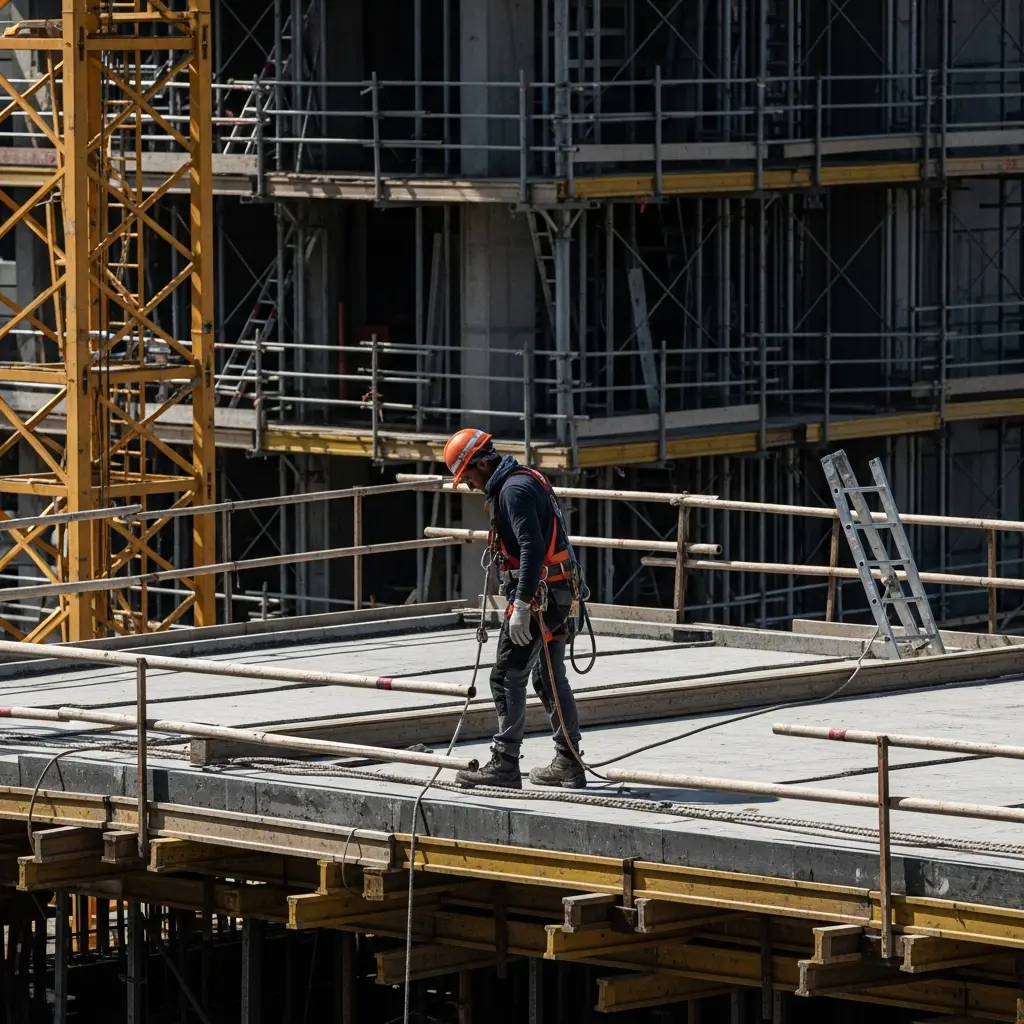
Guardrails are the simplest, most reliable form of fall protection — but only when they are actually installed, complete, and built to spec. A removed section, a missing mid-rail, or an unguarded floor hole gives a worker nothing to catch them. OSHA Scan analyzes job-site photos to flag open edges, missing or undersized guardrails, and uncovered holes before someone steps into the gap.
Free · No account needed to scan · Results in seconds
May relate to 29 CFR 1926.502
Construction deaths are falls
Required guardrail top-rail height (±3 in)
Force a top rail must withstand
Typical time to get scan results
What this scenario looks like
A missing guardrail is any open-sided floor, platform, walkway, mezzanine, or opening six feet or more above a lower level where a compliant rail system should be but is not. OSHA requires a top rail at 42 inches (plus or minus 3 inches), a mid-rail roughly halfway, and a system that can withstand a 200-pound force without failing. Anything short of that — a low rail, a missing mid-rail, or no rail at all — leaves the edge unprotected.
In practice, guardrails go missing when crews remove a section to move materials and never reinstall it, when a floor hole or skylight is left uncovered, or when a temporary platform is built without rails to save time. Leading edges during deck and floor construction are especially exposed, and mezzanine or loading-dock gates are often propped open and forgotten.
The danger is that a gap in the rail reads as 'almost protected' to a busy crew. The surrounding rail creates a false sense of safety, so workers move confidently right up to the one section that is open. That is precisely where falls happen — and precisely what photo-based detection is built to catch.
A labelled example scan for this scenario
Here is what an OSHA Scan report looks like for missing guardrails. It is an illustrative example built from this scenario's hazards — clearly marked, not live scan data.
Compliance score
64
Lower means more potential hazards found
3 potential hazards found
Missing Guardrails
Confirmed violationCriticalPossibly related to Fall protection systems criteria and practices (29 CFR 1926.502)
Observed condition: A missing guardrail is any open-sided floor, platform, walkway, mezzanine, or opening six feet or more above a lower level where a compliant rail system should be but is not.
Corrective action: Install guardrails with a top rail 42 in high (±3 in) and a mid-rail at ~21 in
High confidence
Missing Guardrails: Duty to have fall protection
Needs reviewHighPossibly related to Duty to have fall protection (29 CFR 1926.501)
Observed condition: Requires fall protection on walking/working surfaces with an unprotected side or edge 6 feet or more above a lower level, and requires holes to be guarded by covers or guardrails.
Corrective action: Ensure the system withstands 200 lb applied downward or outward on the top rail
Medium confidenceNot fully clear from the photo — verify on site.
Missing Guardrails: Fall protection systems and falling object protection — criteria
Confirmed violationMediumPossibly related to Fall protection systems and falling object protection — criteria (29 CFR 1910.29)
Observed condition: General industry criteria for guardrail systems on platforms, mezzanines, and open-sided floors, including rail heights, strength, and opening protection.
Corrective action: Add toeboards at least 3.5 in high where tools or materials can fall to a lower level
High confidence
See the workflow click into place
Illustrative AI-assisted workflows. Review the findings; they are not a compliance certification.
Why this scenario matters
Immediate consequences
A fall through a missing guardrail or uncovered hole is often fatal and, when survived, causes severe spinal, head, and internal injuries. There is no second chance once a worker goes through the gap.
Legal & financial impact
Guardrail and fall-protection requirements under 29 CFR 1926.501 and 1926.502 are OSHA's most-cited standards. A serious violation runs over $16,000, willful or repeat violations exceed $160,000, and a fatality invites litigation and criminal referral.
Operational impact
A fall stops the job cold, triggers an OSHA inspection, spikes insurance premiums, and raises your experience modification rate — pricing you out of future bids for years.
Industry-specific concerns
General contractors, steel and deck erectors, warehousing, and facility crews all face open-edge and floor-hole exposure, frequently during fast-moving phases where rails are removed and not put back.
How OSHA Scan detects this hazard
OSHA Scan uses an AI vision model to identify missing and non-compliant guardrails. Upload a photo of your platform, floor, or leading edge and it locates open edges, floor holes, and skylights, checks whether a compliant top rail, mid-rail, and toeboard are present, estimates rail height against the 42-inch standard, and flags each gap with a severity rating and the OSHA citation it may relate to — in seconds.
Analyze your first photo freeScan a photo for missing guardrails now
Upload a real job-site photo and OSHA Scan detects visible hazards in seconds — no account needed to run your first scan.
- Open edges, missing mid-rails, and uncovered floor holes flagged per finding
- The guardrail-criteria standard each unprotected edge may relate to
- A scored, dated edge-protection report exportable to PDF or Excel
Use the real site or facility name. If you save the scan after signup, it becomes the report name.
Three angles, one deeper scan
Only the wide shot is required — every extra angle gives the AI more places to look.
Required: Set the scene — one wide shot lets the AI sweep the whole area at once
Stand at the entry point and capture corner to corner: floors, ladders, scaffolds, and everyone at work
Drop a job-site photo or walkthrough video
Click to upload, drag & drop, or snap a photo on site. Photos scan free in about 15 seconds — no signup, no card. Video walkthroughs (up to 3 min) run on a free account.
Accuracy boosters
Small habits, sharper scans
Set the scene
Start with context
Fill the frame
2–3 ft for close-ups; keep ladders, cords and workers fully in view.
Capture clearly
Make the frame usable
Light it right
Keep the sun or lights behind you — glare and shadows hide hazards.
Tap to focus
Tap the hazard on screen and hold still one second — blur can't be flagged.
Choose the useful view
Give the AI room to understand
Go landscape
Turn your phone sideways — a wider frame catches more of the scene.
Only upload photos you have permission to use, and avoid images showing personal, customer, or confidential information. Demo photos and results are held privately for up to 48 hours so you can save them to a free account; unclaimed photos are deleted automatically. Results are an AI-assisted preliminary review, not an official OSHA determination.
New: Video walkthrough scans
Record up to 3 minutes of your site — the AI extracts frames and categorizes findings with exact timestamps. Free account required.
Get the best results
Wide shot first
Stand at the entrance and photograph the entire work area so AI sees the full context
Hazard areas
Photograph elevated surfaces, equipment, electrical panels, and anywhere workers are active
Close-ups last
Move in close on anything damaged, missing, or that looks risky — the AI catches more detail
A removed rail section on a warehouse mezzanine
The situation
A crew was staging inventory on a warehouse mezzanine and unhooked a removable guardrail gate at the loading edge to swing pallets up from a forklift. They planned to re-latch the gate as soon as the pallets were up.
What went wrong
The gate stayed open through the shift. A worker walking backward while guiding a pallet stepped past the open edge and fell twelve feet to the concrete floor, fracturing his pelvis and suffering a head injury.
How OSHA Scan would have prevented it
A photo of the mezzanine run through OSHA Scan before work resumed would have flagged the open guardrail gate as a critical unprotected-edge hazard, cited 29 CFR 1926.502, and prompted the supervisor to re-latch the gate or install a chain barrier before anyone worked near the edge.
Lessons learned
Removable and swing gates are where guardrail protection quietly fails. Any rail or gate that is opened must be logged and the edge re-checked — a quick photo scan confirms the barrier is back before work continues.
Prevention best practices
Layered controls, from most to least effective.
Engineering controls
Close the edge with compliant physical barriers so a fall is impossible.
- Install guardrails with a top rail 42 in high (±3 in) and a mid-rail at ~21 in
- Ensure the system withstands 200 lb applied downward or outward on the top rail
- Add toeboards at least 3.5 in high where tools or materials can fall to a lower level
- Cover and secure all floor holes and skylights with labeled, load-rated covers
- Use self-closing swing gates instead of removable chains at access points
Administrative controls
Keep every rail installed and complete through the whole job.
- Assign a competent person to inspect all guardrails and covers before each shift
- Log any guardrail removal and require re-inspection before work resumes
- Mark and barricade leading edges during deck and floor construction
- Run a toolbox talk on open-edge and floor-hole hazards for each phase
- Keep access gates closed and latched except during active material movement
Personal protective equipment
The last line of defense where a guardrail is temporarily absent.
- Full-body harness with a lanyard or self-retracting lifeline tied to a rated anchor
- Anchor points rated for 5,000 lb per worker
- Slip-resistant footwear for elevated platforms and decks
- Inspect all harnesses, lanyards, and anchors before each use and remove damaged gear
OSHA compliance & citations
The federal standards this hazard may relate to.
Fall protection systems criteria and practices
Specifies the performance criteria for guardrail systems, including 42-inch top-rail height, mid-rail, 200-pound strength, toeboards, and hole covers, plus the requirements for nets and personal fall arrest.
Up to $16,550 per serious violation; $165,514 for willful or repeat
Duty to have fall protection
Requires fall protection on walking/working surfaces with an unprotected side or edge 6 feet or more above a lower level, and requires holes to be guarded by covers or guardrails.
Up to $16,550 per serious violation
Fall protection systems and falling object protection — criteria
General industry criteria for guardrail systems on platforms, mezzanines, and open-sided floors, including rail heights, strength, and opening protection.
Up to $16,550 per serious violation
Incident response protocol
If an incident occurs, act fast and in order.
Immediate actions (first 5 minutes)
- 1Call 911 immediately
- 2Establish a safe perimeter around the incident area
- 3Do not move the injured worker unless they are in immediate danger
- 4Provide first aid if trained (CPR, bleeding control, spinal precautions)
- 5Assign someone to direct emergency responders to the exact location
Emergency response (5-30 minutes)
- 1Cooperate fully with arriving emergency responders
- 2Provide clear information about how the fall occurred
- 3Account for all other workers and pause nearby elevated work
- 4Barricade the open edge or hole to prevent a second incident
- 5Document the scene with photos once emergency response allows
Post-incident
- 1Notify OSHA within 8 hours for a fatality, or 24 hours for an in-patient hospitalization
- 2Launch an incident investigation within 24 hours
- 3Preserve all evidence, equipment, and documentation
- 4Interview witnesses while details are fresh
- 5Review and update guardrail and hole-cover procedures and retrain the crew
Team training module
Workers will understand how open-edge and floor-hole falls occur, recognize missing or non-compliant guardrails, and correctly install, inspect, and restore guardrail systems and covers.
Train before any elevated work begins, refresh annually, and reinforce with a toolbox talk each shift using real photos to illustrate compliant and missing guardrails.
Training topics
- How falls through missing guardrails occur
- Guardrail height, mid-rail, and strength requirements
- Toeboard and falling-object protection
- Covering and marking floor holes and skylights
- Protecting leading edges during construction
- Logging and restoring removed guardrails
- Self-closing gates versus chains at access points
- Personal fall arrest as a backup control
- Pre-shift inspection by a competent person
- Emergency response for a fall
Compliance checklist
Run these checks to stay ahead of citations.
Daily pre-work inspection
- All open edges, platforms, and openings identified and marked
- Guardrails installed with 42 in top rail and mid-rail
- Rail system secure and able to withstand 200 lb
- Toeboards in place where objects can fall to a lower level
- All floor holes and skylights covered, secured, and labeled
- Access gates closed and self-latching
- Fall arrest systems available where rails are temporarily removed
- Competent person assigned and on site
Unlock the full Missing Guardrails checklist
10 more checklist points are waiting. Register with your email to reveal every item and download the complete OSHA compliance checklist as a printable PDF. Free, and it only takes a few seconds.
Already have an account? Sign in
Frequently asked questions
How tall does a guardrail have to be under OSHA?
The top rail must be 42 inches high, plus or minus 3 inches, above the walking or working surface. A mid-rail (or equivalent intermediate member) is required roughly halfway between the top rail and the surface when there is no wall at least 21 inches high.
How much force does a guardrail need to withstand?
A compliant top rail must withstand a 200-pound force applied within 2 inches of the top edge in any outward or downward direction without failing and without dropping below 39 inches. The mid-rail must withstand at least 150 pounds.
Do I need a toeboard on my guardrail?
Yes, where there is a risk of tools or materials falling onto workers below. Toeboards must be at least 3.5 inches high and capable of withstanding a 50-pound force, or you must screen the opening or use a canopy.
Can I use a chain or rope instead of a rigid rail?
Only if it meets the same height and strength criteria and does not deflect below 39 inches under a 200-pound load. Most single chains and ropes sag too much to comply, which is why self-closing swing gates are preferred at access points.
What are the rules for covering floor holes?
Holes must be covered or guarded. Covers must support at least twice the maximum intended load, be secured against displacement, and be marked with 'HOLE' or 'COVER' so no one removes them by accident.
When can I remove a guardrail to do work?
Only briefly, when the work requires it, and only if you protect the exposed edge with an alternative system such as a personal fall arrest system or controlled access zone. The rail must be reinstalled immediately when the task is done.
Who is responsible for inspecting guardrails on site?
A competent person — someone able to identify hazards and authorized to correct them — must inspect guardrails, covers, and platforms. Best practice is a documented pre-shift inspection before any work near an edge begins.
How accurate is OSHA Scan at detecting missing guardrails?
OSHA Scan detects missing and non-compliant guardrails. It locates open edges and floor holes, checks rail height and completeness, and returns the specific location and OSHA citation.
Close every gap in your fall protection today
Analyze a photo
Upload a photo of your platform, floor, or edge and get instant, specific feedback on missing or non-compliant guardrails.
Get startedGet the prevention checklist
Put our expert guardrail and hole-cover checklist to work on your next job to stay ahead of citations.
Get startedTalk to our team
See how OSHA Scan fits your operation and get recommendations for guarding your specific work areas.
Get startedJoin safety-first contractors
See how other contractors use OSHA Scan to keep every edge guarded before a fall can happen.
Get startedAI photo hazard review
Snap a photo of the job site, and the AI categorizes findings against OSHA standards in seconds.
Consistent corrective actions & JHA
Each finding includes consistent corrective actions and structured JHA outputs. Check items off as your crew resolves them.
Emergency action plans
Access jurisdiction-specific guidelines and emergency action plan templates for your sites.
A qualified person must review AI-flagged items before making safety decisions. Do not replace required comprehensive safety walkthroughs with AI reports. Features, limits, and downloads depend on your account’s plan and permissions.
What the AI can and can't detect
OSHA Scan reads a single photo. That makes it fast and easy for anyone on site — but it also means it has real limits. Here's an honest look at both.
What it can catch from a photo
- Missing or incorrect PPE that is visible in the frame
- Unprotected edges, open holes, and visible fall hazards
- Housekeeping, trip, and blocked walkway or exit hazards
- Visible electrical, struck-by, and equipment-guarding hazards
What a photo can't tell it
- Hazards hidden from view or anything outside the photo
- Exact heights, distances, weights, or measurements
- Training records, procedures, or how equipment is actually used
- Full legal compliance or an official OSHA pass/fail determination
Reviewed by OSHA Scan Editorial
This content is produced by the OSHA Scan Editorial team and reviewed with AI assistance. It is general safety information, not legal or compliance advice. OSHA Scan is an independent tool and is not affiliated with, endorsed by, or certified by OSHA or the U.S. Department of Labor.
Ready to catch hazards before they become incidents?
Start with exactly 5 lifetime AI site scans — no credit card. Build JHA-ready reports and catch changing conditions sooner.
Start your free trial