
1
Set the scene
Start with context
Fill the frame
2–3 ft for close-ups; keep ladders, cords and workers fully in view.
Cave-ins, engulfment, and atmospheric hazards
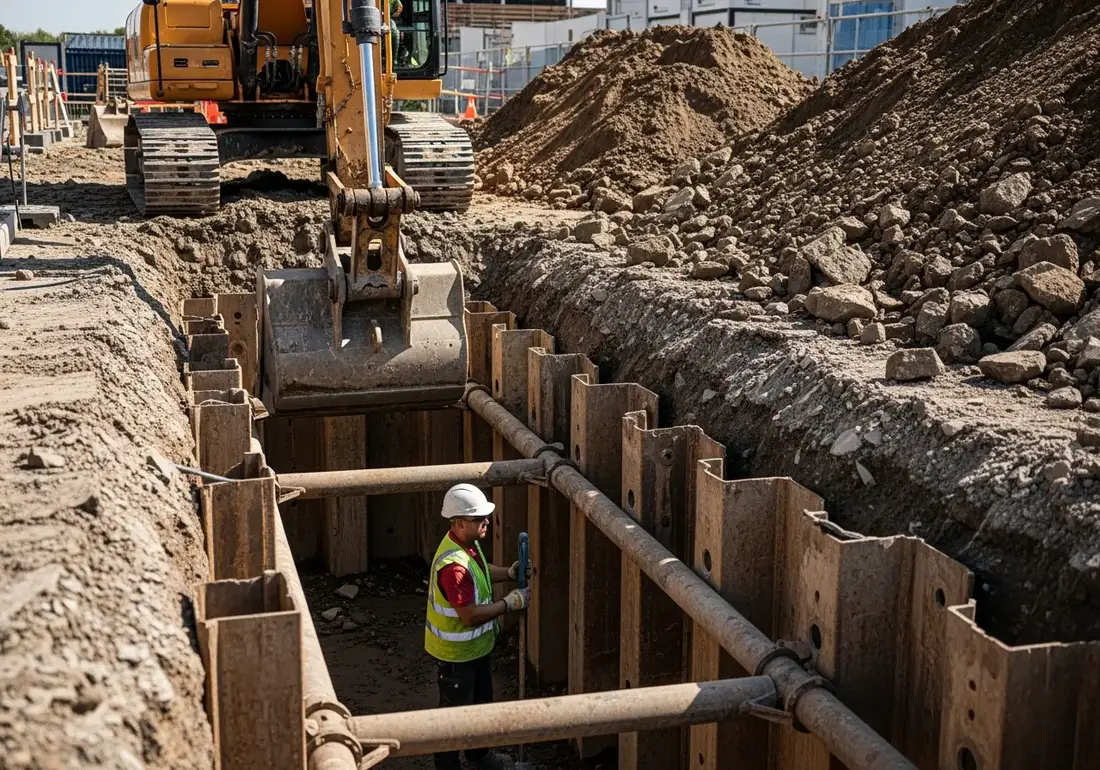
A single cubic yard of soil weighs as much as a car, and a trench wall can collapse faster than a worker can react. OSHA Scan analyzes excavation photos to catch missing protective systems, spoil piles at the edge, and other cave-in setups before a worker enters the trench.
Free · No account needed to scan · Results in seconds
weight of one cubic yard of soil
depth that requires a protective system
trench fatality rate vs. general construction
how fast a collapse can bury a worker
Upload a real job-site photo and OSHA Scan detects visible trenching and excavation hazards in seconds — no account needed to run your first scan.
Use the real site or facility name. If you save the scan after signup, it becomes the report name.
Three angles, one deeper scan
Only the wide shot is required — every extra angle gives the AI more places to look.
Required: Set the scene — one wide shot lets the AI sweep the whole area at once
Stand at the entry point and capture corner to corner: floors, ladders, scaffolds, and everyone at work
Drop a job-site photo or walkthrough video
Click to upload, drag & drop, or snap a photo on site. Photos scan free in about 15 seconds — no signup, no card. Video walkthroughs (up to 3 min) run on a free account.
Small habits, sharper scans
Set the scene
Start with context
Fill the frame
2–3 ft for close-ups; keep ladders, cords and workers fully in view.
Capture clearly
Make the frame usable
Light it right
Keep the sun or lights behind you — glare and shadows hide hazards.
Tap to focus
Tap the hazard on screen and hold still one second — blur can't be flagged.
Choose the useful view
Give the AI room to understand
Go landscape
Turn your phone sideways — a wider frame catches more of the scene.
Only upload photos you have permission to use, and avoid images showing personal, customer, or confidential information. Demo photos and results are held privately for up to 48 hours so you can save them to a free account; unclaimed photos are deleted automatically. Results are an AI-assisted preliminary review, not an official OSHA determination.
Here is what an OSHA Scan report looks like for trenching and excavation hazards. It is an illustrative example built from this trade's hazards — clearly marked, not live scan data.
Compliance score
64
Lower means more potential hazards found
3 potential hazards found
Unprotected trench collapse
Possibly related to Specific excavation requirements (29 CFR 1926.651)
Observed condition: A worker enters a seven-foot trench with vertical walls and no trench box to make a pipe connection.
Corrective action: Use trench boxes or shields sized for the excavation
High confidence
Spoil pile at the edge
Possibly related to Requirements for protective systems (29 CFR 1926.652)
Observed condition: Excavated soil is piled right at the trench lip.
Corrective action: Slope or bench walls according to soil classification
Medium confidenceNot fully clear from the photo — verify on site.
Collapse after rain
Possibly related to Excavations — definitions and scope (29 CFR 1926.650)
Observed condition: A trench inspected as safe the day before is re-entered after overnight rain without re-inspection.
Corrective action: Install hydraulic or timber shoring where boxes are impractical
High confidence
Illustrative AI-assisted workflows. Review the findings; they are not a compliance certification.
Trenching and excavation hazards are dominated by cave-ins, which are the leading cause of excavation fatalities. Soil is deceptively heavy — a single cubic yard can weigh around 3,000 pounds — so even a partial collapse can crush a worker's chest and cause suffocation before rescue is possible. Collapses happen suddenly and without warning.
Primary OSHA standard: 29 CFR 1926.651
Trenching and excavation hazards are dominated by cave-ins, which are the leading cause of excavation fatalities. Soil is deceptively heavy — a single cubic yard can weigh around 3,000 pounds — so even a partial collapse can crush a worker's chest and cause suffocation before rescue is possible. Collapses happen suddenly and without warning.
Beyond cave-ins, excavations create engulfment risk from flowing soil or water, atmospheric hazards when the trench acts as a confined space collecting heavy toxic gases or losing oxygen, and struck-by hazards from spoil, equipment, and falling loads. Water accumulation after rain and vibration from nearby equipment further destabilize trench walls.
What makes trench work uniquely dangerous is how routine it seems. Workers enter shallow-looking trenches to make quick connections, but soil type, moisture, previous digging, and nearby loads all affect stability. Without sloping, shoring, or a trench box, an ordinary-looking trench can become a grave in seconds.
Trenching is an OSHA National Emphasis Program. Protective-system and competent-person violations draw aggressive enforcement and heavy fines.
Cave-ins cause crushing and suffocation with an extremely high fatality rate; survivors often suffer serious internal injuries.
A trench fatality typically halts the project, triggers investigation, and exposes the company to major penalties and liability.
Utility and municipal clients require documented excavation-safety programs and competent-person oversight to award work.
A worker enters a seven-foot trench with vertical walls and no trench box to make a pipe connection. A wall shears off and buries him to the chest before coworkers can react.
Excavated soil is piled right at the trench lip. The added load and vibration cause the wall to fail, sending soil and the spoil pile down onto a worker below.
A trench inspected as safe the day before is re-entered after overnight rain without re-inspection. The saturated soil has lost strength and the wall gives way.
Heavier-than-air gas collects in a deep excavation near a leaking line. A worker enters without testing the atmosphere and is overcome.
A worker stands in the trench beneath the swing of an excavator bucket. Spoil falls from the bucket and strikes him.
The federal regulations that govern trenching work.
Covers utility location, access and egress, atmospheric testing, water control, and daily competent-person inspection of excavations.
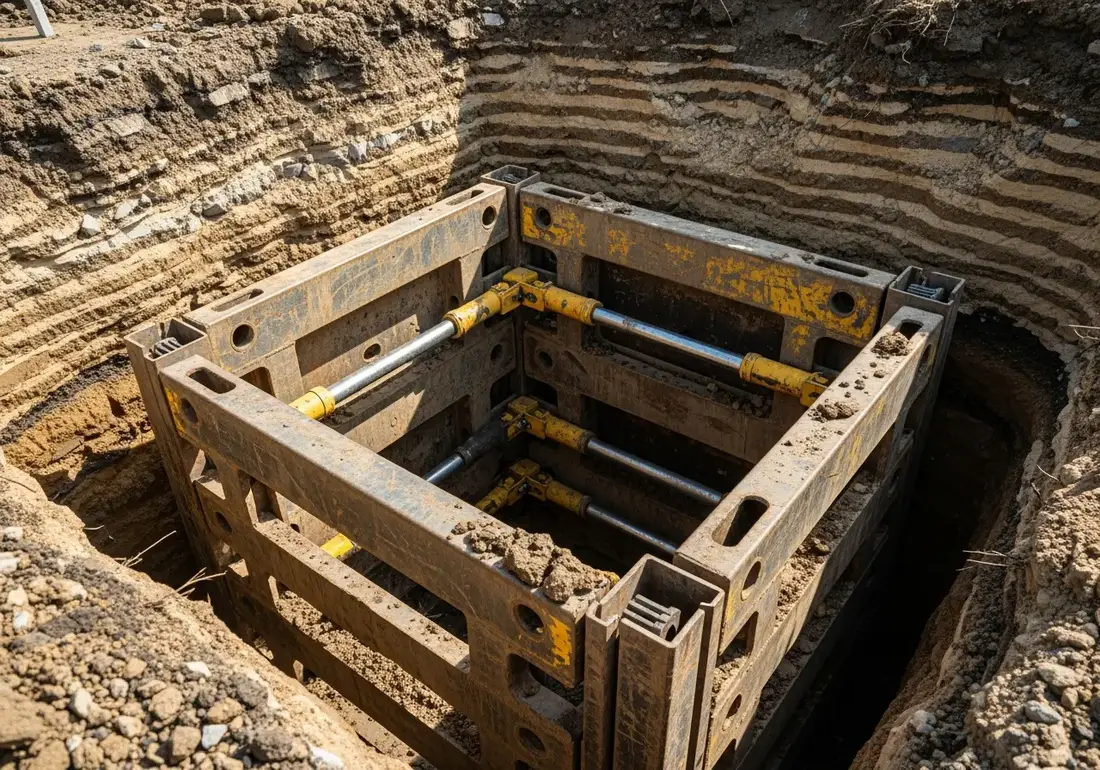
Requires sloping, benching, shoring, or shielding for excavations five feet or deeper, based on soil classification.
Defines excavation terms and the competent-person role central to trench-safety compliance.
Applies when a trench or excavation develops atmospheric hazards that meet the confined-space definition.
Work top-down through the hierarchy of controls — eliminate the hazard first, then fall back to procedures and PPE.
Choose and install a protective system before anyone enters.
Put a competent person in charge of the excavation.
Protect against struck-by, atmospheric, and visibility hazards.
Cave-ins are prevented by a trained, designated competent person who can classify soil, select protective systems, and stop work the instant conditions turn dangerous.
OSHA Scan analyzes excavation photos to flag trenches five feet or deeper without a visible protective system, spoil piles stacked at the trench edge, missing ladders or ramps for egress, and workers positioned under suspended loads or equipment swing. Each finding cites the relevant OSHA Subpart P standard and generates a corrective-action checklist covering protective systems, egress, and edge control — so a competent person can confirm a trench is safe from a photo before entry.
OSHA requires a protective system — sloping, benching, shoring, or a trench box — for any excavation five feet deep or more, unless it is made entirely in stable rock. Protective systems are also required in shallower trenches when a competent person identifies a potential cave-in hazard.
A competent person is someone trained to identify existing and predictable hazards and authorized to take prompt corrective action, including stopping work. For trenching, they classify soil, select protective systems, and inspect the excavation daily and after any condition — like rain or vibration — that could affect stability.
Because soil is extremely heavy and collapses without warning. Even a trench that looks stable can fail due to soil type, moisture, prior digging, nearby loads, or vibration. A partial collapse can pin and suffocate a worker in seconds, which is why protective systems and inspection are required rather than judgment calls.
Spoil, materials, and equipment must be kept at least two feet from the edge of the excavation. Loads placed near the edge add weight that can trigger a wall failure and provide material that falls onto workers below during a collapse.
Deep excavations and those near landfills, sewer lines, or possible gas sources must be tested for oxygen deficiency and hazardous or flammable atmospheres before workers enter. If a hazardous atmosphere exists or could develop, ventilation and confined-space precautions apply.
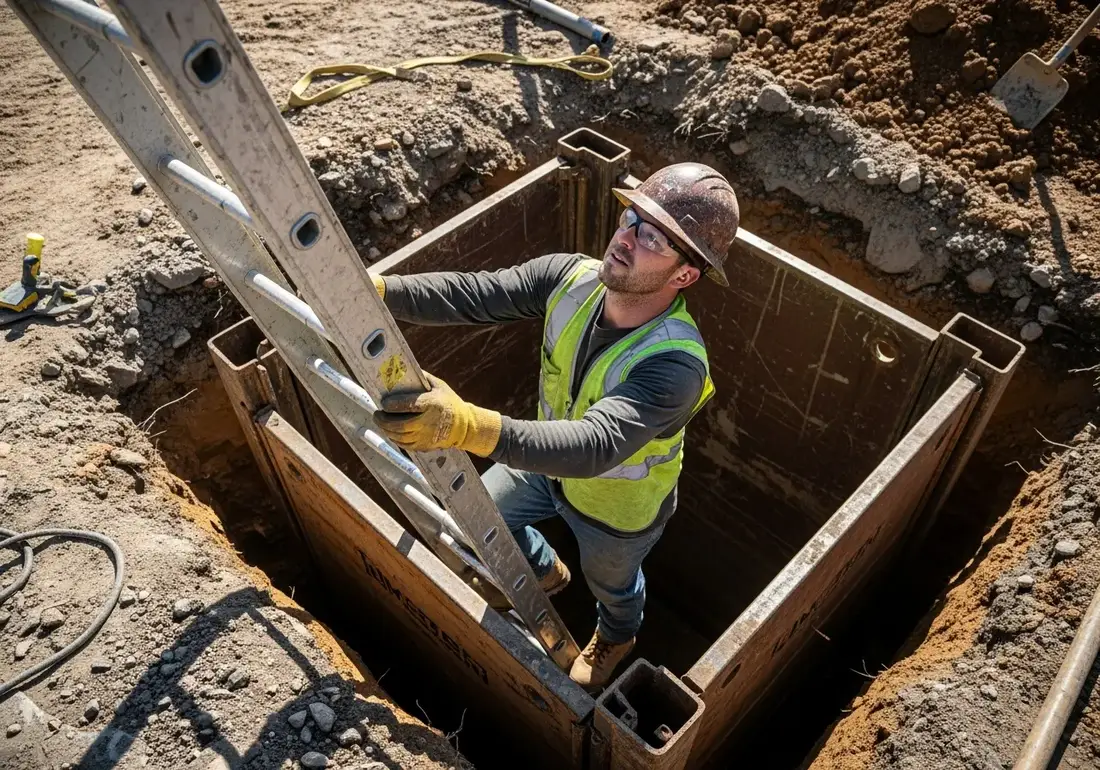
In trenches four feet or deeper, OSHA requires a safe means of exit — a ladder, ramp, or stairway — within 25 feet of any worker at all times. This ensures workers can escape quickly if a wall begins to fail or the atmosphere becomes hazardous.
Trenching sits under an active OSHA National Emphasis Program, so excavations receive heightened inspection and aggressive enforcement. Serious violations such as an unprotected trench, no competent-person inspection, or spoil at the edge routinely draw penalties in the tens of thousands of dollars per item, and willful or repeat citations can reach six figures each. Because cave-ins so often prove fatal, OSHA frequently classifies protective-system failures as willful and refers egregious cases for criminal prosecution. Beyond fines, a citation can trigger project shutdown, debarment from public work, higher insurance costs, and civil liability. The cost of a trench box, competent-person training, and a few minutes of inspection is trivial next to a single willful citation or a wrongful-death claim, which is why documented compliance is treated as non-negotiable on excavation work.
Never send workers into a collapsed or partially collapsed trench to dig by hand — secondary collapses kill would-be rescuers. Call 911 and a trained trench-rescue team immediately, shut down all equipment and traffic that could add vibration, and keep everyone back from the unstable edges. If it can be done safely from outside the trench, provide the buried worker air and reassurance while stabilizing the walls with shoring or a shield before any removal of soil begins. Rescue must be directed by trained personnel using proper protective systems, since soil weight makes manual extraction slow and dangerous. Plan for this in advance: every excavation should have an emergency response procedure, a means to summon rescue, and workers who know not to jump in. Document the incident and any near-miss for corrective action.
A competent person must inspect the excavation, adjacent areas, and protective systems daily before each shift, as needed throughout the shift, and after every event that could increase the hazard — rainfall, snowmelt, vibration from equipment or traffic, a soil change, or any collapse warning sign. If the competent person finds evidence of a possible cave-in, hazardous atmosphere, or protective-system failure, all workers must be removed until the hazard is corrected. These inspections are not a formality; they are the primary safeguard that catches deteriorating conditions before a wall fails. Recording each inspection with date, time, conditions found, and the inspector's signature both drives real corrective action and provides the documentation OSHA expects during a National Emphasis Program inspection.
Stop work immediately whenever conditions exceed the protective plan or the competent person's confidence. Clear signs to halt include a protective system that no longer fits the trench depth or width, spoil or equipment loading the edge, tension cracks or spalling on the walls, water accumulating in the bottom, soil sloughing or bulging, a suspected atmospheric hazard, or heavy rain and vibration since the last inspection. Any worker should also stop work and speak up if something looks wrong. OSHA authorizes the competent person to remove workers and suspend operations until the hazard is corrected, and no schedule pressure justifies entering an unprotected or deteriorating trench. Re-entry should only follow a fresh competent-person inspection confirming the protective system, egress, and atmosphere are all sound.
Run through this before, during, and after every job.
15 more checklist points are waiting. Register with your email to reveal every item and download the complete OSHA compliance checklist as a printable PDF. Free, and it only takes a few seconds.
Already have an account? Sign in
A utility contractor was installing a sewer lateral in a residential street. The trench was about seven feet deep with vertical walls, and to keep the job moving a worker climbed in to make the connection without a trench box.
Spoil had been piled at the edge and a passing truck added vibration. A trench wall sheared away and buried the worker to the chest in seconds. Rescuers had to dig carefully to avoid a secondary collapse, and the worker suffered crushing injuries.
The contractor made trench boxes mandatory for all excavations five feet and deeper, trained and designated competent persons for every crew, enforced the two-foot spoil setback, and adopted OSHA Scan to photo-verify protective systems and egress before anyone entered a trench.
The contractor recorded no further cave-in incidents and passed multiple OSHA National Emphasis Program inspections without protective-system citations. Crews reported that requiring a photo check before entry stopped several unsafe trenches from being worked.
Snap a photo of the job site, and the AI categorizes findings against OSHA standards in seconds.
Each finding includes consistent corrective actions and structured JHA outputs. Check items off as your crew resolves them.
Build a searchable chemical library from label photos. Review manufacturer SDS matches when available and follow the status of missing documents.
Missing-document requests enter a review queue; they do not automatically contact suppliers.
Invite admins, managers, and supervisors with role-based access that keeps the right people in control.
A qualified person must review AI-flagged items before making safety decisions. Do not replace required comprehensive safety walkthroughs with AI reports. Features, limits, and downloads depend on your account’s plan and permissions.
OSHA Scan reads a single photo. That makes it fast and easy for anyone on site — but it also means it has real limits. Here's an honest look at both.
Reviewed by OSHA Scan Editorial
This content is produced by the OSHA Scan Editorial team and reviewed with AI assistance. It is general safety information, not legal or compliance advice. OSHA Scan is an independent tool and is not affiliated with, endorsed by, or certified by OSHA or the U.S. Department of Labor.
Upload a photo of your trenching job site and get an instant, OSHA-cited hazard report.
Start your free trial