
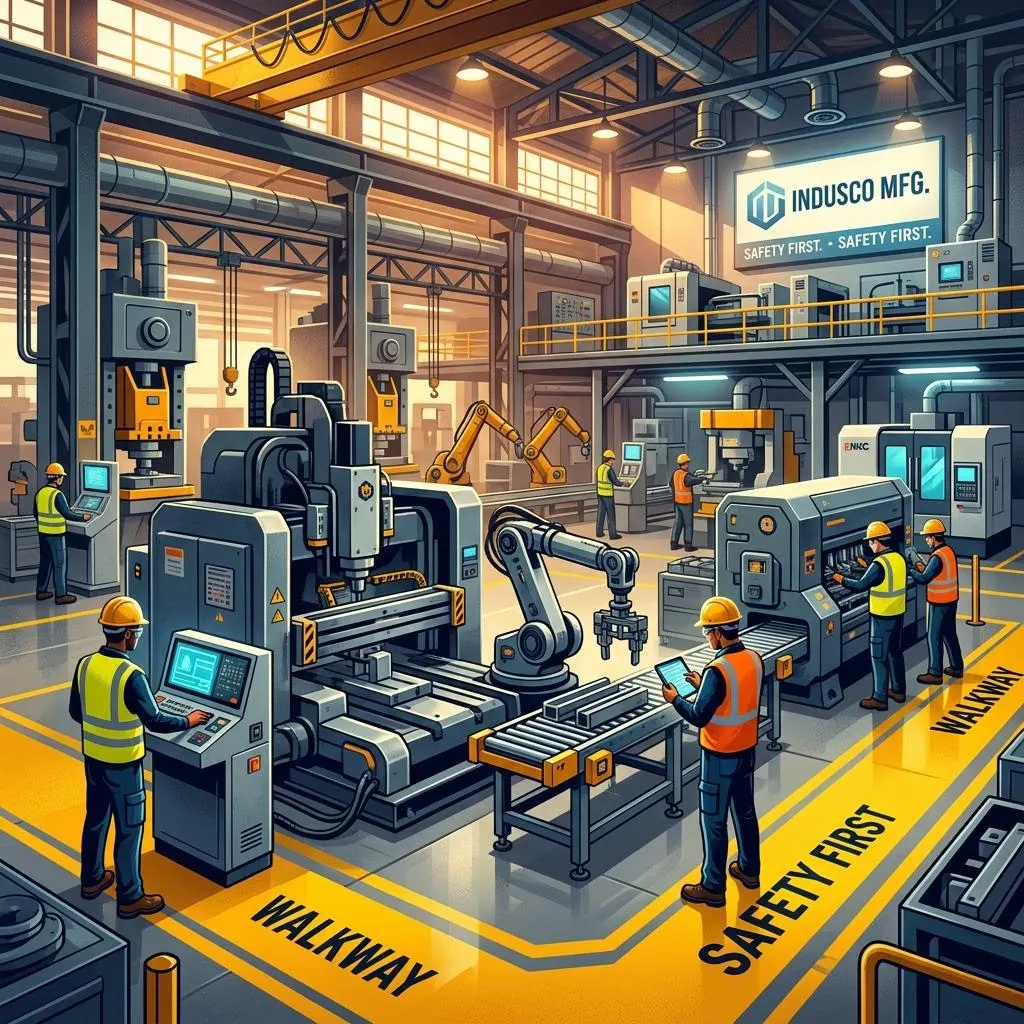
AI-generated editorial illustration. Not a customer site or evidence of compliance.
OSHA Scan Editorial · AI-assisted educational guide
Based on the official sources linked below. No site-specific or independent professional review is implied. Confirm applicability and current federal or State Plan requirements with a qualified professional.
Planning aid only; it is not an engineering design, rescue certification, or determination that a specific system meets OSHA or State Plan requirements.
A useful fall-protection program is a work-planning system, not a box that says “harness available.” Map where people walk, work, climb, load, repair, and reach near an edge or opening. In general industry, 29 CFR 1910.28(b)(1) generally addresses an unprotected side or edge at 4 feet or more above a lower level; that typical trigger is not the whole analysis.
Construction is usually governed by Part 1926, where 1926.501(b)(1) generally uses 6 feet. Do not move either threshold across scopes. Dangerous equipment, holes, hoist areas, runways, roofs, and repair pits have their own provisions. Plan guardrails or covers, personal systems where allowed, training, inspection, and realistic rescue. A photo cannot prove anchorage, fit, clearance, training, or rescue capability.
Who does this apply to?
- Use for U.S. general-industry work under 1910.28 and related provisions. Confirm whether the task is actually construction, maritime, agriculture, or another scope.
- At 4 feet or more, a general-industry unprotected side or edge generally requires a guardrail, safety net, or personal system, subject to the specific section. Dangerous equipment can require protection below 4 feet.
- Openings, hoist areas, roofs, repair pits, and docks can change the analysis. Personal systems require compatible equipment, inspection, training, and prompt rescue planning; an after-the-fact 911 call is not a complete plan.
Implementation Steps
Map surfaces, tasks, and jurisdiction
List elevated surfaces, openings, roof access, docks, platforms, and maintenance tasks. Mark the work scope, lower level, dangerous equipment, and shift changes; the map becomes the program's scope statement. Give every entry a location identifier, surface or opening type, approximate height or relationship to the lower level, access route, task, duration, affected role, existing control, and person who can authorize a change. Ask whether the work is production, maintenance, delivery, or construction before selecting the controlling provision.
- Record surface type, edge or opening, height, access route, task, frequency, and affected roles.
- Separate production, maintenance, temporary, and contractor work; check the exact section for modified triggers.
Choose protection before personal equipment
Eliminate the exposure or use a designed guardrail, cover, or other collective control where allowed. If personal protection is selected, define compatible components, anchorage, clearance, swing-fall controls, and access; a harness in a cabinet is not a system. Illustrative scenario: a maintenance cover must be removed for access; the supervisor records the authorized remover, barricade or interim protection, equipment and material movement, affected workers, and return-to-service verifier. Escalate when the selected system cannot accommodate the route, clearance, rescue access, worker fit, or simultaneous work.
- Design and secure guardrails and covers so they do not create a new opening, trip, or material-handling hazard.
- Document equipment, anchorage, clearance, inspection, rescue method, and dropped-object controls.
Control openings and changing work
A guard removed for delivery, a shifting cover, or a temporary platform can create the exposure. Define who authorizes removal, the interim protection, and the return-to-service check, including housekeeping and simultaneous work. The change record should identify why protection was removed, the start and expected end, people notified, access limits, dropped-object controls, and what makes the area safe to reopen. Do not close it with a time estimate; require a field check and a named verifier.
- Use a permit, barricade, or equivalent handoff for temporary removal and restoration of protection.
- Inspect covers, gates, rails, ladders, platforms, and personal equipment before use and after change.
Train and verify worker capability
Train affected employees on hazards, protection methods, equipment limits, inspection, storage, and task-specific routes. Verify understanding with a demonstration or field discussion rather than attendance alone.
- Maintain a role-based training matrix and document retraining after a change, incident, or observed gap.
- Teach damaged-component, incompatible-connection, unprotected-opening, and changed-clearance recognition; coordinate contractors.
Plan rescue, inspection, and review
Write who raises the alarm, reaches the worker, provides equipment and access, and coordinates medical response. Inspect systems as required, quarantine damage, and review after an incident or meaningful change. Completion evidence should identify the location, equipment and anchor or collective control checked, defect disposition, rescue route and communication method, shift coverage, and verifier. Implementation question: what happens if the primary access route is blocked, and can the team identify an alternate method without entering the hazard? A posted phone number alone does not show that the planned response is reachable or equipped.
- Confirm rescue capability for each location and shift, and record inspections, defects, quarantine, and replacement.
- Review the hazard map and JSA after layout, equipment, staffing, weather, or task changes.
Document planning checklist
Use this planning list to organize applicable records. Suggested owners and review triggers are workflow recommendations; the linked standards determine which documents and retention periods are legally required.
| Document / Record | Purpose | Owner | Review Cadence |
|---|---|---|---|
| Fall hazard inventory and surface map | Identifies edges, openings, access routes, dangerous equipment, work types, and applicable scope. | Facilities and area supervisors | Before new work and after layout, equipment, or process changes |
| Task JSA and control selection record | Explains the sequence, selected controls, access, dropped-object controls, and handoffs. | Supervisor with affected employees | Before non-routine work and after an incident or changed condition |
| Guardrail, cover, and access inspection log | Shows that collective controls and access equipment were checked and defects corrected. | Area owner | Before use, after alteration, and at the site schedule |
| Fall-protection training and demonstration record | Documents hazard recognition, equipment limits, inspection, and worker understanding. | Supervisor or qualified trainer | At assignment, change, incident, or demonstrated knowledge gap; include rescue roles |
Common Pitfalls
Applying six feet everywhere
Six feet is the typical Part 1926 construction threshold; general industry generally uses 4 feet under 1910.28, with condition-specific rules. Identify the work and subpart first.
Calling a harness a complete control
A photo cannot establish a compatible connection, anchorage, clearance, fit, inspection, or rescue capability. Personal equipment needs a designed and maintained system.
Ignoring temporary removal
Production changes and maintenance often create the exposure. Without a removal authorization, interim barrier, and return-to-service check, a sound permanent design can fail during the task.
Frequently Asked Questions
Does a 4-foot edge always require a harness?
When does the six-foot rule apply?
Can an AI photo prove that a fall-protection system is safe?
Is a written rescue plan always a separate OSHA plan?
What the AI can and can't detect
OSHA Scan reads a single photo. That makes it fast and easy for anyone on site — but it also means it has real limits. Here's an honest look at both.
What it can catch from a photo
- Missing or incorrect PPE that is visible in the frame
- Unprotected edges, open holes, and visible fall hazards
- Housekeeping, trip, and blocked walkway or exit hazards
- Visible electrical, struck-by, and equipment-guarding hazards
What a photo can't tell it
- Hazards hidden from view or anything outside the photo
- Exact heights, distances, weights, or measurements
- Training records, procedures, or how equipment is actually used
- Full legal compliance or an official OSHA pass/fail determination