🧪

Chemical Manufacturing OSHA Evacuation Maps 2025

Chemistry of Safety - Create Compliant Maps in Seconds

Chemical plant evacuation maps with hazmat protocols. Generate professional maps free and instant with our AI-powered map maker.

Free instant preview • No credit card • Download in seconds

Get Your Free OSHA Risk Assessment

Identify compliance gaps specific to Chemical Manufacturing in minutes. Our quick assessment helps you understand your evacuation planning requirements.

Start Free Assessment

From Napkin Sketch to Professional Chemical Manufacturing Evacuation Map

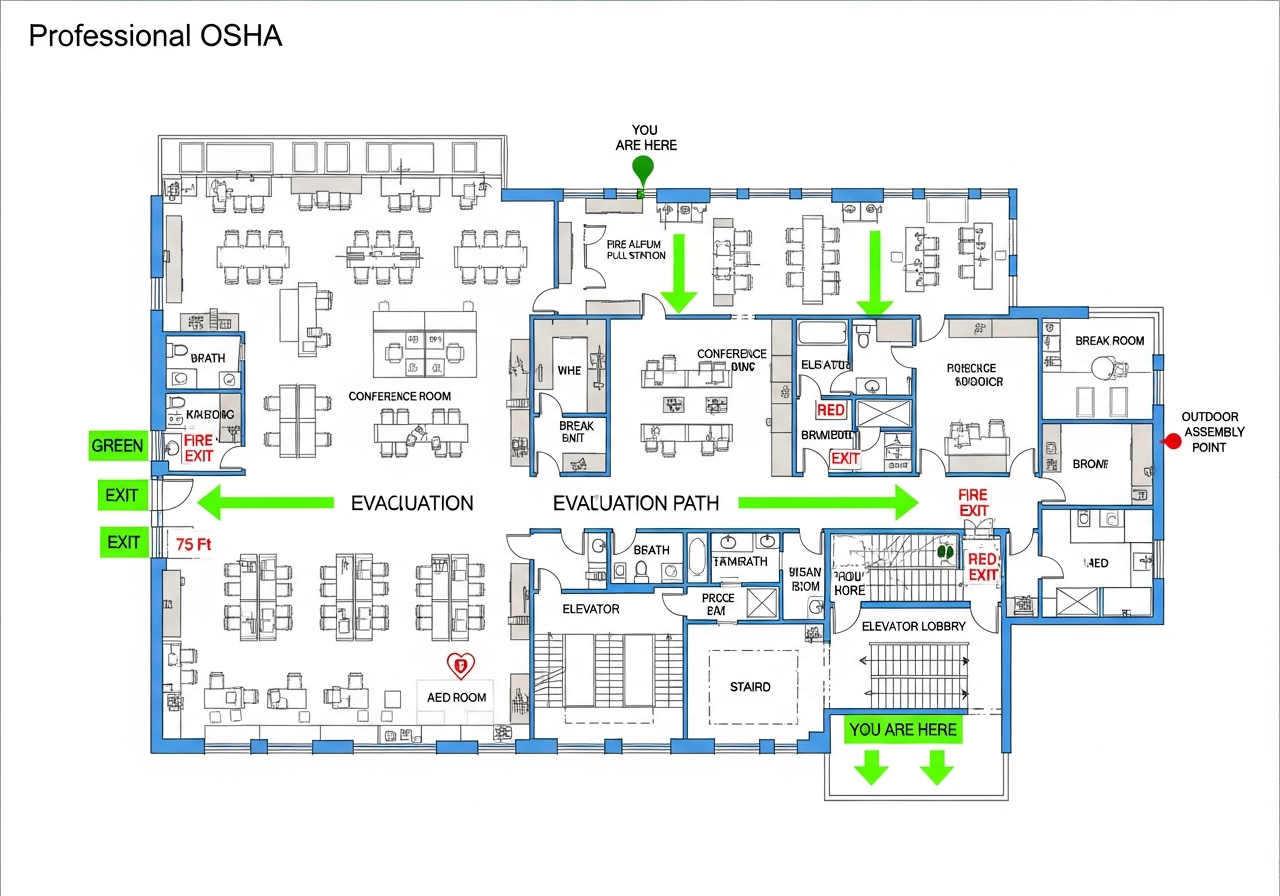
Our AI creates professional evacuation maps specifically designed for Chemical Manufacturing facilities in seconds

Works with photos, scans, PDFs, CAD files, or even hand-drawn napkin sketches

  • 100% OSHA Compliant
  • Instant Results (~30 sec)
  • Print-Ready (11x8.5" or 17x11")

Why Chemical Manufacturing Professionals Choose Our AI Map Generator

Do I need design skills to create an evacuation map?

No design skills are required. Our AI understands hand-drawn floor plans, smartphone photos, scanned blueprints, and PDF documents. Simply upload any representation of your facility layout and receive a professional-grade emergency evacuation map instantly.

Are the generated maps OSHA compliant?

Yes, every generated map meets OSHA 29 CFR 1910.38 Emergency Action Plan requirements including clearly marked exit routes, fire extinguisher locations within 75-foot travel distance, assembly points, YOU ARE HERE markers, and accessibility accommodations per ADA guidelines.

Can I update my evacuation map after renovations?

Yes, unlimited revisions are included. If you renovate your office or add a new emergency exit, simply re-upload your updated floor plan and generate a new compliant map instantly. All free maps include unlimited regeneration so you always have current evacuation documentation.

What types of buildings can use this evacuation map generator?

Our generator works for any building type including warehouses, manufacturing plants, healthcare facilities, schools, retail stores, and office buildings. The AI adapts to any facility size and layout, generating appropriate exit routes, fire safety equipment placement, and assembly point locations.

Industry-Specific Expertise

Chemical Manufacturing Safety: Managing High-Consequence Operations

Operational safety insights designed specifically for Chemical Manufacturing professionals

Operational Realities & Best Practices

Process Safety
Challenge:Catastrophic potential from process failures
Best Practice:PSM program with layers of protection
Toxic Exposures
Challenge:Acute and chronic exposure risks
Best Practice:Industrial hygiene monitoring and exposure controls
Community Impact
Challenge:Releases can affect surrounding areas
Best Practice:Risk Management Program and community notification

Safety-Integrated Workflow

1
Shift Handover
Process status and any abnormal conditions
Complete awareness of current state
2
Process Changes
Management of Change review
Systematic hazard evaluation
3
Maintenance
Permit-to-work and LOTO
Controlled hazardous work

Critical Equipment Zones & Requirements

Reactor Areas

Hazards:
  • Runaway reactions
  • Toxic releases
  • High pressure
Map Requirements:
  • Emergency shutdown controls
  • Gas detection locations
  • Pressure relief systems marked

Storage Tank Farms

Hazards:
  • Spills
  • Fire exposure
  • Vapor release
Map Requirements:
  • Containment capacity marked
  • Fire suppression coverage
  • Wind direction indicators

Loading/Unloading

Hazards:
  • Release during transfer
  • Vehicle hazards
  • Static ignition
Map Requirements:
  • Grounding locations
  • Emergency stop positions
  • Spill containment

Shift-Specific Considerations

All Shifts
Risks: Continuous operations require constant vigilance, Fatigue affects judgment, Handover gaps
Mitigations: Operator rounds, Fitness for duty, Structured handover protocol
Turnaround/Outages
Risks: Multiple contractors, Open equipment, Residual hazards
Mitigations: Enhanced permit systems, Entry controls, Air monitoring

Seasonal Factors

Summer
Heat affects workers and processes
Heat stress programs and process adjustments
Hurricane Season
Potential for emergency shutdown
Pre-storm procedures and secured operations

Technology Integration for Safety

Distributed Control Systems
Automated safety interlocks
🛡️Rapid response to abnormal conditions
Gas Detection Networks
Facility-wide monitoring
🛡️Early warning of releases
Alarm Management
Prioritized operator alerts
🛡️Focus on safety-critical alarms

Get Your Chemical Manufacturing Evacuation Map Now

Industry-specific compliance in under 2 minutes. All chemical manufacturing hazards and OSHA requirements included.

Trusted by chemical manufacturing facilities nationwide

Chemical Manufacturing Workplace Safety Compliance Generator

Upload your floor plan and get a professional OSHA-compliant chemical manufacturing evacuation map in seconds

📊 5 of 5 Free Maps Left

Create Your Chemical Manufacturing Evacuation Map

📷
Clear ImageUse a clean, high-quality scan or photo
↔️
Correct OrientationImage should be right-side up, not rotated or sideways
🔍
No ZoomCapture the entire floor plan, avoid zooming in on sections
💡
Good LightingThe clearer and less blurry, the better results
📁

Drag & drop your floor plan here

or

PNG, JPG, PDF - Hand-drawn sketches work too!

🔒Your files are private: never shared, stored temporarily, deleted automatically.

Compliance Options

Generate bilingual map with English + Spanish labels

ℹ️Adds Spanish translations (Español) to all text on the map
🔥 NEW

Customize Your Map

Add special requests for your safety map - tell our AI exactly what you need!

  • 🎯Add specific details like "Mark fire extinguisher near kitchen"
  • 📍Request specific zones: "Highlight assembly point in parking lot"
  • 🏥Add safety equipment: "Include AED location near reception"
0/2000

Quick Add:

See What You'll Get

Real examples of AI-generated OSHA-compliant evacuation maps

Corporate Office - California - OSHA-compliant evacuation floor plan with marked exits and fire safety equipment
🔍 View Full Size

Corporate Office - California

TechnologyCalifornia
Distribution Center - Texas - OSHA-compliant evacuation floor plan with marked exits and fire safety equipment
🔍 View Full Size

Distribution Center - Texas

WarehousingTexas
Medical Center - New York - OSHA-compliant evacuation floor plan with marked exits and fire safety equipment
🔍 View Full Size

Medical Center - New York

HealthcareNew York
Restaurant - Florida - OSHA-compliant evacuation floor plan with marked exits and fire safety equipment
🔍 View Full Size

Restaurant - Florida

RestaurantFlorida

Ready to create your own professional evacuation map?

Register for 5 free maps with unlimited revisions
🧪

Chemical Manufacturing Safety Requirements

Industry Fatality RateVaries by specific operations
Injury RateIndustry average: 2.8 per 100 workers
Industry BenchmarkLeading Chemical facilities maintain 100% evacuation drill completion

🚨 Top Safety Incidents

  • Slips and falls
  • Ergonomic injuries
  • Fire emergencies

📚 Required Training

Emergency EvacuationFire Extinguisher UseFirst Aid/CPR

🔥 Emergency Scenarios

Fire EvacuationSevere WeatherMedical Emergency

✅ Compliance Checklist

  • Posted evacuation maps
  • Clear exit routes
  • Emergency contact lists
  • Annual drill documentation
"

Cut our map update time from 6 hours to 10 minutes.

★★★★★
Sarah M., Hospital Safety Director

Create a professional evacuation map designed specifically for Chemical Manufacturing facilities

✓ Industry-specific hazards marked✓ OSHA-compliant layout✓ Print-ready in seconds
⚠️ OSHA COMPLIANCE ALERT

Chemical Manufacturing OSHA Compliance Alert

Chemical Manufacturing industry fatality rate: 3.5 per 100,000. 150 workplace deaths annually.

💀3.5 per 100,000Fatality Rate
🩹2.8 per 100Injury Rate
☠️150Annual Deaths
🏥27,734Annual Injuries
🚨

OSHA Penalty Structure - Know Your Risk

Other-than-SeriousUp to $16,131Per violation
Serious ViolationUp to $16,131Per violation
Willful / RepeatUp to $161,323Per violation
Failure to Abate$16,131/dayAfter citation deadline

Avoid costly penalties with compliant evacuation maps

⚠️

Top OSHA Violations in Chemical Manufacturing

Chemical Manufacturing sees 8+ common violation types. Is your facility compliant?

#129 CFR 1910.37

Exit Routes - Obstructed or inadequate emergency exits

Frequency:12% of general industry inspections citations
Typical Penalty:$3,500-$12,000
✓ Prevention:
  • Keep exits unobstructed
  • Maintain illuminated exit signs
#229 CFR 1910.38

Emergency Action Plans - Missing or inadequate EAP

Frequency:11% of general industry inspections citations
Typical Penalty:$4,000-$14,000
✓ Prevention:
  • Develop written EAP
  • Train employees on procedures
#329 CFR 1910.157

Fire Extinguishers - Inspection and training requirements

Frequency:10% of general industry inspections citations
Typical Penalty:$3,000-$10,000
✓ Prevention:
  • Conduct monthly visual inspections
  • Annual maintenance by certified professional
#429 CFR 1910.1200

Hazard Communication - Chemical labeling and SDS requirements

Frequency:9% of general industry inspections citations
Typical Penalty:$4,500-$15,000
✓ Prevention:
  • Maintain updated SDS for all chemicals
  • Train employees on hazard labels
#529 CFR 1910.303

Electrical Safety - Wiring and equipment hazards

Frequency:8% of general industry inspections citations
Typical Penalty:$5,500-$18,000
✓ Prevention:
  • Maintain proper clearances
  • Use proper covers and guards
#629 CFR 1910.22

General Industry safety violation

Frequency:7% of general industry inspections citations
Typical Penalty:$5,000-$15,000
✓ Prevention:
  • Develop compliance program
  • Train employees
🗺️

Missing Evacuation Maps = OSHA Violation

29 CFR 1910.38 requires emergency action plans with posted evacuation routes. Generate compliant maps in minutes.

Don't Wait for an OSHA Inspection

Get Your Chemical Manufacturing Evacuation Map Today

Professional, OSHA-compliant maps generated in minutes. Avoid penalties up to $161,323 per violation.

View Pricing
✓ OSHA Compliant✓ Print Ready✓ AI-Powered✓ Used by 47,000+ Businesses

Popular States for Chemical Manufacturing

What Your Chemical Manufacturing Evacuation Map Includes

🧯

Fire Extinguisher Locations

Strategically placed per OSHA 75-foot travel distance requirements

🚪

Emergency Exits

Clear, prominent EXIT signs at 1.5" width for easy visibility

➡️

Evacuation Routes

Lime green arrows showing the safest path to exits

👥

Assembly Points

Clearly marked gathering locations outside the building

📍

YOU ARE HERE

Bold markers to help occupants orient themselves quickly

🏥

First Aid Stations

Marked locations for emergency medical supplies

Safety Professionals in Chemical Manufacturing

Join other safety leaders using Fire Exit Evacuation Map Generator

Chemical Manufacturing Hazards & Emergency Planning

Understanding risks specific to chemical manufacturing facilities

⚗️

Chemical spills

Chemical exposure risks necessitate proper labeling, spill containment, and emergency shower locations.

Reference: 29 CFR 1910.1200
⚠️

Toxic exposure

Toxic exposure requires specific safety protocols and emergency planning.

Reference: 29 CFR 1910.38
⚠️

Explosive reactions

Explosive reactions requires specific safety protocols and emergency planning.

Reference: 29 CFR 1910.38

Chemical Manufacturing OSHA Compliance Requirements 2025

Key regulatory requirements for chemical manufacturing facilities

📋

29 CFR 1910.119

Specific compliance requirements for chemical manufacturing operations and worker safety.

📋

29 CFR 1910.120

Specific compliance requirements for chemical manufacturing operations and worker safety.

📋

29 CFR 1910.38

Specific compliance requirements for chemical manufacturing operations and worker safety.

Chemical Manufacturing Fire Safety & Evacuation Requirements

🚨

Industry-Specific Emergencies

Chemical Manufacturing facilities face unique emergency scenarios including chemical spills and toxic exposure. Professional evacuation maps ensure employees know exactly where to go during any emergency.

📋

OSHA Compliance

OSHA requires chemical manufacturing facilities to maintain written emergency action plans per 29 CFR 1910.119. Clearly posted evacuation maps are an essential component of these plans.

👷

Worker Protection

With hazards like toxic exposure and explosive reactions, chemical manufacturing workers need clear guidance to evacuate safely. Our maps highlight all exits, fire extinguishers, and assembly points.

💰

Avoid Costly Violations

OSHA violations for inadequate emergency planning can cost up to $15,625 per violation. Professional evacuation maps help chemical manufacturing facilities stay compliant.

Chemical Manufacturing Emergency Preparedness Best Practices

Compliance tips for chemical manufacturing evacuation planning

1

Post Maps at Every Entrance

Place evacuation maps at eye level (4.5-5 feet) at every building entrance and in high-traffic areas like break rooms and lobbies.

2

Update After Layout Changes

Whenever you reconfigure workstations, add equipment, or modify exits, update your evacuation maps immediately to maintain accuracy.

3

Conduct Regular Drills

OSHA recommends evacuation drills at least annually. Use your maps during drills to reinforce evacuation routes with all employees.

4

Train New Employees

Include evacuation map orientation in new hire training. Every employee should know their nearest exit and assembly point on day one.

5

Account for Shift Workers

Chemical Manufacturing facilities often operate multiple shifts. Ensure all shifts have access to maps and are included in evacuation training.

6

Mark Hazard-Specific Equipment

For chemical manufacturing hazards like chemical spills, clearly mark safety equipment locations on your maps.

Free Account Benefits

Create an Account to Unlock

📋

Map History Vault

Never lose a map again

🔄

Unlimited Regeneration

Perfect your evacuation plans

📊

Compliance Dashboard

Stay audit-ready 24/7

🤖

AI Recommendations

Proactive compliance insights

👥

Team Collaboration

Unified safety management

🔔

OSHA Alerts

Never miss an update

📥

Bulk Downloads

Save hours of work

🏆

Priority Support

Expert guidance included

No credit card required

STEP 1 OF 2

Get Free OSHA Compliance Resources

Enter your email to receive free checklists, guides, and compliance tips

"

The free compliance checklist helped us identify 5 safety gaps we didn't know existed!

— Sarah M.Safety Manager, California
256-bit encrypted
No spam, ever
Unsubscribe anytime

By continuing, you agree to our Privacy Policy

🔓 Free Account Bonus

Unlock 5 Free Evacuation Maps

Create your free account in seconds and get instant access to professional, OSHA-compliant evacuation maps.

What You Get When You Register:

  • 5 Free Full-Quality Downloads - Professional maps ready for printing
  • No Watermarks - Clean, presentation-ready evacuation maps
  • Personal Dashboard - Manage all your maps in one place
  • Save & Revisit Anytime - Access your maps from any device
  • OSHA Compliant - Meets 29 CFR 1910.38 requirements
15,000+Maps Generated
4.9/5User Rating
100%Compliant
Sample Output
Sample Chemical Manufacturing OSHA-compliant evacuation floor plan showing emergency exits, fire extinguisher locations, and assembly points
🧯 Fire Extinguishers🚪 Exit Routes📍 You Are Here

No credit card required • Takes 30 seconds • Instant access

Ready to Protect Your Chemical Manufacturing Facility?

Get your professional OSHA-compliant evacuation map in under 2 minutes.

Chemical Manufacturing OSHA Evacuation Map FAQs

What OSHA standards apply to chemical manufacturing evacuation maps?
Chemical Manufacturing facilities must comply with OSHA standards including 29 CFR 1910.119, 29 CFR 1910.120, 29 CFR 1910.38. The primary standard, 29 CFR 1910.119, requires written emergency action plans with evacuation procedures, exit route markings, and employee training. Our AI-generated maps automatically include all required elements for chemical manufacturing compliance, ensuring you meet all applicable standards.
What are the unique hazards in chemical manufacturing that affect evacuation planning?
Chemical Manufacturing facilities face specific hazards including chemical spills, toxic exposure, explosive reactions. These hazards require specialized evacuation routes that avoid high-risk areas, properly placed safety equipment, and clearly marked emergency assembly points away from danger zones. Our chemical manufacturing evacuation maps are designed to address these industry-specific challenges with appropriate exit routes and equipment placement.
How often must chemical manufacturing facilities update evacuation routes?
OSHA requires chemical manufacturing facilities to review and update evacuation plans whenever changes occur that affect egress or emergency procedures. Best practice for chemical manufacturing is quarterly reviews due to chemical spills, toxic exposure, explosive reactions risks. Maps should be immediately updated after equipment moves, layout changes, or when new hazards are introduced. Our platform makes updates fast and maintains version history.
What training is required for chemical manufacturing evacuation procedures?
Under 29 CFR 1910.119, chemical manufacturing employees must be trained on evacuation routes, assembly points, and their specific roles during emergencies. Training should cover recognition of chemical spills, toxic exposure, explosive reactions scenarios that may trigger evacuation. Annual refresher training is required, with additional training after any plan changes. Our maps include clear visual guides that support effective training.
How do I create an evacuation map for my chemical manufacturing facility?
Upload your floor plan to Fire Exit Evacuation Map Generator, select "Chemical Manufacturing" as your industry type, and our AI generates a professional OSHA-compliant evacuation map in under 2 minutes. The map automatically includes chemical manufacturing-specific elements like proper fire extinguisher spacing, exit routes that account for chemical spills, and compliant assembly point locations.
Are chemical manufacturing evacuation maps suitable for fire inspections and OSHA audits?
Yes, our maps are specifically designed to meet all OSHA and fire code requirements for chemical manufacturing facilities. They include compliant exit routes, fire extinguisher locations at required 75-foot travel distance intervals, emergency equipment symbols per 29 CFR 1910.119, assembly points, AED locations, and first aid stations. Maps are print-ready in sizes appropriate for posting requirements.
What emergency equipment must be shown on chemical manufacturing evacuation maps?
Chemical Manufacturing evacuation maps must display fire extinguisher locations (Class ABC for general areas, specialized types for chemical manufacturing-specific hazards), fire alarm pull stations, emergency exits with travel distance compliance, first aid kit locations, AED positions, emergency eyewash stations where applicable, and designated assembly areas. Additional requirements under 29 CFR 1910.38 may apply. Our AI automatically places all required equipment symbols.